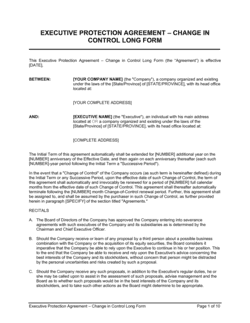
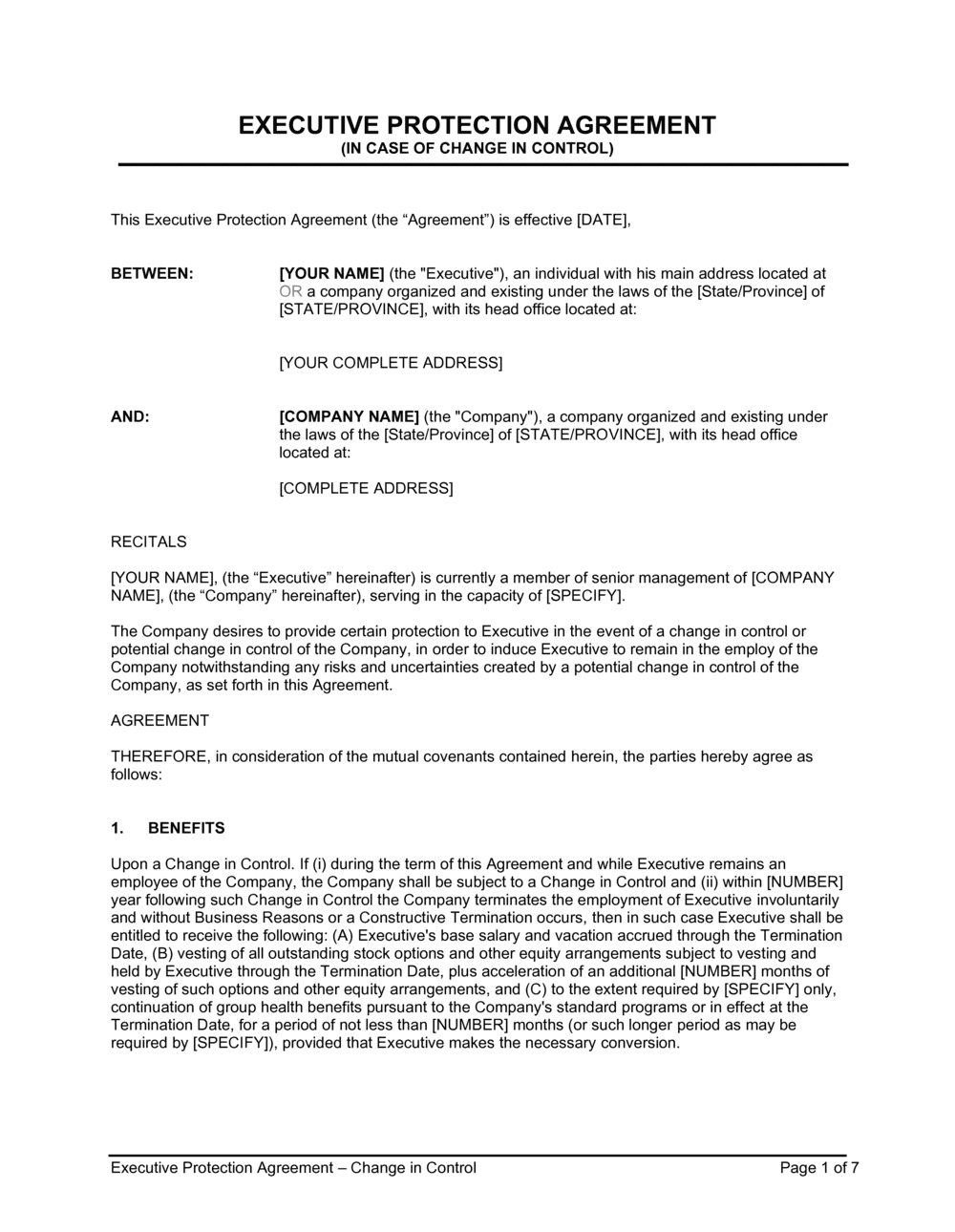
Executive Protection Agreement Change in Control Template

Free Word download • Edit online • Save & share with Drive • Export to PDF

7 pages30–40 min to fillDifficulty: ComplexSignature requiredLegal review recommended
Learn more ↓
FreeExecutive Protection Agreement Change in Control Template

At a glance

What it is
An Executive Protection Agreement — Change in Control is a legally binding contract between a company and a senior executive that defines the compensation, benefits, and obligations triggered when the company undergoes a qualifying change of ownership or control — such as a merger, acquisition, or asset sale. This free Word download gives you a structured starting point covering severance multiples, equity acceleration, benefit continuation, non-compete restrictions, and release requirements, which you can edit online and export as PDF for execution.
When you need it
Use it when hiring or retaining a senior executive whose continued leadership through a potential transaction is critical to business value, or when a board wants to align executive incentives with shareholder interests before entering an M&A process. It should be in place well before any transaction is announced — retroactive agreements raise tax and enforceability concerns.
What's inside
Triggering event definitions, single- and double-trigger provisions, severance cash payments, equity award acceleration, benefit continuation, tax gross-up or cut-back provisions, non-compete and non-solicit restrictions, release of claims requirements, and governing law.

What is an Executive Protection Agreement — Change in Control?

An Executive Protection Agreement — Change in Control is a legally binding contract between a company and a senior executive that defines the specific compensation, equity, and benefits the executive is entitled to receive if the company undergoes a qualifying change of ownership — such as a merger, acquisition, consolidation, or asset sale — and the executive's employment is subsequently affected. Unlike a standard employment contract, which governs the day-to-day employment relationship, a CIC agreement is a forward-looking instrument designed to protect the executive from losing deferred compensation, unvested equity, and benefit entitlements earned over years of service in a transaction where they have no control over the outcome. It also serves the company's interests by aligning executive incentives with shareholder value maximization — an executive with adequate downside protection is far more likely to support a value-creating transaction than to resist it out of personal financial concern.

Why You Need This Document

Without a CIC agreement in place, a senior executive facing an acquisition has every rational incentive to slow-walk a deal, resist integration, or negotiate personal terms on an ad hoc basis at the worst possible moment in a transaction timeline. The absence of documented protections also exposes the company to unlimited common-law claims in Canada and the UK, where courts fill contractual gaps with implied notice obligations that routinely reach 12 to 24 months of total compensation. For US companies, unaddressed equity treatment in a transaction can trigger immediate tax issues for executives and unexpected cash obligations for acquirers — materially affecting deal pricing. A well-structured CIC agreement, adopted proactively and reviewed by the compensation committee before any transaction process begins, eliminates these risks at a fraction of the cost of resolving them mid-deal. This template gives you the structural foundation for that protection, with the clarity that both executives and acquirers require.

Which variant fits your situation?

If your situation is…Use this template
Protecting a single C-suite executive in a privately held companyExecutive Protection Agreement — Change in Control
Broad senior management retention ahead of a known sale processManagement Retention Bonus Agreement
Executive employment terms with embedded CIC protectionExecutive Employment Agreement
Standalone severance terms not linked to a change of controlExecutive Severance Agreement
Equity award vesting acceleration only, without cash severanceEquity Acceleration Agreement
Non-compete and non-solicit obligations only, post-transactionNon-Competition Agreement
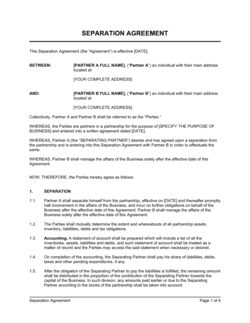
Full separation package following completed termination eventSeparation Agreement and General Release

Common mistakes to avoid

❌ Signing after a transaction is announced

Why it matters: A CIC agreement executed after an acquisition announcement may be challenged as lacking independent consideration, and could violate merger agreement covenants restricting material compensation changes without buyer consent.

Fix: Adopt CIC agreements as part of regular compensation planning — annually reviewed by the compensation committee — well before any strategic process begins.

❌ Mismatched CIC definitions across documents

Why it matters: If the CIC agreement defines a qualifying event differently from the equity plan or existing employment contract, the executive may have equity that accelerates without cash severance, or vice versa — creating both financial and legal disputes at closing.

Fix: Audit all compensation instruments — equity plans, grant agreements, employment contracts — and align CIC definitions before executing the protection agreement.

❌ Including a full gross-up without a 280G cost model

Why it matters: An unmodeled gross-up can expose the company to a tax gross-up payment of 40–60 cents for every dollar of excess parachute payment — costs that become the acquirer's liability and can reduce transaction proceeds.

Fix: Commission a 280G model from a compensation consultant before the board approves any gross-up provision. In most cases, a cut-back provision achieves the protective goal at a fraction of the cost.

❌ Omitting the notice-and-cure requirement from the good reason definition

Why it matters: Without a cure period, executives can immediately claim good reason for minor administrative changes — salary processing delays, reporting line adjustments — forcing the company to pay severance or litigate.

Fix: Include a 30-day written-notice requirement after the triggering condition arises and a 30-day company cure period. Payments are only owed if the condition remains uncured.

❌ Using a single-trigger structure for equity acceleration

Why it matters: Single-trigger acceleration vests equity at closing regardless of whether the executive stays, removing the retention incentive the buyer is paying for and creating immediate dilution and cash drain.

Fix: Default to double-trigger acceleration for all equity awards. Reserve single-trigger treatment only for situations where the executive's role is being eliminated as a direct and immediate consequence of the transaction structure.

❌ Setting a COBRA continuation promise instead of a premium-subsidy

Why it matters: Promising to keep the executive on the active group health plan post-termination is impossible under most plan documents — the company cannot deliver and is in breach from day one.

Fix: Draft the benefit continuation clause as an obligation to pay the employer-equivalent COBRA premium for a defined period, ending if the executive obtains new group coverage.

The 10 key clauses, explained

Definitions and triggering events

In plain language: Precisely defines what constitutes a 'Change in Control' — which transaction types qualify — and sets the measurement thresholds that activate the agreement.

Sample language
'Change in Control' means (a) any acquisition by a person or group of beneficial ownership of more than [50]% of the total voting power of [COMPANY NAME]; (b) consummation of a merger or consolidation in which [COMPANY NAME]'s shareholders hold less than [50]% of the surviving entity; or (c) a sale of all or substantially all of the Company's assets to an unrelated third party.

Common mistake: Setting the ownership threshold too low — a 20% acquisition trigger can activate protections during routine strategic investments, creating unintended liability well before a true change of ownership.

Single- vs. double-trigger structure

In plain language: Specifies whether benefits are paid on the CIC alone (single trigger) or only upon both a CIC event and a qualifying subsequent termination (double trigger).

Sample language
Benefits under this Agreement are payable only upon a 'Double Trigger' — a qualifying Change in Control followed, within [24] months, by (i) termination of Executive's employment without Cause, or (ii) Executive's resignation for Good Reason.

Common mistake: Using single-trigger acceleration for all equity awards. Institutional shareholders and proxy advisory firms (ISS, Glass Lewis) routinely vote against single-trigger equity plans — double trigger is now the market standard for public companies.

Definition of 'good reason' and 'cause'

In plain language: Lists the specific circumstances that qualify as good reason for executive resignation (triggering benefits) and the specific grounds for termination for cause (forfeiting benefits).

Sample language
'Good Reason' means, without Executive's written consent: (a) a material reduction of [10]% or more in base salary; (b) a material diminution in title, authority, or duties; (c) a required relocation of more than [50] miles; or (d) a material breach of this Agreement by the Company. Executive must provide written notice within [30] days of the triggering event and the Company has [30] days to cure.

Common mistake: Omitting a notice-and-cure period from the good reason definition. Without it, courts in several jurisdictions have found that an executive who fails to give the company an opportunity to remedy a breach waives the good reason claim entirely.

Cash severance payment

In plain language: States the cash severance formula — typically a multiple of base salary plus target bonus — and whether it is paid as a lump sum or in salary-continuation installments.

Sample language
Upon a qualifying Double Trigger termination, the Company shall pay Executive a lump-sum cash payment equal to [1.5×] the sum of (i) Executive's annualized base salary in effect immediately prior to the Change in Control, and (ii) Executive's target annual bonus for the year of termination, payable within [60] days of the separation date, subject to execution and non-revocation of the Release.

Common mistake: Paying severance in salary-continuation installments rather than a lump sum. Installment payments are forfeited if the executive starts new employment in some agreements, defeating the protective purpose and creating disputes.

Equity award acceleration

In plain language: Specifies which equity awards vest upon the qualifying trigger — all unvested awards, a pro-rata portion, or only performance awards deemed earned — and the timeline for exercise.

Sample language
Upon a qualifying termination within [24] months following the Change in Control, all unvested time-based RSUs and stock options held by Executive shall immediately accelerate and vest in full. Performance-based awards shall vest at [target / actual achievement / greater of target or trailing-12-month achievement] as of the termination date.

Common mistake: Failing to address what happens to performance awards. Accelerating performance shares at maximum creates excessive cost; vesting at zero is too punitive. 'At target' or 'at actual achievement' is the most defensible approach.

Benefit continuation

In plain language: Covers continuation of health, dental, vision, and life insurance coverage — typically COBRA-equivalent benefits paid by the company for a defined period after termination.

Sample language
For [18] months following the qualifying termination date, the Company shall pay the employer-equivalent cost of COBRA premiums for Executive and eligible dependents, provided Executive timely elects COBRA continuation coverage. This obligation ends if Executive becomes covered by a subsequent employer's group plan.

Common mistake: Promising to maintain Executive on the company's active health plan post-termination rather than funding COBRA. Most group health plans prohibit coverage of former employees — the company promise becomes undeliverable and creates exposure.

Section 280G tax treatment (gross-up or cut-back)

In plain language: Addresses the US excise tax on excess parachute payments — either by promising a gross-up payment to make the executive whole, or by cutting back payments to stay within the safe harbor.

Sample language
If any payment or benefit hereunder constitutes an 'excess parachute payment' under IRC §280G, all payments shall be reduced to the Safe Harbor Amount ($[2.99×] Base Amount) if such reduction results in a greater net after-tax benefit to Executive than the unreduced payments less the excise tax imposed by IRC §4999. No gross-up shall be provided.

Common mistake: Including a gross-up provision without modeling the cost. A full gross-up can multiply the actual severance cost by 1.4× or more — boards that approve agreements without a 280G analysis regularly face shareholder criticism and litigation.

Non-compete and non-solicitation restrictions

In plain language: Post-termination restrictions on the executive's ability to join competitors or solicit customers and employees, which must be reasonable in scope to be enforceable.

Sample language
For [12] months following the termination date, Executive shall not (a) engage in a Competing Business within [GEOGRAPHIC AREA / any market in which the Company operated in the prior 12 months], or (b) directly or indirectly solicit any customer, client, or employee of the Company with whom Executive had material contact during the [24] months prior to termination.

Common mistake: Using the same non-compete duration and geography in a CIC agreement as in a standard employment contract. A departing executive in a post-acquisition context may have an entirely different competitive footprint — tailor scope to the actual risk, or a court will narrow it for you.

Release of claims as condition precedent

In plain language: Makes the executive's receipt of all CIC benefits contingent on signing — and not revoking — a general release of employment claims within a prescribed window.

Sample language
As a condition to receiving any payment or benefit under this Agreement, Executive shall execute and deliver to the Company a Release of Claims in substantially the form attached as Exhibit A within [21] days ([45] days if group layoff rules apply) of the separation date, and shall not revoke such Release during the [7]-day revocation period.

Common mistake: Setting a release deadline that conflicts with ADEA (Age Discrimination in Employment Act) requirements. Executives age 40 or older must receive at least 21 days to consider the release and 7 days to revoke — a shorter window voids the age-discrimination waiver.

Governing law, dispute resolution, and amendment

In plain language: Specifies which jurisdiction's law governs the agreement, how disputes are resolved, and what is required to amend the agreement.

Sample language
This Agreement shall be governed by and construed in accordance with the laws of the State of [DELAWARE / STATE OF INCORPORATION], without regard to conflict-of-laws principles. Any dispute arising hereunder shall be resolved by binding arbitration under [AAA] rules in [CITY, STATE]. This Agreement may only be amended by a written instrument signed by both parties.

Common mistake: Omitting an arbitration clause and defaulting to litigation. Post-acquisition disputes over CIC benefits are expensive and public — arbitration keeps costs manageable and proceedings confidential.

How to fill it out

  1. 1

    Identify the parties and effective date

    Insert the company's full legal name and state of incorporation, the executive's full legal name and title, and the agreement's effective date. Confirm the entity name matches the corporate registry — the acquiring entity in a transaction will assume this agreement.

    💡 If the company is a subsidiary, decide whether the ultimate parent or the subsidiary is the contracting party — obligations follow the signing entity, not its affiliates, unless explicitly stated.

  2. 2

    Define the change-in-control triggers

    Set the ownership-percentage thresholds (commonly 50% for voting control), specify whether asset sales and board-composition changes qualify, and state any minimum transaction-value floor.

    💡 Review your existing shareholder agreement and equity plan documents — your CIC definition should match, or you will have executives with inconsistent benefit triggers across instruments.

  3. 3

    Choose single-trigger or double-trigger structure

    For most privately held and public companies, double-trigger is the current market standard. Select the qualifying termination events and the post-CIC window during which a termination must occur — typically 12 to 24 months.

    💡 A 24-month double-trigger window is now standard for S&P 500 companies; 12 months may be more appropriate for early-stage companies with shorter integration timelines.

  4. 4

    Set the severance multiple and payment mechanics

    Enter the cash severance formula — base salary multiple, bonus inclusion, and whether paid as a lump sum or installments. For public companies, confirm the payment timing complies with Section 409A deferred-compensation rules.

    💡 Lump-sum payment within 60 days of separation is cleanest from a Section 409A compliance standpoint and reduces dispute risk over installment forfeiture.

  5. 5

    Address equity acceleration and performance award treatment

    Specify whether all unvested time-based awards accelerate, and separately define performance-award vesting — at target, at actual achievement, or at the greater of the two. Confirm this matches the language in the executive's individual award agreements.

    💡 Cross-reference every outstanding grant agreement before execution — inconsistent acceleration language between the CIC agreement and the award agreement creates a hierarchy-of-documents dispute.

  6. 6

    Complete the 280G analysis and choose gross-up or cut-back

    Work with a compensation consultant or tax advisor to model the parachute payment value. Based on that analysis, insert either a cut-back provision (pay only up to 2.99× base amount) or, if the business case supports it, a gross-up clause.

    💡 Cut-back provisions are now used in over 80% of new CIC agreements at public companies — gross-ups are increasingly rare and face significant shareholder opposition.

  7. 7

    Draft the release of claims exhibit

    Attach a general release of claims as Exhibit A, setting the review period (21 days for individuals, 45 days for group reductions) and the 7-day ADEA revocation period for executives age 40 or older.

    💡 Do not condition 100% of the severance on the release — ADEA best practices suggest paying at least a nominal amount unconditionally to reinforce that the release is voluntary.

  8. 8

    Have both parties sign before any transaction process begins

    Execute the agreement well before any M&A process launches. Agreements signed after a transaction is announced may be challenged as lacking independent consideration or as violating a no-shop obligation.

    💡 Board or compensation committee approval should be documented in a board resolution adopted at the same meeting the agreement is approved — this protects directors under the business judgment rule.

Frequently asked questions

What is an executive protection agreement — change in control?

An executive protection agreement — change in control is a contract between a company and a senior executive that specifies the compensation, equity, and benefits the executive receives if the company is sold, merged, or otherwise changes ownership and the executive's employment is affected. It protects the executive from losing deferred compensation and equity value in a transaction, and it incentivizes the executive to support a value-maximizing sale rather than resist it out of personal financial concern.

What is the difference between a single-trigger and double-trigger CIC agreement?

A single-trigger agreement pays benefits upon the change-in-control event alone, regardless of whether the executive is terminated. A double-trigger agreement requires both a qualifying CIC event and a subsequent qualifying termination — typically without cause or for good reason — within a defined window (usually 12 to 24 months). Double-trigger is now the market standard for public companies because it preserves retention value for the acquiring company and avoids immediate cash drain at closing.

What is 'good reason' in a change-in-control agreement?

Good reason is a defined set of employer-initiated adverse changes that allow the executive to resign and still collect CIC benefits as though terminated without cause. Typical good reason events include a material salary reduction (often defined as 10% or more), a significant reduction in duties or title, a required relocation beyond a defined mileage threshold, or a material breach of the agreement by the company. Most well-drafted agreements also require the executive to give written notice and allow the company a 30-day cure period before the resignation takes effect.

How does Section 280G affect change-in-control agreements?

Section 280G of the US Internal Revenue Code imposes a 20% excise tax on the executive and denies the company a deduction for any payment that qualifies as an 'excess parachute payment' — generally any CIC-contingent payment exceeding three times the executive's average five-year W-2 compensation. The practical effect is that total CIC payments above that threshold become significantly more expensive. Companies address this either through a gross-up provision (the company covers the excise tax) or a cut-back provision (payments are capped just below the threshold). Cut-back provisions are now more common and are strongly preferred by institutional shareholders.

Should I use a gross-up or a cut-back provision?

Cut-back provisions are the current market standard for new agreements. They cap total CIC payments at 2.99 times the executive's base amount — just below the Section 280G safe harbor — avoiding the excise tax entirely and with no additional cost to the company. Gross-up provisions, which were common in the 1990s and 2000s, have largely fallen out of favor because they can multiply the company's actual payment obligation by 1.4× or more, face strong opposition from proxy advisory firms, and are typically negotiated out by sophisticated acquirers. Consider a gross-up only for C-suite executives where the retention argument is unusually strong and the board has a current 280G cost model.

When should a company put change-in-control agreements in place?

CIC agreements should be adopted as part of routine executive compensation planning — ideally reviewed annually by the compensation committee — well before any strategic transaction process begins. Agreements signed after a transaction is announced raise consideration issues, may violate merger agreement covenants, and can be challenged by acquirers or shareholders. Private companies should consider putting them in place before hiring executives who receive material equity, not after a buyer appears.

What happens to unvested equity in a change-in-control transaction?

Typically, one of three things: the awards are assumed or substituted by the acquirer (the most common outcome), the awards are cashed out at the deal price, or the awards are terminated. A CIC protection agreement with a double-trigger acceleration clause ensures that if the executive is subsequently terminated without cause or resigns for good reason, any assumed or substituted awards vest immediately. Without such a clause, executives who are laid off post-acquisition may lose unvested equity they contributed significant time and performance to earn.

Do change-in-control agreements need board approval?

Yes, in almost all cases. For public companies, CIC agreements for named executive officers typically require compensation committee approval, and material agreements must be disclosed in SEC filings. For private companies, board authorization is typically required under the company's governance documents, and the approving directors should ensure the agreement is reviewed under applicable fiduciary duty standards — particularly if the executive is also a board member or significant shareholder. Document approval in a formal board or committee resolution at the time of execution.

Is a change-in-control agreement the same as an employment contract?

Not exactly. An employment contract governs the full ongoing employment relationship — duties, compensation, benefits, IP, and termination — while a CIC agreement is a standalone instrument that specifically addresses rights and obligations in a transaction context. Some companies embed CIC protections within the executive employment agreement; others maintain them as separate documents. The standalone structure is generally preferable because it can be updated independently as market terms evolve without reopening the full employment agreement.

How this compares to alternatives

vs Executive Employment Agreement

An executive employment agreement governs the full ongoing employment relationship — duties, salary, benefits, IP, and day-to-day termination rights — while an executive protection agreement is specifically triggered by a change-in-control event. Some companies embed CIC terms in the employment agreement, but standalone CIC agreements can be updated independently as market standards evolve without reopening every employment term. For executives with significant equity, a standalone CIC agreement is the cleaner approach.

vs Separation Agreement and General Release

A separation agreement is executed at the time of termination to document the specific severance package and release of claims for a departing employee. A CIC agreement is put in place proactively — before any transaction — to pre-define the terms that will govern a future transaction-related separation. When a CIC-protected termination occurs, the executive typically signs the general release required by the CIC agreement, which may take the form of a standalone separation agreement.

vs Non-Competition Agreement

A non-competition agreement is a standalone post-employment restriction that can exist independent of any transaction event. A CIC agreement includes non-compete and non-solicit provisions as one component of a broader package that also covers severance, equity, and benefits. When significant transaction-linked severance is being paid, courts tend to be more willing to enforce reasonable non-compete restrictions because the executive is receiving substantial compensation in exchange.

vs Management Retention Bonus Agreement

A retention bonus agreement pays a defined cash amount to an executive who remains employed through a specific date or event — typically a transaction close or a defined post-close period. A CIC protection agreement is broader, covering not only a retention incentive but also severance, equity acceleration, and benefit continuation if the executive is terminated. Retention bonuses are often used alongside CIC agreements to provide an additional stay incentive for the integration period.

Industry-specific considerations

Technology / SaaS

Equity-heavy compensation packages make CIC acceleration provisions particularly valuable; acquirers routinely negotiate double-trigger structures to retain key engineering and product leadership post-close.

Financial Services

Regulatory approval timelines in banking and insurance M&A extend the post-CIC window to 36 months in some agreements, and change-in-control payments may require regulatory non-objection from supervisory authorities.

Healthcare and Life Sciences

FDA approval milestones and long development cycles make retention through a transaction critical; performance equity vesting at actual achievement rather than target is common given binary clinical outcomes.

Manufacturing and Industrials

Asset-sale transactions are common and must be explicitly included in the CIC definition; operational continuity of plant management is a key acquirer concern driving double-trigger retention structures.

Jurisdictional notes

United States

Section 280G and 4999 of the Internal Revenue Code are the dominant compliance concerns — CIC payments exceeding the safe harbor threshold trigger a 20% excise tax on the executive and loss of deduction for the company. Section 409A governs the timing of deferred-compensation payments, requiring lump-sum payments to specified employees of public companies to be delayed six months post-separation. Non-compete enforceability varies sharply by state — California, Minnesota, and a growing number of states prohibit most post-employment restrictions.

Canada

Canada has no direct equivalent of Section 280G, but CIC payments may be subject to provincial employment standards minimums that cannot be contracted out of. Ontario courts apply a common-law reasonable notice analysis unless the agreement explicitly addresses termination entitlements. Non-compete clauses for executives are enforceable if reasonable in scope and duration, but courts apply a more protective standard in Ontario and Quebec. French-language requirements apply to provincially regulated Quebec employers.

United Kingdom

TUPE (Transfer of Undertakings — Protection of Employment) regulations may restrict or void contractual variations connected to a business transfer, including attempts to introduce new CIC terms in anticipation of a transaction. Payments in lieu of notice (PILON) above £30,000 are subject to income tax and employer NICs as of 2023. Post-employment restrictive covenants must be supported by adequate consideration and be reasonable in duration and scope to be enforceable by UK courts.

European Union

Works council information and consultation requirements in Germany, France, the Netherlands, and other member states may require employee representative notification before CIC agreements are finalized. Post-employment non-competes typically require financial compensation — generally 25–50% of prior remuneration — to be enforceable, and the obligation must be stated expressly in the agreement. The EU Transparent and Predictable Working Conditions Directive imposes disclosure obligations for material employment terms that may extend to CIC arrangements.

Template vs lawyer — what fits your deal?

PathBest forCostTime
Use the templatePrivate company founders and small business owners establishing basic CIC protections for one or two senior executivesFree1–2 hours
Template + legal reviewGrowth-stage companies with multiple executives, existing equity plans, or an active M&A pipeline where 280G analysis is required$1,500–$4,000 for attorney review and 280G modeling3–7 days
Custom draftedPublic companies, PE-backed companies preparing for a sale process, or executives negotiating bespoke terms with material equity and tax exposure$5,000–$25,000+2–6 weeks

Glossary

Change in Control (CIC)
A defined triggering event — typically a merger, acquisition, asset sale, or change in board majority — that activates the protective provisions of the agreement.
Single Trigger
A structure in which benefits are paid automatically upon the change-in-control event alone, regardless of whether the executive is terminated.
Double Trigger
A structure that requires both a qualifying change-in-control event AND a subsequent qualifying termination — typically without cause or for good reason — before benefits are paid.
Good Reason
A defined set of circumstances — such as a material reduction in duties, pay, or location — that entitle the executive to resign and still collect CIC benefits as if terminated without cause.
Cause
Specific, enumerated grounds — such as fraud, gross negligence, or willful misconduct — that allow the company to terminate the executive without triggering CIC severance obligations.
Severance Multiple
The number of times the executive's base salary and/or target bonus that is paid as a lump-sum or continued salary upon a qualifying termination — commonly 1×, 1.5×, or 2× for senior roles.
Equity Acceleration
The accelerated vesting of unvested stock options, restricted stock units, or other equity awards upon a triggering event, allowing the executive to realize value that would otherwise vest over time.
Section 280G / 4999 (Golden Parachute Rules)
US Internal Revenue Code provisions that impose a 20% excise tax on the executive and deny the company a deduction for 'excess parachute payments' exceeding three times the executive's average annual W-2 compensation.
Gross-Up Payment
An additional payment by the company to cover the executive's Section 4999 excise tax liability, making the executive whole on an after-tax basis — increasingly replaced by cut-back provisions.
Cut-Back Provision
A contractual mechanism that reduces CIC payments to just below the Section 280G safe harbor (2.99× base amount) to avoid triggering the excise tax, used instead of a gross-up.
COBRA Continuation
The executive's right to continue group health coverage under the Consolidated Omnibus Budget Reconciliation Act, often paid for by the company for a defined period as part of the CIC benefit package.
General Release of Claims
A condition precedent to receiving CIC severance — the executive must sign a release waiving all claims against the company arising from employment or termination.

Part of your Business Operating System

This document is one of 3,000+ business & legal templates included in Business in a Box.

  • Fill-in-the-blanks — ready in minutes
  • 100% customizable Word document
  • Compatible with all office suites
  • Export to PDF and share electronically

Create your document in 3 simple steps.

From template to signed document — all inside one Business Operating System.
1
Download or open template

Access over 3,000+ business and legal templates for any business task, project or initiative.

2
Edit and fill in the blanks with AI

Customize your ready-made business document template and save it in the cloud.

3
Save, Share, Send, Sign

Share your files and folders with your team. Create a space of seamless collaboration.

Save time, save money, and create top-quality documents.

★★★★★

"Fantastic value! I'm not sure how I'd do without it. It's worth its weight in gold and paid back for itself many times."

Managing Director · Mall Farm
Robert Whalley
Managing Director, Mall Farm Proprietary Limited
★★★★★

"I have been using Business in a Box for years. It has been the most useful source of templates I have encountered. I recommend it to anyone."

Business Owner · 4+ years
Dr Michael John Freestone
Business Owner
★★★★★

"It has been a life saver so many times I have lost count. Business in a Box has saved me so much time and as you know, time is money."

Owner · Upstate Web
David G. Moore Jr.
Owner, Upstate Web

Run your business with a system — not scattered tools

Stop downloading documents. Start operating with clarity. Business in a Box gives you the Business Operating System used by over 250,000 companies worldwide to structure, run, and grow their business.

Start free · No credit card required