Buy Sell Agreement Template

Free Word download • Edit online • Save & share with Drive • Export to PDF

8 pages30–40 min to fillDifficulty: ComplexSignature requiredLegal review recommended
Learn more ↓
FreeBuy Sell Agreement Template

At a glance

What it is
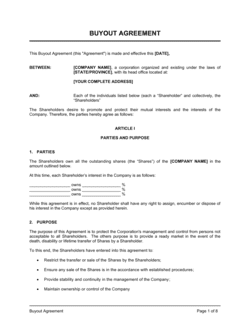
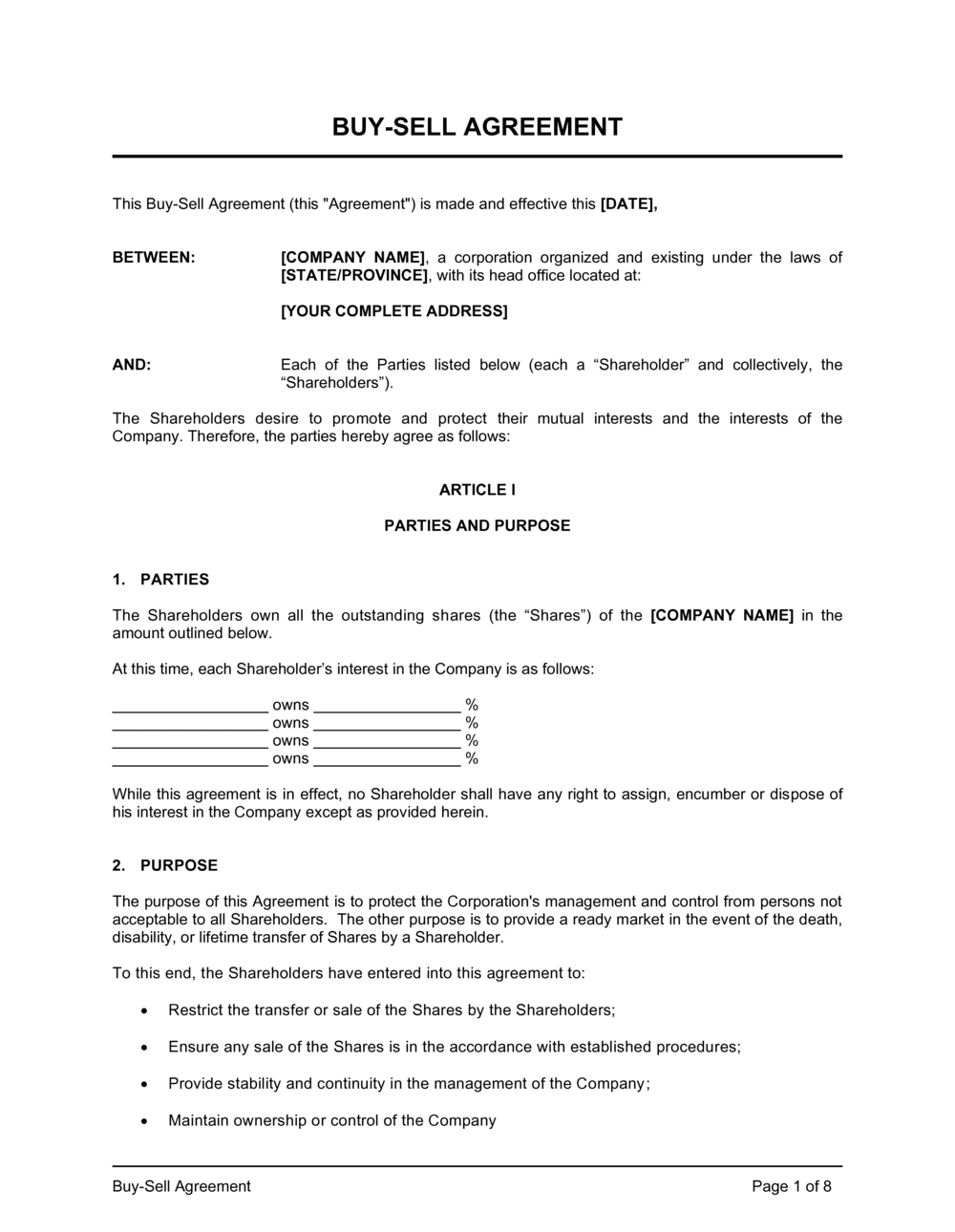
A Buy Sell Agreement is a legally binding contract among business co-owners that governs how an owner's interest must be valued and transferred when a triggering event occurs — such as death, disability, retirement, divorce, or a voluntary sale. This free Word download gives you a structured, attorney-ready starting point you can edit online and export as PDF to share with co-owners, legal counsel, and your life insurance provider.
When you need it
Use it when forming a partnership, LLC, or closely held corporation with two or more owners, or when an existing multi-owner business lacks a formal succession plan. It is particularly urgent before any owner faces a health event, a divorce proceeding, or an unsolicited outside offer to purchase a stake.
What's inside
Triggering events and obligations to buy or sell, valuation methodology, funding mechanism (life insurance, installment payments, or sinking fund), right of first refusal, transfer restrictions, deadlock resolution, and governing law. The agreement ties directly to your shareholders or operating agreement to form a complete ownership-management framework.

What is a Buy Sell Agreement?

A Buy Sell Agreement is a legally binding contract among the co-owners of a business that pre-establishes the rules for how an owner's interest must be valued and transferred when a defined triggering event occurs — such as death, permanent disability, retirement, divorce, bankruptcy, or a voluntary offer to sell to an outside party. Rather than leaving these transitions to negotiation under pressure or resolution through litigation, a buy sell agreement locks in the methodology, the buyer, the timeline, and the funding mechanism while all parties are in a neutral position. It functions simultaneously as a succession plan, a transfer restriction mechanism, and a liquidity tool for the departing owner or their estate.

Why You Need This Document

Without a buy sell agreement, any triggering event — a co-founder's sudden death, a partner's divorce, or an unsolicited acquisition offer — forces surviving owners to negotiate ownership and valuation terms under the worst possible conditions: time pressure, grief, legal adversaries, and no pre-agreed framework. A deceased owner's heirs inherit a seat at the table. A divorcing owner's spouse may be awarded a portion of the business by a family court with no understanding of the company's operations. A departing owner who can't agree on value with remaining owners has no choice but to file for judicial dissolution. Each of these scenarios can destroy an otherwise healthy business. A properly executed buy sell agreement, in place before any of these events is anticipated, closes every one of these gaps — and this template gives you the structured starting point to draft, review with counsel, and execute before the need arises.

Which variant fits your situation?

If your situation is…Use this template
Two or more owners want the business entity itself to buy out the departing ownerEntity-Purchase (Redemption) Buy Sell Agreement
Each owner wants to personally buy the departing owner's interest directlyCross-Purchase Buy Sell Agreement
A hybrid structure allowing either the entity or remaining owners to buy, in that orderWait-and-See Buy Sell Agreement
Two owners are deadlocked and need a mechanism to resolve the stalemateShotgun Clause Buy Sell Agreement
Partners in a general or limited partnership need buyout termsPartnership Buyout Agreement
A sole owner is selling the entire business to a third partyBusiness Purchase Agreement
Owners need a shareholder-level agreement for a corporationShareholders Agreement

Common mistakes to avoid

❌ Using a stale fixed valuation price

Why it matters: A price set at formation can diverge dramatically from actual business value within 18–24 months. Surviving owners end up overpaying or the departing owner's estate receives far less than fair value, triggering disputes.

Fix: Schedule an annual review meeting to update the agreed valuation in Schedule A. If owners miss the review, require that an independent appraisal applies automatically.

❌ Omitting divorce as a triggering event

Why it matters: Without a divorce trigger, a family court can award part of an owner's business interest to their former spouse, putting a stranger on the ownership register with rights to distributions and information.

Fix: Include divorce explicitly as a triggering event and give the company and remaining owners the right to purchase the interest attributed to the divorcing owner's spouse at fair market value.

❌ Mismatched insurance face value and current business value

Why it matters: If a $500,000 life insurance policy funds a buyout for a business now worth $2 million, the surviving owners cannot complete the purchase — the estate receives partial payment and may force a fire sale or litigation.

Fix: Tie the required insurance face value to the most recently agreed valuation and require owners to increase coverage within 90 days of any valuation update.

❌ Conflicting transfer restrictions with the operating or shareholders agreement

Why it matters: Two documents with different transfer restriction mechanics give a departing owner the ability to argue for whichever version is more favorable to them, undermining both agreements.

Fix: Include an explicit supersession clause and review the operating or shareholders agreement at the same time the buy sell agreement is drafted, amending inconsistencies before signing.

❌ No defined dispute resolution process for valuation disagreements

Why it matters: When owners cannot agree on price and there is no agreed process, the only resolution is litigation — which can cost $50,000–$200,000 in legal fees and often destroys the business in the process.

Fix: Specify a two-appraiser process with a third tiebreaker, or commit to a specific arbitration body (e.g., AAA), and require that the process be initiated within 30 days of a triggering event.

❌ Signing the agreement after a triggering event has already occurred

Why it matters: An agreement executed after an owner is already terminally ill, in divorce proceedings, or contemplating a sale will be challenged as lacking fresh consideration and may be voided by a court.

Fix: Execute the buy sell agreement when the business is formed or when a new owner joins, while all parties are in a neutral position — before any specific event is anticipated.

The 10 key clauses, explained

Parties and recitals

In plain language: Identifies every owner by legal name and ownership percentage and states the purpose of the agreement — to provide an orderly, pre-agreed mechanism for ownership transitions.

Sample language
This Buy Sell Agreement ('Agreement') is entered into as of [DATE] by and among [OWNER 1 NAME], holding a [X]% interest, [OWNER 2 NAME], holding a [Y]% interest, and [COMPANY LEGAL NAME], a [STATE] [ENTITY TYPE] (collectively, the 'Parties').

Common mistake: Listing ownership percentages that don't add up to 100% or that conflict with the operating agreement or cap table — creating ambiguity that invalidates the transfer mechanics.

Triggering events

In plain language: Defines the specific circumstances that obligate or entitle an owner or the business to initiate a buyout, such as death, permanent disability, voluntary transfer, retirement, divorce, or bankruptcy.

Sample language
A 'Triggering Event' shall mean any of the following: (a) the death of an Owner; (b) the Permanent Disability of an Owner, as defined in Section [X]; (c) a voluntary offer to transfer an Owner's Interest to a third party; (d) the filing of a bankruptcy petition by or against an Owner; (e) the entry of a divorce decree affecting an Owner's Interest.

Common mistake: Omitting divorce as a triggering event. Without it, a divorcing owner's spouse may be awarded a portion of the business interest by a family court, giving an outsider a seat at the table.

Valuation methodology

In plain language: Specifies exactly how the business interest will be priced when a triggering event occurs — whether by fixed price updated annually, formula (e.g., capitalized EBITDA), book value, or independent appraisal.

Sample language
The purchase price for an Owner's Interest shall be determined by [CHOSEN METHOD]: (a) Fixed Price: $[AMOUNT] per [UNIT/SHARE], subject to annual review and update by the Owners each January 1; OR (b) Independent Appraisal: a certified business valuator mutually agreed upon by the Parties within [30] days of the Triggering Event.

Common mistake: Setting a fixed price at signing and never updating it. After two or three years, a stale fixed price dramatically undervalues or overvalues the departing owner's interest, leading to litigation.

Purchase obligation and option

In plain language: States whether the purchase is mandatory (both parties must complete it) or optional (one party has the right but not the obligation to buy or sell), and which party — the entity or the remaining owners — has priority to purchase.

Sample language
Upon a Triggering Event, the Company shall have a first right to purchase the Departing Owner's Interest at the Agreed Price within [60] days of notice. If the Company does not exercise this right, the Remaining Owners shall have a secondary right to purchase pro rata within an additional [30] days.

Common mistake: Failing to specify whether the purchase obligation is mandatory or optional. An optional buy sell gives the buyer a free option — they buy when convenient but are not compelled to when the seller most needs liquidity.

Right of first refusal

In plain language: Requires an owner who receives a bona fide outside offer to first offer the interest to the remaining owners and/or the company at the same price and terms before accepting the outside offer.

Sample language
Before accepting any offer to transfer all or any portion of an Owner's Interest to a third party, the transferring Owner ('Offeror') shall provide written notice to the Company and remaining Owners of the proposed terms. The Company and remaining Owners shall have [30] days to elect to purchase the Interest on the same terms.

Common mistake: Not specifying what happens if the remaining owners can only collectively match part of the offer. Define whether partial exercise is permitted or whether the right must be exercised in full.

Funding mechanism

In plain language: Describes how the buyer will finance the purchase — typically life insurance proceeds for a death trigger, disability buyout insurance for a disability trigger, and installment payments or a sinking fund for voluntary transfers.

Sample language
To fund the purchase obligation upon the death of an Owner, each Owner / the Company [select one] shall maintain a life insurance policy on each other Owner in an amount no less than [X]% of such Owner's Interest value as last determined. Proceeds received shall be applied directly to the purchase price.

Common mistake: Specifying life insurance as the funding source without confirming the policy amount is updated whenever the valuation is updated. An underinsured policy leaves a surviving owner short of the funds needed to complete the buyout.

Transfer restrictions

In plain language: Prohibits any voluntary or involuntary transfer of an ownership interest except as expressly permitted by this agreement, preventing ownership from passing to heirs, creditors, or outsiders without consent.

Sample language
No Owner shall transfer, assign, pledge, hypothecate, or otherwise encumber all or any portion of their Interest except in strict compliance with this Agreement. Any purported transfer in violation of this Section shall be null and void and of no force or effect.

Common mistake: Using transfer restriction language that conflicts with the entity's operating agreement or shareholders agreement. Conflicting documents create enforcement gaps — courts may apply whichever provision is more favorable to the transferring owner.

Deadlock and dispute resolution

In plain language: Provides a mechanism for resolving owner disputes that cannot otherwise be resolved, including valuation disagreements, through mediation, arbitration, or the shotgun clause.

Sample language
If the Parties cannot agree on the value of the Interest within [30] days of a Triggering Event, each Party shall appoint an independent certified business valuator. If the two valuators disagree by more than [10]%, the two valuators shall jointly appoint a third, whose determination shall be final and binding.

Common mistake: No dispute resolution clause at all — when owners disagree on valuation and there is no agreed process, the only option is litigation, which can cost more than the buyout itself.

Termination and amendment

In plain language: States the conditions under which the agreement terminates — typically when one owner buys out all others, the company is sold, or the company dissolves — and the process required to amend the agreement.

Sample language
This Agreement shall terminate upon: (a) the written consent of all Parties; (b) the completion of a transfer leaving only one Owner; or (c) the dissolution or winding up of the Company. Amendments require the written consent of all Owners then party to this Agreement.

Common mistake: No amendment clause, which means a stale valuation method or outdated triggering-event list cannot be updated without a new agreement — leaving owners bound by terms that no longer reflect the business reality.

Governing law and entire agreement

In plain language: Specifies the jurisdiction whose laws govern the agreement and confirms that this document — together with any referenced schedules — supersedes all prior understandings between the owners on ownership transfer.

Sample language
This Agreement shall be governed by and construed in accordance with the laws of the State of [STATE], without regard to its conflict-of-law principles. This Agreement constitutes the entire agreement among the Parties with respect to the subject matter hereof and supersedes all prior agreements and understandings.

Common mistake: Choosing a governing law with no connection to where the business operates or where the owners reside — courts in the owners' home jurisdiction may disregard the choice-of-law clause entirely.

How to fill it out

  1. 1

    List all current owners with legal names and exact ownership percentages

    Enter each owner's full legal name and their precise ownership percentage as it appears in the operating agreement, shareholders agreement, or cap table. Confirm the percentages sum to 100%.

    💡 Cross-reference the state registry filing and the most recent equity schedule before signing — discrepancies between documents give courts a reason to question which controls.

  2. 2

    Define every triggering event specific to your situation

    Work through the standard list — death, permanent disability, voluntary transfer, retirement, divorce, bankruptcy, and loss of professional license — and decide which ones apply to your business. Add any industry-specific events.

    💡 Retirement is often the most-argued triggering event. Define it precisely: age threshold, years of service, or written notice of intent — not just 'when an owner decides to retire.'

  3. 3

    Select and document the valuation methodology

    Choose one primary method (fixed price, formula-based, or independent appraisal) and specify the fallback if owners cannot agree. Document the current agreed value in a Schedule A and commit to reviewing it annually.

    💡 For businesses with volatile earnings, a trailing-twelve-month EBITDA multiple is more defensible than book value, which can swing dramatically based on depreciation timing.

  4. 4

    Decide on entity purchase, cross-purchase, or wait-and-see structure

    Determine whether the company or the individual owners (or both, in sequence) will have the obligation or option to purchase the departing owner's interest. This choice has significant tax and insurance implications — consult a tax advisor before finalizing.

    💡 For businesses with three or more owners, a cross-purchase structure requires each owner to hold a life insurance policy on every other owner — the number of policies grows exponentially. An entity-purchase or wait-and-see structure is typically simpler to administer.

  5. 5

    Specify the funding mechanism for each triggering event

    Match each triggering event to a funding source: life insurance for death, disability buyout insurance for disability, sinking fund or installment plan for retirement or voluntary sale. State the minimum insurance face value and who is responsible for maintaining each policy.

    💡 Review existing life insurance policies before drafting this clause — you may be able to repurpose policies already in force rather than purchasing new ones.

  6. 6

    Draft the right of first refusal and transfer restriction clauses

    Set the notice period (typically 30–60 days), specify whether partial exercise is permitted, and confirm the transfer restriction language does not conflict with your operating or shareholders agreement.

    💡 If your operating agreement already contains a right of first refusal, this agreement should supersede it explicitly — otherwise courts may apply both and reach contradictory results.

  7. 7

    Execute before any triggering event is on the horizon

    All current owners must sign the agreement. Each owner should receive an executed original or a fully executed PDF. Store a copy with the business records, with each owner's estate planner, and with the insurance broker.

    💡 Sign the agreement at or before the time the business is formed, or at the time a new owner joins. Post-event timing raises consideration issues and may make the agreement unenforceable.

Frequently asked questions

What is a buy sell agreement?

A buy sell agreement is a legally binding contract among co-owners of a business that governs what happens to an owner's interest when a triggering event occurs — such as death, disability, retirement, divorce, bankruptcy, or a voluntary sale. It pre-agrees the price, the buyer, and the funding mechanism so that ownership transitions happen smoothly rather than through litigation or forced sales. It is sometimes called a buyout agreement or a business succession agreement.

When should a buy sell agreement be put in place?

The best time to execute a buy sell agreement is when the business is first formed and all co-owners are in a neutral position. The second-best time is when a new co-owner joins the business. Waiting until a triggering event is on the horizon — an illness, a divorce, or a retirement — makes the agreement far harder to negotiate and easier for a court to challenge on consideration grounds.

What are the three main types of buy sell agreements?

The three primary structures are: (1) Entity-purchase (or redemption), where the business itself buys the departing owner's interest; (2) Cross-purchase, where the remaining individual owners buy the interest directly from the departing owner; and (3) Wait-and-see, a hybrid that gives the entity the first right to purchase, with remaining owners exercising a secondary right if the entity declines. The right structure depends on tax objectives, the number of owners, and how the buyout will be funded.

How is the purchase price determined in a buy sell agreement?

Common valuation methods include a fixed price updated annually by the owners, a formula based on a multiple of EBITDA or book value, or an independent appraisal triggered at the time of the event. Fixed-price approaches are administratively simple but require disciplined annual updates to remain accurate. Formula approaches are self-updating but can produce counterintuitive results in unusual years. Independent appraisal is the most accurate but takes time and costs $5,000–$25,000 per event.

How is a buy sell agreement typically funded?

For a death trigger, life insurance is the most common and cost-effective funding source — the policy proceeds are paid tax-free in most cases and are immediately available to complete the buyout. Disability buyout insurance funds the disability trigger. Voluntary transfers and retirement buyouts are often funded through installment payments or a sinking fund accumulated over time. Some agreements combine multiple mechanisms depending on the trigger.

Does a buy sell agreement need to be updated?

Yes. At minimum, the valuation should be reviewed annually, and the agreement itself should be reviewed whenever the business adds or loses an owner, changes its structure, or undergoes a significant change in value. The funding mechanism — particularly life insurance face values — must be updated whenever the agreed valuation increases. A buy sell agreement that is more than two to three years out of date is likely to produce a purchase price that no longer reflects reality.

Is a buy sell agreement the same as a shareholders agreement?

They overlap but are not the same. A shareholders agreement is a broader governance document covering voting rights, dividend policy, board composition, and management decisions. A buy sell agreement focuses specifically on ownership transfer — triggering events, valuation, purchase obligations, and funding. Many closely held businesses use both, with the buy sell agreement either standing alone or incorporated as a transfer-restriction schedule within the shareholders agreement.

Can a buy sell agreement be used in an LLC?

Yes. Buy sell provisions can be incorporated into an LLC's operating agreement or executed as a standalone buy sell agreement among the members. The mechanics are the same as for corporations — triggering events, valuation, purchase rights, and funding — but the terminology refers to membership interests rather than shares. State LLC statutes vary on transfer restriction enforceability, so legal review is recommended.

What happens if there is no buy sell agreement when an owner dies?

Without a buy sell agreement, a deceased owner's interest passes to their estate and ultimately to their heirs under the will or intestacy laws. The heirs become co-owners of the business with all associated rights — including the right to demand distributions, inspect books, and in some cases, block decisions. Surviving owners who want to buy out the estate must negotiate price and terms under duress, often leading to protracted disputes and, in the worst case, a court-ordered forced sale of the entire business.

How this compares to alternatives

vs Shareholders Agreement

A shareholders agreement is a broad governance document covering voting rights, board composition, dividend policy, and management authority. A buy sell agreement is narrower — it addresses only ownership transfer mechanics when a triggering event occurs. Many closely held businesses need both: the shareholders agreement runs the business day-to-day while the buy sell agreement governs what happens when an owner exits.

vs Partnership Buyout Agreement

A partnership buyout agreement documents the specific terms of a single, already-agreed purchase of one partner's interest and is used at the time of an actual transaction. A buy sell agreement is a forward-looking document that pre-agrees the rules for future hypothetical exits — it governs the process, not the transaction itself. Use the buyout agreement to close the deal the buy sell agreement was designed to govern.

vs Business Purchase Agreement

A business purchase agreement transfers 100% of a business to a third-party buyer and covers the full transaction — assets or shares, representations and warranties, closing conditions, and indemnification. A buy sell agreement applies only to transfers among existing co-owners and does not address third-party acquisitions. When a buy sell triggers a full sale, a business purchase agreement documents the resulting transaction.

vs Operating Agreement

An LLC operating agreement governs the ongoing management and financial rights of members — capital contributions, distributions, voting, and manager authority. Transfer restrictions and buyout provisions in an operating agreement are often brief and general. A standalone buy sell agreement provides the detailed valuation methodology, funding mechanism, and triggering-event specificity that a standard operating agreement's transfer section typically lacks.

Industry-specific considerations

Professional Services

Buyouts must address the loss of a licensed professional (law, accounting, medicine) as a triggering event, and valuations often rely on client book or recurring fee revenue multiples rather than hard assets.

Manufacturing

Asset-heavy balance sheets mean book value can be a meaningful valuation input, but equipment depreciation schedules can distort it significantly — independent appraisal is often required for large facilities.

Technology / SaaS

Valuation is typically based on ARR multiples or discounted cash flow; IP assignment and non-compete clauses in the buy sell agreement are critical given that founder departures can directly affect software ownership and competitive positioning.

Family Business

Divorce and death triggers are the primary concerns; the agreement must interact carefully with estate plans, family trusts, and any shareholder loans to family members to prevent unintended ownership fragmentation.

Healthcare

Loss of medical licensure or DEA registration is a common additional triggering event; patient-base valuation requires specialized healthcare appraisers familiar with payer mix and practice goodwill methodology.

Retail / Hospitality

Lease assignment rights and location-specific goodwill are key valuation components; a departing owner's death or disability during peak season can create immediate operational and liquidity pressure that the funding mechanism must address.

Jurisdictional notes

United States

Buy sell agreements are governed by state contract and corporate law, which varies significantly. The tax treatment of entity-purchase versus cross-purchase structures differs under the IRC — cross-purchase arrangements receive a step-up in basis for the purchasing owners while redemption agreements do not. California imposes restrictions on transfer restrictions for corporations. The FLP (Family Limited Partnership) structure is commonly paired with buy sell agreements for estate planning in high-net-worth situations.

Canada

In Canada, buy sell agreements must align with applicable provincial corporate or partnership statutes — the Canada Business Corporations Act or provincial equivalents govern share transfer restrictions for corporations. Life insurance funding of buy sell agreements has specific tax treatment under the Income Tax Act, including the capital dividend account (CDA) rules that can allow tax-free distribution of insurance proceeds to surviving shareholders. Quebec civil law introduces distinct enforceability considerations for restrictive clauses.

United Kingdom

UK buy sell arrangements, often embedded in shareholders agreements, must comply with the Companies Act 2006, including restrictions on a company purchasing its own shares (treasury shares rules apply). Life insurance policies used to fund buyouts should be structured as relevant life policies or business protection policies for tax efficiency. Stamp duty of 0.5% applies to share transfers above £1,000 and must be accounted for in the funding mechanism.

European Union

EU member states each have distinct corporate law frameworks governing share transfer restrictions — German GmbH law, French SAS rules, and Dutch BV regulations all treat right-of-first-refusal and forced transfer clauses differently. GDPR considerations arise when the agreement references personal data of owners or beneficiaries. Valuation disputes that cross member-state borders may require specifying EU arbitration rules explicitly. Insurance funding structures vary in tax treatment by country and should be reviewed locally.

Template vs lawyer — what fits your deal?

PathBest forCostTime
Use the templateTwo-owner businesses with straightforward equal splits, simple valuation, and no estate planning complexityFree1–2 hours
Template + legal reviewThree or more owners, businesses with significant value, or situations involving life insurance coordination and annual updates$500–$1,5003–7 days
Custom draftedComplex ownership structures, multi-entity businesses, high-value enterprises, or agreements requiring integration with estate plans and trust structures$2,500–$10,000+2–6 weeks

Glossary

Triggering Event
A predefined circumstance — death, disability, retirement, divorce, bankruptcy, or voluntary sale — that activates the buy sell agreement's transfer obligations.
Redemption Agreement
A type of buy sell arrangement in which the business entity itself purchases the departing owner's interest, rather than the remaining individual owners.
Cross-Purchase Agreement
A buy sell structure where surviving or remaining owners personally buy the departing owner's interest directly, often funded by life insurance policies on each other.
Right of First Refusal
A contractual right giving existing owners the first opportunity to purchase a departing owner's interest before it can be sold to an outside third party.
Valuation Method
The formula or process specified in the agreement for determining the fair market value of an owner's interest at the time of a triggering event — common methods include fixed price, book value, capitalized earnings, and independent appraisal.
Funding Mechanism
The financial arrangement — typically life insurance, a sinking fund, or installment payments — that ensures the purchasing party has the liquidity to complete the buyout.
Sinking Fund
A reserve of cash set aside periodically by the business or its owners specifically to fund future buyout obligations without relying on external financing.
Disability Buyout Insurance
A specialized insurance policy that pays a lump sum or periodic benefit to fund the purchase of a disabled owner's interest under the terms of the buy sell agreement.
Book Value
The net asset value of the business as reported on its balance sheet — total assets minus total liabilities — used as one method of valuing an owner's interest.
Shotgun Clause
A deadlock-resolution mechanism in which one owner names a price to buy out the other; the other owner must either sell at that price or buy the proposing owner out at the same price.
Installment Purchase
A buyout structure in which the purchase price is paid in scheduled installments over a defined period, rather than as a single lump sum at closing.
Fair Market Value
The price at which an interest would change hands between a willing buyer and a willing seller, neither under compulsion, both with reasonable knowledge of the relevant facts.

Part of your Business Operating System

This document is one of 3,000+ business & legal templates included in Business in a Box.

  • Fill-in-the-blanks — ready in minutes
  • 100% customizable Word document
  • Compatible with all office suites
  • Export to PDF and share electronically

Create your document in 3 simple steps.

From template to signed document — all inside one Business Operating System.
1
Download or open template

Access over 3,000+ business and legal templates for any business task, project or initiative.

2
Edit and fill in the blanks with AI

Customize your ready-made business document template and save it in the cloud.

3
Save, Share, Send, Sign

Share your files and folders with your team. Create a space of seamless collaboration.

Save time, save money, and create top-quality documents.

★★★★★

"Fantastic value! I'm not sure how I'd do without it. It's worth its weight in gold and paid back for itself many times."

Managing Director · Mall Farm
Robert Whalley
Managing Director, Mall Farm Proprietary Limited
★★★★★

"I have been using Business in a Box for years. It has been the most useful source of templates I have encountered. I recommend it to anyone."

Business Owner · 4+ years
Dr Michael John Freestone
Business Owner
★★★★★

"It has been a life saver so many times I have lost count. Business in a Box has saved me so much time and as you know, time is money."

Owner · Upstate Web
David G. Moore Jr.
Owner, Upstate Web

Run your business with a system — not scattered tools

Stop downloading documents. Start operating with clarity. Business in a Box gives you the Business Operating System used by over 250,000 companies worldwide to structure, run, and grow their business.

Free Forever Plan · No credit card required