Notice of Grant of Stock Option Template

Free Word download β€’ Edit online β€’ Save & share with Drive β€’ Export to PDF

3 pagesβ€’20–25 min to fillβ€’Difficulty: Standard
Learn more ↓
FreeNotice of Grant of Stock Option Template

At a glance

What it is
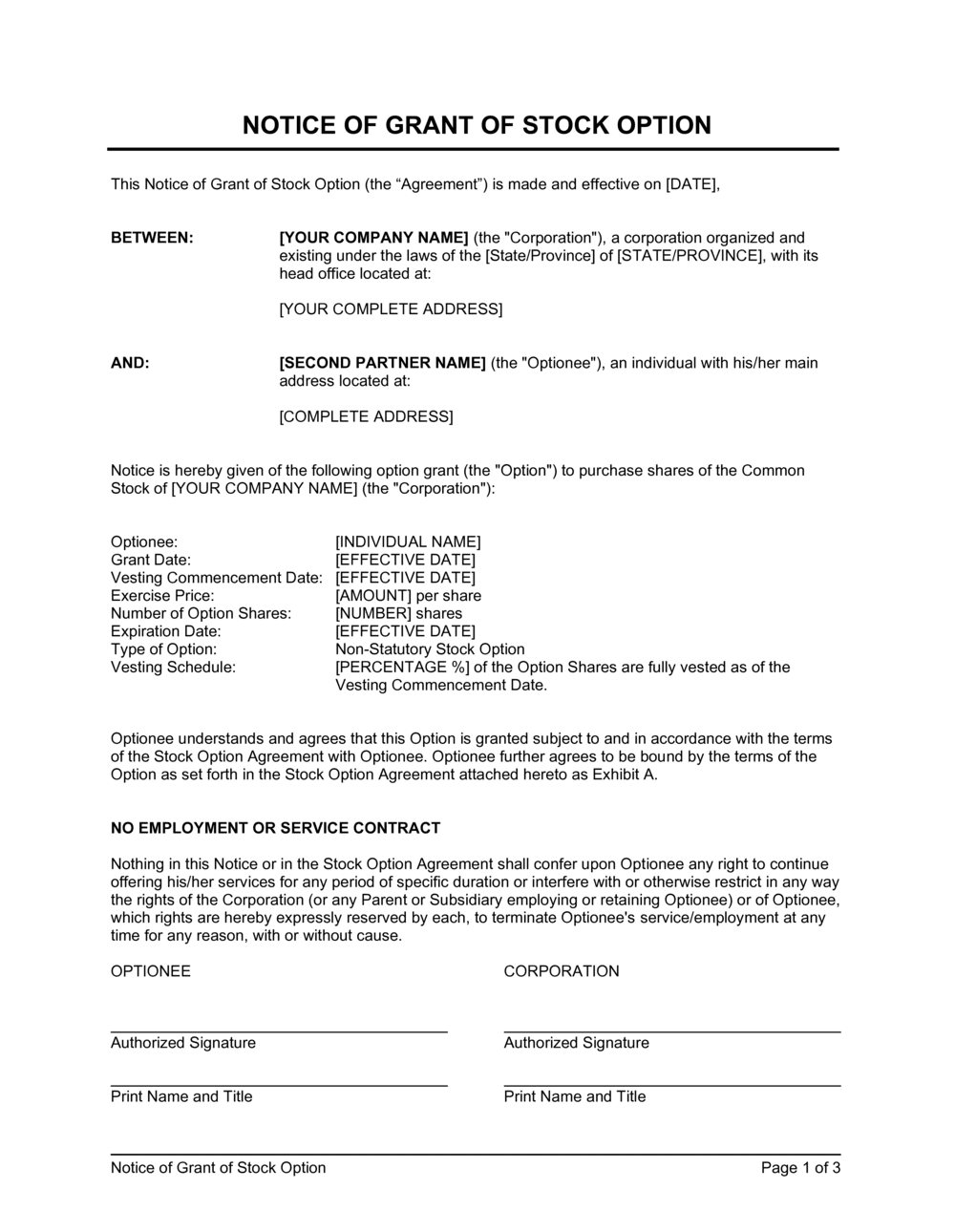
A Notice of Grant of Stock Option is a formal written communication issued by a company to an employee or service provider confirming that the company has granted them the right to purchase a specified number of shares at a fixed exercise price. This free Word download gives you a structured, ready-to-edit template you can personalize and deliver to recipients in minutes, then export as PDF for your records.
When you need it
Issue it whenever your board approves a new stock option grant β€” typically at hiring, during annual equity refresh cycles, or as a performance-based award. The notice creates a formal record of the grant date, price, and vesting schedule that both parties can reference.
What's inside
Recipient and company identification, grant date and grant number, option type (ISO or NSO), number of shares, exercise price per share, vesting schedule, expiration date, and references to the governing equity plan and award agreement.

What is a Notice of Grant of Stock Option?

A Notice of Grant of Stock Option is a formal written communication issued by a company to an employee, director, or advisor confirming that the board of directors has approved an equity award granting the recipient the right to purchase a specified number of company shares at a fixed exercise price. The notice records the grant date, option type (ISO or NSO), share count, exercise price, vesting schedule, and expiration date, and directs the recipient to the governing equity incentive plan and accompanying award agreement. It functions as the authoritative point-of-reference document that both the company and the recipient retain to evidence the terms of the grant.

Why You Need This Document

Without a formal grant notice, an equity award exists only in a board resolution β€” meaning the recipient has no written record of their vesting schedule, exercise price, or expiration date, and disputes about any of those terms become credibility contests rather than document interpretation. From the company's side, an undocumented grant creates exposure on three fronts: IRC Β§409A compliance requires a defensible grant date and exercise price memorialized in writing; ASC 718 stock-based compensation accounting requires a documented measurement date; and a departing employee who was never formally notified of their options may claim the grant was never properly made. This template gives you a clean, board-consistent notice you can issue within minutes of approval, ensuring every recipient knows exactly what they have been granted, when it vests, and when it expires.

Which variant fits your situation?

If your situation is…Use this template
Granting incentive stock options to a US employee for favorable tax treatmentISO Stock Option Grant Notice
Granting non-qualified stock options to a contractor, advisor, or non-US recipientNSO Stock Option Grant Notice
Awarding restricted stock units instead of optionsRSU Grant Notice
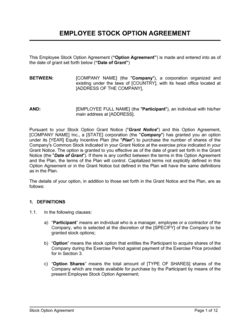
Communicating the full terms of an option alongside the grant noticeStock Option Agreement
Granting equity as part of an executive compensation packageExecutive Stock Option Agreement
Issuing a performance-vesting equity award tied to company milestonesPerformance Share Award Notice
Notifying an employee of an option modification or repricingStock Option Amendment Notice

Common mistakes to avoid

❌ Using the notice delivery date as the grant date

Why it matters: The grant date determines the exercise price and starts the vesting clock. Using the wrong date misstates both, creating tax and accounting errors under ASC 718 and IRC Β§409A.

Fix: Always use the board approval date as the grant date. If the notice is issued days later, the grant date and notice date will differ β€” that is normal and correct.

❌ Omitting the option type (ISO vs. NSO)

Why it matters: ISO and NSO options carry different tax treatment for the recipient. A notice that does not specify the type forces the recipient to guess, and an incorrectly treated exercise can trigger unexpected taxes.

Fix: Explicitly state 'Incentive Stock Option' or 'Non-Qualified Stock Option' in the grant type field. If there is any doubt about ISO eligibility, consult your equity plan administrator.

❌ Issuing the notice without an accompanying award agreement

Why it matters: The notice alone does not document exercise procedures, tax withholding obligations, or termination triggers. Without the full agreement, the company has limited ability to enforce its terms.

Fix: Always attach or link the award agreement when delivering the grant notice. Confirm the recipient has received and accepted both documents.

❌ Vesting schedule in the notice conflicts with the award agreement

Why it matters: If the two documents state different vesting terms, a departing employee can argue in favor of whichever schedule is more favorable β€” and courts may agree.

Fix: Cross-reference the vesting language in both documents before issuing. If the award agreement is your master document, quote its vesting terms verbatim in the notice.

The 9 key clauses, explained

Header and grant reference

In plain language: Identifies the document as a formal notice, names the company, states the recipient's name and role, and assigns a unique grant number for tracking.

Sample language
NOTICE OF GRANT OF STOCK OPTION | [COMPANY LEGAL NAME] | Grantee: [EMPLOYEE FULL NAME] | Title: [JOB TITLE] | Grant No.: [GRANT-YYYY-NNNN]

Common mistake: Omitting the grant number β€” without one, tracking multiple grants per recipient in your cap table or equity platform becomes error-prone and creates audit risk.

Grant date and option type

In plain language: States the official grant date on which the award was authorized by the board and specifies whether the option is an ISO or NSO.

Sample language
Pursuant to the [COMPANY NAME] [YEAR] Equity Incentive Plan, the Company hereby grants you a [Incentive / Non-Qualified] Stock Option, effective [GRANT DATE].

Common mistake: Using the date the notice is delivered rather than the board approval date as the grant date β€” the two can differ by days or weeks, affecting the exercise price and tax treatment.

Number of shares and exercise price

In plain language: Specifies the exact number of shares covered by the option and the per-share exercise price, which must equal or exceed FMV on the grant date.

Sample language
You have been granted an option to purchase [NUMBER] shares of the Company's Common Stock at an exercise price of $[AMOUNT] per share.

Common mistake: Setting the exercise price below FMV on the grant date β€” even by a small amount β€” creates immediate IRC Β§409A violations and significant tax penalties for the recipient.

Vesting schedule

In plain language: Details how and when the option becomes exercisable β€” the cliff period, the vesting frequency, and the full vesting date.

Sample language
This option vests as follows: 25% of the shares vest on the one-year anniversary of [VESTING COMMENCEMENT DATE], with the remaining 75% vesting monthly in equal installments over the following 36 months, subject to your continued service.

Common mistake: Stating a vesting schedule that differs from the underlying option agreement β€” the two documents must match exactly or the discrepancy creates a dispute about which controls.

Expiration date and option term

In plain language: States the date on which the option expires if not exercised and the maximum term of the grant.

Sample language
This option expires on [EXPIRATION DATE], which is 10 years from the Grant Date, unless earlier terminated in accordance with the Plan.

Common mistake: Failing to note early-termination triggers β€” most plans accelerate expiration to 90 days after employment ends, and recipients who are not told this are often caught off guard.

Governing plan reference

In plain language: Incorporates the company's equity incentive plan by reference, making the plan's full terms binding on the recipient without reprinting them in the notice.

Sample language
This option is granted under and subject to the terms of the [COMPANY NAME] [YEAR] Equity Incentive Plan (the 'Plan'), the terms of which are incorporated herein by reference.

Common mistake: Referencing a plan version that is outdated or has not yet received board approval β€” always confirm the plan is current and in effect on the grant date.

Award agreement reference

In plain language: Directs the recipient to the separate stock option agreement that contains the full legal terms governing exercise, transferability, and termination.

Sample language
By accepting this Notice, you agree to be bound by the terms of the [COMPANY NAME] Stock Option Award Agreement, a copy of which accompanies this Notice or is available upon request.

Common mistake: Issuing the grant notice without the accompanying award agreement β€” the notice alone does not contain sufficient terms for enforcement and leaves the company exposed if the recipient disputes exercise conditions.

Acceptance instruction

In plain language: Tells the recipient how to formally accept the grant β€” by countersignature, electronic acknowledgment, or through the company's equity platform.

Sample language
Please indicate your acceptance of this option grant by signing and returning a copy of this Notice, or by accepting through [EQUITY PLATFORM NAME], no later than [ACCEPTANCE DEADLINE DATE].

Common mistake: Setting an acceptance deadline that is too short β€” granting two weeks rather than 30 days is adequate for most employees, but recipients who miss the window may assume the grant lapses when it does not.

Authorized signature block

In plain language: Identifies the authorized company representative whose signature confirms the board has approved the grant and the company is bound.

Sample language
[COMPANY LEGAL NAME] | By: [AUTHORIZED SIGNATORY NAME] | Title: [CEO / CFO / VP People] | Date: [DATE]

Common mistake: Having someone sign who is not authorized by the board resolution approving the grant β€” an unauthorized signatory can cloud the enforceability of the entire notice.

How to fill it out

  1. 1

    Confirm board approval and grant date

    Verify the board resolution or unanimous written consent that approved the equity grant. Use the board approval date as the official grant date β€” not the date you draft the notice.

    πŸ’‘ Keep a copy of the board resolution on file alongside the executed notice; auditors and investors will request both.

  2. 2

    Enter recipient details and assign a grant number

    Fill in the grantee's full legal name, job title, and employment start date. Assign a unique sequential grant number (e.g., GRANT-2026-0012) for cap table tracking.

    πŸ’‘ Use the same grant numbering format across all equity documents so your cap table, equity platform, and notices stay in sync.

  3. 3

    Specify option type, share count, and exercise price

    Select ISO or NSO based on the recipient's status and the company's ISO pool. Enter the exact share count and the exercise price equal to the most recent 409A FMV.

    πŸ’‘ Do not issue options without a current 409A valuation in place β€” a stale valuation (older than 12 months) does not provide IRC Β§409A safe harbor.

  4. 4

    Enter the vesting schedule and commencement date

    State the vesting commencement date (often the hire date, not the grant date), the cliff period, and the post-cliff vesting frequency. Confirm these match the award agreement exactly.

    πŸ’‘ If the commencement date predates the grant date β€” common for new hires β€” ensure your equity platform can handle retroactive vesting credit.

  5. 5

    State the expiration date

    Set the expiration at 10 years from the grant date for standard options (7 years for ISOs granted to 10%+ shareholders). Note any shorter post-termination exercise windows in the governing plan.

    πŸ’‘ Consider adding a plain-language sentence flagging that the option expires 90 days after the employment relationship ends β€” most recipients do not read the full plan.

  6. 6

    Reference the governing plan and award agreement

    Name the exact plan (including the year it was adopted) and confirm a copy of the award agreement accompanies the notice or is accessible via your equity platform.

    πŸ’‘ If you use an equity platform such as Carta or Pulley, include the direct URL or login instructions so the recipient can accept electronically.

  7. 7

    Obtain an authorized signature and deliver

    Have the CEO, CFO, or VP People sign on behalf of the company per the board authorization. Deliver the notice to the recipient with a clear acceptance deadline and instructions.

    πŸ’‘ Deliver by email with read receipt or through your equity platform's tracked delivery feature β€” you want a timestamped record of when the recipient received the notice.

Frequently asked questions

What is a notice of grant of stock option?

A notice of grant of stock option is a formal written communication a company sends to an employee, director, or service provider confirming that the board has approved an equity award. It states the grant date, option type, number of shares, exercise price, vesting schedule, and expiration date, and directs the recipient to the full award agreement that governs exercise and termination. It creates an official record for both the company and the recipient.

What is the difference between an ISO and an NSO?

An ISO (Incentive Stock Option) qualifies for favorable US tax treatment under IRC Β§422 β€” the recipient pays no ordinary income tax at exercise and may qualify for long-term capital gains rates if holding period requirements are met. ISOs can only be granted to employees. An NSO (Non-Qualified Stock Option) does not qualify for those benefits; the spread between the exercise price and FMV at exercise is taxed as ordinary income. NSOs can be granted to employees, directors, and consultants.

Why does the grant date matter?

The grant date establishes the exercise price β€” which must equal or exceed FMV on that date β€” and starts the vesting clock. Using the wrong date, even by a few days, can result in a below-FMV exercise price that triggers IRC Β§409A penalties for the recipient, misstatement of stock-based compensation expense under ASC 718, and potential securities law issues. Always use the board approval date, not the date the notice is printed or delivered.

Does the recipient need to sign the grant notice?

Many equity plans require the recipient to formally accept the grant within a set period β€” typically 30 to 60 days. Acceptance is usually done by countersigning the notice or clicking an acceptance button on an equity platform. If the recipient fails to accept, most plans treat the option as either forfeited or still outstanding, depending on plan terms. Check your governing plan and state the acceptance method clearly in the notice.

What is a 409A valuation and why is it required?

A 409A valuation is an independent appraisal of a private company's common stock fair market value, required under IRC Β§409A before granting stock options. It provides a defensible exercise price for tax purposes. Without a current 409A valuation, the IRS can recharacterize options as deferred compensation and impose a 20% excise tax plus interest on recipients. Most 409A valuations are valid for 12 months or until a material event changes the company's value.

What happens to unvested options when an employee leaves?

Unvested options are typically forfeited on the date the employment relationship ends, reverting to the company's option pool. Vested but unexercised options usually must be exercised within 90 days of termination (for ISOs) or the period specified in the award agreement. Options not exercised within that window expire worthless. Some companies extend post-termination exercise windows to one or more years β€” check your plan terms and state them plainly in the notice.

Is this notice the same as the stock option agreement?

No. The grant notice is a short summary document confirming the key terms of the award. The stock option agreement is the full legal contract that governs how, when, and under what conditions the option may be exercised, transferred, or terminated. Both documents work together β€” the notice references the agreement, and the agreement incorporates the equity incentive plan. Never issue a grant notice without also delivering the full award agreement.

Can stock options be granted to contractors or advisors?

Yes, but only as NSOs. ISO treatment is limited to employees on the company's payroll. Contractors, advisors, and board members can receive NSOs, which carry the same economic upside but result in ordinary income taxation at exercise. Some equity plans exclude non-employees entirely β€” check your plan's eligibility provisions before issuing a notice to a non-employee.

How long is a stock option valid?

The standard option term is 10 years from the grant date. ISOs granted to shareholders who own more than 10% of the company's voting stock are limited to a 7-year term. Options typically expire earlier upon termination β€” often 90 days after the employment relationship ends for ISOs, or a period specified in the plan for NSOs. The grant notice should state the full expiration date and note any earlier termination triggers.

How this compares to alternatives

vs Stock Option Agreement

A stock option agreement is the full legal contract governing the terms of an option grant β€” exercise procedures, tax withholding, transferability, and termination. The grant notice is a short summary document that references and incorporates the agreement. Both documents are needed for a complete, enforceable equity grant; the notice alone is insufficient.

vs RSU Grant Notice

An RSU (restricted stock unit) grant notice communicates an award of share units that convert to actual shares upon vesting β€” no exercise price and no purchase required. A stock option grant notice covers the right to buy shares at a fixed price. RSUs are simpler for recipients to understand but create a tax event at vesting regardless of whether the recipient takes any action.

vs Offer Letter

An offer letter may reference an equity grant as part of the compensation package, but it is not a substitute for the formal grant notice. The grant notice is issued only after board approval and contains the precise legal terms β€” grant date, exercise price, and vesting schedule β€” that the offer letter cannot predict. Always issue a grant notice after board approval even when the offer letter mentioned equity.

vs Employee Stock Purchase Plan (ESPP) Notice

An ESPP notice enrolls employees in a plan that lets them buy company stock at a discount through payroll deductions over an offering period. A stock option grant notice awards a specific number of options at a fixed exercise price. ESPPs are broad-based plans with relatively small individual awards; option grants are typically targeted at key employees with larger potential upside.

Industry-specific considerations

Technology / SaaS

Equity grants are a core compensation tool for attracting engineers and product managers; ISO grants are standard for US employees, with NSOs for non-US team members and advisors.

Financial Services

Option grants to key personnel require coordination with broker-dealer compliance rules and may be subject to blackout periods tied to material non-public information policies.

Healthcare / MedTech

Grants to physician founders and clinical advisors are typically NSOs; FDA approval milestones often serve as performance-vesting triggers referenced in the notice.

Professional Services

Equity grants to senior partners and directors are used to align long-term incentives; NSO treatment is common given the mix of employees and independent contractors.

Template vs pro β€” what fits your needs?

PathBest forCostTime
Use the templateStartups and small businesses issuing standard grants under an approved equity plan with a current 409A valuationFree10–15 minutes per grant
Template + professional reviewCompanies issuing grants to non-US recipients, modifying existing grants, or operating without equity administration software$200–$600 (equity counsel or plan administrator review)1–3 days
Custom draftedPre-IPO companies, complex multi-tranche grants, executive packages with performance vesting, or grants tied to M&A transactions$1,000–$5,000+ (securities counsel)1–3 weeks

Glossary

Stock Option
A contractual right granted to an individual to purchase a set number of company shares at a fixed price within a defined period.
Grant Date
The specific calendar date on which the company formally awards the option, establishing the exercise price and starting the vesting clock.
Exercise Price
The price per share at which the option holder may purchase shares, set at or above fair market value on the grant date.
Vesting Schedule
The timetable that determines when portions of the option become exercisable β€” commonly monthly or annual tranches over a four-year period.
Cliff Vesting
A vesting structure in which no options vest until a defined initial period β€” typically 12 months β€” has passed, after which a lump tranche becomes exercisable.
ISO (Incentive Stock Option)
A stock option that qualifies for favorable US tax treatment under IRC Β§422, available only to employees and subject to strict IRS limits.
NSO (Non-Qualified Stock Option)
A stock option that does not qualify for ISO tax treatment; the spread on exercise is taxed as ordinary income and can be granted to employees, directors, and consultants.
Expiration Date
The last date on which an option can be exercised; unexercised options typically expire 10 years from the grant date or earlier upon termination.
Equity Incentive Plan
The overarching company plan that governs all stock option and equity award grants, approved by the board and typically by shareholders.
Fair Market Value (FMV)
The price at which a share would change hands between a willing buyer and a willing seller, determined by a 409A valuation for private companies.
409A Valuation
An independent appraisal of a private company's common stock fair market value required under IRC Β§409A to set defensible option exercise prices.

Part of your Business Operating System

This document is one of 3,000+ business & legal templates included in Business in a Box.

  • Fill-in-the-blanks β€” ready in minutes
  • 100% customizable Word document
  • Compatible with all office suites
  • Export to PDF and share electronically

Create your document in 3 simple steps.

From template to signed document β€” all inside one Business Operating System.
1
Download or open template

Access over 3,000+ business and legal templates for any business task, project or initiative.

2
Edit and fill in the blanks with AI

Customize your ready-made business document template and save it in the cloud.

3
Save, Share, Send, Sign

Share your files and folders with your team. Create a space of seamless collaboration.

Save time, save money, and create top-quality documents.

β˜…β˜…β˜…β˜…β˜…

"Fantastic value! I'm not sure how I'd do without it. It's worth its weight in gold and paid back for itself many times."

Managing Director Β· Mall Farm
Robert Whalley
Managing Director, Mall Farm Proprietary Limited
β˜…β˜…β˜…β˜…β˜…

"I have been using Business in a Box for years. It has been the most useful source of templates I have encountered. I recommend it to anyone."

Business Owner Β· 4+ years
Dr Michael John Freestone
Business Owner
β˜…β˜…β˜…β˜…β˜…

"It has been a life saver so many times I have lost count. Business in a Box has saved me so much time and as you know, time is money."

Owner Β· Upstate Web
David G. Moore Jr.
Owner, Upstate Web

Run your business with a system β€” not scattered tools

Stop downloading documents. Start operating with clarity. Business in a Box gives you the Business Operating System used by over 250,000 companies worldwide to structure, run, and grow their business.

Start freeΒ Β·Β No credit card required