Vesting Agreement Template

Free Word download • Edit online • Save & share with Drive • Export to PDF

5 pages25–35 min to fillDifficulty: ComplexSignature requiredLegal review recommended
Learn more ↓
FreeVesting Agreement Template

At a glance

What it is
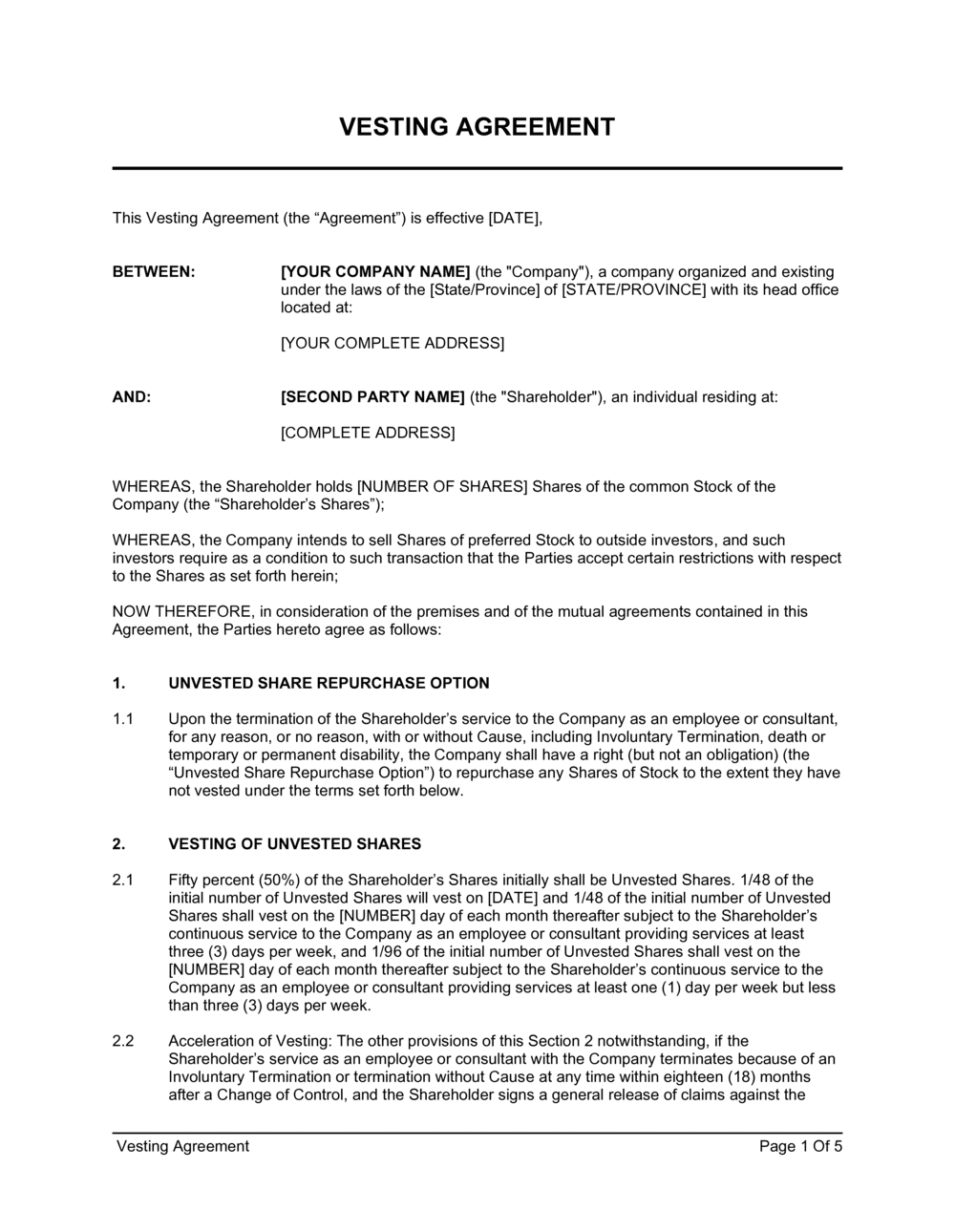
A Vesting Agreement is a legally binding document between a company and a recipient — founder, employee, or advisor — that defines how equity, stock options, or other equity-based compensation is earned over time or against defined milestones. This free Word download covers cliff period, vesting schedule, acceleration triggers, forfeiture conditions, and applicable tax elections, and can be exported as PDF and signed before any equity is issued.
When you need it
Use it whenever you grant equity to a co-founder before incorporation is complete, issue stock options to an employee as part of a compensation package, or onboard an advisor with an equity stake tied to performance milestones. Executing the agreement before the recipient starts work is critical — any delay creates legal and tax complications.
What's inside
Parties and grant details, vesting commencement date, cliff and vesting schedule, performance or milestone triggers, single and double-trigger acceleration, forfeiture and repurchase rights on departure, tax elections (including Section 83(b) in the US), and governing law.

What is a Vesting Agreement?

A Vesting Agreement is a legally binding contract between a company and a recipient — typically a co-founder, employee, or advisor — that defines precisely how equity, stock options, or other equity-based compensation is earned over time or upon achieving specific milestones. Rather than transferring full ownership of shares immediately, the agreement imposes a schedule under which ownership is earned incrementally, subject to a cliff period, and forfeited if the recipient departs before each tranche vests. It governs the cliff, monthly or quarterly vesting rate, performance triggers, single and double-trigger acceleration events, repurchase rights on departure, and any applicable tax elections — creating the complete legal framework for an equity grant from day one through full vesting or earlier departure.

Why You Need This Document

Without a vesting agreement, a co-founder who leaves after three months retains the same equity stake as one who stays for five years — a misaligned cap table that can block future financing, deter acquirers, and generate costly disputes. Institutional investors at the seed and Series A stage typically require all founders to be subject to a formal vesting schedule as a condition of investment, and will conduct cap table due diligence to confirm it. Beyond the investor relationship, a properly executed vesting agreement protects the company's IP assignment, activates the recipient's Section 83(b) election window in the US, and gives the company enforceable repurchase rights over unvested shares when someone leaves. The cost of omitting this document — in equity dilution, tax liability, and litigation risk — routinely exceeds the value of the grant itself.

Which variant fits your situation?

If your situation is…Use this template
Vesting restricted stock units for a full-time employeeRestricted Stock Unit (RSU) Agreement
Granting incentive stock options under a formal equity planStock Option Agreement (ISO)
Granting non-qualified stock options to contractors or advisorsStock Option Agreement (NSO)
Applying vesting to co-founder shares at formationFounder Restricted Stock Purchase Agreement
Performance-based vesting tied to company revenue milestonesPerformance Share Plan Agreement
Advisor equity grant with a shorter 2-year vesting scheduleAdvisor Equity Agreement
Executive equity with double-trigger acceleration on change of controlExecutive Employment Agreement

Common mistakes to avoid

❌ Missing the 30-day Section 83(b) election window

Why it matters: A US recipient who misses the filing deadline owes ordinary income tax on the full fair-market-value appreciation at each vesting date — potentially a multi-million-dollar liability payable in cash with illiquid shares.

Fix: Attach a completed sample 83(b) election form to the agreement as an exhibit, include an explicit deadline notice in the agreement body, and send a calendar reminder to the recipient immediately after signing.

❌ Back-dating the grant date rather than the vesting commencement date

Why it matters: Back-dating the formal grant date to secure a lower exercise price is a securities violation and a basis for civil and criminal liability; back-dating vesting commencement to reflect actual service start is standard and legitimate.

Fix: Set the grant date to the board approval date. Set the vesting commencement date to the recipient's actual start date — these two fields serve different legal purposes.

❌ Granting full single-trigger acceleration company-wide

Why it matters: Acquirers typically reduce deal consideration by the value of unvested equity that will accelerate at closing, effectively transferring value from all shareholders to the accelerating recipients.

Fix: Limit single-trigger acceleration to senior executives or founders, and cap the percentage at 25–50% of unvested shares. Use double-trigger acceleration for all other employees.

❌ Defining milestones subjectively

Why it matters: Vague milestones like 'successful launch' or 'board satisfaction' give the board discretion courts may override, and create disputes that can consume more in legal fees than the equity is worth.

Fix: Define every milestone as an objective, measurable event with a specific metric, date, or third-party certification requirement.

❌ Omitting a definition of Continuous Service

Why it matters: Without a definition, approved leaves of absence — medical, parental, or military — may inadvertently trigger the forfeiture clause, creating discrimination or employment-law exposure.

Fix: Define Continuous Service to explicitly include all legally protected leaves and any leave approved in writing by the board.

❌ Executing the agreement after the grant date has passed

Why it matters: A post-grant-date signature may void time-sensitive tax elections and, in some jurisdictions, requires fresh consideration to make new restrictions enforceable against the recipient.

Fix: Execute the agreement on or before the grant date. If circumstances delay signing, provide documented additional consideration — a cash payment or modified terms — at the time of late execution.

The 10 key clauses, explained

Parties, grant details, and recitals

In plain language: Identifies the company and the recipient, states the number of shares or options granted, the grant date, and the exercise price (for options) or purchase price (for restricted stock).

Sample language
This Vesting Agreement is entered into as of [GRANT DATE] between [COMPANY LEGAL NAME], a [STATE] [ENTITY TYPE] (the 'Company'), and [RECIPIENT FULL NAME] ('Recipient'). The Company hereby grants Recipient [NUMBER] shares of [CLASS] common stock at a purchase price of $[PRICE] per share.

Common mistake: Using the incorporation date instead of the board approval date as the grant date. The grant date triggers the Section 83(b) election window and the vesting clock — using the wrong date can invalidate a timely tax election.

Vesting commencement date and schedule

In plain language: States when the vesting clock starts — which may differ from the grant date — and the rate at which equity vests, typically monthly or quarterly after the cliff.

Sample language
Vesting shall commence on [VESTING START DATE]. Subject to the cliff in Section [X], [TOTAL SHARES] shares shall vest over [48] months, with [25]% vesting on the [12]-month anniversary of the Vesting Commencement Date and [1/48th] of the total shares vesting each month thereafter.

Common mistake: Setting the vesting commencement date to the grant date without confirming the recipient's actual start date. If a co-founder joined six months before the grant, the schedule should back-date to the true start date — failing to do so gives them a windfall cliff payment.

Cliff provision

In plain language: Defines the minimum service period before any equity vests, and the amount that vests in a single tranche on the cliff date.

Sample language
No shares shall vest prior to the [12]-month anniversary of the Vesting Commencement Date (the 'Cliff Date'). On the Cliff Date, [25]% of the total shares subject to this Agreement shall vest, provided Recipient remains in Continuous Service through that date.

Common mistake: Omitting what happens if the company terminates the recipient one day before the cliff. Without explicit language, courts may imply entitlement in jurisdictions that recognize good-faith obligations in employment relationships.

Performance and milestone vesting

In plain language: For agreements where some or all vesting is tied to achievement of specific company or individual milestones rather than the passage of time alone.

Sample language
Notwithstanding the time-based schedule, [X]% of the total shares shall vest upon the Company's achievement of [MILESTONE — e.g., $[X]M in annual recurring revenue] as certified by the Board in writing.

Common mistake: Defining milestones too vaguely — 'successful product launch' or 'strong company performance' gives the board subjective discretion that courts may override. Milestones must be objectively measurable to be enforceable.

Acceleration — single and double trigger

In plain language: Specifies whether and how unvested equity accelerates upon a change of control, and whether a subsequent termination is required as a second condition.

Sample language
Upon a Change of Control, [X]% of Recipient's then-unvested shares shall accelerate and vest immediately (single trigger). An additional [X]% of then-unvested shares shall accelerate if Recipient's employment is involuntarily terminated without Cause within [18] months following the Change of Control (double trigger).

Common mistake: Granting full single-trigger acceleration to all employees. Acquirers typically price single-trigger acceleration into the purchase price reduction, effectively punishing the founders and other shareholders who are not accelerating.

Forfeiture and repurchase rights

In plain language: States that unvested shares are automatically forfeited or subject to company repurchase at the original price upon the recipient's departure, defining what triggers forfeiture and the repurchase mechanics.

Sample language
Upon termination of Recipient's Continuous Service for any reason, all unvested shares shall be immediately forfeited. The Company shall have the right, exercisable within [90] days of termination, to repurchase unvested shares at the lower of the original purchase price or the then-current fair market value.

Common mistake: Forgetting to define 'Continuous Service' to include approved leaves of absence. If a recipient takes medical or parental leave, an undefined term can inadvertently trigger forfeiture.

Good leaver and bad leaver provisions

In plain language: Classifies departure scenarios and links each to different economic outcomes — particularly relevant where vested equity can also be repurchased upon bad-leaver events.

Sample language
'Good Leaver' means termination without Cause or resignation with Good Reason. 'Bad Leaver' means termination for Cause, voluntary resignation without Good Reason, or breach of a restrictive covenant. A Bad Leaver forfeits all unvested shares and the Company may repurchase vested shares at the lower of cost or fair market value.

Common mistake: Applying bad-leaver mechanics to vested equity without explicit written consent from the recipient at signing. Courts in several jurisdictions treat forfeiture of already-vested equity as a penalty clause, which may be unenforceable without clear upfront disclosure.

Tax elections and withholding

In plain language: Addresses the recipient's obligation to consider and file a Section 83(b) election (US), Employment Income election (Canada), or equivalent tax event notice, and the company's withholding obligations on option exercises.

Sample language
Recipient acknowledges that a Section 83(b) election under the Internal Revenue Code may be available with respect to the shares granted herein and must be filed with the IRS within 30 days of the Grant Date. The Company shall have no obligation to notify Recipient of the deadline. Upon exercise of any option, Recipient authorizes the Company to withhold applicable taxes from any compensation then owed.

Common mistake: Assuming the recipient knows about the 83(b) election window. Founders who miss the 30-day window can face ordinary income tax on the full fair-market-value appreciation at vesting — a bill that may be impossible to pay with illiquid shares.

Transferability restrictions

In plain language: Restricts the recipient from transferring, pledging, or otherwise encumbering unvested shares without board consent, and subjects any transfer to the company's right of first refusal.

Sample language
Unvested shares may not be transferred, assigned, pledged, or hypothecated without the prior written consent of the Company's Board of Directors. Any purported transfer in violation of this Section shall be void. Vested shares remain subject to the Company's Right of First Refusal as set forth in the Company's Stockholder Agreement.

Common mistake: Failing to cross-reference the company's broader stockholder agreement or shareholders' rights agreement. Inconsistent transfer restrictions across documents create ambiguity that can block future financing rounds or acquisitions.

Governing law, entire agreement, and amendment

In plain language: Specifies which jurisdiction's law governs, confirms this agreement supersedes prior representations, and requires written amendments signed by both parties.

Sample language
This Agreement shall be governed by the laws of the State of [STATE], without regard to conflicts-of-law principles. This Agreement constitutes the entire agreement between the parties with respect to the subject matter hereof and supersedes all prior representations and understandings. This Agreement may not be amended except by a written instrument signed by both parties.

Common mistake: Choosing a governing state with no connection to where the company operates or the recipient lives. Enforcement of repurchase rights and forfeiture provisions can differ materially between states, and a mismatch creates unpredictable outcomes.

How to fill it out

  1. 1

    Enter the parties, grant date, and share details

    Use the company's full registered legal name and the recipient's legal name as it appears on government ID. Enter the exact board approval date as the grant date, the share class (e.g., common stock), the number of shares, and the price per share.

    💡 Confirm the grant date matches the board resolution approving the grant — discrepancies between the resolution and the agreement are a common cap table audit finding.

  2. 2

    Set the vesting commencement date

    Determine whether vesting starts on the grant date, the recipient's employment start date, or another agreed date. For co-founders, back-date the commencement to the actual date they began contributing to the company.

    💡 Back-dating vesting commencement is standard and legitimate for founders — it is not the same as back-dating the grant itself, which is a securities violation.

  3. 3

    Define the cliff and monthly vesting rate

    Enter the cliff period in months (12 is standard for most employee and founder grants; 6 is common for advisors). Then set the monthly vesting rate for the remaining shares — 1/48 per month for a 4-year schedule is the venture-backed default.

    💡 For advisors, the FAST Agreement standard (1–2 year vesting, no cliff, or a 3–6 month cliff) is widely recognized and accepted by early-stage investors.

  4. 4

    Add performance milestones if applicable

    If any portion of the grant is milestone-based, write each milestone as an objectively verifiable event — a dollar amount of revenue, a product release with a specific version number, or a signed contract with a named customer category.

    💡 Include a catch-all provision stating that if a milestone becomes impossible to achieve, the board may substitute a comparable milestone with the recipient's written consent.

  5. 5

    Choose and document the acceleration structure

    Decide between no acceleration, single-trigger, double-trigger, or a hybrid. For most employees, double-trigger (12 months' additional vesting) is appropriate. For founders or executives, partial single-trigger plus double-trigger is common.

    💡 State the acceleration as a percentage of total granted shares or unvested shares at the trigger date — not a fixed number — so it remains accurate as the schedule progresses.

  6. 6

    Define good leaver and bad leaver categories

    List specific events constituting Cause (e.g., conviction of a felony, material fraud, willful breach of fiduciary duty) and Good Reason (e.g., a material reduction in compensation or title). Avoid vague language like 'unsatisfactory performance.'

    💡 Have the recipient initial the leaver definitions separately to confirm they understood and agreed to these specific terms — not just the agreement as a whole.

  7. 7

    Include the Section 83(b) election notice for US recipients

    Add a provision explicitly advising US recipients that a Section 83(b) election may be available for restricted stock grants and must be filed within 30 days of the grant date. Attach a sample election form as an exhibit.

    💡 The company cannot file the 83(b) election on behalf of the recipient. Providing a completed sample form and a calendar reminder reduces the risk of a missed deadline.

  8. 8

    Execute before the recipient's first day or grant date

    Both parties must sign before the recipient begins service or the grant date passes. Obtain board resolution approving the grant on the same date. Distribute fully executed copies to all signatories and store originals in the company's cap table records.

    💡 Use a digital signature platform that timestamps execution — this is critical evidence if the grant date is ever challenged in litigation or an M&A diligence process.

Frequently asked questions

What is a vesting agreement?

A vesting agreement is a legally binding contract between a company and a recipient — typically a founder, employee, or advisor — that defines how equity or stock options are earned over time or upon achieving specific milestones. It specifies the cliff period, vesting schedule, acceleration triggers, and forfeiture conditions that apply if the recipient leaves before fully vesting. Without a vesting agreement, equity is typically treated as immediately owned, removing the retention incentive entirely.

What is a standard vesting schedule?

The venture-backed standard for founders and employees in the US and Canada is a 4-year vesting schedule with a 1-year cliff — meaning 25% of the total grant vests on the 12-month anniversary of the vesting commencement date, and the remaining 75% vests monthly (1/48 per month) over the following 36 months. Advisor grants typically use shorter schedules of 1–2 years with a 3–6 month cliff or no cliff at all.

What is a cliff in a vesting agreement?

A cliff is the minimum period a recipient must remain in continuous service before any equity vests. In a standard 4-year/1-year schedule, no shares vest during the first 12 months. On the cliff date, 25% of the total grant vests in a single tranche. The cliff protects the company from issuing equity to someone who leaves in the first few months before demonstrating sustained contribution.

What is accelerated vesting and when does it apply?

Accelerated vesting causes some or all unvested equity to vest immediately upon a triggering event rather than waiting for the scheduled dates. Single-trigger acceleration vests equity on a change of control alone. Double-trigger acceleration requires both a change of control and a subsequent involuntary termination within a defined window — typically 12–18 months. Double-trigger is the investor-preferred structure for most employees; single-trigger is sometimes negotiated for founders or C-suite executives.

Do I need to file a Section 83(b) election?

If you are a US taxpayer receiving restricted stock — shares granted now but subject to vesting — filing a Section 83(b) election within 30 days of the grant date is typically highly advantageous. The election locks in your tax basis at the current (usually low) grant-date value rather than the potentially much higher fair-market value at each future vesting date. Missing the 30-day window permanently forecloses this option. Consult a tax advisor before your grant date to determine whether the election is appropriate for your situation.

What happens to unvested equity when an employee leaves?

The default under most vesting agreements is that unvested shares or options are immediately forfeited upon termination of continuous service for any reason. The company typically also holds a right to repurchase unvested shares at the original purchase price. Some agreements distinguish between good-leaver and bad-leaver scenarios — a good leaver may retain some additional vesting or extended exercise periods, while a bad leaver (for cause) may forfeit even vested equity in certain jurisdictions.

Should co-founders have vesting agreements?

Yes — founder vesting is widely considered best practice and is expected by most institutional investors. Without vesting, a co-founder who leaves in Year 1 retains the same equity percentage as one who stays for five years, creating a misaligned cap table that can complicate or block future financing. Most seed and Series A term sheets require that all founders be subject to a 4-year vesting schedule as a condition of investment.

What is the difference between a vesting agreement and a stock option agreement?

A vesting agreement governs when equity is earned — it sets the cliff, schedule, acceleration, and forfeiture terms. A stock option agreement governs the mechanics of exercising the right to purchase shares at a fixed price — it sets the exercise price, option term, and exercise window. Many equity grants combine both in a single document or reference a stock option plan that incorporates vesting terms by reference. Either way, both sets of provisions must be in place before a grant is complete.

Is a vesting agreement legally enforceable in all jurisdictions?

Vesting agreements are generally enforceable in the US, Canada, the UK, and the EU when properly drafted and executed. However, enforceability of specific provisions — particularly bad-leaver forfeiture of vested equity and post-departure restrictions — varies materially by jurisdiction. In some EU member states, forfeiture of already-vested equity may be treated as an unenforceable penalty clause. Legal review by counsel in the recipient's jurisdiction of employment is advisable for any grant with material value.

Do I need a lawyer to draft a vesting agreement?

For straightforward time-based grants to employees in a single jurisdiction with standard 4-year/1-year terms, a high-quality template reviewed by a startup attorney is usually sufficient. Engage counsel when the grant involves material equity to a co-founder, complex performance milestones, executives with negotiated acceleration, cross-border recipients, or any situation where the value of the grant exceeds $50,000. A 1–2 hour review typically costs $400–$800 and is inexpensive relative to the disputes it prevents.

How this compares to alternatives

vs Stock Option Agreement

A stock option agreement defines the right to purchase shares at a fixed price and governs exercise mechanics, option term, and ISO versus NSO tax treatment. A vesting agreement defines when equity is earned — the cliff, schedule, acceleration, and forfeiture conditions. Many grants incorporate both in a single document; when separated, both must be executed to create a complete equity grant.

vs Restricted Stock Purchase Agreement

A restricted stock purchase agreement governs the actual purchase of shares at formation — the transfer of shares in exchange for consideration. A vesting agreement overlays the forfeiture and repurchase mechanics on those shares. For founder grants, these are often combined into a single Founder Restricted Stock Purchase Agreement that addresses both the purchase and the vesting terms.

vs Employment Agreement

An employment agreement defines the compensation, duties, and termination terms of the employment relationship; it may reference equity but rarely governs vesting mechanics in full detail. A standalone vesting agreement provides the complete legal framework for the equity grant itself and survives termination of the employment agreement. For senior executives, both documents must be cross-referenced carefully to avoid inconsistencies in acceleration and forfeiture terms.

vs Shareholders Agreement

A shareholders agreement governs the rights and obligations of all shareholders collectively — voting, drag-along, tag-along, and information rights. A vesting agreement governs the individual recipient's path to becoming a full, unrestricted shareholder. The two documents must be consistent: vesting agreements should reference and defer to transfer restrictions and right-of-first-refusal provisions in the shareholders agreement.

Industry-specific considerations

Technology / SaaS

Founder vesting is required by virtually every institutional seed and Series A investor; double-trigger acceleration is standard for all employees in M&A-active sectors.

Biotech and life sciences

Milestone-based vesting tied to FDA submission dates, Phase II trial completion, or licensing agreements is common alongside time-based schedules.

Professional services

Equity grants to senior partners or key-person advisors often use longer 5–6 year schedules with client revenue retention milestones rather than pure time-based vesting.

Financial services and fintech

Regulatory bonus deferral requirements in the UK and EU may interact with vesting schedules; clawback provisions required for regulated individuals must be drafted consistently with FCA or MiFID II rules.

Manufacturing and deep tech

Vesting tied to patent issuance, production scale milestones, or government contract awards is common; IP assignment must be confirmed in the same or a parallel agreement.

Consumer brands and retail

Equity grants to brand ambassadors or key operators often use shorter 2-year schedules; good-leaver provisions are particularly important given higher voluntary turnover rates.

Jurisdictional notes

United States

Section 83(b) of the Internal Revenue Code gives recipients of restricted stock a 30-day window from the grant date to elect to pay ordinary income tax on the current value rather than future vested value — missing this deadline is typically irreversible and costly. Non-qualified stock options trigger W-2 income on exercise; ISOs receive capital-gains treatment if holding-period requirements are met. Delaware law governs most startup equity agreements, but California imposes additional securities and employment law considerations for California-based recipients.

Canada

In Canada, stock option benefits are generally taxed as employment income at exercise (not grant) unless the employer is a Canadian-Controlled Private Corporation (CCPC), in which case taxation may be deferred until the shares are sold. The 2021 federal budget introduced a $200,000 annual cap on stock option grants eligible for the one-half deduction for non-CCPC employees. Quebec requires French-language agreements for provincially-regulated employers. Provincial securities law exemptions must be confirmed before issuing shares to recipients.

United Kingdom

Enterprise Management Incentive (EMI) options offer significant tax advantages for eligible UK companies — recipients pay capital gains tax rather than income tax on the gain, and the employer receives a corporate tax deduction. EMI eligibility is subject to company size limits (gross assets under £30M, fewer than 250 full-time employees). Good-leaver provisions that allow forfeiture of already-vested equity should be reviewed carefully, as UK employment tribunals may treat them as unlawful deductions from wages in some circumstances.

European Union

EU member states apply widely differing tax treatment to equity grants — France has qualified BSPCE warrants with favorable capital-gains treatment; Germany taxes options at exercise as employment income; the Netherlands has specific rules for option valuation at grant. Bad-leaver forfeiture of vested equity is frequently treated as an unenforceable penalty clause in civil-law jurisdictions including France, Germany, and Spain, meaning vested equity protections may be stronger than in common-law jurisdictions. Legal review in each recipient's country of residence is essential for any EU-wide equity plan.

Template vs lawyer — what fits your deal?

PathBest forCostTime
Use the templateStandard time-based grants to employees in a single US state or Canadian province with grants under $50,000 in valueFree30–45 minutes
Template + legal reviewFounder equity grants, grants with acceleration triggers, cross-border recipients, or any grant above $50,000 in estimated value$400–$8002–4 days
Custom draftedC-suite executives with negotiated acceleration and clawback, multi-jurisdiction grants, or grants subject to securities regulation$2,000–$8,000+1–3 weeks

Glossary

Vesting Schedule
The timeline and conditions under which a recipient earns the right to own granted equity outright, free from forfeiture.
Cliff
The minimum period a recipient must remain before any equity vests — typically 12 months, after which the first tranche vests all at once.
Restricted Stock
Shares issued to a recipient upfront but subject to forfeiture if the recipient leaves before the applicable vesting conditions are met.
Stock Option
A contractual right to purchase a set number of shares at a fixed exercise price at any point after vesting, typically within 10 years of grant.
Section 83(b) Election
A US tax election filed within 30 days of a restricted stock grant that allows the recipient to pay income tax on the grant-date value rather than the higher vested value — locking in a lower tax basis.
Single-Trigger Acceleration
A provision that causes some or all unvested equity to vest immediately upon a single event — most commonly a change of control — regardless of whether the recipient is terminated.
Double-Trigger Acceleration
A provision requiring two events to trigger accelerated vesting — typically a change of control followed by the recipient's involuntary termination within a defined window, often 12–18 months.
Repurchase Right
The company's right to buy back unvested shares from a departing recipient at the original purchase price or a formula price, effectively canceling the unvested portion.
Grant Date
The date the board formally approves the equity grant, which sets the clock for the vesting schedule, cliff calculation, and any tax elections.
Good Leaver / Bad Leaver
Defined departure classifications — a good leaver (voluntary resignation or no-cause termination) typically retains vested equity; a bad leaver (terminated for cause) may forfeit all equity including vested shares.
Dilution
The reduction in each existing shareholder's ownership percentage caused by issuing additional shares, including shares that vest under outstanding equity grants.
Incentive Stock Option (ISO)
A US stock option qualifying for preferential capital-gains tax treatment if specific holding-period requirements are met after exercise.

Part of your Business Operating System

This document is one of 3,000+ business & legal templates included in Business in a Box.

  • Fill-in-the-blanks — ready in minutes
  • 100% customizable Word document
  • Compatible with all office suites
  • Export to PDF and share electronically

Create your document in 3 simple steps.

From template to signed document — all inside one Business Operating System.
1
Download or open template

Access over 3,000+ business and legal templates for any business task, project or initiative.

2
Edit and fill in the blanks with AI

Customize your ready-made business document template and save it in the cloud.

3
Save, Share, Send, Sign

Share your files and folders with your team. Create a space of seamless collaboration.

Save time, save money, and create top-quality documents.

★★★★★

"Fantastic value! I'm not sure how I'd do without it. It's worth its weight in gold and paid back for itself many times."

Managing Director · Mall Farm
Robert Whalley
Managing Director, Mall Farm Proprietary Limited
★★★★★

"I have been using Business in a Box for years. It has been the most useful source of templates I have encountered. I recommend it to anyone."

Business Owner · 4+ years
Dr Michael John Freestone
Business Owner
★★★★★

"It has been a life saver so many times I have lost count. Business in a Box has saved me so much time and as you know, time is money."

Owner · Upstate Web
David G. Moore Jr.
Owner, Upstate Web

Run your business with a system — not scattered tools

Stop downloading documents. Start operating with clarity. Business in a Box gives you the Business Operating System used by over 250,000 companies worldwide to structure, run, and grow their business.

Start free · No credit card required