1
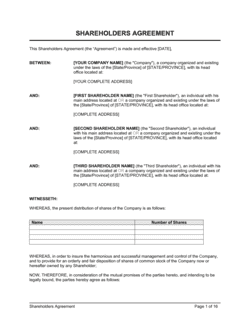
Identify all parties by full legal name and entity type
Enter each equity holder's full registered legal name — not a trade name or nickname — and specify their entity type (individual, LLC, corporation). Include the company's legal name and jurisdiction of incorporation.
💡 Run a corporate registry search to confirm the exact registered name before execution — mismatches between the agreement and registration records create enforcement problems.
2
Complete the cap table and equity percentages
List every equity holder with their exact percentage and attach the cap table as Exhibit A. Include any reserved pool for future employee grants or investor rounds so the full 100% is accounted for.
💡 Use decimals rather than rounded whole numbers for precision — '33.33%' is clearer and less dispute-prone than '33%' when three co-founders split equally.
3
Document capital contributions with valuations
Record each party's contribution — cash amount, IP description and agreed value, services description and agreed value — and set a delivery deadline. For non-cash contributions, attach a valuation methodology or independent appraisal as an exhibit.
💡 Non-cash contributions valued above $25,000 should be supported by a third-party valuation to withstand IRS or CRA scrutiny on issuance.
4
Set the vesting schedule and acceleration triggers
Specify the total vesting period (typically 36–48 months), the cliff date (typically 12 months), and the percentage that vests monthly or quarterly after the cliff. Define which events trigger full acceleration — change of control, termination without cause.
💡 Single-trigger acceleration (change of control alone) is more founder-friendly; double-trigger (change of control plus termination) is more investor-friendly. Decide before negotiating.
5
Define voting thresholds for reserved decisions
List the specific decisions that require supermajority or unanimous consent — new equity issuance, asset sales, debt above a threshold, amendment of the agreement — and set the required percentage for each category.
💡 Keep the unanimous-consent list narrow. The longer it is, the easier it is for a minority holder to block routine business decisions and create deadlock.
6
Configure transfer restrictions and ROFR mechanics
Specify the ROFR notice period (30 days is standard), who receives the notice, how the offered price is determined, and what happens if no holder exercises the right within the window.
💡 Include a deemed-transfer provision covering pledges and assignments to lenders — otherwise a holder can effectively transfer economic rights without triggering ROFR.
7
Draft the buyout price methodology
Choose between fair market value (preferred), EBITDA multiple, book value, or a hybrid formula. Specify how the appraiser is selected and the timeline for completing the valuation after a triggering event.
💡 A pre-agreed EBITDA multiple (e.g., 5× trailing 12-month EBITDA) is faster and cheaper than a full appraisal — but only works if the business has consistent, auditable earnings.
8
Sign before any equity is issued or money changes hands
All parties must execute the agreement before the effective date of the equity grant or capital contribution. Post-contribution signatures in common-law jurisdictions risk being unenforceable without documented fresh consideration.
💡 Use a dated signature block with witness lines for each party and store the fully-executed original in a secure, accessible location such as BIB Drive.