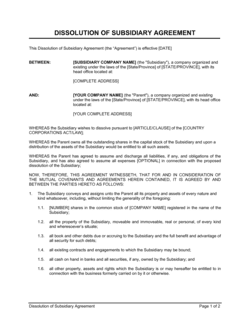
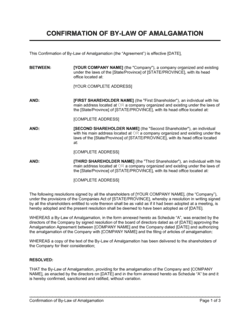
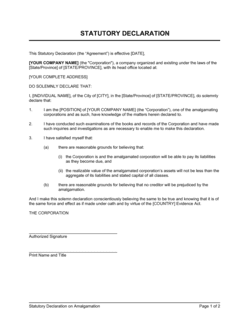
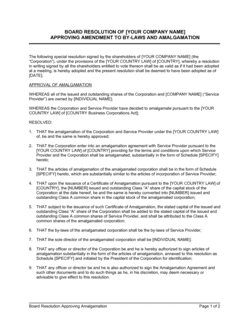
Amalgamation Agreement (100% Subsidiary) Template

Free Word download • Edit online • Save & share with Drive • Export to PDF

5 pages25–35 min to fillDifficulty: ComplexSignature requiredLegal review recommended
Learn more ↓
FreeAmalgamation Agreement (100% Subsidiary) Template

At a glance

What it is
An Amalgamation Agreement 100% Subsidiary is a binding corporate legal document that governs the merger of a wholly owned subsidiary into its parent company, combining their assets, liabilities, and operations into a single continuing entity. This free Word download gives you a structured, attorney-ready starting point you can edit online and export as PDF for board approval, regulatory filing, and corporate record-keeping.
When you need it
Use it when a parent corporation decides to absorb a subsidiary it owns 100% — eliminating a redundant legal entity, consolidating corporate structure after an acquisition, or simplifying operations ahead of a financing event or sale.
What's inside
Recitals identifying both entities, representations and warranties, transfer of all assets and liabilities to the parent, cancellation of subsidiary shares, dissolution and winding-up provisions, employee and contract continuation clauses, regulatory filing obligations, and governing law.

What is an Amalgamation Agreement 100% Subsidiary?

An Amalgamation Agreement 100% Subsidiary is a binding corporate legal document that governs the statutory merger of a wholly owned subsidiary into its parent company, combining both entities' assets, liabilities, contracts, and employees into a single continuing corporation. Because the parent already holds every issued share of the subsidiary, most jurisdictions permit this as a short-form amalgamation — requiring only board approval from each corporation rather than shareholder votes, independent valuations, or dissent-rights procedures. The agreement sets out the mechanics of the transfer, confirms the identity of the continuing corporation, cancels the subsidiary's shares, and triggers the Articles of Amalgamation filing that makes the merger legally effective under the applicable corporate statute.

Why You Need This Document

Without a properly executed amalgamation agreement, a parent that simply stops using a subsidiary's legal name has not actually eliminated the entity — it remains registered, subject to annual filings, tax returns, and compliance obligations. Proceeding with a registry filing without a governing agreement leaves the transfer of specific assets, intercompany accounts, and contract obligations undocumented, creating disputes with counterparties and tax authorities after the fact. A signed amalgamation agreement also provides the board of directors of both corporations with the documented authorization they need to satisfy their fiduciary duties and certify solvency — protecting them from personal liability claims if a creditor later challenges the transaction. This template gives your legal team or external counsel a complete, jurisdiction-ready starting point that covers every material clause, reducing drafting time and the risk of a rejected registry filing.

Which variant fits your situation?

If your situation is…Use this template
Merging a wholly owned subsidiary with no third-party shareholdersAmalgamation Agreement 100% Subsidiary
Merging two subsidiaries that are not wholly owned by the parentGeneral Amalgamation Agreement
Merging entities across different corporate jurisdictionsCross-Border Merger Agreement
Dissolving a dormant subsidiary without an operating mergerArticles of Dissolution
Transferring all assets from subsidiary to parent without a formal amalgamationAsset Purchase Agreement
Acquiring a subsidiary from a third party before folding it inShare Purchase Agreement
Documenting board authorization for the amalgamation decisionBoard Resolution — Amalgamation

Common mistakes to avoid

❌ Proceeding without confirming 100% ownership

Why it matters: If any shares, options, or convertible notes are outstanding in the subsidiary, the short-form procedure is unavailable and a general amalgamation — requiring shareholder votes and more complex documentation — is required instead.

Fix: Obtain and review a certified copy of the subsidiary's share register and all outstanding option or convertible instrument agreements before drafting the agreement.

❌ Missing change-of-control triggers in key contracts

Why it matters: Commercial leases, credit facilities, and enterprise software agreements frequently define statutory amalgamation as a change-of-control event that entitles the counterparty to terminate or accelerate — a missed trigger can disrupt operations immediately after filing.

Fix: Conduct a systematic contract review covering at least the top 20 contracts by annual value before the effective date, and obtain written consents or waivers where required.

❌ Ignoring the tax consequences of intercompany account cancellation

Why it matters: Cancelling an intercompany loan on amalgamation can create forgiven-debt income, a deemed disposition at fair market value, or a loss that is denied under related-party rules — all of which generate unexpected tax liabilities.

Fix: Have a tax advisor model the intercompany account balances and propose a pre-amalgamation settlement or restructuring where the cancellation would otherwise be taxable.

❌ Setting a fixed contractual effective date instead of a registry-acceptance date

Why it matters: If the Articles of Amalgamation are rejected or delayed by the registry, a fixed contractual date creates a gap period during which neither the old structure nor the new one is clearly in effect — leaving contracts, bank accounts, and employment relationships in legal uncertainty.

Fix: Define the effective date as the date the Articles of Amalgamation are accepted for filing by the applicable registry, with no fallback calendar date in the agreement.

❌ Omitting a post-amalgamation records update plan

Why it matters: Tax registrations, bank signing authorities, professional licenses, and regulatory permits do not automatically transfer to the continuing corporation's name — operating under the wrong name or number can trigger penalties and payment delays.

Fix: Prepare a post-closing checklist before filing that covers every registration, license, and bank account associated with the subsidiary, with assigned owners and 30-day deadlines.

❌ Directors signing the solvency certificate without reviewing combined financials

Why it matters: Directors who certify solvency without examining the combined balance sheet can be held personally liable if the continuing corporation is insolvent at the effective date — particularly where the subsidiary carried undisclosed contingent liabilities.

Fix: Prepare a pro forma combined balance sheet reflecting the amalgamated entity's financial position and have directors review it with the CFO before signing the certificate.

The 10 key clauses, explained

Recitals and corporate background

In plain language: Identifies both corporations by full legal name and jurisdiction, confirms the parent's 100% ownership of the subsidiary, and states the parties' intent to amalgamate.

Sample language
WHEREAS [PARENT CORP NAME], a corporation incorporated under the laws of [JURISDICTION] ('Parent'), holds all of the issued and outstanding shares of [SUBSIDIARY CORP NAME], a corporation incorporated under the laws of [JURISDICTION] ('Subsidiary'); AND WHEREAS the parties intend to amalgamate pursuant to [APPLICABLE STATUTE].

Common mistake: Citing the wrong statute or jurisdiction in the recitals. If the subsidiary is incorporated in a different province or state than the parent, the applicable amalgamation procedure — and the correct statute to cite — may differ, invalidating the filing.

Amalgamation and continuing corporation

In plain language: Declares that the parent and subsidiary will amalgamate and specifies which entity continues as the surviving corporation, along with its name, registered office, and authorized share structure.

Sample language
Pursuant to this Agreement, Parent and Subsidiary shall amalgamate to form [CONTINUING CORP NAME] (the 'Continuing Corporation'), which shall be deemed to be a continuation of Parent, with its registered office at [ADDRESS] and authorized capital of [SHARE STRUCTURE].

Common mistake: Failing to confirm whether the continuing corporation retains the parent's name and registration number or receives a new one. Most registries require explicit instruction — an ambiguous filing is rejected or results in an unintended new entity number.

Transfer of assets and liabilities

In plain language: States that all property, assets, rights, and liabilities of both amalgamating corporations vest automatically in the continuing corporation at the effective date by operation of law.

Sample language
Upon the Effective Date, all property, rights, privileges, and assets of each of Parent and Subsidiary shall vest in and become the property of the Continuing Corporation without further act or deed, and the Continuing Corporation shall be liable for all obligations and liabilities of each amalgamating corporation.

Common mistake: Attempting to selectively exclude specific liabilities from the transfer. Statutory amalgamations transfer all liabilities by operation of law regardless of contractual language — trying to carve out liabilities creates a false sense of protection and may mislead third parties.

Cancellation of subsidiary shares

In plain language: Provides that all issued shares of the subsidiary are cancelled at the effective time without payment or replacement, since they were wholly owned by the parent.

Sample language
At the Effective Date, all issued and outstanding shares of Subsidiary held by Parent shall be cancelled for no consideration and without any repayment of capital in respect thereof.

Common mistake: Omitting a statement that no consideration is payable on cancellation. Without this language, some registries flag the agreement for potential dividend or deemed distribution tax analysis, causing unnecessary delay.

Representations and warranties

In plain language: Each party confirms its legal existence, board authority to enter the agreement, absence of third-party consents required, and that no undisclosed material liabilities exist.

Sample language
Each party represents and warrants that: (a) it is duly incorporated and in good standing; (b) it has full corporate power and authority to enter into and perform this Agreement; (c) no consent, approval, or authorization of any third party is required; and (d) there are no material undisclosed liabilities.

Common mistake: Using generic M&A representations without adjusting for the subsidiary-amalgamation context. Third-party consent triggers (e.g., change-of-control clauses in key contracts) are just as relevant in a short-form amalgamation and must be identified and addressed before the effective date.

Employee and contract continuation

In plain language: Confirms that all employment agreements, collective agreements, and material contracts of the subsidiary continue in force under the continuing corporation without interruption.

Sample language
All contracts of employment, collective agreements, and material third-party agreements to which Subsidiary is a party shall continue in full force and effect as obligations of the Continuing Corporation as of the Effective Date, without novation or amendment.

Common mistake: Assuming all contracts automatically survive without reviewing individual change-of-control provisions. Some commercial leases, software licenses, and financing agreements require advance notice or consent on a statutory amalgamation — missing these triggers can result in termination or acceleration.

Intercorporate account settlement

In plain language: Addresses any intercompany loans, payables, or receivables between the parent and subsidiary, which are eliminated on amalgamation since the same entity cannot owe money to itself.

Sample language
All intercompany accounts, loans, payables, and receivables between Parent and Subsidiary outstanding as of the Effective Date shall be deemed to be cancelled and extinguished at the Effective Date without payment, set-off, or any other consideration.

Common mistake: Ignoring intercompany accounts until after filing. Unresolved intercompany balances can create taxable deemed dispositions or forgiven-debt income — tax counsel should review the intercompany position before the agreement is executed.

Regulatory filings and effective date

In plain language: Obliges the parties to file Articles of Amalgamation with the applicable corporate registry and designates the effective date as the date of acceptance by that registry.

Sample language
The parties shall cooperate to file Articles of Amalgamation with [REGISTRY NAME] as soon as practicable after execution of this Agreement. The amalgamation shall take effect on the date the Articles of Amalgamation are accepted for filing by [REGISTRY NAME] (the 'Effective Date').

Common mistake: Setting a fixed calendar effective date in the agreement rather than tying it to registry acceptance. If the filing is delayed or rejected, a fixed date creates a legal gap between the contractual effective date and the actual statutory effective date.

Solvency confirmation and directors' certificate

In plain language: Requires the directors of both amalgamating corporations to certify that the continuing corporation will be able to pay its liabilities as they fall due after amalgamation, satisfying the statutory solvency test.

Sample language
The directors of each amalgamating corporation have considered the financial position of both corporations and are of the opinion that the Continuing Corporation will, immediately after the Effective Date, be able to pay its liabilities as they become due in the ordinary course of business.

Common mistake: Treating the solvency certificate as a formality without actually reviewing the combined liability position. If the combined entity cannot pass the solvency test, proceeding with the amalgamation exposes directors to personal liability under corporate statutes.

Governing law and entire agreement

In plain language: Specifies the jurisdiction whose laws govern the agreement and confirms the document constitutes the entire agreement between the parties, superseding all prior discussions.

Sample language
This Agreement shall be governed by and construed in accordance with the laws of [JURISDICTION]. This Agreement constitutes the entire agreement between the parties with respect to the subject matter hereof and supersedes all prior negotiations, representations, and agreements.

Common mistake: Selecting a governing law that does not match the jurisdiction of incorporation of either party. Courts in common-law jurisdictions generally apply the law of the corporation's incorporating jurisdiction to matters of corporate law regardless of what the contract says.

How to fill it out

  1. 1

    Confirm statutory eligibility for a short-form amalgamation

    Verify that the parent owns 100% of the subsidiary's issued and outstanding shares with no options, warrants, or convertible instruments outstanding that could dilute ownership below 100%.

    💡 Check the subsidiary's share register and any outstanding option agreements before drafting — a single unconverted warrant breaks the short-form eligibility requirement in most jurisdictions.

  2. 2

    Identify the continuing corporation and its share structure

    Decide whether the parent or a newly named entity continues. Confirm the name, registered office address, and authorized share capital that will appear in the Articles of Amalgamation.

    💡 Retaining the parent's name and registration number minimizes downstream updates to banking, licensing, and tax registrations.

  3. 3

    Audit intercompany accounts and resolve tax implications

    Obtain a current balance of all intercompany loans, payables, and receivables. Engage a tax advisor to confirm that cancelling these balances will not trigger a deemed disposition, forgiven-debt income, or thin-capitalization issue.

    💡 Resolving intercompany accounts before filing is almost always cheaper than amending returns after the fact.

  4. 4

    Review material contracts for change-of-control provisions

    Pull all significant contracts — leases, financing agreements, key customer and supplier contracts, software licenses — and check for clauses that define amalgamation or statutory merger as a triggering change of control.

    💡 Request consents or waivers in parallel with drafting the agreement so they are in hand before the Articles are filed.

  5. 5

    Complete the representations and warranties

    Fill in each representation confirming legal standing, board authority, no required third-party consents, and no undisclosed material liabilities. If any representation cannot be given cleanly, add a disclosure schedule rather than omitting or softening the rep.

    💡 A disclosure schedule that accurately lists known exceptions is always preferable to a warranty that is technically false.

  6. 6

    Obtain board resolutions from both corporations

    Each corporation's board of directors must pass a resolution approving the amalgamation agreement. For the subsidiary, a written resolution signed by the sole director is sufficient in most jurisdictions when the parent is the sole shareholder.

    💡 Date the board resolutions the same day as or before the execution of the agreement — post-dated authorizations have been challenged in several corporate law disputes.

  7. 7

    Execute the agreement and prepare Articles of Amalgamation

    Have authorized officers of both corporations sign the agreement. Prepare the Articles of Amalgamation in the form required by the applicable corporate registry, attaching the agreement if required.

    💡 Some registries (e.g., Ontario's ServiceOntario, Canada's Corporations Canada) allow electronic filing — confirm the accepted format before printing and signing originals.

  8. 8

    File with the registry and update corporate records

    Submit the Articles of Amalgamation to the applicable registry and retain the certificate of amalgamation. Update the continuing corporation's minute book, share register, banking authorities, licenses, and tax accounts to reflect the amalgamation.

    💡 Set a calendar reminder to update the CRA business number, state tax registrations, and any professional or industry-specific licenses within 30 days of the effective date.

Frequently asked questions

What is an amalgamation agreement for a 100% subsidiary?

An amalgamation agreement for a 100% subsidiary is a legal document that governs the merger of a wholly owned subsidiary into its parent corporation. Because the parent already owns all of the subsidiary's shares, most jurisdictions permit a simplified short-form procedure requiring only board approval — no shareholder vote is needed. The agreement sets out how assets, liabilities, contracts, and employees transfer to the continuing corporation and triggers the Articles of Amalgamation filing that makes the merger legally effective.

What is the difference between an amalgamation and a merger?

In Canadian and Commonwealth corporate law, an amalgamation is the statutory process by which two or more corporations combine into a single continuing entity — distinct from a merger (used in US terminology) in which one entity survives and another is absorbed. The practical outcomes are similar: one entity remains, holding all assets and liabilities of both predecessors. The key difference is the governing statute and required filings, which vary by jurisdiction.

Do I need shareholder approval for a 100% subsidiary amalgamation?

In most Canadian provinces and federal jurisdictions under the CBCA, a short-form amalgamation of a wholly owned subsidiary requires only board resolutions — no shareholder meeting or vote is needed. In the United States, similar short-form merger statutes apply in Delaware and most other states when the parent owns at least 90% (and often 100%) of the subsidiary. Confirm the specific ownership threshold and procedure with counsel in the applicable jurisdiction.

What happens to the subsidiary's employees when it amalgamates into the parent?

In a statutory amalgamation, employment contracts continue in force with the continuing corporation by operation of law — there is no technical termination and re-hire. However, if individual employment agreements contain change-of-control provisions, those may be triggered. Collective agreements and any statutory obligations (such as notice of transfer under EU TUPE regulations) must also be reviewed and addressed before the effective date.

What are Articles of Amalgamation and when are they filed?

Articles of Amalgamation are the prescribed statutory form filed with the corporate registry (e.g., Corporations Canada, ServiceOntario, or a state secretary of state) to legally effect the amalgamation. They are typically filed after the amalgamation agreement is executed and both boards have passed approving resolutions. The amalgamation takes legal effect on the date the registry accepts and issues a certificate of amalgamation — not on the date the agreement is signed.

Are there tax consequences to amalgamating a subsidiary into a parent?

Yes, and they vary significantly by jurisdiction. In Canada, a qualifying vertical amalgamation under the Income Tax Act can generally be structured as a tax-deferred rollover. In the United States, a short-form statutory merger can qualify as a tax-free reorganization under IRC Section 368. Intercompany account balances, loss carryforwards, and any cross-border elements require specific analysis. Always obtain tax advice before proceeding — unexpected tax costs are the most common reason amalgamations are restructured or delayed.

Does an amalgamation affect the subsidiary's contracts with third parties?

Contracts of the subsidiary vest automatically in the continuing corporation by operation of law. However, contracts that contain change-of-control or anti-assignment clauses defining amalgamation as a triggering event may allow the counterparty to terminate or demand consent. Key commercial agreements — leases, credit facilities, and enterprise licenses — should be audited for these provisions, and required consents obtained before filing.

What is a short-form amalgamation?

A short-form amalgamation (called a short-form merger in the US) is a simplified statutory procedure available when a parent corporation owns all or a qualifying majority of a subsidiary's shares. It requires only board approval from the parent — no shareholder vote, no independent valuation, and no dissent rights for minority shareholders (since there are none). The procedure reduces the time and cost of completing the amalgamation significantly compared to a general amalgamation involving unrelated or partially owned entities.

How long does a 100% subsidiary amalgamation take to complete?

Once the agreement is executed and board resolutions are in place, the timeline is largely driven by registry processing times. In Canada, Corporations Canada typically processes Articles of Amalgamation within 1–5 business days for electronic filings. Provincial registries vary from same-day (Ontario) to 4–6 weeks (some provinces). US state secretaries of state generally process in 1–3 business days, with expedited same-day service available in Delaware and most major states. Pre-filing steps — contract review, tax analysis, intercompany account resolution — typically add 2–6 weeks.

How this compares to alternatives

vs General Amalgamation Agreement

A general amalgamation agreement is used when the amalgamating corporations are not in a parent-subsidiary relationship — for example, two independent companies combining to form a new entity. It requires shareholder votes from both corporations, dissent rights procedures, and independent valuations. The 100% subsidiary version eliminates all of these steps because there are no minority shareholders to protect, making it significantly simpler and faster.

vs Asset Purchase Agreement

An asset purchase agreement transfers specific assets and selected liabilities from one entity to another — the seller's entity survives and the buyer picks what it wants. An amalgamation transfers everything by operation of law with no selection possible. Asset purchases are preferred when the buyer wants to leave behind contingent liabilities; amalgamations are preferred when a clean, automatic transfer of all contracts and registrations is more efficient.

vs Share Purchase Agreement

A share purchase agreement transfers ownership of the subsidiary's shares from one shareholder to another — the subsidiary continues as a separate legal entity. An amalgamation eliminates the subsidiary's separate legal existence entirely. A share purchase is the right tool when the parent wants to transfer ownership of the subsidiary to a third party; an amalgamation is used when the parent wants to absorb the subsidiary into itself.

vs Articles of Dissolution

Articles of dissolution wind up a corporation that has ceased operations and has no remaining assets or liabilities — the entity is simply struck off the registry. An amalgamation is used when the subsidiary still has operating assets, contracts, or employees that need to transfer to the parent. If the subsidiary is dormant and has already distributed all its assets, dissolution is simpler; if it has ongoing business activity, amalgamation is the correct process.

Industry-specific considerations

Technology / SaaS

Post-acquisition integration of acquired software companies into the parent's corporate structure, eliminating duplicate IP-holding entities and consolidating software licensing agreements under a single entity.

Financial Services

Regulatory-driven entity rationalization where a bank or insurance group collapses subsidiary legal entities to reduce compliance filings, capital allocation complexity, and regulatory reporting obligations.

Real Estate

Merging single-purpose property-holding subsidiaries back into an operating parent after a property is sold or refinanced, eliminating the maintenance cost of separate corporate entities with no remaining purpose.

Manufacturing

Post-merger integration following the acquisition of a manufacturing subsidiary, consolidating supply contracts, equipment title, and regulatory permits under the parent's operating entity to eliminate duplicated compliance filings.

Jurisdictional notes

United States

Most US states permit a short-form merger when the parent owns at least 90% of the subsidiary's shares, with Delaware (DGCL Section 253) and the Model Business Corporation Act as the primary frameworks. No shareholder vote is required at the parent level; the subsidiary's shareholders (i.e., the parent) have no dissent rights. Federal and state tax consequences — particularly IRC Section 368 reorganization eligibility — must be confirmed by a tax advisor before proceeding.

Canada

The Canada Business Corporations Act (CBCA) Section 184 and equivalent provincial statutes permit a vertical short-form amalgamation of a wholly owned subsidiary requiring only board resolutions — no shareholder approval needed. Quebec's Business Corporations Act contains equivalent provisions. Tax-deferred treatment under ITA Section 87 is generally available for qualifying domestic amalgamations, but intercompany balances and loss utilization require pre-filing analysis. Electronic filing is available through Corporations Canada.

United Kingdom

UK company law does not have a direct equivalent to the Canadian short-form amalgamation. Instead, a subsidiary is typically absorbed through a members' voluntary liquidation combined with a hive-up of assets, or via a cross-border merger under the Companies (Cross-Border Mergers) Regulations 2007 if EU elements are involved. TUPE (Transfer of Undertakings) regulations apply to employee transfers and require advance information and consultation obligations. Legal advice specific to England and Wales, Scotland, or Northern Ireland is recommended.

European Union

EU member states implement domestic merger procedures under their own company law statutes — Germany's UmwG, France's Code de commerce, and the Netherlands' Civil Code each have distinct procedures for parent-subsidiary absorptions. The EU Directive on Cross-Border Conversions, Mergers and Divisions (2019/2121) provides a harmonized framework for cross-border mergers within the EU. GDPR data transfer implications arise when the subsidiary held personal data, and employee transfer protections under the Acquired Rights Directive must be addressed in all member states.

Template vs lawyer — what fits your deal?

PathBest forCostTime
Use the templateParent companies with simple domestic subsidiary structures, no material third-party contracts, and no outstanding intercompany loansFree2–4 hours to complete the agreement; 1–5 business days for registry processing
Template + legal reviewSubsidiaries with material commercial contracts, employees, intercompany balances, or provincial/state tax registrations that need to be updated$800–$2,500 for a corporate lawyer review and filing assistance1–3 weeks including contract audit and pre-filing tax review
Custom draftedCross-border amalgamations, regulated industry entities (banking, insurance, healthcare), subsidiaries with complex IP ownership, or situations where the tax analysis requires restructuring before filing$3,000–$15,000+ depending on jurisdiction complexity and number of entities4–12 weeks

Glossary

Amalgamation
A statutory process by which two or more corporations merge into a single continuing legal entity, with all assets and liabilities transferred by operation of law.
Wholly Owned Subsidiary
A corporation whose issued and outstanding shares are 100% held — directly or indirectly — by a single parent company.
Continuing Corporation
The surviving entity that remains in existence after an amalgamation and assumes all assets, liabilities, contracts, and obligations of the amalgamating corporations.
Short-Form Amalgamation
A simplified statutory merger available when a parent owns all of a subsidiary's shares, typically requiring only board approval rather than shareholder votes.
Articles of Amalgamation
The public filing submitted to the relevant corporate registry to legally effect the amalgamation and create or continue the resulting corporate entity.
Successor Liability
The principle that the continuing corporation inherits all liabilities — including contingent and undisclosed ones — of the amalgamating entities by operation of law.
Cancellation of Shares
The formal extinguishment of the subsidiary's issued shares at the effective time of amalgamation, since those shares are held entirely by the parent and become redundant.
Effective Date
The date and time on which the amalgamation legally takes effect, typically the date the Articles of Amalgamation are accepted and filed by the relevant registry.
Representations and Warranties
Factual statements made by each party about its legal status, authority, financial condition, and absence of undisclosed liabilities, which survive closing and may give rise to indemnification claims.
Solvency Test
A statutory requirement in most jurisdictions that the continuing corporation must be able to pay its liabilities as they become due after the amalgamation takes effect.
Intercorporate Accounts
Loans, payables, and receivables between the parent and subsidiary that are eliminated on consolidation and must be addressed in the amalgamation agreement before closing.

Part of your Business Operating System

This document is one of 3,000+ business & legal templates included in Business in a Box.

  • Fill-in-the-blanks — ready in minutes
  • 100% customizable Word document
  • Compatible with all office suites
  • Export to PDF and share electronically

Create your document in 3 simple steps.

From template to signed document — all inside one Business Operating System.
1
Download or open template

Access over 3,000+ business and legal templates for any business task, project or initiative.

2
Edit and fill in the blanks with AI

Customize your ready-made business document template and save it in the cloud.

3
Save, Share, Send, Sign

Share your files and folders with your team. Create a space of seamless collaboration.

Save time, save money, and create top-quality documents.

★★★★★

"Fantastic value! I'm not sure how I'd do without it. It's worth its weight in gold and paid back for itself many times."

Managing Director · Mall Farm
Robert Whalley
Managing Director, Mall Farm Proprietary Limited
★★★★★

"I have been using Business in a Box for years. It has been the most useful source of templates I have encountered. I recommend it to anyone."

Business Owner · 4+ years
Dr Michael John Freestone
Business Owner
★★★★★

"It has been a life saver so many times I have lost count. Business in a Box has saved me so much time and as you know, time is money."

Owner · Upstate Web
David G. Moore Jr.
Owner, Upstate Web

Run your business with a system — not scattered tools

Stop downloading documents. Start operating with clarity. Business in a Box gives you the Business Operating System used by over 250,000 companies worldwide to structure, run, and grow their business.

Start free · No credit card required