Confirmation of By-Law of Amalgamation Template

Free Word download • Edit online • Save & share with Drive • Export to PDF

3 pages25–30 min to fillDifficulty: StandardSignature requiredLegal review recommended
Learn more ↓
FreeConfirmation of By-Law of Amalgamation Template

At a glance

What it is
A Confirmation of By-Law of Amalgamation is a formal corporate document that records the shareholders' ratification of a by-law authorizing two or more corporations to merge into a single legal entity. This free Word download gives you a structured, board-ready template you can edit online and export as PDF to file with the relevant corporate registry.
When you need it
Use it after the board of directors has passed an amalgamation by-law and the shareholders have voted to confirm it — a step required under most corporate statutes before the amalgamation can be registered and take legal effect. It is typically executed at a special shareholder meeting or by written resolution in lieu of a meeting.
What's inside
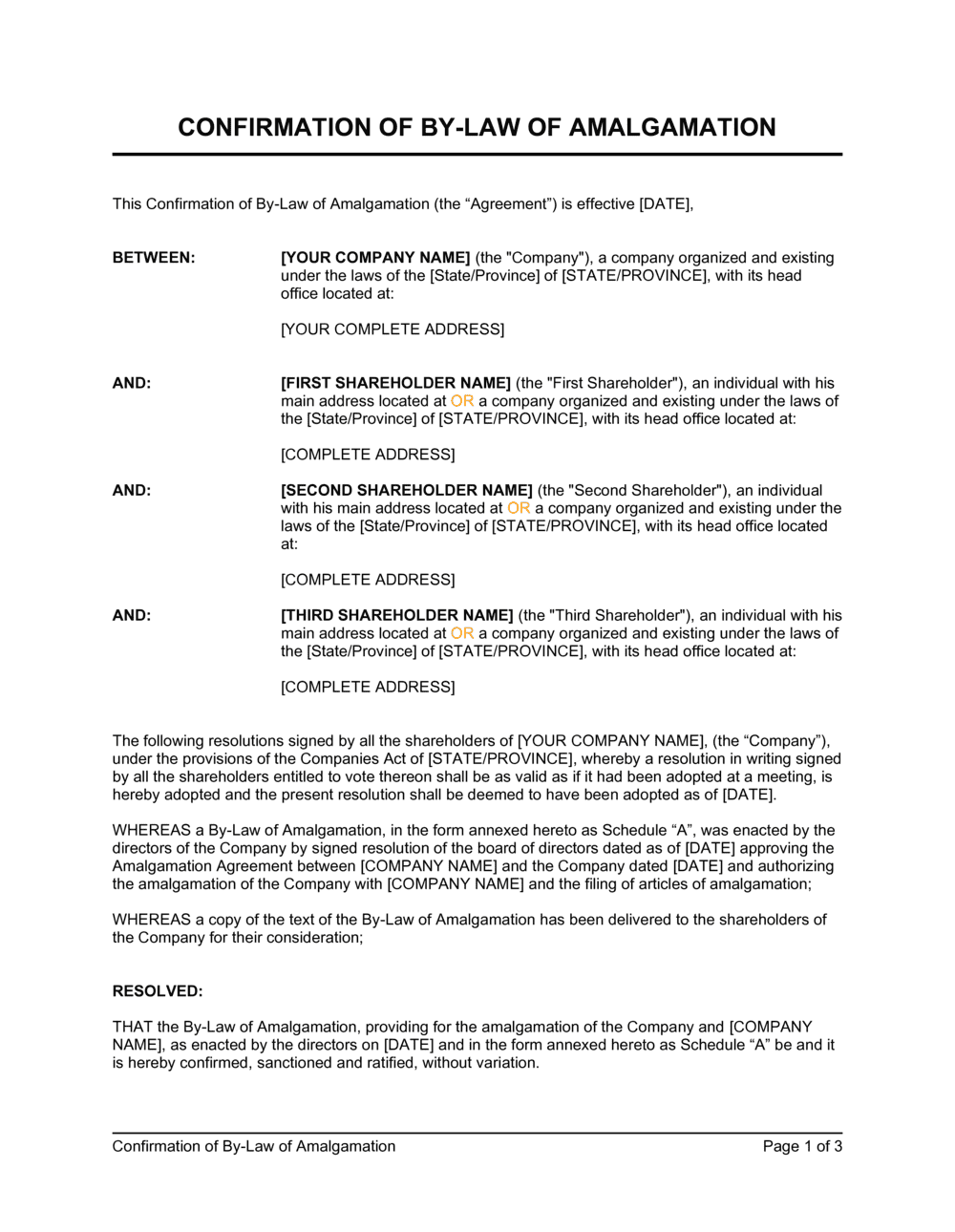
Identification of the amalgamating corporations, recitals confirming the board's prior adoption of the amalgamation by-law, the shareholder confirmation resolution, effective date, signature blocks for authorized officers, and the certificate or annexure referencing the underlying amalgamation agreement.

What is a Confirmation of By-Law of Amalgamation?

A Confirmation of By-Law of Amalgamation is a formal corporate resolution document in which the shareholders of each amalgamating corporation ratify the by-law that their board of directors has already passed to authorize a merger. Most corporate statutes treat an amalgamation as a fundamental change requiring a two-step approval process: the board adopts the by-law, and the shareholders then confirm it — typically by special resolution requiring a two-thirds supermajority. Until that confirmation is obtained and filed alongside the Articles of Amalgamation, the merger cannot legally take effect and the corporate registry will not issue a certificate of amalgamation. This free Word download gives you a professionally structured confirmation document you can edit online and export as PDF for execution and registry filing.

Why You Need This Document

Proceeding with an amalgamation without a properly executed confirmation exposes every party to significant risk. A missing or defective confirmation means the Articles of Amalgamation will be rejected on filing, stalling a transaction that may have dozens of downstream closing conditions tied to it. If the confirmation is executed with the wrong vote threshold — ordinary resolution where a special resolution is required — the entire shareholder approval is procedurally void and must be redone, often at material cost and delay. Beyond the registry filing, the confirmation forms a permanent part of each corporation's minute book and will be reviewed by lawyers, auditors, and acquirers in every future due diligence process involving the amalgamated entity. A defect discovered years later can cloud title to assets, invalidate contracts assigned by operation of the amalgamation, and trigger regulatory scrutiny. Using this template ensures the recitals, resolution language, vote threshold, effective date, and execution block are aligned with statutory requirements — giving you a filing-ready document that protects the transaction and the resulting entity's corporate record from day one.

Which variant fits your situation?

If your situation is…Use this template
Two wholly-owned subsidiaries merging into one under the same parentShort-Form Amalgamation Agreement
Arm's length corporations merging with distinct shareholder groupsAmalgamation Agreement (Long Form)
Vertical amalgamation of parent absorbing a subsidiaryVertical Short-Form Amalgamation Resolution
Board-level approval step preceding shareholder confirmationDirectors' Resolution Approving Amalgamation By-Law
Shareholder approval obtained by written consent rather than a meetingWritten Shareholder Resolution — Amalgamation
Cross-border amalgamation involving a foreign entityPlan of Arrangement Agreement
Post-amalgamation update of corporate name and articlesArticles of Amendment

Common mistakes to avoid

❌ Passing an ordinary resolution where a special resolution is required

Why it matters: Most corporate statutes require a two-thirds supermajority vote for amalgamations. A confirmation passed by simple majority is procedurally defective and can be voided, requiring the process to restart.

Fix: Verify the vote threshold in the governing statute before drafting the resolution, and record the actual vote count to confirm the statutory threshold was met.

❌ Signing after the stated effective date

Why it matters: If the document records an effective date that has already passed at the time of execution, the confirmation is backdated — a serious legal and potentially regulatory problem that can invalidate the filing.

Fix: Set the effective date as the date of certificate issuance rather than a fixed calendar date, or confirm the signing sequence with the registry in advance.

❌ Using trade names instead of registered legal entity names

Why it matters: Corporate registries will reject filings where the entity name does not exactly match the registered name, causing delays and potentially disrupting a time-sensitive closing.

Fix: Run a current registry search for each amalgamating corporation on the day of drafting and copy the legal name character-for-character, including the corporate suffix.

❌ Omitting the share exchange ratio or leaving it vague

Why it matters: Without a clear exchange ratio, shareholders of each amalgamating corporation have no documented basis for their entitlement in the amalgamated corporation — a fertile source of post-closing disputes and potential litigation.

Fix: Specify the exchange ratio for every class of shares of every amalgamating corporation, including the treatment of fractional shares and any cancelled shares.

❌ Failing to attach the amalgamation agreement or by-law as a schedule

Why it matters: The confirmation document ratifies the underlying by-law; if the by-law is not attached or clearly referenced, there is no record of what was actually confirmed — creating ambiguity for future corporate housekeeping and due diligence.

Fix: Always attach a certified copy of the amalgamation by-law as Schedule A to the confirmation document and reference it explicitly in the recitals.

❌ Not notifying creditors as required by statute

Why it matters: Several jurisdictions require creditor notice before or concurrent with shareholder confirmation of an amalgamation. Failing to provide it exposes the amalgamated corporation to challenges from creditors who can argue the amalgamation was improperly effected.

Fix: Check the creditor-notice requirements in the governing corporate statute before scheduling the shareholder meeting and send notices within the required timeframe.

The 10 key clauses, explained

Identification of amalgamating corporations

In plain language: Names each corporation participating in the amalgamation, states its jurisdiction of incorporation, and provides its corporate registration number.

Sample language
This Confirmation of By-Law of Amalgamation is made between [CORPORATION A LEGAL NAME], a corporation incorporated under the laws of [JURISDICTION], registration number [XXXXXXXXX], and [CORPORATION B LEGAL NAME], a corporation incorporated under the laws of [JURISDICTION], registration number [XXXXXXXXX].

Common mistake: Using a trade name instead of the exact legal entity name registered with the corporate registry — a mismatch causes the filing to be rejected and delays the effective date.

Recitals confirming board adoption of the by-law

In plain language: Records that the board of each amalgamating corporation has already passed the amalgamation by-law and states the date on which it was adopted.

Sample language
WHEREAS the board of directors of [CORPORATION A] duly passed the By-Law of Amalgamation on [DATE] by resolution at a meeting held on [DATE] [or by written resolution dated [DATE]]; and WHEREAS the board of directors of [CORPORATION B] similarly passed the By-Law of Amalgamation on [DATE].

Common mistake: Omitting the date the board resolution was passed — without it the sequence of board adoption followed by shareholder confirmation cannot be established, which may invalidate the confirmation.

Shareholder confirmation resolution

In plain language: States the formal resolution by which the shareholders of each amalgamating corporation confirm and ratify the amalgamation by-law passed by the board.

Sample language
BE IT RESOLVED, as a special resolution of the shareholders of [CORPORATION NAME], that the By-Law of Amalgamation adopted by the board of directors on [DATE] is hereby confirmed, ratified, and approved.

Common mistake: Passing the confirmation as an ordinary resolution when the applicable corporate statute requires a special resolution (two-thirds majority) — making the confirmation procedurally defective and potentially void.

Vote threshold and quorum confirmation

In plain language: Records the percentage of votes cast in favour, the total shares voted, and confirmation that quorum was met, demonstrating the required majority was achieved.

Sample language
The foregoing resolution was passed at a meeting of shareholders held on [DATE], at which a quorum was present. [X]% of the votes cast ([X] votes in favour, [X] votes against) were cast in favour of the resolution, satisfying the special resolution requirement.

Common mistake: Failing to record the actual vote count and quorum confirmation — if the resolution is ever challenged, there is no contemporaneous evidence that the statutory threshold was met.

Terms of the amalgamation

In plain language: Incorporates or cross-references the key terms of the amalgamation: the name of the amalgamated corporation, the share exchange ratio, the treatment of outstanding options, and the registered office.

Sample language
The amalgamation shall be effected on the following terms: (a) the name of the Amalgamated Corporation shall be [NAME]; (b) the registered office shall be at [ADDRESS]; (c) shares of [CORPORATION A] shall be exchanged for shares of the Amalgamated Corporation on the basis of [RATIO]; (d) shares of [CORPORATION B] shall be cancelled [or exchanged on the basis of [RATIO]].

Common mistake: Leaving the share exchange ratio vague or referencing a separate schedule that is not attached — creating post-closing disputes among shareholders about their entitlements in the amalgamated corporation.

Effective date clause

In plain language: Specifies when the amalgamation takes legal effect — either a fixed calendar date or the date on which the certificate of amalgamation is issued by the corporate registry.

Sample language
The amalgamation shall become effective on the date that the Director appointed under the [APPLICABLE CORPORATE STATUTE] issues the Certificate of Amalgamation, or on [SPECIFIC DATE], whichever occurs first.

Common mistake: Setting a fixed effective date without accounting for registry processing times — if the certificate is issued after the stated date the document contains an incorrect effective date and may need to be corrected by an amending resolution.

Successor rights and liabilities

In plain language: Confirms that the amalgamated corporation automatically assumes all assets, contracts, liabilities, and legal proceedings of each amalgamating corporation on the effective date.

Sample language
On the Effective Date, the Amalgamated Corporation shall possess all the property, rights, privileges, and franchises and shall be subject to all the liabilities, contracts, disabilities, and debts of each of the Amalgamating Corporations.

Common mistake: Omitting this clause in a short-form confirmation on the assumption that the statute covers it automatically — while often true, an express clause protects against contractual counterparties disputing the automatic assignment of agreements.

Authorization to file articles of amalgamation

In plain language: Authorizes the directors or a named officer to execute and file the Articles of Amalgamation and any ancillary documents with the corporate registry.

Sample language
Any officer or director of the Amalgamated Corporation is hereby authorized and directed to execute and deliver to the Director under the [STATUTE] such Articles of Amalgamation and other documents as may be required to give effect to the amalgamation.

Common mistake: Authorizing 'any director' without specifying a title — corporate registries in some jurisdictions require the signature of a specifically identified officer, and a generic authorization can cause the filing to be returned.

Governing law and entire agreement

In plain language: States which jurisdiction's corporate law governs the amalgamation and confirms the document supersedes all prior negotiations and understandings about the amalgamation.

Sample language
This Confirmation of By-Law of Amalgamation is governed by the laws of [PROVINCE / STATE / JURISDICTION]. This document, together with the By-Law of Amalgamation and the Amalgamation Agreement attached hereto, constitutes the entire agreement of the parties with respect to the amalgamation.

Common mistake: Choosing a governing law that does not match the incorporating jurisdiction of the amalgamated corporation — this creates ambiguity about which statutory provisions apply to the post-amalgamation entity.

Signature and execution block

In plain language: Provides signature lines for authorized officers of each amalgamating corporation, the date of execution, and witness or notarial attestation if required by the applicable jurisdiction.

Sample language
IN WITNESS WHEREOF the parties have executed this Confirmation of By-Law of Amalgamation as of [DATE]. [CORPORATION A LEGAL NAME] Per: ___________________________ Name: [NAME] Title: [TITLE] [CORPORATION B LEGAL NAME] Per: ___________________________ Name: [NAME] Title: [TITLE]

Common mistake: Having a person sign who lacks the authority conferred by the board resolution — if the authorized signatories are not identical to those named in the board resolution, the registry or a counterparty can challenge the validity of the execution.

How to fill it out

  1. 1

    Confirm the statutory requirements in the governing jurisdiction

    Before drafting, identify the specific corporate statute that governs each amalgamating corporation — for example, the Canada Business Corporations Act, Ontario Business Corporations Act, or a US state corporation code. Check the required vote threshold (ordinary vs. special resolution), any creditor-notice requirements, and filing deadlines.

    💡 Different classes of shares may carry different voting rights on an amalgamation resolution — review the share structure of each amalgamating corporation before setting the quorum and vote-threshold language.

  2. 2

    Enter the full legal names and registration numbers of all amalgamating corporations

    Use the exact legal entity name as it appears in the corporate registry, including the corporate suffix (Ltd., Inc., Corp., etc.). Include the registration or corporation number for each party. Confirm names against current registry searches — names may have changed since incorporation.

    💡 Run a registry search the day you draft the document, not the day you filed the original articles — name changes or corrections may have occurred since original filing.

  3. 3

    Insert the dates of the board resolutions adopting the by-law

    Record the precise date each board of directors passed the amalgamation by-law. If passed by written resolution rather than at a meeting, reference the date of the written resolution. These dates must precede the shareholder confirmation date.

    💡 Keep certified copies of the board resolutions in the minute book of each amalgamating corporation — registries and auditors frequently request them as supporting evidence.

  4. 4

    Complete the shareholder confirmation resolution block

    Draft the resolution as a special resolution unless your applicable statute permits a lower threshold. Record the vote count, the total shares voted, and confirmation that quorum was achieved. If approval was by written resolution rather than a meeting, state that all required shareholders signed the written resolution.

    💡 For closely-held corporations where one or two shareholders hold all shares, a written shareholder resolution signed the same day as the board resolution is common — confirm your statute permits this procedure.

  5. 5

    Define the terms of amalgamation

    Fill in the name of the amalgamated corporation, its registered office, the share exchange ratios for each class of shares of each amalgamating corporation, and the treatment of any fractional shares, options, or warrants. Attach the full amalgamation agreement as a schedule if it is a separate document.

    💡 If fractional shares would result from the exchange ratio, state explicitly whether they will be rounded, paid out in cash, or eliminated — ambiguity here is a common source of post-closing shareholder complaints.

  6. 6

    Set the effective date

    Choose between a fixed calendar date and the date of certificate issuance. For most straightforward amalgamations, tying the effective date to certificate issuance is safer because it avoids a mismatch if the registry processes the filing on a different day than expected.

    💡 If the amalgamation is part of a broader transaction with a fixed closing date, coordinate the registry filing date with the other closing conditions to ensure all steps occur in the correct sequence.

  7. 7

    Execute the document with properly authorized signatories

    Have the authorized officers identified in each corporation's board resolution sign the confirmation. Ensure the signing date is on or after the shareholder meeting or written resolution date. Attach the original or certified copies of the shareholder resolutions as exhibits.

    💡 Use Business in a Box eSign to timestamp execution and store the fully executed confirmation in BIB Drive alongside the board resolutions and amalgamation agreement.

  8. 8

    File with the corporate registry and update the minute book

    Submit the Articles of Amalgamation together with any required fees, the confirmation document, and ancillary filings to the applicable corporate registry. Once the certificate is issued, update the minute book of the amalgamated corporation to reflect the new share register, directors, and officers.

    💡 Notify banks, key suppliers, and counterparties with material contracts shortly after the certificate is issued — successor liability vests automatically by statute, but practical notice prevents payment and contract management disruptions.

Frequently asked questions

What is a Confirmation of By-Law of Amalgamation?

A Confirmation of By-Law of Amalgamation is a formal corporate document that records shareholders ratifying the by-law their board of directors passed to authorize a corporate merger. Most corporate statutes require shareholder confirmation — typically by special resolution — before the amalgamation can be registered with the corporate registry and take legal effect. Without it, the amalgamation is procedurally incomplete regardless of what the board has approved.

What is the difference between an amalgamation by-law and a confirmation of the by-law?

The amalgamation by-law is passed by the board of directors and sets out the terms on which the corporations will merge. The confirmation is a separate shareholder resolution that ratifies the board's by-law — a two-step process required because amalgamations are considered a fundamental change to the corporation that shareholders must approve. Both documents typically need to be filed together or referenced in the Articles of Amalgamation.

Does every amalgamation require a shareholder confirmation?

Not always. Many jurisdictions permit a short-form or vertical amalgamation — where one corporation wholly owns the other — to proceed with only director approval, with no shareholder vote required. For arm's length amalgamations involving distinct shareholder groups, a shareholder special resolution is generally required. Always check the specific corporate statute governing each amalgamating corporation before determining what approvals are needed.

What vote threshold is required to confirm an amalgamation by-law?

In most Canadian and UK jurisdictions, confirmation requires a special resolution passed by at least two-thirds of the votes cast. In many US states, a simple majority of outstanding shares entitled to vote is sufficient, though some states require a higher threshold and some require class votes. The applicable corporate statute and the corporation's own articles may impose a higher threshold — confirm both before scheduling the meeting.

Can shareholders approve an amalgamation by written resolution instead of a meeting?

Yes, in most jurisdictions a written shareholder resolution signed by all shareholders entitled to vote — or by the required majority, depending on the statute — is a valid substitute for a meeting. For closely-held corporations with one or two shareholders, written resolution is the most common procedure. Some jurisdictions require unanimous written consent for certain fundamental changes, so confirm the local rule before proceeding without a formal meeting.

What documents need to be filed with the corporate registry after confirmation?

Typically, the Articles of Amalgamation are the primary filing with the corporate registry. Supporting documents often required include the Confirmation of By-Law of Amalgamation, certified copies of the directors' and shareholders' resolutions, the amalgamation agreement, and the applicable filing fee. Requirements vary by jurisdiction — some registries (such as Corporations Canada) have prescribed forms and accept electronic filing through their online portals.

What happens to contracts and liabilities of the amalgamating corporations after the amalgamation?

By statute in most jurisdictions, the amalgamated corporation automatically assumes all assets, liabilities, contracts, and legal proceedings of every amalgamating corporation on the effective date — a principle called successor liability. Counterparties to existing contracts do not generally need to consent to the novation unless the contract contains a change-of-control or anti-assignment clause. Reviewing material contracts before the amalgamation for such clauses is an important part of pre-closing due diligence.

What are the tax implications of an amalgamation?

In Canada, a qualifying amalgamation under section 87 of the Income Tax Act is generally tax-deferred, with the amalgamated corporation inheriting the tax attributes of each predecessor. In the US, whether a merger is tax-free depends on whether it qualifies as a reorganization under IRC Section 368. Tax treatment varies significantly by jurisdiction and structure, and professional tax advice is strongly recommended before proceeding with any amalgamation.

How this compares to alternatives

vs Amalgamation Agreement

The Amalgamation Agreement is the underlying contract between the amalgamating corporations that sets out the full terms of the merger — share exchange ratios, representations, and conditions precedent. The Confirmation of By-Law of Amalgamation is the shareholder document that ratifies the board's adoption of the amalgamation by-law derived from that agreement. Both documents are typically required; the confirmation cannot exist without the prior agreement.

vs Articles of Amalgamation

Articles of Amalgamation are the prescribed statutory form filed with the corporate registry to legally effect the amalgamation and obtain the certificate. The Confirmation of By-Law is an internal corporate document evidencing shareholder approval — it supports the articles filing but does not replace it. Registries typically require both, with the articles as the primary instrument.

vs Directors' Resolution Approving Amalgamation

The directors' resolution is the board-level step that adopts the amalgamation by-law — it must precede the shareholder confirmation in sequence. The Confirmation of By-Law is the shareholder-level ratification that follows. Both sit in the minute book; the confirmation has no effect without a valid prior board resolution.

vs Plan of Arrangement

A Plan of Arrangement is a court-supervised transaction mechanism used for complex corporate reorganizations — including mergers — where the standard amalgamation procedure is impractical or insufficient, such as cross-border transactions or multi-step restructurings. A Confirmation of By-Law of Amalgamation is the simpler, registry-filed route used when no court approval is required. Plans of arrangement involve significantly greater cost and time.

Industry-specific considerations

Financial Services

Amalgamations in financial services require regulatory pre-approval from banking or securities authorities in addition to corporate registry filings, making precise documentation of shareholder confirmation critical for the regulatory record.

Professional Services

Law firms, accounting practices, and consulting firms routinely amalgamate holding and operating companies to consolidate structure — the confirmation document forms part of the minute book reviewed during partnership due diligence.

Technology / SaaS

Startups restructuring multiple IP-holding and operating entities before a funding round or acquisition use the confirmation document to ensure the merged entity has clean title to all IP and no outstanding structural defects.

Real Estate

Property holding companies are frequently amalgamated to simplify title structures and reduce annual filing obligations — the confirmation document is required by land registries to update title to real property held by the predecessor corporations.

Manufacturing

Manufacturing groups with separate operating and property subsidiaries use amalgamations to consolidate balance sheets, and the confirmation document must address the transfer of equipment financing agreements and environmental permits that may contain change-of-control triggers.

Healthcare

Healthcare corporations amalgamating clinic or pharmacy operations must coordinate the confirmation and registry filing with regulatory bodies that license the practice — successor licensing is not automatic in most provinces and states.

Jurisdictional notes

United States

In the US, corporate mergers are governed by individual state corporation codes rather than a single federal statute. Most states require approval by a majority of outstanding shares entitled to vote, though some states and certain share classes require higher thresholds. Delaware's General Corporation Law (Section 251) is the most commonly referenced framework and permits board approval without shareholder vote in certain limited circumstances. Confirm the governing state law for each constituent corporation.

Canada

Amalgamations in Canada are governed by either the Canada Business Corporations Act (federal) or the applicable provincial Business Corporations Act — Ontario, British Columbia, Alberta, and Quebec each have their own statute. A special resolution (two-thirds majority) is required in most cases. Quebec corporations must ensure all corporate documents are provided in French for provincially-regulated entities. Short-form amalgamations between a parent and its wholly-owned subsidiary require only director approval.

United Kingdom

In the UK, corporate mergers between private companies are typically effected under Part 27 of the Companies Act 2006 as a scheme of arrangement or under the Insolvency Act in restructuring contexts — the concept of an amalgamation by-law as used in Canada does not have a direct equivalent. Share-for-share exchanges and hive-downs are more common structures. Cross-border mergers post-Brexit are subject to additional complexity, and legal advice on the applicable procedure is strongly recommended.

European Union

The EU Cross-Border Mergers Directive (codified in Directive 2017/1132) provides a framework for mergers between companies in different EU member states. Domestic mergers are governed by each member state's company law. Employee co-determination rights under the SE Statute and national laws (particularly in Germany and the Netherlands) can affect the approval process. GDPR considerations apply if the amalgamation involves the transfer of personal data held by either entity.

Template vs lawyer — what fits your deal?

PathBest forCostTime
Use the templateClosely-held corporations with a single shareholder amalgamating two wholly-owned subsidiaries under a straightforward statuteFree1–2 hours
Template + legal reviewSmall to mid-size businesses amalgamating with outside shareholders, multiple share classes, or regulated industries$500–$1,5002–5 business days
Custom draftedComplex multi-party amalgamations, cross-border structures, publicly traded corporations, or transactions with material tax or regulatory implications$3,000–$15,000+2–8 weeks

Glossary

Amalgamation
The statutory process by which two or more corporations merge to form a single continuing corporation, with all assets, liabilities, and rights vesting in the amalgamated entity.
By-Law of Amalgamation
A by-law passed by the board of directors that authorizes the corporation to enter into an amalgamation and sets out the terms agreed between the amalgamating parties.
Confirmation Resolution
A shareholders' resolution formally ratifying a by-law that the board has already passed — required under most corporate statutes for major corporate changes including amalgamations.
Amalgamating Corporation
Each of the corporations that is party to an amalgamation and ceases to exist as a separate legal entity upon the amalgamation becoming effective.
Amalgamated Corporation
The single continuing corporation that exists after the amalgamation takes effect, holding all assets and liabilities of the predecessor entities.
Articles of Amalgamation
The constituting document filed with the corporate registry to give legal effect to the amalgamation, typically submitted together with or after the confirmation document.
Effective Date
The date on which the amalgamation legally takes effect, usually the date the corporate registry issues a certificate of amalgamation.
Special Resolution
A shareholder resolution that requires approval by a supermajority — typically two-thirds of votes cast — rather than a simple majority.
Short-Form Amalgamation
A simplified amalgamation procedure available in many jurisdictions when one corporation wholly owns the other, requiring only director approval and no shareholder vote.
Minute Book
The official corporate record containing the company's constating documents, share register, and all resolutions of directors and shareholders.
Successor Liability
The principle that the amalgamated corporation automatically assumes all debts, obligations, contracts, and legal proceedings of each amalgamating corporation.

Part of your Business Operating System

This document is one of 3,000+ business & legal templates included in Business in a Box.

  • Fill-in-the-blanks — ready in minutes
  • 100% customizable Word document
  • Compatible with all office suites
  • Export to PDF and share electronically

Create your document in 3 simple steps.

From template to signed document — all inside one Business Operating System.
1
Download or open template

Access over 3,000+ business and legal templates for any business task, project or initiative.

2
Edit and fill in the blanks with AI

Customize your ready-made business document template and save it in the cloud.

3
Save, Share, Send, Sign

Share your files and folders with your team. Create a space of seamless collaboration.

Save time, save money, and create top-quality documents.

★★★★★

"Fantastic value! I'm not sure how I'd do without it. It's worth its weight in gold and paid back for itself many times."

Managing Director · Mall Farm
Robert Whalley
Managing Director, Mall Farm Proprietary Limited
★★★★★

"I have been using Business in a Box for years. It has been the most useful source of templates I have encountered. I recommend it to anyone."

Business Owner · 4+ years
Dr Michael John Freestone
Business Owner
★★★★★

"It has been a life saver so many times I have lost count. Business in a Box has saved me so much time and as you know, time is money."

Owner · Upstate Web
David G. Moore Jr.
Owner, Upstate Web

Run your business with a system — not scattered tools

Stop downloading documents. Start operating with clarity. Business in a Box gives you the Business Operating System used by over 250,000 companies worldwide to structure, run, and grow their business.

Start free · No credit card required