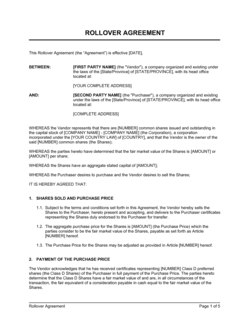
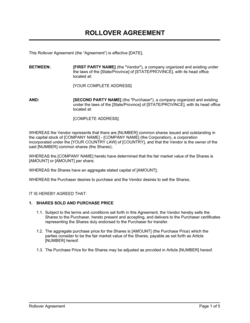
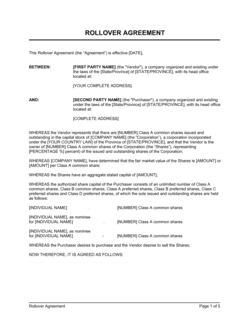
Rollover Agreement Many Value Provision Options Template

Free Word download • Edit online • Save & share with Drive • Export to PDF

6 pages25–35 min to fillDifficulty: ComplexSignature requiredLegal review recommended
Learn more ↓
FreeRollover Agreement Many Value Provision Options Template

At a glance

What it is
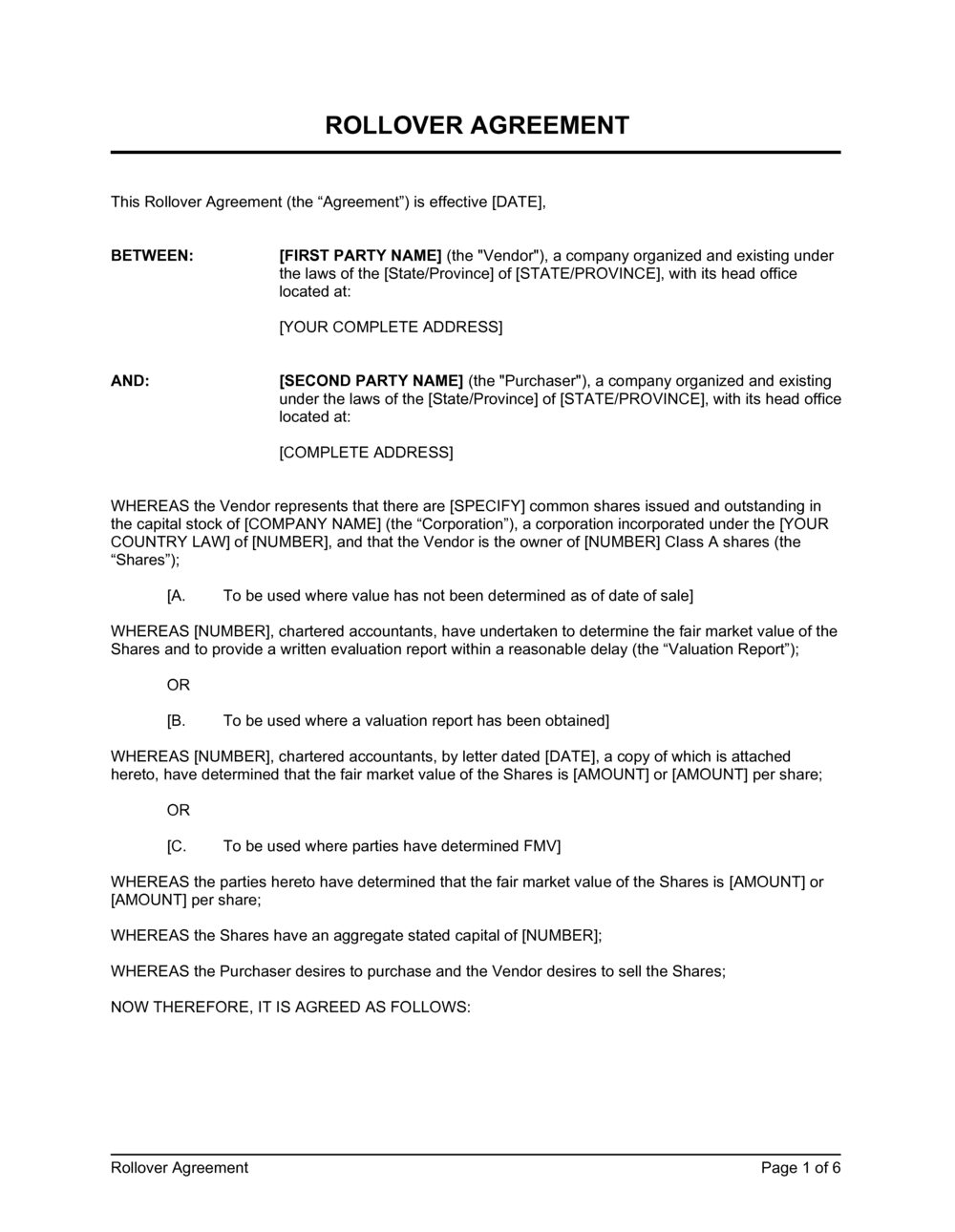
A Rollover Agreement is a legally binding contract used in mergers, acquisitions, and private equity transactions in which a selling shareholder or key employee agrees to reinvest a portion of their sale proceeds into the acquiring or successor entity rather than receiving full cash consideration at closing. This template is a free Word download with multiple value provision options — covering equity percentage rollover, fixed-dollar reinvestment, deferred consideration, and hybrid structures — which you can edit online and export as PDF for execution alongside your primary purchase agreement.
When you need it
Use it in any transaction where the buyer requires the seller or management team to retain an economic stake in the go-forward business — typically a private equity buyout, management buyout, recapitalization, or strategic acquisition with an earnout component. It is executed at or before the closing of the main purchase agreement.
What's inside
Parties and transaction recitals, rollover value provisions with selectable structures, representations and warranties of the rolling seller, tax treatment elections and covenants, equity interest terms in the acquiring entity, transfer restrictions, tag-along and drag-along rights, governance participation rights, and termination and forfeiture conditions.

What is a Rollover Agreement?

A Rollover Agreement is a legally binding contract used in mergers, acquisitions, and private equity transactions in which a selling shareholder — often a founder, owner-operator, or key executive — agrees to reinvest a defined portion of their sale proceeds as an equity stake in the acquiring or successor entity rather than receiving full cash consideration at closing. Instead of walking away with 100% of their deal proceeds, the rolling seller contributes a negotiated amount back into the transaction in exchange for a minority interest in the new ownership structure. The agreement governs the exact value provision structure chosen (percentage of proceeds, fixed dollar amount, or a hybrid), the class and economic terms of the equity issued to the seller, the tax treatment of the contribution, and the conditions — including transfer restrictions, vesting, and forfeiture — that govern the seller's ongoing stake.

Why You Need This Document

Without a properly drafted rollover agreement, the economic alignment between buyer and rolling seller is undefined and unenforceable. Buyers relying on an oral understanding or a term sheet reference to seller rollover face the risk that the seller disputes the calculation basis at closing, receives equity without any transfer restrictions or forfeiture provisions, or triggers an inadvertent taxable gain event by failing to satisfy the conditions of the applicable IRC deferral provision. For the seller, an undocumented rollover means no tag-along protection in a future exit, no governance or information rights in the entity they now co-own, and no clarity on what happens to their stake if their employment ends. Each of these gaps has produced litigation in middle-market and private equity transactions. This template provides the complete clause architecture — including multiple selectable value provision structures — that both parties need to close with certainty and protect their respective interests through the holding period and eventual exit.

Which variant fits your situation?

If your situation is…Use this template
Seller reinvests a fixed percentage of gross sale proceedsRollover Agreement — Percentage of Proceeds
Seller reinvests a fixed dollar amount regardless of total considerationRollover Agreement — Fixed Dollar Value
Management team retains equity under a new incentive plan post-closingManagement Equity Incentive Agreement
Seller defers a portion of consideration contingent on future performanceEarnout Agreement
Seller contributes equity into a holding company at closingEquity Contribution Agreement
Full acquisition with no retained seller equityStock Purchase Agreement
Partial recapitalization where existing owners retain majority controlRecapitalization Agreement

Common mistakes to avoid

❌ Ambiguous rollover calculation basis

Why it matters: If the agreement doesn't specify whether the rollover percentage applies before or after escrow holdbacks, working capital adjustments, and transaction expenses, the parties will have conflicting interpretations of the closing economics — sometimes differing by hundreds of thousands of dollars.

Fix: Define the exact basis — gross closing consideration, net of adjustments, or a specific line item from the closing statement — and run a worked example in a schedule to confirm mutual understanding.

❌ Omitting the accredited investor representation

Why it matters: Issuing unregistered equity to a non-accredited investor violates Regulation D and gives the seller a right of rescission — effectively the right to undo the deal and recover their rollover amount plus interest.

Fix: Include an accredited investor representation and, where appropriate, require the seller to deliver a completed investor questionnaire before closing.

❌ No automatic termination on failure of the main deal

Why it matters: A rollover agreement executed as a standalone document may survive the termination of the purchase agreement, leaving the parties with conflicting obligations on an acquisition that never closed.

Fix: Include an express provision stating that the rollover agreement automatically terminates without further action if the main purchase agreement is terminated before closing.

❌ Vesting schedule mischaracterized as compensatory

Why it matters: Applying time-based vesting to equity a seller purchased with after-tax rollover proceeds can cause the IRS to treat unvested units as compensatory — triggering payroll taxes and deferred compensation rules under IRC §409A.

Fix: Structure and document rollover equity as purchased at fair market value on the closing date. If forfeiture conditions are required, use a repurchase right at FMV rather than a forfeiture to zero.

❌ Transfer restriction without pledge coverage

Why it matters: A restriction on 'sales and transfers' that doesn't expressly cover pledges allows a rollover holder to pledge their units as collateral on a personal loan — a de facto economic transfer that circumvents the lock-up.

Fix: Define 'Transfer' broadly to include any sale, assignment, gift, pledge, hypothecation, encumbrance, or indirect transfer through an entity that holds the units.

❌ Governance rights granted without confidentiality obligations

Why it matters: A rollover holder with board observation rights receives the same sensitive financial and strategic information as voting directors but may not be bound by the same fiduciary confidentiality duties.

Fix: Tie any observation or information rights to a written confidentiality undertaking, either within the rollover agreement itself or by requiring the seller to execute a separate NDA as a condition to receiving board materials.

The 10 key clauses, explained

Parties, recitals, and defined terms

In plain language: Identifies the acquiring entity (Newco or buyer), the rolling seller, and the target company; recites the broader transaction context; and defines key terms used throughout the agreement.

Sample language
This Rollover Agreement ('Agreement') is entered into as of [DATE] by and among [NEWCO LEGAL NAME] ('Buyer'), [SELLER LEGAL NAME] ('Seller'), and [TARGET COMPANY NAME] ('Company'). Capitalized terms used herein and not otherwise defined shall have the meanings ascribed to them in the Purchase Agreement dated [DATE].

Common mistake: Defining 'Rollover Value' inconsistently with how it appears in the main purchase agreement — courts resolve conflicts against the drafter, which can alter the economics the parties intended.

Rollover value provision and election

In plain language: States the specific value structure chosen — percentage of proceeds, fixed dollar amount, or hybrid — and the mechanics by which the seller's rollover contribution is calculated, applied, and acknowledged at closing.

Sample language
Seller hereby agrees to roll over [X]% of the gross Closing Consideration (the 'Rollover Amount'), equal to approximately $[DOLLAR AMOUNT], by contributing such amount to Buyer in exchange for [CLASS] Units of Buyer as set out in Schedule A. [ALTERNATIVE: Seller agrees to roll over a fixed amount of $[DOLLAR AMOUNT] regardless of the total Closing Consideration.]

Common mistake: Failing to specify whether the rollover percentage is applied before or after escrow holdbacks, working capital adjustments, and transaction expenses — each basis produces a materially different dollar figure.

Issuance of equity interests in the acquiring entity

In plain language: Specifies the class, number, and economic terms of the equity units issued to the seller in exchange for the rollover contribution, and how that interest relates to the overall cap table of the acquiring entity.

Sample language
In consideration of the Rollover Amount, Buyer shall issue to Seller [NUMBER] Class [B / Common] Units, representing [X]% of the outstanding Units of Buyer on a fully diluted basis immediately following Closing, subject to the terms of the LLC Agreement attached as Exhibit [A].

Common mistake: Stating the rollover holder's ownership percentage without specifying 'fully diluted basis' — this overstates the actual economic ownership once option pools and warrants are accounted for.

Representations and warranties of the rolling seller

In plain language: Records the seller's factual representations regarding ownership of the contributed interest, authority to enter the agreement, no encumbrances, and awareness of investment risk.

Sample language
Seller represents and warrants that: (a) Seller has full legal capacity and authority to execute this Agreement; (b) the Contributed Interest is free and clear of all liens, pledges, and encumbrances; (c) Seller is an 'accredited investor' within the meaning of Rule 501(a) of Regulation D; and (d) Seller is aware that the Units are not registered under the Securities Act and are subject to transfer restrictions.

Common mistake: Omitting the accredited investor representation when the buyer is a private fund. Issuing unregistered securities to a non-accredited investor exposes the buyer to rescission rights and potential securities law liability.

Tax treatment and covenants

In plain language: Addresses whether the rollover is structured as a tax-deferred contribution and what the parties must do — or avoid doing — to preserve the intended tax treatment.

Sample language
The parties intend that the contribution of the Rollover Amount shall qualify as a tax-free contribution under Section 721 of the Internal Revenue Code (or Section 351, as applicable). Seller covenants not to take any action, and Buyer covenants to maintain the entity classification necessary, to prevent such treatment through the [X]-year period following Closing.

Common mistake: Including tax deferral language without confirming the chosen entity structure (partnership vs. corporation) actually supports the cited IRC provision — a mismatch triggers immediate gain recognition.

Transfer restrictions and lock-up period

In plain language: Prohibits the rollover holder from selling, transferring, pledging, or otherwise disposing of their equity interest for a defined period, with limited exceptions for permitted transfers to affiliates or estate-planning vehicles.

Sample language
Seller shall not Transfer any Units prior to the earlier of (a) [X] years following the Closing Date and (b) a Qualifying Exit Event, without the prior written consent of Buyer, which may be withheld in Buyer's sole discretion. Permitted Transfers to Seller's Affiliates shall not require consent provided Seller provides 10 days' prior written notice.

Common mistake: No definition of 'Transfer' that covers pledges and indirect transfers through entity restructurings — sellers have circumvented transfer restrictions by contributing units to a holding company and then selling the holding company.

Tag-along and drag-along rights

In plain language: Gives the rollover holder the right to participate in any majority sale on the same terms (tag-along) and obligates the rollover holder to sell their interest in a qualifying exit transaction directed by the majority (drag-along).

Sample language
Tag-Along: If Buyer proposes to Transfer more than [50]% of its outstanding Units to a third party, Seller shall have the right to include a pro rata portion of Seller's Units in such Transfer on the same price and terms. Drag-Along: Upon a Drag-Along Sale approved by holders of at least [X]% of the outstanding Units, Seller shall be required to Transfer all of Seller's Units on the same terms.

Common mistake: Setting the drag-along threshold so low (e.g., simple majority) that the rollover holder can be forced into an exit at a price that may not reflect negotiated downside protections.

Forfeiture and vesting schedule

In plain language: Sets out the conditions under which the rollover equity vests over time and the circumstances — resignation, termination for cause, covenant breach — that trigger partial or full forfeiture.

Sample language
Seller's Units shall vest [25]% on each anniversary of the Closing Date, subject to Seller's continued service. Upon termination of Seller's service for Cause, all unvested Units shall be forfeited without consideration. Upon termination without Cause, all unvested Units shall accelerate and vest as of the termination date.

Common mistake: Applying a vesting schedule to units that the seller contributed with after-tax rollover proceeds — economic and tax arguments support treating contributed equity as purchased rather than compensatory, and vesting terms that contradict this expose the buyer to payroll tax reclassification.

Governance and information rights

In plain language: Defines the rollover holder's rights to board or advisory committee observation, voting on major decisions, and access to periodic financial information about the acquiring entity.

Sample language
Seller shall be entitled to receive quarterly unaudited financial statements of Buyer within [45] days following each quarter end. Seller shall have the right to attend, as a non-voting observer, all meetings of the Board of Managers of Buyer, subject to recusal on matters creating a conflict of interest.

Common mistake: Granting rollover holders board observation rights without a corresponding confidentiality obligation — observers receive the same sensitive information as voting members but may not be bound by existing director confidentiality duties.

Termination, amendment, and governing law

In plain language: States the conditions under which the agreement terminates (e.g., if the main purchase agreement is terminated), the amendment procedure, and the governing jurisdiction and dispute resolution mechanism.

Sample language
This Agreement shall automatically terminate and be of no further force or effect if the Purchase Agreement is terminated in accordance with its terms prior to Closing. This Agreement may be amended only by a written instrument signed by all parties. This Agreement shall be governed by the laws of the State of [DELAWARE / STATE], without regard to conflicts-of-law principles.

Common mistake: Omitting automatic termination on purchase agreement termination — standalone rollover agreements have been held to survive the collapse of the main deal, requiring a separate unwinding negotiation.

How to fill it out

  1. 1

    Identify all parties and reference the main purchase agreement

    Enter the full legal names of the acquiring entity (Newco), the rolling seller, and the target company. Cross-reference the date and title of the underlying purchase agreement so defined terms are incorporated by reference.

    💡 Use exactly the same party names as the purchase agreement — any discrepancy between the two documents creates ambiguity that courts resolve against the drafter.

  2. 2

    Select and complete the rollover value provision

    Choose the rollover structure that matches your deal: fixed percentage of gross proceeds, fixed dollar amount, or a hybrid tied to performance thresholds. Enter the agreed percentage or dollar figure and confirm the calculation basis — pre- or post-adjustment.

    💡 Walk through three deal scenarios (base, upside, downside) with the chosen formula before finalizing. Percentage-of-proceeds structures can produce very different dollar figures than either party expects at higher valuations.

  3. 3

    Define the equity interest issued to the rolling seller

    Specify the class of units or shares, the number issued, the implied per-unit price, and the seller's resulting ownership percentage on a fully diluted basis. Attach the LLC Agreement or shareholder agreement as an exhibit.

    💡 State the fully diluted percentage explicitly — ambiguity about whether management option pools are included before or after issuance has been a source of litigation in private equity transactions.

  4. 4

    Complete the representations and warranties block

    Confirm the seller's authority and ownership, absence of encumbrances on the contributed interest, accredited investor status, and awareness of transfer restrictions. Tailor each representation to the specific facts.

    💡 If the seller is an entity rather than an individual, add entity-specific representations: due organization, authorization by governing body, and no conflicts with constituent documents.

  5. 5

    Elect and document the tax treatment

    Determine whether the rollover will be treated as tax-deferred under IRC §721 (partnership) or §351 (corporation) and include the corresponding covenants. Confirm the acquiring entity's tax classification supports the election.

    💡 Have a tax advisor confirm the election in writing before execution — a rollover structured as tax-deferred that fails the requirements can trigger an unexpected gain recognition event for the seller.

  6. 6

    Set transfer restrictions, vesting, and forfeiture terms

    Enter the lock-up period, list permitted transfer exceptions, define the vesting schedule with cliff and annual increments, and specify the forfeiture triggers and treatment of unvested units on each termination scenario.

    💡 Align the vesting schedule with the holding period the private equity sponsor projects for the investment — a 4-year vesting schedule on a 3-year fund cycle misaligns incentives.

  7. 7

    Confirm tag-along and drag-along thresholds

    Set the ownership threshold that triggers drag-along obligations and the transfer size that activates tag-along rights. Confirm these figures are consistent with the LLC Agreement or shareholder agreement governing the acquiring entity.

    💡 Test the drag-along threshold against the sponsor's actual ownership position — a threshold the sponsor never reaches is commercially meaningless.

  8. 8

    Execute alongside the main purchase agreement

    Both parties must sign before or simultaneously with the closing of the main purchase agreement. Attach all referenced exhibits — LLC Agreement, cap table, Schedule A of rollover amounts — before circulating for signature.

    💡 Use the same signature page convention (wet ink or electronic) as the main purchase agreement to ensure consistent enforceability across your closing set.

Frequently asked questions

What is a rollover agreement?

A rollover agreement is a binding contract used in mergers and acquisitions in which a selling shareholder agrees to reinvest a portion of their sale proceeds as an equity stake in the acquiring or successor entity rather than receiving full cash at closing. It aligns the seller's economic interests with the buyer's post-closing performance goals and is most common in private equity buyouts, management buyouts, and recapitalizations. The agreement specifies the amount rolled, the class and percentage of equity received, and the conditions governing that stake.

What are the main rollover value provision options?

The three primary structures are: a fixed-percentage rollover, in which the seller reinvests a defined percentage of gross or net proceeds (commonly 10–30% in private equity transactions); a fixed-dollar rollover, where a specific dollar amount is agreed regardless of total consideration; and a hybrid or tiered structure tied to valuation thresholds or earnout milestones. This template provides language for each option so the parties can select and complete the structure that matches their negotiated deal terms.

Is a rollover agreement the same as a stock purchase agreement?

No. A stock purchase agreement governs the acquisition itself — the transfer of the target company's equity to the buyer for consideration. A rollover agreement is a parallel document that governs what happens to a portion of that consideration: instead of being paid out in cash, it is reinvested as equity in the acquiring entity. The two agreements are executed together at closing, with the rollover agreement typically referencing and incorporating definitions from the main purchase agreement.

Can a rollover be structured as tax-deferred?

In many cases, yes. Under IRC Section 721, a seller contributing property to a partnership (including an LLC taxed as a partnership) in exchange for a partnership interest generally does not recognize gain at the time of contribution. Under IRC Section 351, a similar deferral applies to contributions to a corporation. The specific structure of the acquiring entity, the nature of the contributed interest, and any boot received affect eligibility. Parties should confirm the applicable deferral provision with a tax advisor before executing the rollover agreement.

What equity rights does a rolling seller typically receive?

A rolling seller typically receives a minority equity interest in the acquiring entity — commonly 10–30% depending on the deal — along with tag-along rights to participate in any future exit sale, information rights to periodic financial reporting, and sometimes board observation rights. They are typically subject to drag-along obligations, transfer restrictions for a defined lock-up period, and potentially a vesting schedule with forfeiture triggers tied to continued service.

What happens to rollover equity if the seller leaves the company?

The outcome depends on the terms of the rollover and any applicable operating or shareholder agreement. Termination without cause typically accelerates unvested equity and allows the seller to retain their vested stake. Termination for cause commonly triggers forfeiture of unvested units and, in some structures, a buyer repurchase right on vested units at cost or fair market value. Voluntary resignation is usually treated similarly to termination for cause, but the specific terms should be negotiated and documented explicitly.

Does a rollover agreement need to be signed before closing?

Yes. The rollover agreement should be executed at or before the closing of the main purchase agreement, typically as part of the closing deliverables package. Executing it after closing creates consideration and enforceability issues — particularly for any forfeiture, vesting, or restrictive covenant provisions — and may affect the tax deferral analysis if the contribution does not occur simultaneously with the main transaction.

What jurisdictions govern rollover agreements most commonly?

In the United States, rollover agreements in private equity transactions are most frequently governed by Delaware law because most private equity acquisition vehicles are Delaware LLCs or corporations. However, the agreement will be governed by whatever state is specified in the governing law clause, and parties should ensure that choice is consistent with the main purchase agreement. Cross-border transactions may involve additional Canadian, UK, or EU overlay depending on the target company's location and the seller's residence.

Do I need a lawyer to prepare a rollover agreement?

Legal review is strongly recommended. Rollover agreements interact with securities law, federal tax law (IRC Sections 721 and 351), state corporate or LLC law, and the detailed economics of the main acquisition. Mistakes in the rollover value formula, tax election, or securities representations can expose both parties to significant financial and regulatory consequences. A template provides the correct structure and complete drafting options, but an M&A attorney should review the final document in the context of the full transaction before execution.

How this compares to alternatives

vs Stock Purchase Agreement

A stock purchase agreement governs the outright sale of equity in the target company from seller to buyer, with the seller receiving full cash consideration at closing. A rollover agreement is a parallel instrument that redirects a portion of that consideration back into equity in the acquiring entity. The two documents are executed together and cross-reference each other; neither replaces the other.

vs Earnout Agreement

An earnout agreement defers a portion of the purchase price contingent on the target achieving defined post-closing financial or operational milestones — the seller receives additional cash if targets are met. A rollover agreement provides the seller with equity at closing in exchange for reinvested proceeds, with value realized only at a future exit event. Earnouts are cash-contingent; rollovers are equity-permanent.

vs Management Equity Incentive Agreement

A management equity incentive agreement grants newly issued equity or options to employees as compensation for future performance, typically with a vesting schedule and no upfront payment. A rollover agreement formalizes the reinvestment of proceeds that a selling shareholder already earned — it is a purchase of equity, not a compensatory grant. The tax treatment, securities law analysis, and accounting classification differ significantly between the two instruments.

vs Asset Purchase Agreement

An asset purchase agreement transfers specific assets and liabilities rather than equity in the target company. Rollover structures are technically possible but significantly more complex in asset deals because there is no target equity to roll — the seller must contribute cash proceeds into a new entity rather than contributing existing equity interests. Most rollover agreements are used in stock or unit purchase transactions, not asset deals.

Industry-specific considerations

Private Equity and Venture Capital

Rollover equity is a standard closing requirement in sponsor-led buyouts — typically 10–30% of seller proceeds — to align management and selling owners with the fund's exit timeline and return targets.

Technology / SaaS

Founder rollovers in SaaS acquisitions often include performance-linked vesting tied to ARR growth milestones and customer retention rates rather than time-based schedules alone.

Healthcare

Physician practice and healthcare platform acquisitions frequently use rollover structures to retain clinical leaders post-close, with regulatory compliance representations specific to HIPAA and state licensing layered into the agreement.

Professional Services

Client relationship concentration in professional services firms makes seller retention critical, and rollover agreements are paired with non-solicitation clauses and client-transfer obligations to protect the acquired book of business.

Jurisdictional notes

United States

Most rollover agreements in US private equity transactions are governed by Delaware law and structured to satisfy IRC Section 721 (partnership contribution) or Section 351 (corporate contribution) for tax deferral. The equity issued to rolling sellers constitutes a securities offering subject to federal and state securities laws — the most commonly relied-upon exemption is Rule 506(b) of Regulation D, which requires accredited investor status. California and New York have additional state securities registration requirements that may apply even to exempt offerings.

Canada

Canadian rollover transactions commonly rely on Section 85 of the Income Tax Act to achieve a tax-deferred rollover of property to a Canadian corporation, with the agreed amount elected by the parties within prescribed limits. Provincial securities legislation in Ontario, British Columbia, and Alberta requires reliance on prospectus exemptions — typically the accredited investor or minimum amount exemptions under National Instrument 45-106. Quebec transactions may require French-language disclosure for individual sellers resident in Quebec.

United Kingdom

In the UK, rollover relief for capital gains purposes is available under specific HMRC provisions — primarily Section 135 TCGA 1992 for share-for-share exchanges — but the conditions are strict and must be confirmed by a UK tax advisor before execution. The issuance of equity in the acquiring entity constitutes a financial promotion subject to FSMA 2000 and may require reliance on an exemption or approval by an FCA-authorized person. Management equity structures must also be reviewed under the employment-related securities rules of ITEPA 2003 to avoid unexpected income tax charges.

European Union

EU rollover structures must navigate the Merger Directive (2009/133/EC), which provides tax neutrality for qualifying share exchanges within EU member states, but implementation varies by country. GDPR implications arise where the rollover agreement involves processing personal data of individual sellers — data transfer provisions should be included or addressed in a side letter. Securities issuance to rolling sellers may constitute an offer of securities subject to the EU Prospectus Regulation (Regulation 2017/1129), though private placement exemptions are widely available for transactions below EUR 8 million or targeted at qualified investors.

Template vs lawyer — what fits your deal?

PathBest forCostTime
Use the templateStraightforward domestic rollover structures where the main purchase agreement is already drafted and the value provision terms are agreedFree1–2 hours to complete
Template + legal reviewAny rollover involving a tax deferral election, vesting schedule, or securities law representation — the template provides the structure, the attorney confirms the application$500–$2,000 for an M&A attorney review2–5 business days
Custom draftedComplex private equity transactions, cross-border rollovers, executive compensation overlap, or deals where rollover economics are heavily negotiated$3,000–$15,000+ depending on deal size and complexity1–3 weeks alongside the main transaction

Glossary

Rollover Equity
The portion of a seller's sale proceeds that is reinvested as an ownership stake in the acquiring or successor entity rather than received as cash at closing.
Rollover Value
The agreed dollar amount or percentage of total transaction consideration that the rolling seller contributes back into the new entity.
Newco
A newly formed entity — typically an LLC or holding company — created by the buyer to consummate the acquisition and into which rollover equity is contributed.
Promote (Carried Interest)
The disproportionate share of upside profits allocated to the private equity sponsor above a preferred return threshold, which affects how rollover proceeds are ultimately distributed.
Tag-Along Right
A contractual right allowing a minority rollover holder to sell their stake on the same terms as the majority holder in any future sale transaction.
Drag-Along Right
A right granted to the majority holder to compel minority rollover holders to sell their stake in a qualifying exit transaction on the same terms.
Transfer Restriction
A contractual prohibition — typically a lock-up period — preventing a rollover holder from selling, pledging, or assigning their equity interest without prior written consent.
Tax-Free Rollover Election
A structural choice under IRC Section 721 or Section 351 allowing a seller to contribute equity to a partnership or corporation without recognizing taxable gain at the time of contribution.
Preferred Return
A minimum annual return threshold — typically 6–8% — that limited partners or rollover holders receive before profits are split with the sponsor.
Forfeiture Provision
A clause under which a rollover holder forfeits some or all of their equity interest upon voluntary resignation, termination for cause, or breach of a restrictive covenant.
Anti-Dilution Protection
A provision protecting a rollover holder from having their ownership percentage reduced below a floor in future financing rounds without consent or proportionate adjustment.

Part of your Business Operating System

This document is one of 3,000+ business & legal templates included in Business in a Box.

  • Fill-in-the-blanks — ready in minutes
  • 100% customizable Word document
  • Compatible with all office suites
  • Export to PDF and share electronically

Create your document in 3 simple steps.

From template to signed document — all inside one Business Operating System.
1
Download or open template

Access over 3,000+ business and legal templates for any business task, project or initiative.

2
Edit and fill in the blanks with AI

Customize your ready-made business document template and save it in the cloud.

3
Save, Share, Send, Sign

Share your files and folders with your team. Create a space of seamless collaboration.

Save time, save money, and create top-quality documents.

★★★★★

"Fantastic value! I'm not sure how I'd do without it. It's worth its weight in gold and paid back for itself many times."

Managing Director · Mall Farm
Robert Whalley
Managing Director, Mall Farm Proprietary Limited
★★★★★

"I have been using Business in a Box for years. It has been the most useful source of templates I have encountered. I recommend it to anyone."

Business Owner · 4+ years
Dr Michael John Freestone
Business Owner
★★★★★

"It has been a life saver so many times I have lost count. Business in a Box has saved me so much time and as you know, time is money."

Owner · Upstate Web
David G. Moore Jr.
Owner, Upstate Web

Run your business with a system — not scattered tools

Stop downloading documents. Start operating with clarity. Business in a Box gives you the Business Operating System used by over 250,000 companies worldwide to structure, run, and grow their business.

Start free · No credit card required