Profit Sharing Agreement Template

Free Word download • Edit online • Save & share with Drive • Export to PDF

3 pages25–30 min to fillDifficulty: ComplexSignature requiredLegal review recommended
Learn more ↓
FreeProfit Sharing Agreement Template

At a glance

What it is
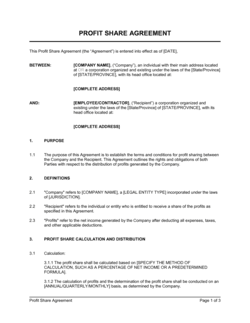
A Profit Sharing Agreement is a legally binding contract between a business and one or more parties — employees, partners, investors, or affiliates — that grants the recipient a defined share of the company's profits under agreed conditions. This free Word download lets you set the profit definition, calculation method, payment schedule, audit rights, and termination provisions in a single enforceable document you can edit online and export as PDF.
When you need it
Use it when you want to reward employees or partners with a stake in financial results without transferring equity, when structuring a revenue-share arrangement with an affiliate or joint-venture partner, or when formalizing an existing informal profit-split before it creates a dispute.
What's inside
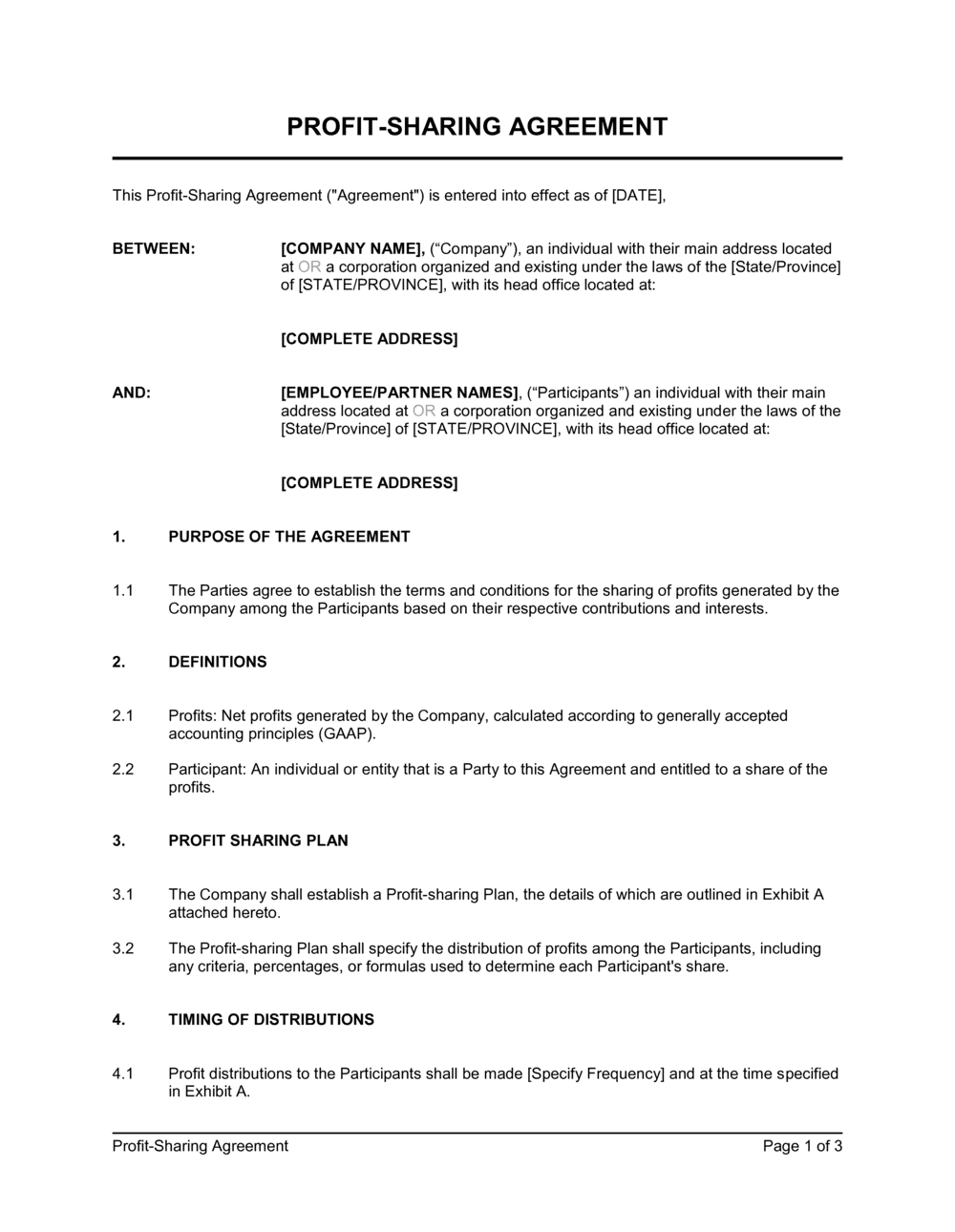
Definitions of "profit" and the calculation methodology, the recipient's percentage share and payment timeline, representations and audit rights, confidentiality obligations, term and termination conditions, and governing law. The template includes schedule placeholders for financial reporting and calculation worksheets.

What is a Profit Sharing Agreement?

A Profit Sharing Agreement is a legally binding contract between a business and one or more parties — employees, partners, investors, or affiliates — that grants the recipient a defined percentage of the company's profits under specific, agreed conditions. Unlike an equity arrangement, it transfers no ownership stake, no voting rights, and no claim on assets at liquidation; it creates a purely financial entitlement governed by the contractual definition of "profit," the agreed calculation method, and the payment schedule set out in the document. Because the profit figure can be heavily influenced by how expenses are categorized and deducted, the definition clause is the most consequential part of the agreement — a vague or absent definition routinely becomes the source of disputes that a clearly drafted contract would have prevented entirely.

Why You Need This Document

Without a written profit sharing agreement, every material term of the arrangement — what counts as profit, which expenses are deductible, when payment is due, and what happens when the relationship ends — is subject to competing recollections. Recipients have gone an entire fiscal year without payment after a Company redefined permissible deductions mid-year; businesses have faced claims for profit shares on periods before any agreement was finalized. A clearly drafted agreement locks in the profit definition, the percentage, and the payment timeline before either party has a financial interest in changing them. It also gives the recipient enforceable audit rights — the only meaningful protection against a Company that calculates accurately in good times and creatively in bad ones. This template provides the structural framework to document all of those terms in a single enforceable document, reducing the risk of a profitable business relationship ending in a payment dispute.

Which variant fits your situation?

If your situation is…Use this template
Sharing profits with full-time employees as a retention toolEmployee Profit Sharing Agreement
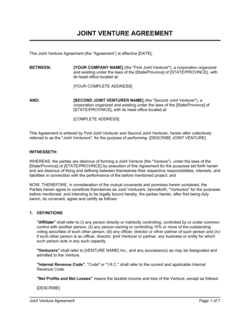
Splitting profits between two businesses in a joint ventureJoint Venture Agreement
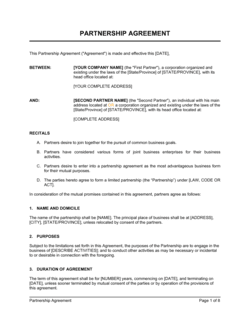
Compensating a partner who contributed capital but not laborPartnership Agreement
Paying a revenue-based percentage to an affiliate or referral sourceRevenue Sharing Agreement
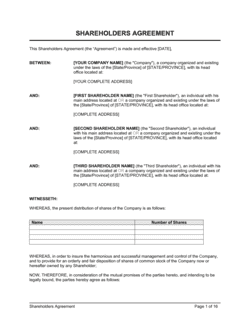
Granting equity with profit rights to a co-founderShareholders Agreement
Rewarding a senior manager with a bonus tied to net incomeExecutive Employment Agreement
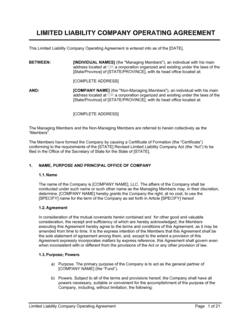
Distributing profits among members of an LLCLLC Operating Agreement

Common mistakes to avoid

❌ Leaving 'profit' undefined

Why it matters: An undefined profit term allows the Company to deduct owner salaries, related-party fees, and discretionary reserves before calculating the sharing pool — potentially reducing the recipient's payment to zero even in a profitable year.

Fix: Define 'profit' in a dedicated definitions clause with an exhaustive list of permitted deductions. Have both parties review and initial the deductions list specifically.

❌ No threshold or floor on payments

Why it matters: Without a minimum profit level, the Company owes small payments in breakeven periods that create administrative friction and may trigger employment-law complications for employee recipients.

Fix: Add a threshold clause stating no payment is due unless profit exceeds a defined minimum — e.g., $[X] per calculation period — and confirm that unprofitable periods do not carry forward as a deficit.

❌ Omitting a reporting and calculation statement requirement

Why it matters: Without a required written statement, the recipient has no mechanism to verify accuracy, no defined dispute window, and no paper trail for audits or litigation.

Fix: Require a written Calculation Statement with each payment showing all inputs and deductions. Set a 30-day window for the recipient to raise written objections.

❌ No accrued-profit provision on termination

Why it matters: If the agreement is silent on termination timing, a Company can terminate immediately before a calculation date and argue that no payment is due for the entire preceding period — leaving the recipient uncompensated for months of contribution.

Fix: Include an express clause requiring calculation and payment of profit accrued up to the termination date within 30 days, regardless of which party initiated termination.

❌ Signing after the recipient has already started contributing

Why it matters: In common-law jurisdictions, a contract signed after the relevant work or contribution has already begun may lack fresh consideration, making restrictive provisions — including clawback and confidentiality — potentially unenforceable.

Fix: Execute the agreement before the recipient takes any action that would generate a profit entitlement, or provide documented additional consideration if signing retrospectively.

❌ No confidentiality obligation on profit data

Why it matters: Profit figures, margins, and revenue data disclosed through calculation statements or audits are commercially sensitive. Without a confidentiality clause, the recipient is free to share them with competitors, staff, or the press.

Fix: Add a confidentiality clause covering all financial information disclosed under the agreement, with an explicit carve-out for the recipient's legal and accounting advisors bound by professional secrecy obligations.

The 10 key clauses, explained

Parties and recitals

In plain language: Identifies the business paying the profit share and the recipient, states the nature of their relationship, and explains why the agreement is being entered into.

Sample language
This Profit Sharing Agreement is entered into as of [DATE] between [COMPANY LEGAL NAME], a [STATE/JURISDICTION] [ENTITY TYPE] ('Company'), and [RECIPIENT FULL NAME / ENTITY NAME] ('Recipient'). The parties wish to formalize the terms under which Recipient will participate in the profits of the Company.

Common mistake: Using a trade name instead of the registered legal entity name for the Company. If the entity name on the agreement differs from the entity that holds the bank account, enforcement becomes complicated.

Definition of profit

In plain language: Specifies exactly what 'profit' means for the purposes of this agreement — gross, net, or a custom-defined figure — and lists every permitted deduction.

Sample language
'Profit' means the net income of the Company for the relevant Calculation Period as determined in accordance with [GAAP / IFRS / COMPANY ACCOUNTING POLICY], after deduction of [LIST OF PERMITTED DEDUCTIONS], but before deduction of any amounts payable under this Agreement.

Common mistake: Leaving 'profit' undefined and defaulting to 'net income.' The Company may then deduct owner salaries, management fees, or related-party expenses that effectively eliminate distributable profit, leaving the recipient with nothing.

Profit share percentage and threshold

In plain language: States the percentage of defined profit the recipient receives and any minimum profit level that must be exceeded before any payment is owed.

Sample language
Company shall pay Recipient [X]% of Profit for each Calculation Period in which Profit exceeds $[THRESHOLD AMOUNT]. If Profit does not exceed the Threshold in any period, no payment shall be due for that period.

Common mistake: Setting no threshold at all. Without a floor, the Company may owe small payments in breakeven or marginal periods that create administrative burden without meaningfully compensating the recipient.

Calculation period and payment schedule

In plain language: Defines how often profit is measured (monthly, quarterly, or annually) and when the resulting payment must actually be made to the recipient.

Sample language
Profit shall be calculated on a [quarterly / annual] basis, with each Calculation Period ending on [DATE]. Payment of the applicable profit share shall be made within [30] days of the end of each Calculation Period, accompanied by a written calculation statement.

Common mistake: Agreeing on an annual calculation period but failing to specify a payment deadline. Recipients have waited 6–12 months for a calculation and then faced further delays on payment — combined, this erodes trust and triggers disputes.

Calculation statement and reporting

In plain language: Requires the Company to deliver a written profit calculation to the recipient at each payment date, showing the inputs, deductions, and arithmetic that produced the payment.

Sample language
Together with each payment, Company shall deliver a written Calculation Statement setting out total revenue, each permitted deduction with amounts, resulting Profit, Recipient's percentage, and the amount due. Recipient shall have [30] days to raise a written objection to any Calculation Statement.

Common mistake: Omitting any reporting obligation. Without a required statement, the recipient has no basis to verify accuracy and no defined window to raise a dispute — making audit rights practically meaningless.

Audit rights

In plain language: Grants the recipient the right to inspect or have an independent accountant review the Company's financial records to verify that profit has been calculated correctly.

Sample language
Recipient may, upon [30] days' written notice and no more than once per calendar year, appoint an independent certified public accountant to audit the Company's financial records for the purpose of verifying any Calculation Statement. Costs of the audit shall be borne by Recipient unless the audit reveals an underpayment of more than [5]%, in which case Company shall bear all reasonable audit costs.

Common mistake: No audit right at all — or an audit right with no cost-shifting mechanic. Without the cost-shifting threshold, the recipient has little incentive to audit and the Company has no incentive to calculate accurately.

Confidentiality

In plain language: Prohibits the recipient from disclosing the Company's financial information accessed under this agreement to any third party.

Sample language
Recipient shall keep all financial information disclosed under this Agreement strictly confidential and shall not disclose such information to any third party without the prior written consent of the Company, except as required by law or to Recipient's professional advisors bound by equivalent confidentiality obligations.

Common mistake: No confidentiality clause at all. Profit figures, margins, and customer revenue data disclosed for audit purposes are highly sensitive — without a confidentiality obligation, the recipient may share them with competitors or the public.

Term and termination

In plain language: States how long the agreement runs, under what conditions either party may end it early, and what happens to profit accrued but not yet paid at termination.

Sample language
This Agreement commences on [START DATE] and continues for [TERM / until terminated]. Either party may terminate upon [90] days' written notice. Termination shall not affect any profit share accrued but unpaid as of the termination date, which shall be paid within [30] days of termination.

Common mistake: No provision for accrued-but-unpaid profit on termination. Companies have terminated agreements immediately before a calculation date, arguing no amount was 'due' yet — leaving the recipient with nothing for a full period of contribution.

Clawback

In plain language: Requires the recipient to repay profit distributions if the underlying financials are restated downward or if the recipient causes the event that reduces profit.

Sample language
If a Calculation Statement is amended within [24] months of issuance due to an accounting restatement, fraud, or material error, and such amendment results in an overpayment to Recipient, Recipient shall repay the excess within [30] days of written demand.

Common mistake: Clawback that is unlimited in time. Courts in several jurisdictions have declined to enforce indefinite clawback provisions as unreasonably punitive — cap the lookback period at 24–36 months.

Governing law and dispute resolution

In plain language: Specifies which jurisdiction's law governs the agreement and how disputes — including disagreements over profit calculations — will be resolved.

Sample language
This Agreement is governed by the laws of [STATE / PROVINCE / COUNTRY]. Any dispute arising under this Agreement, including disputes over Calculation Statements, shall be referred first to mediation and, if unresolved within [30] days, to binding arbitration administered by [AAA / JAMS / ICDR] in [CITY].

Common mistake: Choosing governing law that conflicts with where the recipient actually works or resides. Some jurisdictions impose mandatory employee-protection laws that override the chosen law for recipients who qualify as employees.

How to fill it out

  1. 1

    Identify the parties with full legal names

    Enter the Company's registered legal name, entity type, and jurisdiction of formation, and the Recipient's full legal name or registered entity name. Include addresses for both parties.

    💡 Confirm the Company's legal name against its articles of incorporation or certificate of formation — a mismatch between the agreement and the bank account creates enforcement problems.

  2. 2

    Define 'profit' precisely and list every permitted deduction

    Choose whether the share applies to gross profit, net income, or a custom-defined figure. Then list every deduction the Company is entitled to take before calculating the pool — owner salaries, depreciation, taxes, reserves, and debt service if applicable.

    💡 A recipient should negotiate to exclude owner/related-party management fees from permitted deductions, as these are often used to reduce distributable profit to near zero.

  3. 3

    Set the percentage, threshold, and any cap

    Enter the recipient's percentage share, the minimum profit level that triggers a payment obligation, and — if appropriate — a maximum payment per period. All three numbers should reflect what was actually agreed verbally before drafting.

    💡 Confirm that the agreed percentage, applied to realistic profit projections, produces a payment that reflects the recipient's contribution — run the math before signing.

  4. 4

    Choose the calculation period and payment deadline

    Select monthly, quarterly, or annual calculation periods and set a firm payment deadline — typically 30 days after period end. Annual periods are simpler administratively but delay cash to the recipient.

    💡 Quarterly calculation with a 30-day payment window is the most common balance between administrative simplicity and timely compensation.

  5. 5

    Draft the reporting and calculation statement requirements

    Specify exactly what the written Calculation Statement must show — revenue, each line of permitted deductions, resulting profit, the percentage applied, and the amount due. Set a dispute window of 30 days from receipt.

    💡 Attach a sample Calculation Statement as a schedule to the agreement so both parties know what format is expected — this eliminates disputes about presentation later.

  6. 6

    Set the audit rights terms and cost-shifting threshold

    Confirm how much notice is required to trigger an audit, how many audits are permitted per year, and at what underpayment percentage the Company bears the audit cost. Five percent is a common cost-shifting trigger.

    💡 Restrict audits to an independent CPA firm rather than the recipient personally — this protects the Company's financial confidentiality and produces more credible results.

  7. 7

    Define term, termination notice, and accrued-profit treatment

    Set the agreement's duration or make it open-ended with a notice period for termination. Explicitly state that profit accrued for any partial calculation period up to termination must be calculated and paid within 30 days of the termination date.

    💡 Include a 'survival' clause confirming that confidentiality and clawback obligations survive termination — these are the provisions most likely to be disputed after the relationship ends.

  8. 8

    Execute before the recipient begins contributing

    Both parties must sign before the recipient starts any work or contribution that would generate profit entitlement. Post-start signatures raise enforceability questions in common-law jurisdictions.

    💡 Use a witnessed or countersigned execution to create a clear record of when the agreement was signed — this is critical if the payment date or term start is ever disputed.

Frequently asked questions

What is a profit sharing agreement?

A profit sharing agreement is a legally binding contract between a business and one or more recipients — employees, partners, investors, or affiliates — that entitles the recipient to a defined percentage of the company's profits over an agreed period. It specifies how profit is defined, how it is calculated, when payments are made, and what rights the recipient has to verify the numbers. Unlike equity, a profit share does not grant ownership or voting rights in the business.

What is the difference between a profit sharing agreement and an equity arrangement?

A profit sharing agreement gives the recipient a percentage of earnings without transferring any ownership stake, voting rights, or claim on assets at liquidation. An equity arrangement — shares, options, or an LLC membership interest — gives the recipient actual ownership with corresponding governance rights. Profit sharing is simpler to administer, easier to terminate, and does not require securities compliance in most jurisdictions, but it offers no upside from a business sale or liquidation.

How is profit defined in a profit sharing agreement?

Profit is defined in the agreement itself — and the definition matters enormously. Common choices are gross profit (revenue minus cost of goods sold), net income (after all expenses and taxes), or a custom-defined figure that excludes specific items such as owner salaries, related-party fees, depreciation, or capital expenditures. Leaving profit undefined or defaulting to net income without restricting permitted deductions is the most common and costly drafting error in these agreements.

Do profit sharing agreements need to be in writing?

While oral profit sharing arrangements can create legal obligations in some jurisdictions, a written agreement is strongly recommended. Without a written document, every term — profit definition, percentage, payment timing, and termination rights — becomes a credibility contest. Written agreements also satisfy audit and accounting requirements and provide a clear dispute-resolution mechanism.

What audit rights should a profit sharing agreement include?

The recipient should have the right to appoint an independent CPA to review the Company's financial records at least once per year with reasonable advance notice — typically 30 days. The agreement should include cost-shifting: if the audit reveals an underpayment above a threshold (commonly 5%), the Company pays the audit cost; otherwise, the recipient does. This structure incentivizes accurate calculation without encouraging frivolous audits.

Can an employee receive a profit share without it being treated as wages?

Tax treatment depends on jurisdiction. In the US, profit share payments to employees are generally treated as supplemental wages subject to income tax withholding and payroll taxes. In the UK, profit sharing paid to employees is typically taxable as employment income under PAYE. In Canada, payments to employees are employment income subject to CPP, EI, and income tax withholding. Consult a tax advisor to confirm the correct withholding and reporting treatment for your jurisdiction and recipient type.

What happens to profit share if the recipient leaves mid-year?

The agreement should expressly address this. A common approach is to calculate and pay profit accrued on a pro-rata basis up to the termination date within 30 days of separation. Without this provision, a Company can terminate the agreement immediately before a calculation date and argue that no payment is owed for the entire preceding period. The surviving-obligations clause should also confirm that confidentiality and clawback survive termination.

Is a profit sharing agreement enforceable if signed after the recipient starts work?

In common-law jurisdictions including the US, Canada, the UK, and Australia, a contract requires consideration — each party must give something of value. An employee or partner who has already been contributing before signing may be found to have provided no new consideration, making restrictive provisions such as clawback and confidentiality potentially unenforceable. Execute the agreement before the recipient begins contributing, or provide documented additional compensation — a bonus, salary increase, or other benefit — at the time of a retrospective signing.

Do I need a lawyer to draft a profit sharing agreement?

For straightforward arrangements — a single employee or partner, a clear profit definition, and a simple percentage — a well-drafted template reviewed by an accountant for the tax implications is often sufficient. Engage a lawyer when the recipient is a significant contributor with leverage to negotiate, when the profit pool is material (above $50,000 annually), when the recipient is in a jurisdiction with strong employee-protection laws, or when related-party transactions could be used to manipulate the profit figure. A 1–2 hour attorney review typically costs $300–$600 and is worthwhile for any arrangement above $25,000 per year.

How this compares to alternatives

vs Revenue Sharing Agreement

A revenue sharing agreement pays the recipient a percentage of top-line revenue before any expenses are deducted. A profit sharing agreement pays a percentage of what remains after expenses. Revenue sharing is simpler to calculate and harder for the Company to manipulate, but exposes the Company to paying out when it is losing money. Profit sharing aligns the recipient's incentive with the Company's bottom-line health but requires a carefully defined expense policy to prevent manipulation.

vs Partnership Agreement

A partnership agreement establishes a formal legal partnership between parties who co-own and co-operate a business, with shared liability and governance rights. A profit sharing agreement grants financial participation only, with no ownership, no liability exposure, and no governance rights. Use a partnership agreement when parties are joint owners; use a profit sharing agreement when one party is a contributor or service provider receiving a performance-based payment.

vs Joint Venture Agreement

A joint venture agreement creates a collaborative business structure between two independent entities for a defined project or purpose, typically with shared decision-making. A profit sharing agreement is a simpler, unilateral arrangement where one party pays another a share of profits without creating a new legal structure or shared governance. Joint ventures are appropriate for complex, multi-year collaborations; profit sharing suits simpler contributor or affiliate arrangements.

vs Shareholders Agreement

A shareholders agreement governs the rights and obligations of equity holders — including dividend policy, voting, share transfers, and exit mechanics. A profit sharing agreement operates entirely outside the equity structure and grants no ownership claim. Shareholders receive dividends from after-tax retained earnings under corporate law rules; profit share recipients receive contractual payments under the terms of this agreement, with different tax, priority, and governance implications.

Industry-specific considerations

Professional Services

Law firms, accounting practices, and consulting partnerships routinely use profit sharing to allocate partner distributions, with permitted deductions covering associate salaries and practice overhead.

Retail and Hospitality

Store managers and restaurant general managers are frequently rewarded through location-level profit sharing, requiring careful definition of allocated overhead and inter-company charges to avoid disputes.

Technology / SaaS

Early-stage SaaS companies use profit sharing to compensate key contributors before establishing a formal equity plan, with gross-margin-based definitions common to exclude large R&D and infrastructure costs from the pool.

Construction and Real Estate

Project-level profit sharing between developers and operating partners requires a project-specific profit definition, accounting for contingency reserves, cost overruns, and lender priority distributions before calculating the sharing pool.

Jurisdictional notes

United States

Profit share payments to employees are supplemental wages subject to federal income tax withholding at 22% (or aggregate method) and FICA payroll taxes. ERISA governs formal profit-sharing retirement plans, which have separate regulatory requirements distinct from contractual profit sharing. Non-compete or confidentiality provisions attached to a profit sharing agreement should be tailored to the employee's state, as California, Minnesota, and other states impose restrictions that override contractual choice-of-law clauses.

Canada

Profit sharing paid to employees is employment income subject to CPP contributions, EI premiums, and income tax withholding at source under the Income Tax Act. Deferred profit-sharing plans (DPSPs) are a separate registered vehicle with CRA contribution limits and distinct tax treatment. Ontario and Quebec courts have held that profit sharing arrangements that become a consistent feature of employment may create a contractual entitlement the employer cannot unilaterally remove — making clear 'discretionary' language or a written agreement essential.

United Kingdom

Profit share payments to employees are employment income taxable under PAYE and subject to National Insurance contributions for both employer and employee. HMRC-approved Share Incentive Plans (SIPs) offer a tax-advantaged route to employee profit sharing with separate regulatory requirements. Where a profit sharing arrangement gives an employee a contractual entitlement, any attempt to reduce or remove it unilaterally may constitute a breach of contract or constructive dismissal under the Employment Rights Act 1996.

European Union

EU member states treat profit sharing differently: France has a mandatory profit-sharing regime (participation) for companies with 50 or more employees, creating statutory obligations separate from any contractual arrangement. Germany, the Netherlands, and Spain have their own tax treatment and labor-law implications for profit-related pay. GDPR applies to financial data disclosed under audit rights if it includes personal data about identifiable individuals. Always verify local rules before deploying a uniform profit sharing agreement across multiple EU jurisdictions.

Template vs lawyer — what fits your deal?

PathBest forCostTime
Use the templateStraightforward arrangements with a single employee or affiliate where the profit pool is under $25,000 per year and the profit definition is unambiguousFree30–60 minutes
Template + legal reviewArrangements above $25,000 annually, recipients in jurisdictions with employee-protection laws, or agreements involving related-party transactions that could affect the profit calculation$300–$7002–4 days
Custom draftedMulti-party profit splits, complex profit definitions with multiple expense tiers, cross-border arrangements, or material earnout structures tied to a business sale$1,500–$5,000+1–3 weeks

Glossary

Net Profit
Total revenue minus all operating expenses, taxes, interest, and depreciation — the amount available for distribution after all obligations are met.
Gross Profit
Revenue minus the direct cost of goods sold or services delivered, before operating expenses and overhead are deducted.
Profit Share Percentage
The contractually agreed fraction of defined profit that the recipient is entitled to receive, expressed as a percentage.
Calculation Period
The defined interval — monthly, quarterly, or annually — over which profit is measured and the recipient's entitlement is computed.
Audit Rights
A contractual right allowing the recipient (or an appointed accountant) to inspect the payer's financial records to verify that profit calculations are accurate.
Distributable Profit
Net profit after any agreed reserves, reinvestment set-asides, or priority payments have been deducted — the pool actually available for sharing.
Clawback
A provision requiring the recipient to repay previously distributed profit shares if profits are later restated downward or if the recipient breaches the agreement.
Threshold
A minimum profit level that must be reached before any sharing obligation is triggered — protects the business from paying out during marginal-profit periods.
Cap
A maximum total payment the recipient can receive in a given period, regardless of how high profits rise — limits the payer's upside exposure.
Profit and Loss Statement (P&L)
A financial statement summarizing revenues, costs, and expenses over a period, used as the reference document for profit share calculations.
Earnout
A deferred payment mechanism tied to post-transaction financial performance — conceptually similar to profit sharing but typically used in M&A contexts.

Part of your Business Operating System

This document is one of 3,000+ business & legal templates included in Business in a Box.

  • Fill-in-the-blanks — ready in minutes
  • 100% customizable Word document
  • Compatible with all office suites
  • Export to PDF and share electronically

Create your document in 3 simple steps.

From template to signed document — all inside one Business Operating System.
1
Download or open template

Access over 3,000+ business and legal templates for any business task, project or initiative.

2
Edit and fill in the blanks with AI

Customize your ready-made business document template and save it in the cloud.

3
Save, Share, Send, Sign

Share your files and folders with your team. Create a space of seamless collaboration.

Save time, save money, and create top-quality documents.

★★★★★

"Fantastic value! I'm not sure how I'd do without it. It's worth its weight in gold and paid back for itself many times."

Managing Director · Mall Farm
Robert Whalley
Managing Director, Mall Farm Proprietary Limited
★★★★★

"I have been using Business in a Box for years. It has been the most useful source of templates I have encountered. I recommend it to anyone."

Business Owner · 4+ years
Dr Michael John Freestone
Business Owner
★★★★★

"It has been a life saver so many times I have lost count. Business in a Box has saved me so much time and as you know, time is money."

Owner · Upstate Web
David G. Moore Jr.
Owner, Upstate Web

Run your business with a system — not scattered tools

Stop downloading documents. Start operating with clarity. Business in a Box gives you the Business Operating System used by over 250,000 companies worldwide to structure, run, and grow their business.

Free Forever Plan · No credit card required