Board Resolution Approving Sale of Assets Template

Free Word download β€’ Edit online β€’ Save & share with Drive β€’ Export to PDF

1 pageβ€’20–25 min to fillβ€’Difficulty: Standardβ€’Signature requiredβ€’Legal review recommended
Learn more ↓
FreeBoard Resolution Approving Sale of Assets Template

At a glance

What it is
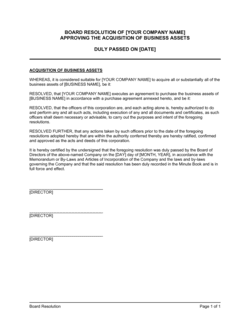
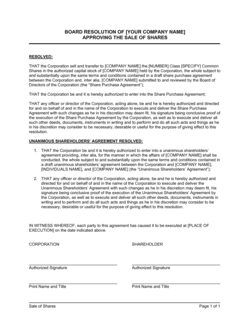
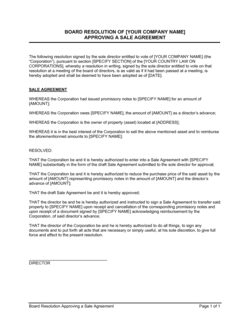
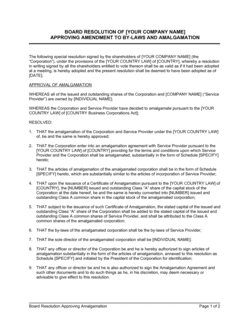
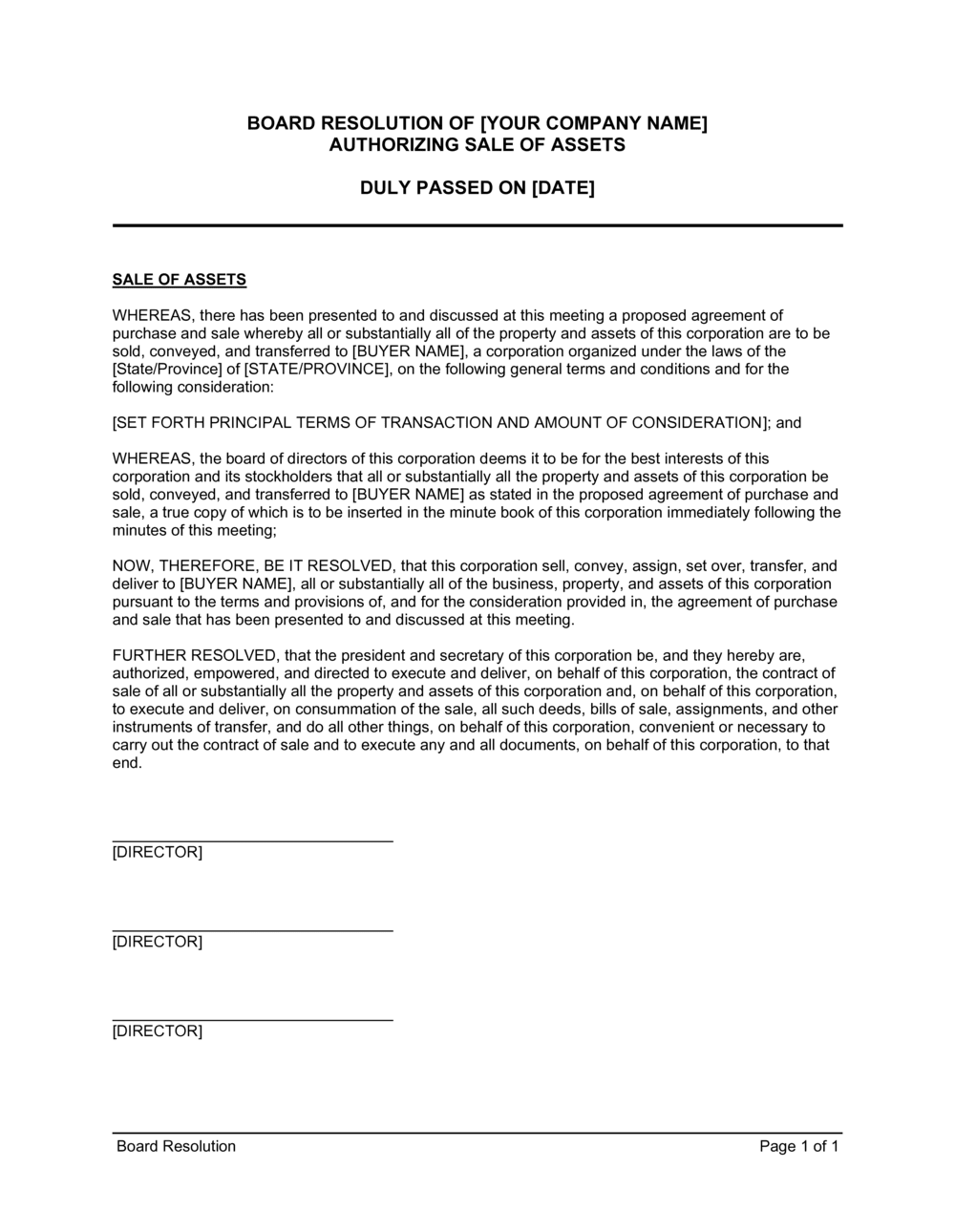
A Board Resolution Approving Sale of Assets is a formal corporate document in which a company's board of directors officially votes to authorize the sale of one or more specified assets. This free Word download captures the board's decision in binding written form, identifies the assets being sold, states the approved terms, and delegates authority to named officers to execute the transaction β€” all in a single document you can edit online and export as PDF.
When you need it
Use it any time a company proposes to sell real estate, equipment, intellectual property, a business division, or any other significant asset that requires board-level authorization under the company's bylaws, articles of incorporation, or applicable corporate law. It is also required by most buyers, lenders, and title companies as evidence that the seller's officers have authority to complete the transaction.
What's inside
Recitals identifying the company and the purpose of the meeting, a description of the assets to be sold, the approved sale price and material terms, a delegation of signing authority to specific officers, any required conditions precedent, and the dated signatures of the board members present and voting.

What is a Board Resolution Approving Sale of Assets?

A Board Resolution Approving Sale of Assets is a formal corporate authorization document in which a company's board of directors votes to approve the disposal of one or more specified assets and delegates signing authority to named officers. It records the board's decision in binding written form β€” identifying the assets, the approved price and terms, any conditions that must be satisfied before closing, and the individuals empowered to execute the transaction documents on the company's behalf. The resolution functions as the corporate authority trail that connects the board's decision to every downstream closing document: the asset purchase agreement, the bill of sale, the deed, and any assignment instruments.

Why You Need This Document

Without a properly adopted board resolution, the officers signing your closing documents may lack provable authority β€” and buyers, title companies, and lenders will not close without it. A missing or defective resolution can stall a real estate recording, trigger a title insurance exclusion, or expose the transaction to rescission by a shareholder who argues the sale exceeded officer authority. The consequences are not hypothetical: courts in the United States, Canada, and the United Kingdom have voided asset transfers that lacked adequate corporate authorization, forcing expensive corrective proceedings or returning assets to sellers. Beyond protecting the transaction itself, a well-drafted resolution protects your directors by documenting that the sale was approved through a proper governance process β€” essential evidence if a fiduciary-duty claim is ever raised. This template gives you a structured, jurisdiction-aware starting point that covers every material authorization element, so your officers walk into closing with clean authority and your records reflect a complete governance trail.

Which variant fits your situation?

If your situation is…Use this template
Selling the entire business or substantially all assetsBoard Resolution Approving Sale of Business
Selling real estate owned by the corporationBoard Resolution Authorizing Real Property Sale
Approving the purchase of assets rather than a saleBoard Resolution Approving Purchase of Assets
Authorizing a specific officer to sign contracts on behalf of the boardBoard Resolution Authorizing Officer to Sign
Documenting board approval for a merger or acquisitionBoard Resolution Approving Merger
Approving the sale of shares rather than physical or IP assetsBoard Resolution Approving Share Transfer
Recording a unanimous written consent in lieu of a formal meetingUnanimous Written Consent of Directors

Common mistakes to avoid

❌ Using a trade name instead of the registered corporate name

Why it matters: Title companies, buyers' attorneys, and recording offices match the selling entity exactly against registered ownership records. A name mismatch requires a corrective instrument and can delay or kill a closing.

Fix: Pull the current certificate of good standing or corporate registry record and copy the legal name character-for-character into the resolution.

❌ Omitting a specific asset description

Why it matters: A vague description like 'certain real property' or 'the equipment' does not constitute adequate authority. Buyers and lenders will require a supplemental resolution or affidavit, adding cost and delay.

Fix: Attach a Schedule A with the full legal description, serial number, or registration number of every asset being sold, and cross-reference it in the resolution body.

❌ Skipping the substantially-all-assets analysis

Why it matters: Most corporate statutes require shareholder approval when a sale involves substantially all of a company's assets β€” typically 50–80% of total value. Proceeding without it exposes the transaction to shareholder challenge and potential rescission.

Fix: Calculate the sold asset's value as a percentage of total company assets using the most recent audited or reviewed balance sheet. If the threshold is close, obtain shareholder approval before closing.

❌ Authorizing an officer by title only without naming the individual

Why it matters: If the officer's title is shared by multiple people, or the role is vacant between the resolution date and closing, third parties cannot confirm who actually has authority β€” and may refuse to accept signed documents.

Fix: Always name the authorized individual by full legal name and title. If the officer changes before closing, adopt a new or amended resolution naming the current officeholder.

The 9 key clauses, explained

Corporate identification and meeting recitals

In plain language: States the full legal name of the corporation, the date and type of meeting (regular, special, or written consent), and confirms that proper notice was given and a quorum was present.

Sample language
WHEREAS, [CORPORATION LEGAL NAME], a [STATE/PROVINCE] [ENTITY TYPE] ('Company'), held a [special / regular] meeting of its Board of Directors on [DATE], at which a quorum was present and the following resolutions were duly adopted;

Common mistake: Using a trade name instead of the registered corporate name. If the resolution names the wrong entity, buyers and title companies will reject it as insufficient authority to convey the asset.

Asset description and identification

In plain language: Specifically identifies the asset or assets being sold β€” by legal description, serial number, registration, or IP registration number β€” so there is no ambiguity about what the board authorized.

Sample language
RESOLVED, that the Board hereby approves the sale of the following asset(s): [FULL LEGAL DESCRIPTION / SERIAL NUMBER / ASSET NAME] ('Asset'), currently held by the Company and described in Schedule A attached hereto.

Common mistake: Using a generic description such as 'certain equipment' or 'the property.' Ambiguous asset identification gives buyers grounds to demand additional documentation before closing β€” or void the transaction.

Approved sale price and material terms

In plain language: Records the purchase price the board has authorized, the payment structure (lump sum, installments, or earn-out), and any material conditions such as representations, warranties, or indemnities.

Sample language
RESOLVED, that the Board approves the sale of the Asset to [BUYER NAME] for an aggregate purchase price of $[AMOUNT], payable as follows: $[DEPOSIT] upon execution and $[BALANCE] at closing on or before [DATE], on the terms set forth in the Asset Purchase Agreement dated [DATE].

Common mistake: Approving a price range rather than a specific amount. A resolution that says 'not less than $X' gives officers discretion that may exceed what the board intended and creates audit and fiduciary exposure.

Authorization to execute transaction documents

In plain language: Delegates authority to one or more named officers to sign the asset purchase agreement, bill of sale, deed, assignment, and any related closing documents on behalf of the corporation.

Sample language
RESOLVED, that [OFFICER TITLE] [OFFICER NAME], and/or [OFFICER TITLE] [OFFICER NAME], acting individually, are each hereby authorized and directed to negotiate, execute, and deliver on behalf of the Company any and all documents necessary to consummate the sale of the Asset.

Common mistake: Authorizing an officer by title only without naming the individual. If the title is ambiguous or the role is vacant, third parties cannot confirm authority and closing is delayed.

Representations and compliance confirmation

In plain language: States that the sale does not violate the company's articles, bylaws, any existing agreements, or applicable law, and that any required consents β€” from lenders, partners, or regulators β€” have been or will be obtained.

Sample language
RESOLVED, that the Board confirms the sale of the Asset does not conflict with the Company's articles of incorporation, bylaws, or any material agreement to which the Company is a party, and that all required third-party consents, regulatory approvals, and lien releases shall be obtained prior to closing.

Common mistake: Skipping the compliance confirmation entirely. If the asset is encumbered by a loan covenant or security interest, selling without confirming lender consent can trigger a default or void the transfer.

Shareholder approval confirmation or waiver

In plain language: Records whether shareholder approval is required under statute, the company's bylaws, or the nature of the transaction β€” and confirms it has been obtained or that the transaction falls below the threshold requiring it.

Sample language
RESOLVED, that the Board has determined that the proposed sale [does not constitute / constitutes] a sale of substantially all of the Company's assets within the meaning of [APPLICABLE STATUTE], and that [no shareholder approval is required / shareholder approval was obtained by written consent dated [DATE]].

Common mistake: Ignoring the substantially-all-assets test. Many corporate statutes require shareholder approval when a sale exceeds 50–80% of total asset value β€” proceeding without that approval exposes the transaction to rescission.

Conditions precedent and closing mechanics

In plain language: Lists any conditions that must be satisfied before the sale closes β€” due diligence completion, regulatory clearance, lien release, or third-party consents β€” and specifies the expected closing date.

Sample language
RESOLVED, that the authorization granted herein is conditioned upon: (a) completion of buyer's due diligence to buyer's satisfaction; (b) release of all liens on the Asset by [LIENHOLDER]; and (c) receipt of all required regulatory approvals, in each case on or before [CLOSING DATE].

Common mistake: Omitting conditions precedent and authorizing an unconditional sale before lender releases or regulatory clearances are confirmed. This forces a second resolution or a retroactive written consent if conditions are not met on time.

Ratification of prior acts

In plain language: Confirms and ratifies any actions already taken by officers in connection with the proposed sale β€” such as signing a letter of intent or engaging a broker β€” before the formal resolution was adopted.

Sample language
RESOLVED, that all acts, transactions, and agreements undertaken by the officers of the Company in connection with the negotiation and preparation of the sale of the Asset prior to the date of this resolution are hereby ratified, confirmed, and approved in all respects.

Common mistake: Omitting ratification when officers have already signed an LOI or term sheet. Without it, prior acts may be characterized as unauthorized, complicating title insurance and buyer counsel review.

Certification and signatures

In plain language: Records the vote count or unanimous consent, identifies each signing director by name and title, and includes the date and corporate seal block where required.

Sample language
The foregoing resolutions were duly adopted by the Board of Directors of [CORPORATION LEGAL NAME] on [DATE], by a vote of [X] in favor, [X] opposed, and [X] abstaining. IN WITNESS WHEREOF, the undersigned directors have executed this resolution as of the date first written above.

Common mistake: Recording the vote count incorrectly or omitting abstentions. An inaccurate vote tally undermines the resolution's validity if challenged, particularly when the margin is close or a director has a conflict of interest.

How to fill it out

  1. 1

    Confirm board authority in the company's governing documents

    Review the corporation's bylaws and articles of incorporation to confirm that the board has authority to approve this sale and to check whether shareholder approval is required based on the asset's value relative to total company assets.

    πŸ’‘ Pull the most recent balance sheet to calculate whether the asset exceeds the substantially-all-assets threshold β€” typically 50–80% of total asset value depending on jurisdiction.

  2. 2

    Enter the corporation's full legal name and meeting details

    Use the registered corporate name exactly as it appears in your state or provincial filing β€” not a trade name or DBA. Record the exact date, time, and location (or confirm written consent in lieu of meeting) and verify that a quorum of directors was present.

    πŸ’‘ If you are using unanimous written consent instead of a meeting, replace all meeting references with the consent date and confirm every director signs.

  3. 3

    Describe the asset with full legal specificity

    Identify the asset using its legal description (for real property), serial or VIN number (for equipment and vehicles), patent or trademark registration number (for IP), or a line-item description keyed to the company's fixed-asset register. Attach as Schedule A if the description is lengthy.

    πŸ’‘ Match the asset description exactly to how it appears in the title, deed, or registration β€” even minor discrepancies can delay closing with a title company.

  4. 4

    Record the approved purchase price and payment structure

    Enter the exact purchase price, deposit amount, balance due at closing, and the expected closing date. If the sale includes earn-out components or seller financing, reference the asset purchase agreement rather than trying to summarize complex terms in the resolution itself.

    πŸ’‘ Never approve a range β€” specify a floor only if your bylaws explicitly require it. A precise number prevents officers from accepting less without further board action.

  5. 5

    Name the authorized officers by title and full name

    List the specific individuals authorized to sign closing documents β€” CEO, CFO, President, or Secretary β€” by both title and legal name. If two officers must act jointly, state that clearly; if either can act individually, state that as well.

    πŸ’‘ Providing both title and name protects against ambiguity if the officer changes roles between the resolution date and the closing date.

  6. 6

    Confirm compliance and identify required consents

    Review the company's existing loan agreements, partnership agreements, and operating contracts for any consent requirements triggered by the asset sale. List required lender releases, regulatory approvals, or partner consents in the conditions-precedent clause.

    πŸ’‘ Call your lender's counsel before signing β€” security agreements often require written consent to sell collateral, and failing to obtain it can accelerate the loan.

  7. 7

    Record the vote, collect signatures, and file with corporate records

    Document the vote count accurately, have each director sign, and attach the resolution to the official board meeting minutes. Provide a certified copy to the buyer, title company, and any other party requiring evidence of authority.

    πŸ’‘ Have the corporate secretary certify the resolution with a certificate of secretary β€” many title companies and lenders require this specific form rather than accepting a bare resolution.

Frequently asked questions

What is a board resolution approving sale of assets?

A board resolution approving sale of assets is a formal corporate document in which a company's board of directors votes to authorize the sale of one or more specified assets. It records the board's decision in writing, identifies the assets, states the approved price and terms, and delegates authority to named officers to sign closing documents on the company's behalf. Most buyers, lenders, and title companies require a certified copy before a transaction can close.

When is a board resolution required for an asset sale?

A board resolution is typically required whenever a company's bylaws, articles of incorporation, or applicable corporate statute require board-level authorization for significant disposals. As a practical matter, most buyers and their counsel require one for any material asset sale as part of closing due diligence β€” to confirm that the officer signing the bill of sale or deed actually has authority. Real estate transactions almost always require one for recording purposes.

Does an asset sale always require shareholder approval?

Not always. Routine asset disposals in the ordinary course of business typically require only board approval. However, most corporate statutes β€” Delaware DGCL Section 271, CBCA Section 189, and their equivalents β€” require shareholder approval when the sale involves substantially all of a company's assets, generally interpreted as 50–80% of total asset value. The resolution should confirm whether this threshold is crossed and document any shareholder consent obtained.

What is the difference between a board resolution and board meeting minutes?

Board meeting minutes are the comprehensive record of everything discussed and decided at a meeting β€” attendance, agenda items, debate, and all votes taken. A board resolution is the specific formal decision extracted from those minutes for use as a standalone authorization document. The resolution is typically certified by the corporate secretary and provided to third parties; the full minutes remain in the company's internal records.

Can a board resolution be adopted without a formal meeting?

Yes. Most corporate statutes permit directors to act by unanimous written consent in lieu of a meeting, provided all directors entitled to vote sign the written consent. This is common for routine or time-sensitive authorizations. The written consent has the same legal effect as a resolution adopted at a duly convened meeting and should be filed with the corporation's minute book.

What assets require a board resolution for their sale?

Any asset material enough to require board authorization under the company's governing documents typically needs a resolution β€” real estate, significant equipment, vehicles, intellectual property, investment securities, or a business division. For smaller businesses, even the sale of a key piece of equipment or a domain name may warrant one to create a clean authority trail. When in doubt, adopting a resolution costs less than litigating authority after closing.

Who needs to sign a board resolution?

The resolution itself is signed by the directors present and voting β€” or by all directors in the case of unanimous written consent. In addition, most third parties require the corporate secretary (or assistant secretary) to certify a copy of the resolution, confirming that it was duly adopted, that the signatories are current directors, and that the resolution remains in full force and effect as of the certification date.

What happens if a company sells assets without a board resolution?

Selling assets without proper board authorization can expose the transaction to challenge as ultra vires β€” beyond the officer's actual authority. Buyers who fail to verify authorization risk receiving title they cannot defend. Directors who approved or facilitated an unauthorized sale may face personal liability for breach of fiduciary duty. Title insurance companies will typically exclude coverage for any claim arising from defective corporate authorization.

Does a board resolution for an asset sale need to be notarized?

In most jurisdictions, a board resolution itself does not require notarization to be legally effective. However, some real estate conveyances require a notarized corporate acknowledgment on the deed, and some states require a notarized certification of secretary. Check the recording requirements of the jurisdiction where the asset is located, particularly for real property transactions.

How this compares to alternatives

vs Board Resolution Approving Purchase of Assets

A purchase resolution authorizes the company to acquire assets, creating obligations as buyer β€” funding, due diligence, and representations about payment. A sale resolution authorizes disposing of assets already owned, focusing on authority to convey title and receive proceeds. Both are needed when a single transaction involves exchanging one asset for another.

vs Asset Purchase Agreement

The asset purchase agreement is the binding commercial contract between buyer and seller setting out representations, warranties, price, and closing mechanics. The board resolution is the internal corporate authorization proving the seller's officers have authority to sign that agreement. Third parties require both β€” the agreement is the deal; the resolution is the authorization to make the deal.

vs Bill of Sale

A bill of sale is the document that actually transfers title to tangible personal property at closing β€” it is the instrument of conveyance. The board resolution authorizes the transaction and empowers officers to sign the bill of sale. Without the resolution, the bill of sale may lack valid corporate authority; without the bill of sale, the resolution alone does not transfer ownership.

vs Corporate Bylaws

Corporate bylaws are the standing governance rules that determine when and how the board must act β€” including what vote threshold or asset value triggers board or shareholder approval for a sale. The board resolution is the specific action taken in compliance with those rules for a particular transaction. The bylaws set the framework; the resolution documents execution within that framework.

Industry-specific considerations

Manufacturing

Equipment disposals, facility sales, and production-line asset transfers all require board authorization, with lender consent typically needed to release security interests on financed machinery.

Real Estate

Title companies universally require a certified board resolution before recording a deed from a corporate seller, and the resolution must match the grantor name on the title exactly.

Technology / SaaS

IP asset sales β€” patents, trademarks, source code, and domain portfolios β€” require a resolution that specifically identifies each registered asset by registration number and confirms no conflicting license agreements.

Professional Services

Client list or book-of-business sales, common in accounting and insurance firm transfers, require the resolution to address any client consent obligations and professional regulatory approvals.

Jurisdictional notes

United States

Delaware General Corporation Law Section 271 requires shareholder approval for the sale of substantially all assets β€” a threshold courts have interpreted as any sale that quantitatively and qualitatively leaves the corporation without the ability to conduct its business. Most other states follow similar rules. Real estate asset sales require a resolution that matches the deed grantor name exactly for recording. The FTC may require Hart-Scott-Rodino filing for large transactions.

Canada

Canada Business Corporations Act Section 189 requires approval by two-thirds of voting shareholders for sales of all or substantially all of a corporation's assets outside the ordinary course of business. Provincial statutes (OBCA, BCBCA, ABCA) have equivalent provisions with similar thresholds. Quebec requires French-language versions of corporate documents for provincially regulated entities. Shareholder dissent and appraisal rights apply under most provincial statutes.

United Kingdom

Under the Companies Act 2006, substantial property transactions with directors or connected persons require shareholder approval under Section 190. Sales of a material portion of the business may require shareholder approval under the UK Listing Rules for listed companies. The resolution should confirm compliance with any restrictions in the company's articles of association and confirm that no competing fiduciary interests exist among voting directors.

European Union

EU member states implement their own company law frameworks, but most require board authorization for significant asset disposals and shareholder approval when the sale constitutes a substantial portion of company assets. The EU Merger Regulation applies to large cross-border transactions meeting turnover thresholds. GDPR considerations arise when the assets being sold include customer databases or personal data β€” the resolution should reference a separate data transfer impact assessment.

Template vs lawyer β€” what fits your deal?

PathBest forCostTime
Use the templateRoutine asset disposals where the asset is clearly identified, the sale price is below material thresholds, and no lender consent or regulatory approval is requiredFree30–60 minutes
Template + legal reviewReal estate sales, IP transfers, transactions requiring lender releases, or sales approaching the substantially-all-assets threshold$300–$8001–3 days
Custom draftedSales of substantially all assets, transactions involving shareholder approval, cross-border asset disposals, or assets subject to regulatory oversight$1,500–$5,000+1–2 weeks

Glossary

Board Resolution
A formal written record of a decision made by a company's board of directors, serving as the official authorization for the action described.
Recitals
Introductory clauses in a corporate document that state background facts β€” the company's identity, the date of the meeting, and the purpose of the resolution.
Quorum
The minimum number of board members who must be present at a meeting for any official vote or resolution to be legally valid under the company's bylaws.
Delegated Authority
A provision in the resolution granting a named officer the power to sign documents and take actions necessary to complete the authorized transaction.
Substantially All Assets
A threshold β€” typically 50–80% of a company's total asset value β€” that triggers heightened approval requirements such as shareholder consent under corporate statutes.
Conditions Precedent
Specific events or requirements that must occur before the board's authorization becomes effective or before the sale can be completed.
Unanimous Written Consent
An alternative to a formal board meeting in which all directors sign a written resolution, producing the same legal effect as a vote taken at a duly convened meeting.
Minutes
The official written record of a board meeting, including attendance, motions made, votes cast, and resolutions adopted.
Ultra Vires
An act taken by a corporate officer or director beyond the scope of authority granted by the company's governing documents β€” potentially void or voidable.
Fiduciary Duty
The legal obligation of directors to act in the best interests of the company and its shareholders when approving transactions such as asset sales.

Part of your Business Operating System

This document is one of 3,000+ business & legal templates included in Business in a Box.

  • Fill-in-the-blanks β€” ready in minutes
  • 100% customizable Word document
  • Compatible with all office suites
  • Export to PDF and share electronically

Create your document in 3 simple steps.

From template to signed document β€” all inside one Business Operating System.
1
Download or open template

Access over 3,000+ business and legal templates for any business task, project or initiative.

2
Edit and fill in the blanks with AI

Customize your ready-made business document template and save it in the cloud.

3
Save, Share, Send, Sign

Share your files and folders with your team. Create a space of seamless collaboration.

Save time, save money, and create top-quality documents.

β˜…β˜…β˜…β˜…β˜…

"Fantastic value! I'm not sure how I'd do without it. It's worth its weight in gold and paid back for itself many times."

Managing Director Β· Mall Farm
Robert Whalley
Managing Director, Mall Farm Proprietary Limited
β˜…β˜…β˜…β˜…β˜…

"I have been using Business in a Box for years. It has been the most useful source of templates I have encountered. I recommend it to anyone."

Business Owner Β· 4+ years
Dr Michael John Freestone
Business Owner
β˜…β˜…β˜…β˜…β˜…

"It has been a life saver so many times I have lost count. Business in a Box has saved me so much time and as you know, time is money."

Owner Β· Upstate Web
David G. Moore Jr.
Owner, Upstate Web

Run your business with a system β€” not scattered tools

Stop downloading documents. Start operating with clarity. Business in a Box gives you the Business Operating System used by over 250,000 companies worldwide to structure, run, and grow their business.

Start freeΒ Β·Β No credit card required