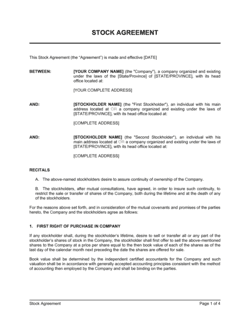
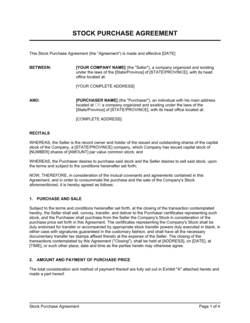
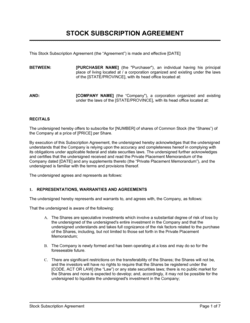
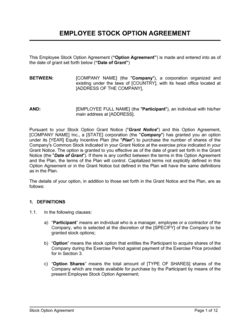
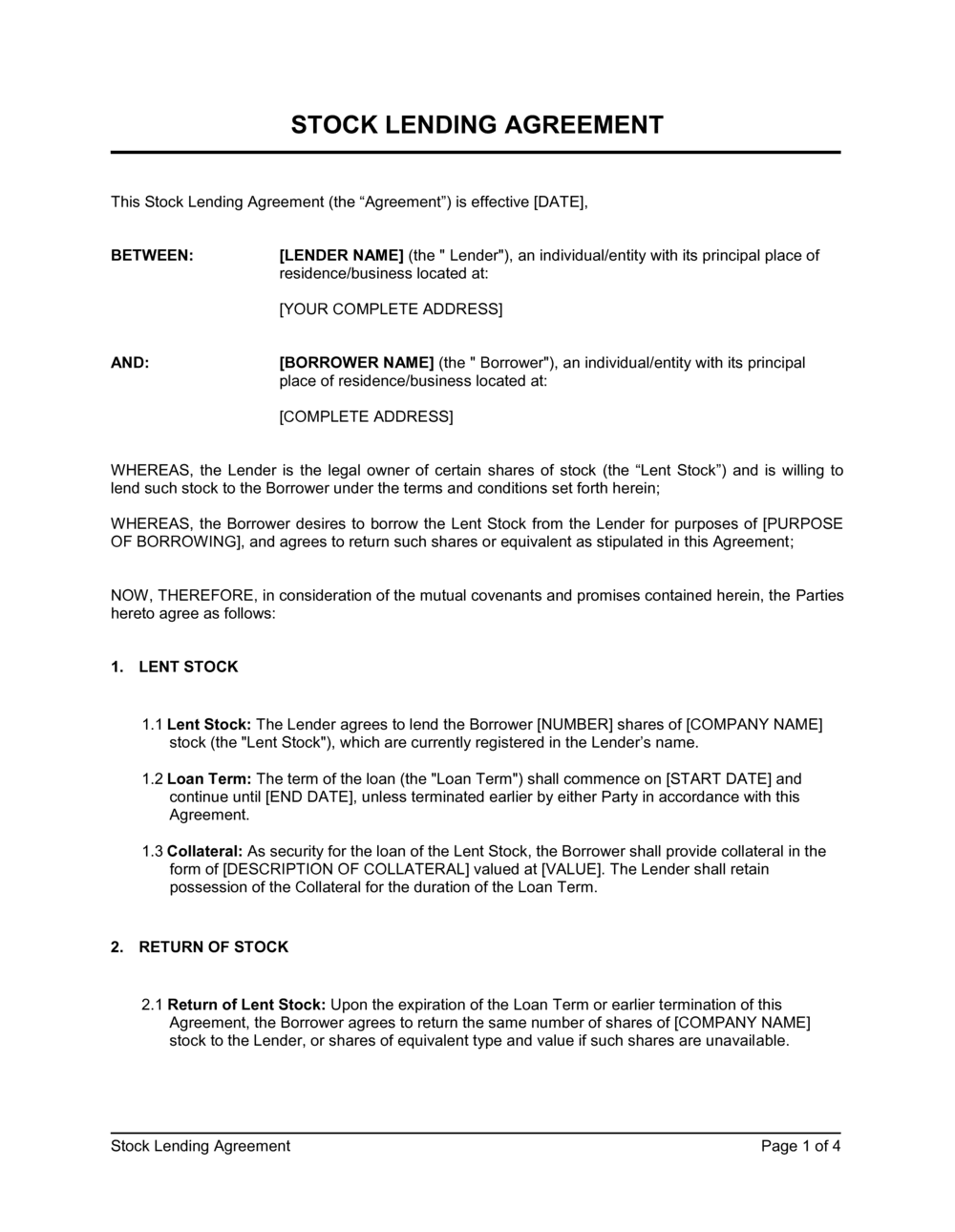
Stock Lending Agreement Template

Free Word download • Edit online • Save & share with Drive • Export to PDF

4 pages25–35 min to fillDifficulty: ComplexSignature requiredLegal review recommended
Learn more ↓
FreeStock Lending Agreement Template

At a glance

What it is
A Stock Lending Agreement is a legally binding contract under which a securities owner (the lender) temporarily transfers shares or other equity instruments to a borrower in exchange for collateral and a lending fee. This free Word download gives you a professionally structured template you can edit online and export as PDF — covering loan terms, collateral requirements, fee arrangements, dividend equivalents, recall rights, and default remedies in a single document.
When you need it
Use it whenever an institutional investor, broker-dealer, or private party lends securities to facilitate short selling, arbitrage strategies, or settlement coverage. It is also required when a portfolio manager wants to generate incremental income on a long-term equity position by temporarily transferring shares to a counterparty.
What's inside
Identification of the lender and borrower, loan commencement and term, description of loaned securities, collateral type and margin requirements, lending fee or rebate structure, manufactured dividend and corporate action provisions, recall and return rights, events of default, and governing law.

What is a Stock Lending Agreement?

A Stock Lending Agreement is a legally binding contract under which a securities owner — the lender — temporarily transfers shares or other equity instruments to a borrower in exchange for collateral and a lending fee, with the borrower contractually obligated to return equivalent securities at the end of the loan term. Unlike an outright sale, title reverts to the lender at maturity; in the interim, the borrower posts collateral equal to or greater than the market value of the loaned shares, and the lender receives manufactured dividend payments replicating any distributions declared during the loan period. The agreement governs every dimension of this relationship: the precise securities lent, the collateral type and margin requirements, the fee or rebate structure, corporate action handling, recall rights, and the remedies available to each party upon default.

Why You Need This Document

Operating a securities lending arrangement without a written agreement exposes both parties to serious and concrete risks. Without a recall right documented in writing, a lender cannot retrieve shares in time to vote at a shareholder meeting — votes are lost permanently, not recoverable after the record date. Without a close-out netting clause, a lender whose borrower becomes insolvent must pursue each defaulted loan individually through bankruptcy proceedings while the administrator selectively honors only favorable obligations. Without clear collateral and margin-call provisions, a collateral shortfall during a volatile market session can go unresolved for days, leaving the lender exposed to uncollateralized credit risk. Manufactured dividend disputes — especially in cross-border arrangements where withholding tax rates differ — generate some of the most expensive post-trade litigation in securities finance. A properly executed Stock Lending Agreement eliminates each of these exposures by fixing every material term before the first share is transferred, giving both parties a single enforceable document to rely on if conditions change.

Which variant fits your situation?

If your situation is…Use this template
Lending publicly traded equities between broker-dealer counterpartiesStock Lending Agreement (ISLA/GMSLA framework)
Lending government bonds or fixed-income securitiesSecurities Lending Agreement (Fixed Income)
Short-term share transfer with full title and repurchase obligationRepurchase Agreement (Repo)
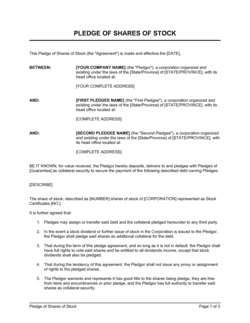
Pledging shares as collateral without transferring titleShare Pledge Agreement
Transferring stock as security for a personal or business loanStock Pledge Agreement
Allowing an investor to borrow on margin against a brokerage accountMargin Account Agreement
Documenting a sale and simultaneous agreement to repurchase sharesShare Buyback Agreement

Common mistakes to avoid

❌ Omitting a recall right on open-term loans

Why it matters: Without a contractual recall right, the lender cannot retrieve shares to exercise voting rights at a shareholder meeting or comply with a regulatory holding requirement, creating governance failures and potential regulatory breaches.

Fix: Include an explicit recall clause with a defined notice period and settlement window, and add a specific pre-record-date recall trigger ahead of any shareholder meeting.

❌ Failing to specify withholding tax treatment on manufactured dividends

Why it matters: Cross-border loans subject manufactured dividends to source-country withholding at the standard rate rather than the applicable treaty rate, causing permanent tax leakage that erodes the net yield on the lending program.

Fix: Confirm the applicable treaty rate for each borrower jurisdiction before execution, document it in the agreement, and include a gross-up obligation if the borrower withholds at the wrong rate.

❌ Using a benchmark rate without a fallback provision

Why it matters: Rebate rates pegged to LIBOR with no fallback became unenforceable overnight when LIBOR was discontinued, forcing expensive renegotiations or leaving the rate undefined until the dispute was resolved.

Fix: Reference a current benchmark (SOFR in USD, SONIA in GBP) and include a waterfall fallback provision specifying the replacement rate if the primary benchmark is discontinued or unavailable.

❌ No close-out netting clause

Why it matters: Without close-out netting, the non-defaulting party must continue performing its own obligations while the defaulting party's insolvency administrator selectively honors only favorable positions — a process called 'cherry-picking' that can result in catastrophic losses.

Fix: Include a close-out netting clause and confirm it is legally recognized in both parties' home jurisdictions, consulting local counsel in any civil-law jurisdiction before relying on it.

❌ Describing loaned securities by ticker symbol only

Why it matters: Ticker symbols can be reassigned or changed after corporate actions such as mergers, spin-offs, or relistings, making it impossible to identify the original loaned instrument with certainty if a dispute arises later.

Fix: Always identify securities by ISIN or CUSIP in addition to the issuer name and share class — these identifiers follow the security itself through corporate actions.

❌ Signing after the first securities transfer

Why it matters: In most jurisdictions, an agreement executed after the transaction it purports to govern may lack the legal authority to retroactively impose restrictive clauses — including default remedies and collateral rights — on the pre-agreement transfer.

Fix: Execute the master agreement before any securities are delivered. If a loan must be made urgently, use a binding term sheet or email confirmation that explicitly references the forthcoming master agreement.

The 10 key clauses, explained

Parties and Definitions

In plain language: Identifies the lender and borrower as legal entities and defines the key terms used throughout the agreement, including loaned securities, collateral, and business day.

Sample language
This Stock Lending Agreement is entered into on [DATE] between [LENDER LEGAL NAME], a [ENTITY TYPE] ('Lender'), and [BORROWER LEGAL NAME], a [ENTITY TYPE] ('Borrower'). Capitalized terms used herein have the meanings set out in Schedule 1.

Common mistake: Using trading names or account aliases instead of the full registered legal entity names — mismatches create enforceability gaps, particularly in insolvency proceedings where exact entity identity is scrutinized.

Loan Commencement and Term

In plain language: States the date the loan begins, the scheduled end date or open-term nature, and the conditions for extension or early termination by either party.

Sample language
The Loan shall commence on [DATE] and continue on an open basis until terminated by either party on [X] Business Days' written notice, unless a Fixed Term of [DATE] is specified in the relevant Loan Confirmation.

Common mistake: Failing to distinguish between open-term and fixed-term loans in the same master agreement — open loans require recall provisions; fixed-term loans require early-termination compensation clauses.

Description and Delivery of Loaned Securities

In plain language: Specifies exactly which securities are being lent — by issuer, ISIN, quantity, and class — and the settlement mechanics and deadline for delivery.

Sample language
Lender shall deliver [QUANTITY] ordinary shares of [ISSUER NAME] (ISIN: [ISIN CODE]) to Borrower's account at [CUSTODIAN] by [SETTLEMENT DATE], against receipt of Collateral as specified in Clause [X].

Common mistake: Describing securities by ticker symbol only rather than ISIN or CUSIP — tickers can change or be reassigned after corporate actions, creating disputes about which instrument was actually loaned.

Collateral and Margin Requirements

In plain language: Sets out the type of collateral the borrower must deliver, the initial margin percentage, the daily mark-to-market obligation, and the threshold for margin calls.

Sample language
Borrower shall deliver Collateral equal to [102]% of the Market Value of the Loaned Securities on the Loan Date and shall maintain that ratio daily. If the ratio falls below [100]%, Borrower shall deliver additional Collateral within [1] Business Day.

Common mistake: Setting a margin threshold without specifying a cure period — without a defined window to remedy a shortfall, disputes arise over whether an event of default has occurred or the borrower is still within cure.

Lending Fee and Rebate Rate

In plain language: States the annualized lending fee payable by the borrower, or the rebate rate payable on cash collateral, the payment frequency, and the calculation basis.

Sample language
Borrower shall pay Lender a Lending Fee of [X] basis points per annum on the daily Market Value of the Loaned Securities, payable monthly in arrears. Where Cash Collateral is provided, Lender shall pay Borrower a Rebate Rate of [BENCHMARK RATE minus X] basis points.

Common mistake: Pegging the rebate rate to a benchmark (e.g., SOFR, SONIA) without specifying a fallback if that benchmark is discontinued — this has caused material disputes for legacy agreements referencing LIBOR.

Manufactured Dividends and Corporate Actions

In plain language: Requires the borrower to pass through to the lender all cash dividends, stock dividends, and other distributions paid on the loaned securities during the loan term, net of applicable withholding tax.

Sample language
Borrower shall pay to Lender an amount equal to any cash dividend or distribution paid on the Loaned Securities on the record date during the Loan Term, within [2] Business Days of the payment date, net of withholding tax at the applicable treaty rate.

Common mistake: Omitting the withholding tax treatment for cross-border loans — lenders in higher-tax jurisdictions often receive manufactured dividends net of a tax that does not match the treaty rate they would have received directly, resulting in permanent tax leakage.

Recall Rights and Return of Securities

In plain language: Grants the lender the right to recall loaned securities at any time on open-term loans and requires the borrower to return equivalent securities within the specified settlement period.

Sample language
Lender may recall all or any part of the Loaned Securities by delivering a Recall Notice no later than [9:00 AM] on the intended settlement date. Borrower shall return equivalent Loaned Securities within [3] Business Days of receipt of a valid Recall Notice.

Common mistake: No contractual right to recall — common in informal bilateral arrangements. Without it, the lender cannot retrieve shares to vote at an AGM or meet a regulatory block-trade restriction, causing governance failures.

Voting Rights

In plain language: Clarifies that the borrower holds voting rights during the loan term as the registered holder of the securities, and sets out any agreed mechanism for the lender to receive a recall notice ahead of a record date.

Sample language
Borrower shall be entitled to exercise all voting rights attaching to the Loaned Securities during the Loan Term. Lender may recall Loaned Securities no later than [X] Business Days prior to any shareholder meeting record date if Lender wishes to exercise voting rights.

Common mistake: Assuming the lender retains voting rights without an explicit recall — once title passes to the borrower, votes follow the shares. Lenders who fail to recall before a record date permanently lose their vote for that meeting.

Events of Default and Close-Out

In plain language: Lists specific default triggers and gives the non-defaulting party the right to terminate all open loans immediately, value all positions at market, and net obligations to a single payment.

Sample language
Each of the following constitutes an Event of Default: (a) failure to return Loaned Securities within [3] Business Days of a valid Recall Notice; (b) failure to deliver or maintain Collateral; (c) insolvency, liquidation, or appointment of a receiver. Upon an Event of Default, the non-defaulting party may terminate all Loans and apply close-out netting.

Common mistake: Listing events of default without a netting clause — without close-out netting, the non-defaulting party must fulfill its own obligations while the defaulting party's estate cherry-picks which obligations to honor.

Governing Law and Jurisdiction

In plain language: Specifies which jurisdiction's law governs the agreement and where disputes will be resolved — a court, arbitral forum, or the courts of a specified city.

Sample language
This Agreement and all Loans made hereunder are governed by the laws of [ENGLAND AND WALES / STATE OF NEW YORK / OTHER JURISDICTION]. The parties irrevocably submit to the exclusive jurisdiction of the courts of [CITY / JURISDICTION] for the resolution of any dispute.

Common mistake: Choosing governing law without considering where each party's assets are held and enforced — a New York-law agreement may be difficult to enforce against a borrower whose assets sit in a jurisdiction that does not recognize New York judgments without a full re-litigation.

How to fill it out

  1. 1

    Enter the legal entity names and roles

    Identify the lender and borrower by their full registered legal names, jurisdiction of incorporation, and principal office addresses. Confirm which party is the securities owner and which is the borrower.

    💡 Pull entity names directly from the corporate registry filing — mismatches between the agreement and registry records can void the title transfer in insolvency.

  2. 2

    Specify the loaned securities precisely

    List each security by issuer name, ISIN or CUSIP, share class, and quantity. If the agreement is a master that will govern multiple loan transactions, note that specific securities will be identified in individual loan confirmations.

    💡 Use ISIN rather than ticker symbol — tickers change; ISINs are permanent identifiers tied to the specific security class.

  3. 3

    Set the collateral type and initial margin

    Choose cash, government securities, or approved non-cash collateral. Set the initial margin percentage (typically 102% for domestic equities, 105% for international) and the daily mark-to-market threshold that triggers a margin call.

    💡 Non-cash collateral requires a haircut schedule — the percentage discount applied to each eligible collateral type based on its liquidity and credit quality.

  4. 4

    Define the lending fee or rebate rate

    Enter the annualized lending fee in basis points, the payment frequency (monthly is standard), and the calculation basis (actual/360 or actual/365). For cash collateral, specify the rebate rate benchmark and spread.

    💡 For hard-to-borrow securities, negotiate the fee before execution and record it in the loan confirmation rather than the master agreement, so it can be updated without amending the contract.

  5. 5

    Complete the manufactured dividend and corporate action provisions

    Confirm the withholding tax rate applicable to the lender's jurisdiction, the payment timeline for manufactured dividends, and how stock splits, rights issues, and mergers are handled.

    💡 For cross-border loans, confirm the applicable tax treaty rate in writing before execution — a rate dispute after a dividend payment date is difficult to resolve retroactively.

  6. 6

    Set recall notice periods and return mechanics

    Choose the number of business days' notice required for recall (one to three is market standard) and the settlement window for the borrower's return obligation. Align these with the standard settlement cycle for the relevant market.

    💡 Build in a pre-record-date recall window — specify that the lender may deliver a recall notice at least five business days before any shareholder meeting record date to preserve voting rights.

  7. 7

    Define events of default and close-out netting

    List all default triggers — failure to return, collateral shortfall, insolvency, regulatory action — and confirm that the netting clause covers all open loans under the master agreement.

    💡 Confirm that close-out netting is legally enforceable in both parties' jurisdictions before relying on it — several civil-law countries require specific regulatory approvals for netting to be binding in insolvency.

  8. 8

    Select governing law and sign before the first loan

    Choose the governing law (New York law or English law are the two market standards) and the dispute-resolution forum. Both parties should sign the master agreement before any securities are transferred.

    💡 Use the ISLA Global Master Securities Lending Agreement (GMSLA) or SIFMA/ISLA Master Securities Loan Agreement (MSLA) as a baseline and adapt from there — custom drafting from scratch increases legal review time and cost significantly.

Frequently asked questions

What is a stock lending agreement?

A stock lending agreement is a legally binding contract under which a securities owner (the lender) temporarily transfers shares or other equity instruments to a borrower in exchange for collateral and a lending fee. Unlike a sale, the borrower is obligated to return equivalent securities at the end of the loan term. The lender retains economic exposure through manufactured dividend payments and the collateral arrangement, but loses voting rights for the duration of the loan.

Why do parties enter into stock lending agreements?

Lenders use stock lending to generate incremental income on long-term holdings without selling the position. Borrowers — typically broker-dealers, prime brokers, and hedge funds — use borrowed securities to cover short-sale delivery obligations, support arbitrage strategies, or facilitate market-making. The lending fee compensates the lender for the credit risk and opportunity cost of transferring title to the securities.

What collateral is acceptable in a stock lending agreement?

Acceptable collateral typically includes cash (USD, GBP, EUR), government bonds (Treasuries, Gilts, Bunds), agency securities, and, in some agreements, investment-grade corporate bonds or equity securities with an approved haircut. Cash collateral is the most common form in North America; non-cash collateral (government bonds) is more prevalent in European markets. The agreement should specify eligible collateral types, haircut percentages, and concentration limits.

What is the difference between a stock lending agreement and a repurchase agreement?

In a repurchase agreement (repo), a party sells securities and simultaneously agrees to buy them back at a fixed price on a future date — the economics resemble secured borrowing. In a stock lending agreement, title transfers but the borrower posts collateral and pays a fee; the lender retains economic exposure through manufactured dividends. Repos are typically used for liquidity management and fixed-income financing; stock lending is primarily used to supply securities for short selling and settlement.

Does the lender lose voting rights when lending shares?

Yes. Once title to the shares passes to the borrower, the borrower becomes the registered holder and controls the voting rights for the duration of the loan. Lenders who wish to vote at a shareholder meeting must recall the securities before the record date — typically requiring notice of three to five business days. Institutional investors running lending programs often face a trade-off between fee income and governance engagement; some adopt a policy of recalling for material votes only.

Are manufactured dividends taxed the same as ordinary dividends?

Not always. Manufactured dividends are contractual payments that replicate the economic value of a dividend, but their tax treatment differs by jurisdiction. In many countries, manufactured dividends do not qualify for the same reduced withholding tax rates available under bilateral tax treaties that apply to direct dividends. Cross-border stock lending programs should confirm the applicable withholding treatment with tax counsel before execution, as the difference can materially affect the net yield.

Is a stock lending agreement legally enforceable?

A properly executed stock lending agreement is generally enforceable as a binding contract in most common-law and civil-law jurisdictions when it includes offer, acceptance, and consideration. However, enforceability of specific provisions — particularly close-out netting and collateral enforcement — varies by jurisdiction. In some civil-law countries, netting is enforceable only under a recognized master agreement framework (such as the GMSLA) and may require regulatory recognition. Legal review is strongly recommended for cross-border arrangements or where insolvency scenarios are a material concern.

What is the GMSLA and should my agreement follow it?

The Global Master Securities Lending Agreement (GMSLA), published by the International Securities Lending Association (ISLA), is the industry-standard master agreement for cross-border equity and bond lending. In North America, the SIFMA/ISLA Master Securities Loan Agreement (MSLA) serves a similar function. Using these frameworks provides legal certainty, market familiarity, and recognized close-out netting opinions in over 60 jurisdictions. For bilateral or proprietary arrangements, adapting from the GMSLA baseline is significantly faster and safer than drafting from scratch.

What happens if the borrower defaults and cannot return the securities?

If the borrower defaults, the lender is entitled to enforce its collateral rights — selling or applying the posted collateral to purchase equivalent securities in the market or satisfy the outstanding obligation. Under a close-out netting clause, all open loans are terminated simultaneously, positions are valued at current market prices, and a single net payment is calculated. Without close-out netting, the lender must pursue each defaulted loan separately through insolvency proceedings, which is significantly slower and less certain.

How this compares to alternatives

vs Share Pledge Agreement

A share pledge agreement uses shares as collateral for a loan without transferring title — the pledgor retains ownership and voting rights unless the borrower defaults and enforces the pledge. A stock lending agreement transfers full title to the borrower in exchange for collateral and a fee. Pledges are used for secured financing; stock lending is used for short selling and yield enhancement.

vs Repurchase Agreement (Repo)

A repo is economically equivalent to secured borrowing — one party sells securities and agrees to buy them back at a fixed price, embedding interest in the price differential. A stock lending agreement transfers title in exchange for collateral and an explicit fee, with the borrower returning equivalent securities at the end of the term. Repos dominate fixed-income markets; stock lending is the primary mechanism for equity short selling.

vs Margin Account Agreement

A margin account agreement governs a broker's right to lend a retail or institutional client's securities held on margin, often under a general customer agreement. A standalone stock lending agreement is a bilateral negotiated contract between two counterparties with specific fee terms, collateral schedules, and recall provisions. Institutional lenders need a dedicated stock lending agreement; retail margin lending is covered by the brokerage customer agreement.

vs Securities Purchase Agreement

A securities purchase agreement permanently transfers ownership of shares from seller to buyer for a fixed price with no return obligation. A stock lending agreement transfers title temporarily with a contractual obligation to return equivalent securities and pay a lending fee. If the goal is outright acquisition of shares, use a purchase agreement; if the goal is temporary access to securities for short selling or settlement, use a stock lending agreement.

Industry-specific considerations

Asset Management

Pension funds, mutual funds, and ETF managers run systematic lending programs to generate basis-point returns on large, stable equity positions without altering their investment mandate.

Financial Services / Prime Brokerage

Prime brokers intermediate stock lending at scale, borrowing securities from custodian banks and institutional lenders to supply hedge fund clients covering short positions across global markets.

Investment Banking

Equity finance desks use stock lending to support block trades, equity swaps, and convertible bond hedges, requiring precise recall and delivery mechanics tied to settlement deadlines.

Insurance

Insurance companies lend portions of their general account equity portfolios under strict regulatory parameters, requiring collateral eligibility schedules aligned with local solvency frameworks such as Solvency II or RBC rules.

Jurisdictional notes

United States

Stock lending in the US is primarily governed by the SIFMA/ISLA Master Securities Loan Agreement (MSLA). The SEC's Regulation T and FINRA Rule 4330 govern broker-dealer securities lending programs. Close-out netting is recognized under the Bankruptcy Code's safe-harbor provisions for securities contracts (11 U.S.C. §§ 555–562), providing strong protection in counterparty insolvency. State UCC Article 8 governs title transfer and collateral rights for securities held through intermediaries.

Canada

Securities lending in Canada follows the ISLA GMSLA framework adapted for Canadian law. IIROC (now CIRO) rules govern broker-dealer lending programs, and provincial securities legislation applies to registered dealers and advisers. Close-out netting is enforceable under the Payment Clearing and Settlement Act for designated netting systems. Manufactured dividends receive favorable treatment under the Income Tax Act when paid between arm's-length Canadian entities, but cross-border withholding must be analyzed under the applicable tax treaty.

United Kingdom

English law governs the majority of global stock lending under the ISLA GMSLA (2010 and 2018 versions), and English courts have a well-developed body of case law supporting close-out netting. The FCA's Client Assets Sourcebook (CASS) imposes strict rules on FCA-regulated firms lending client securities, including enhanced disclosure and consent requirements. Post-Brexit, UK and EU netting opinions must be obtained separately for cross-border arrangements.

European Union

The EU Securities Financing Transactions Regulation (SFTR) requires both counterparties to report stock lending transactions to a registered trade repository within one business day, with detailed data fields covering collateral, fees, and tenor. EMIR close-out netting opinions are required for EU-domiciled entities. Member state insolvency law varies significantly — French and German law provide strong netting recognition, while some other jurisdictions require specific contractual structures to achieve equivalent protection. GDPR considerations apply to any personal data processed in connection with individual account holders.

Template vs lawyer — what fits your deal?

PathBest forCostTime
Use the templateStraightforward bilateral equity lending between two domestic counterparties with standard collateral and fee termsFree1–2 hours
Template + legal reviewDomestic institutional programs, broker-dealer arrangements, or first-time lending agreements where collateral and default provisions need verification$500–$1,5002–5 days
Custom draftedCross-border lending programs, GMSLA/MSLA adaptation, regulated entities (pension funds, insurance companies), or complex collateral and netting structures$3,000–$15,000+2–6 weeks

Glossary

Securities Lending
The temporary transfer of securities from a lender to a borrower in exchange for collateral and a fee, with an obligation to return equivalent securities.
Loaned Securities
The specific shares or equity instruments temporarily transferred to the borrower under the agreement.
Collateral
Assets — typically cash, government bonds, or letters of credit — delivered by the borrower to the lender as security for the return of loaned securities.
Margin Requirement
The minimum collateral value expressed as a percentage of the market value of loaned securities, typically 102–105% for domestic equities.
Lending Fee
The annualized rate charged by the lender to the borrower for the use of the securities, expressed as a basis-point spread or a fixed percentage.
Rebate Rate
When cash collateral is used, the interest paid by the lender back to the borrower on the deposited cash, often set below prevailing money-market rates.
Manufactured Dividend
A payment made by the borrower to the lender that replicates any cash dividend declared on the loaned securities during the loan term.
Recall Notice
A formal notification from the lender requiring the borrower to return the loaned securities, typically within a defined settlement window of one to three business days.
Mark-to-Market
The daily or intraday process of revaluing loaned securities and adjusting collateral posted to maintain the required margin level.
Event of Default
A defined trigger — such as failure to return securities, insolvency, or collateral shortfall — that entitles the non-defaulting party to close out and net all open positions.
Close-Out Netting
The contractual right to offset all obligations between two parties upon default so that only a single net amount is owed, reducing counterparty credit exposure.
Hard-to-Borrow
A designation for securities with limited supply in the lending market, typically commanding significantly higher fees than general collateral.

Part of your Business Operating System

This document is one of 3,000+ business & legal templates included in Business in a Box.

  • Fill-in-the-blanks — ready in minutes
  • 100% customizable Word document
  • Compatible with all office suites
  • Export to PDF and share electronically

Create your document in 3 simple steps.

From template to signed document — all inside one Business Operating System.
1
Download or open template

Access over 3,000+ business and legal templates for any business task, project or initiative.

2
Edit and fill in the blanks with AI

Customize your ready-made business document template and save it in the cloud.

3
Save, Share, Send, Sign

Share your files and folders with your team. Create a space of seamless collaboration.

Save time, save money, and create top-quality documents.

★★★★★

"Fantastic value! I'm not sure how I'd do without it. It's worth its weight in gold and paid back for itself many times."

Managing Director · Mall Farm
Robert Whalley
Managing Director, Mall Farm Proprietary Limited
★★★★★

"I have been using Business in a Box for years. It has been the most useful source of templates I have encountered. I recommend it to anyone."

Business Owner · 4+ years
Dr Michael John Freestone
Business Owner
★★★★★

"It has been a life saver so many times I have lost count. Business in a Box has saved me so much time and as you know, time is money."

Owner · Upstate Web
David G. Moore Jr.
Owner, Upstate Web

Run your business with a system — not scattered tools

Stop downloading documents. Start operating with clarity. Business in a Box gives you the Business Operating System used by over 250,000 companies worldwide to structure, run, and grow their business.

Start free · No credit card required