Shares Capital Description Preferred Shares Template

Free Word download • Edit online • Save & share with Drive • Export to PDF

14 pages30–40 min to fillDifficulty: ComplexSignature requiredLegal review recommended
Learn more ↓
FreeShares Capital Description Preferred Shares Template

At a glance

What it is
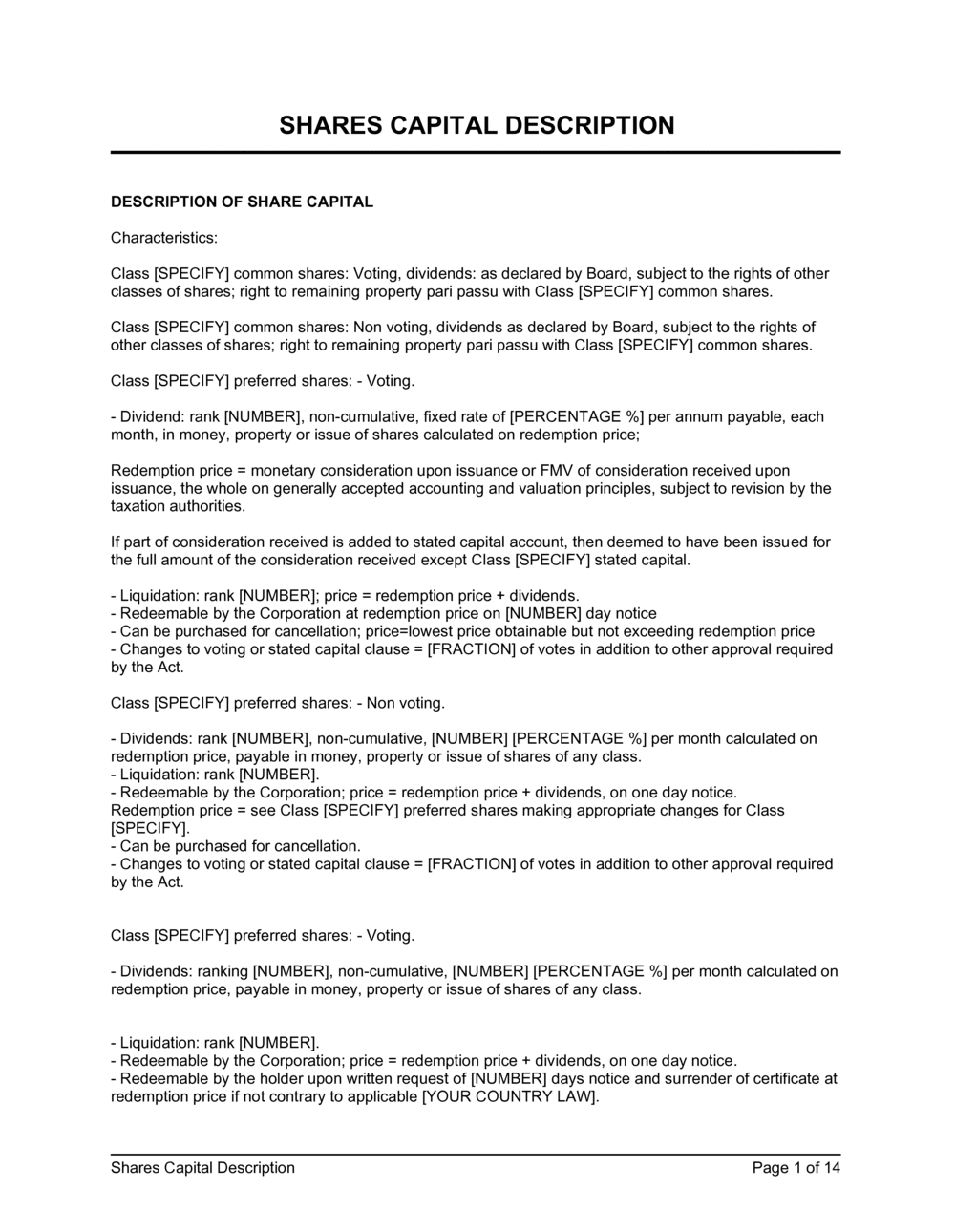
A Shares Capital Description — Preferred Shares is a binding corporate document that formally defines the rights, privileges, restrictions, and conditions attached to a class of preferred shares in a corporation's authorized capital structure. This free Word download gives you a structured, attorney-ready starting point covering dividends, liquidation preference, conversion rights, voting rights, and redemption terms — ready to incorporate into your articles of incorporation, shareholder agreement, or share purchase agreement.
When you need it
Use it when incorporating a new entity with multiple share classes, when issuing preferred shares to investors in a seed or Series A round, or when amending an existing share structure to add or reclassify a preferred class. It is also required when updating a corporation's articles or charter to reflect capital changes approved by shareholders.
What's inside
The template covers the full description of preferred share rights including cumulative or non-cumulative dividend entitlements, liquidation and dissolution preference over common shares, optional and mandatory conversion mechanics, anti-dilution adjustments, voting rights, redemption provisions, and the rank of the preferred class relative to other share classes in the capital structure.

What is a Shares Capital Description — Preferred Shares?

A Shares Capital Description — Preferred Shares is a formal binding corporate document that defines all the rights, privileges, restrictions, and conditions attached to a class of preferred shares in a corporation's authorized capital structure. It specifies how preferred shareholders are treated in relation to common shareholders across four critical dimensions: economic rights (dividends, liquidation preference, and participation), conversion mechanics (voluntary and mandatory conversion into common shares, anti-dilution adjustments), governance rights (voting, protective provisions, and board representation triggers), and exit mechanics (redemption rights and deemed liquidation definitions). In most jurisdictions, this document is embedded in or attached to the corporation's articles of incorporation, making it a public corporate record rather than a private agreement.

Preferred shares are the standard equity instrument used in venture capital and angel financing because they allow investors to negotiate specific protections — a priority return of capital, anti-dilution adjustments in down rounds, and veto rights over major corporate decisions — while still holding equity that converts into common shares at a successful exit. The shares capital description is the document that makes those protections legally binding and enforceable against the corporation and all current and future shareholders.

Why You Need This Document

Without a clearly drafted preferred shares capital description, the specific economic and governance protections that investors negotiate in a term sheet have no legal standing once shares are issued. A handshake understanding of "1× liquidation preference and weighted-average anti-dilution" means nothing if those terms are not formally incorporated into the articles. When a sale or merger occurs, the distribution of proceeds is determined by what the articles say — not what the parties understood at the time of investment. Ambiguous or missing terms in the capital description become the basis for shareholder disputes, delayed closings, and, in the worst cases, litigation that consumes the very proceeds being distributed.

For founders, a well-structured preferred share description protects the common share value that founders and employees hold. For investors, it is the legal foundation of their economic rights. For both parties, having a professionally structured template as a starting point — reviewed by counsel before filing — reduces the negotiation surface, speeds up incorporation and amendment filings, and ensures the document integrates cleanly with the shareholder agreement and share purchase agreement that accompany every serious financing round.

Which variant fits your situation?

If your situation is…Use this template
Issuing convertible preferred shares to institutional investors in a priced roundShares Capital Description Preferred Shares
Describing common shares and their voting and dividend rightsShares Capital Description Common Shares
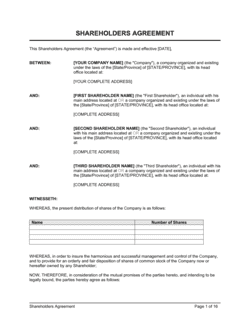
Governing all shareholder rights and share transfer restrictionsShareholder Agreement
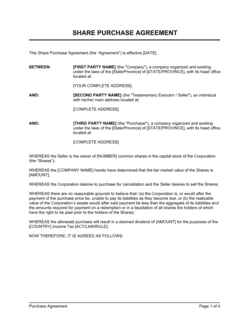
Documenting the sale of preferred or common shares to investorsShare Purchase Agreement
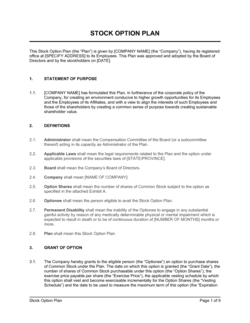
Issuing shares to employees or advisors with vesting conditionsStock Option Plan
Recording the initial share issuance at incorporationSubscription Agreement
Amending an existing share class after a new funding roundShare Capital Amendment Resolution

Common mistakes to avoid

❌ Omitting the deemed liquidation definition

Why it matters: Without it, a sale of the company for cash may not trigger the liquidation preference, leaving preferred investors with no priority over founders in the most common exit scenario.

Fix: Define Deemed Liquidation Event to include any merger, acquisition, or asset sale representing more than 50% of the corporation's assets or voting control, and confirm the definition is cross-referenced in the shareholder agreement.

❌ Using full-ratchet anti-dilution without understanding the founder impact

Why it matters: Full-ratchet adjusts the conversion price to match the lowest subsequent issuance price, which can convert a modest down-round into catastrophic dilution for founders and employees.

Fix: Default to broad-based weighted-average anti-dilution for early rounds. Reserve full-ratchet only for specific tranches in highly negotiated term sheets where investors explicitly require it.

❌ Authorizing exactly the number of shares you plan to issue

Why it matters: If you exhaust the authorized preferred shares before the round closes or before a follow-on tranche, you cannot issue additional shares without calling a shareholder meeting and amending the articles — a process that can take 4–8 weeks and can delay or collapse a closing.

Fix: Authorize at least 1.25–1.5× the shares you intend to issue in the current round to provide a buffer for option conversion and additional tranches.

❌ Making all corporate actions subject to preferred-class protective provisions

Why it matters: Overly broad protective provisions mean preferred shareholders can block routine decisions — approving annual budgets, hiring executives, or entering standard vendor contracts — creating deadlock in day-to-day governance.

Fix: Limit protective provisions to capital structure changes, dividend payments on junior classes, related-party transactions above a threshold, and amendments to the articles or shareholder agreement that adversely affect the preferred class.

❌ Granting fully participating preferred with no cap in seed rounds

Why it matters: On a $10M exit with a 1× liquidation preference plus full participation, a preferred holder investing $3M at a 30% stake may recover $6M — nearly double the investment — while founders and employees share the remainder, destroying retention incentives before closing.

Fix: Cap participation at 2–3× the stated capital per share, or negotiate non-participating preferred (preference only, no residual sharing) in exchange for a higher preference multiple.

❌ Inconsistent defined terms across the articles, share description, and shareholder agreement

Why it matters: If 'Conversion Price' is defined differently in the articles than in the shareholder agreement, every conversion event becomes a negotiation — or a lawsuit — over which document governs.

Fix: Run a defined-terms audit across all three documents before execution. Where definitions differ, choose the most precise version and update all documents to match before signing.

The 10 key clauses, explained

Share Class Designation and Authorized Number

In plain language: Names the class (e.g., Series A Preferred Shares) and states the total number of shares authorized in that class.

Sample language
The Corporation is authorized to issue [NUMBER] shares designated as Series [A] Preferred Shares (the 'Preferred Shares'), with a stated capital of $[AMOUNT] per share.

Common mistake: Authorizing too few shares at incorporation — if the number is exhausted before a subsequent round closes, an emergency shareholders' meeting is required to authorize more, delaying the deal.

Dividend Rights

In plain language: Sets the preferred dividend rate, states whether dividends are cumulative or non-cumulative, and defines when and how dividends are paid relative to common shares.

Sample language
Holders of Preferred Shares shall be entitled to receive, when and as declared by the Board, cumulative preferential dividends at a rate of [X]% per annum on the stated capital per share, before any dividend is declared or paid on the Common Shares.

Common mistake: Omitting whether dividends are cumulative or non-cumulative. Courts and regulators in multiple jurisdictions treat the default differently, creating uncertainty that becomes a dispute in a future liquidity event.

Liquidation Preference

In plain language: Defines what preferred shareholders receive first in a dissolution, wind-up, sale, or deemed liquidation event — typically stated capital plus any accrued unpaid dividends — before common shareholders receive anything.

Sample language
In the event of any liquidation, dissolution, wind-up, or Deemed Liquidation Event, holders of Preferred Shares shall be entitled to receive, prior to any distribution to holders of Common Shares, an amount equal to $[X] per share plus all accrued and unpaid dividends.

Common mistake: Failing to define 'Deemed Liquidation Event' to include a merger or acquisition. Without this definition, a sale of the company may not trigger the liquidation preference, leaving preferred investors unprotected.

Conversion Rights

In plain language: Gives preferred shareholders the right to convert their shares into common shares at a defined conversion ratio, and specifies events that trigger mandatory conversion.

Sample language
Each Preferred Share is convertible, at the option of the holder, into [RATIO] fully paid Common Shares at any time. Conversion shall be mandatory upon a Qualified IPO generating aggregate gross proceeds of not less than $[AMOUNT] at a price per share of not less than $[X].

Common mistake: Setting the mandatory conversion threshold too low. If a modest public offering triggers forced conversion before investors have recovered their preference, the protective value of the preferred class is eliminated.

Anti-Dilution Adjustment

In plain language: Adjusts the conversion price of preferred shares downward if the company later issues shares at a price below the original conversion price, protecting earlier investors from dilution.

Sample language
If the Corporation issues Common Shares or securities convertible into Common Shares at a price per share less than the then-applicable Conversion Price, the Conversion Price shall be adjusted on a [broad-based weighted-average / full ratchet] basis as set out in Schedule [A].

Common mistake: Using full-ratchet anti-dilution instead of weighted-average without understanding the consequence. Full ratchet can reduce the conversion price to the new low price, severely diluting founders and employees in a down round.

Voting Rights

In plain language: States the number of votes each preferred share carries — typically one vote per common share into which it could be converted — and identifies any matters reserved for a separate class vote.

Sample language
Each holder of Preferred Shares shall be entitled to [one] vote for each Common Share into which such Preferred Share is then convertible, voting together with holders of Common Shares as a single class, except as otherwise provided herein or required by law.

Common mistake: Granting preferred shareholders super-majority voting power on all matters rather than restricting special votes to protective provisions only. This can paralyze routine corporate decisions when investor and founder interests diverge.

Protective Provisions

In plain language: Lists specific corporate actions — such as creating a new senior share class, paying dividends on common shares, or amending the articles — that require approval of a specified majority or supermajority of preferred shareholders.

Sample language
For so long as at least [X]% of the Preferred Shares remain outstanding, the Corporation shall not, without the prior written consent of the holders of at least [X]% of the outstanding Preferred Shares: (a) authorize or issue any shares ranking senior to or on parity with the Preferred Shares; (b) declare or pay any dividend on Common Shares; (c) amend the articles in a manner adverse to the Preferred Shares.

Common mistake: Making the protective-provision consent threshold so low (e.g., any single preferred shareholder) that routine corporate governance becomes subject to minority veto, making the company uninvestable for future rounds.

Redemption

In plain language: Allows the corporation, the preferred shareholder, or both to redeem (buy back) the preferred shares at a stated price after a specified date or upon a triggering event.

Sample language
At any time after [DATE], holders of not less than [X]% of the outstanding Preferred Shares may require the Corporation to redeem all or any portion of the Preferred Shares at a price per share equal to the stated capital plus all accrued and unpaid dividends, payable within [90] days of written demand.

Common mistake: Including a mandatory redemption clause without confirming the corporation will have sufficient available surplus to fund it. In many jurisdictions, a corporation may not redeem shares if it is insolvent or the redemption would render it insolvent.

Rank and Priority

In plain language: States where the preferred class sits in the capital hierarchy relative to other existing or future share classes — confirming it ranks ahead of common shares and equal to or behind other preferred series.

Sample language
The Preferred Shares shall rank: (a) senior to the Common Shares with respect to the payment of dividends and the distribution of assets on liquidation; and (b) pari passu with any other series of Preferred Shares designated by the Board unless otherwise specified in the applicable share description.

Common mistake: Omitting the ranking clause entirely and relying on order of share class creation. If a future series is created without an explicit ranking, litigation over priority in a liquidation is almost certain.

Participating Rights on Liquidation

In plain language: Determines whether preferred shareholders receive only their liquidation preference or also participate in residual proceeds alongside common shareholders after recovering their preference.

Sample language
After payment of the liquidation preference described herein, the remaining assets of the Corporation available for distribution shall be distributed pro rata among the holders of Common Shares and Preferred Shares on an as-converted basis [up to a maximum aggregate return of [X]× the stated capital per Preferred Share / without cap].

Common mistake: Granting fully participating preferred with no cap in early-stage rounds. At exit, this can reduce common shareholder (and founder) proceeds so dramatically that key employees become demotivated before closing.

How to fill it out

  1. 1

    Identify the share class and authorized number

    Name the series (e.g., Series A Preferred Shares) and decide how many shares to authorize. Authorize at least 20–30% more than you plan to issue to accommodate option grants and future tranches without a shareholder vote.

    💡 Use a round number like 10,000,000 authorized — it simplifies the cap table math and is standard in venture-backed structures.

  2. 2

    Set the dividend rate and cumulation basis

    Choose a dividend rate (typically 6–8% per annum for venture preferred) and explicitly state whether dividends are cumulative or non-cumulative. For most early-stage rounds, cumulative non-cash dividends that convert at exit are standard.

    💡 If dividends are cumulative, confirm your financial model can handle the accrual — cumulative dividends that grow for 5 years can materially reduce common-share proceeds at exit.

  3. 3

    Define the liquidation preference and deemed liquidation trigger

    Set the preference amount per share (typically 1× stated capital) and explicitly define Deemed Liquidation Event to include mergers, asset sales, and change of control transactions above and below a threshold.

    💡 Include a carve-out for internal restructurings or same-entity reorganizations so routine corporate housekeeping does not accidentally trigger the preference.

  4. 4

    Set the conversion ratio and mandatory conversion threshold

    The initial conversion ratio is typically 1:1 (one preferred to one common). Set the mandatory IPO conversion threshold at a price and proceeds level that reflects a genuine liquidity outcome — at least 3× the original issue price is common.

    💡 Confirm the conversion ratio interacts correctly with the anti-dilution formula — a weighted-average adjustment changes the effective ratio at conversion.

  5. 5

    Choose and document the anti-dilution mechanism

    Select broad-based weighted-average anti-dilution for most rounds. Document the exact formula in a schedule attached to the description, including all share classes included in the 'fully diluted' base.

    💡 Exclude shares issued to employees under stock option plans from the anti-dilution trigger — including them would make routine option grants prohibitively expensive.

  6. 6

    Draft the protective provisions list

    List every corporate action that requires a separate preferred-class vote, and set the consent threshold at 50–67% of outstanding preferred shares. Limit protective provisions to genuinely material actions to avoid governance paralysis.

    💡 Review every protective provision against your standard corporate calendar — if a routine board action lands on the list, remove it.

  7. 7

    Confirm redemption mechanics and solvency compliance

    If including a redemption right, confirm the redemption date is at least 5 years from issuance and verify that applicable corporate statutes permit redemption from available surplus only. Add language voiding the obligation if the corporation would be rendered insolvent.

    💡 In Canada, the Canada Business Corporations Act and most provincial statutes prohibit redemptions that would leave a corporation unable to pay its liabilities. Include a statutory solvency carve-out by name.

  8. 8

    Integrate with articles of incorporation and shareholder agreement

    Cross-reference the share description by title in the articles of incorporation and the shareholder agreement. Confirm that all three documents use identical defined terms for conversion price, liquidation event, and conversion ratio.

    💡 Inconsistent defined terms across the articles and shareholder agreement are the single most common source of investor-founder disputes at exit — run a definitions audit before execution.

Frequently asked questions

What is a shares capital description for preferred shares?

A shares capital description for preferred shares is a formal corporate document that defines all the rights, privileges, restrictions, and conditions attached to a class of preferred shares in a corporation's authorized capital. It covers dividend entitlements, liquidation preference, conversion mechanics, voting rights, anti-dilution protections, redemption terms, and the rank of the preferred class relative to common and other share classes. It is typically incorporated into or attached to the corporation's articles of incorporation.

What is the difference between preferred shares and common shares?

Common shares represent basic ownership with voting rights and a residual claim on assets after all other obligations are paid. Preferred shares carry preferential rights — they receive dividends before common shareholders and recover their capital before common shareholders in a liquidation or sale. Preferred shares are typically issued to investors while founders and employees hold common shares. In most startup structures, preferred shares are convertible into common shares at the holder's option or upon an IPO.

When does a corporation need to create a preferred share class?

A corporation typically creates a preferred share class when raising capital from institutional investors, angel investors, or venture capital funds who require preferential protections in exchange for their investment. It is also used when splitting the ownership structure between founders (common) and investors (preferred) at incorporation, or when amending the capital structure to accommodate a new financing round that requires a senior or pari-passu share class.

What is a liquidation preference and why does it matter?

A liquidation preference gives preferred shareholders the right to receive a specified amount — typically 1× their invested capital plus accrued dividends — before common shareholders receive any proceeds in a sale, merger, or wind-up. It matters because most startup exits occur through M&A rather than IPO, and at moderate exit valuations the liquidation preference can consume all or most of the proceeds, leaving common shareholders (founders and employees) with little or nothing. Negotiating the preference multiple and participation cap directly determines how proceeds are split at exit.

What is anti-dilution protection in a preferred share description?

Anti-dilution protection adjusts the conversion price of preferred shares downward when the company issues new shares at a lower price than earlier investors paid, reducing the dilutive effect of a down round. The two main types are broad-based weighted-average (the most common and investor-friendly balance) and full-ratchet (the most aggressive, resetting the conversion price to the lowest new issuance price). Broad-based weighted-average anti-dilution is standard in most venture term sheets today.

Do preferred shares always have voting rights?

Not necessarily. Preferred shares may have no voting rights, limited voting rights on specific matters only, or the same voting rights as common shares on an as-converted basis. In most venture-backed structures, preferred shareholders vote alongside common shareholders on an as-converted basis for routine matters, but hold a separate class vote on specific protective provisions such as creating a new senior share class or amending the articles in a way that adversely affects the preferred class.

What are protective provisions in a preferred share description?

Protective provisions are a list of corporate actions that require approval of a majority or supermajority of preferred shareholders as a separate class, regardless of the overall shareholder vote. Common protective provisions include authorizing a new share class senior to existing preferred, paying dividends on common shares, selling all or substantially all of the company's assets, and amending the articles in a manner that adversely affects the preferred class. They function as a minority veto on matters most critical to investor protection.

Is a shares capital description the same as a shareholders agreement?

No. A shares capital description defines the specific rights attached to a share class and is typically embedded in or attached to the corporation's articles of incorporation — making it a public corporate record in most jurisdictions. A shareholders agreement is a private contract among the shareholders and the corporation that governs transfer restrictions, drag-along and tag-along rights, board composition, information rights, and other governance matters. Both documents are needed in a complete venture financing and must use consistent defined terms.

Does a shares capital description need to be filed with the government?

In most jurisdictions, yes. In the United States, the certificate of incorporation (or its equivalent) containing the preferred share description is filed with the secretary of state. In Canada, preferred share terms are set out in the articles of incorporation filed with the federal or provincial corporate registry. In the UK, the statement of capital and rights must be filed at Companies House. The document is therefore a public record — it is not a confidential agreement between private parties.

How this compares to alternatives

vs Shareholders Agreement

A shareholders agreement is a private contract governing relationships among shareholders — transfer restrictions, drag-along rights, board seats, and information rights. A shares capital description defines the legal rights of a share class and is embedded in the articles of incorporation as a public corporate record. Both are needed in a venture financing and must cross-reference each other, but they serve distinct legal functions and are governed by different legal regimes.

vs Share Purchase Agreement

A share purchase agreement governs a specific transaction — the sale of shares from one party to another, with representations, warranties, and closing conditions. A shares capital description is a standing document defining the rights of the share class regardless of who holds the shares. The purchase agreement references the capital description but does not replace it; both are required to complete a preferred share investment.

vs Stock Option Plan

A stock option plan governs the grant of rights to employees and advisors to purchase common shares at a future date. A preferred share capital description governs investor-held preferred shares with fixed rights and preferences. The two documents interact through the anti-dilution clause — option grants affect the fully diluted share count used in weighted-average anti-dilution calculations and must be carved out of down-round triggers.

vs Common Shares Capital Description

A common shares capital description defines the basic voting, dividend, and residual rights of ordinary equity holders — typically founders and employees. A preferred shares description creates a senior class with preferential economic and governance rights layered on top of the common structure. Both descriptions must be incorporated into the articles together, with explicit ranking provisions confirming the preferred class sits senior to common in dividends and on liquidation.

Industry-specific considerations

Technology / SaaS

Series A and B preferred share structures typically include broad-based weighted-average anti-dilution, 1× non-participating liquidation preference, and automatic conversion at a qualified IPO — standard terms driven by NVCA model documents.

Biotech and Life Sciences

Long development timelines and high capital requirements often produce participating preferred with cumulative dividends, mandatory redemption rights after 7–10 years, and enhanced protective provisions covering clinical trial spend and IP licensing decisions.

Financial Services / Fintech

Regulatory capital requirements may constrain the use of cumulative dividend preferred; redeemable preferred shares structured as quasi-debt are common in bank holding companies and require specific approval from prudential regulators.

Real Estate

Preferred equity in real estate joint ventures typically features a fixed preferred return (8–12% per annum), a waterfall distribution on exit, and redemption mechanics tied to asset sale proceeds rather than a conversion right.

Jurisdictional notes

United States

In Delaware — where most venture-backed companies incorporate — preferred share rights are set out in the Certificate of Incorporation and a Certificate of Designations filed with the Delaware Division of Corporations. The NVCA model documents provide widely accepted standard terms for Series A preferred. Securities law compliance (Reg D exemption) governs the sale of shares but not the description of share rights itself. State blue-sky laws vary and should be confirmed before issuance.

Canada

Preferred share rights under the Canada Business Corporations Act (CBCA) or provincial equivalents (e.g., Ontario's OBCA, British Columbia's BCA) are set out in the articles of incorporation or articles of amendment filed with the relevant corporate registry. Redemption is restricted by statutory solvency tests — a corporation may not redeem shares if it is insolvent or if redemption would render it insolvent. Quebec civil law introduces distinct interpretive rules for share rights, and French-language filings are required for provincially regulated Quebec corporations.

United Kingdom

Under the Companies Act 2006, the rights attached to a class of shares must be set out in the company's articles of association, a shareholders resolution, or the terms of issue — all of which are filed at Companies House and become public record. Variation of class rights requires a 75% supermajority of the affected class. The UK does not have a statutory anti-dilution mechanism — protection must be expressly drafted into the articles or subscription agreement. FCA financial promotion rules apply to communications related to share issuances.

European Union

EU member states each have distinct company law frameworks governing preferred share rights — German GmbH structures, French SAS, and Dutch BV all treat preferred equity differently. The EU Shareholders Rights Directive II imposes transparency and voting requirements for listed companies, with limited application to private placements. Anti-dilution and liquidation preference terms are generally enforceable across member states but must comply with local mandatory capital maintenance rules. GDPR may apply to shareholder data held in corporate registers.

Template vs lawyer — what fits your deal?

PathBest forCostTime
Use the templateFounders incorporating a two-class share structure for a straightforward seed round with standard 1× non-participating preferred termsFree1–2 hours to complete; 1–3 days for corporate registry filing
Template + legal reviewSeed or Series A rounds with institutional investors, participating preferred, or anti-dilution provisions requiring jurisdiction-specific calibration$500–$1,500 for a corporate lawyer review3–5 days
Custom draftedSeries B and later rounds, complex multi-class capital structures, regulated industries, or cross-border issuances requiring securities law compliance in multiple jurisdictions$3,000–$10,000+2–4 weeks

Glossary

Preferred Shares
A class of equity with preferential rights over common shares in dividends and on liquidation, typically issued to investors in exchange for capital.
Liquidation Preference
The right of preferred shareholders to receive a specified return of capital before common shareholders receive anything in a sale, merger, or wind-up.
Cumulative Dividend
A dividend that accrues unpaid year over year and must be paid in full to preferred shareholders before any dividend is paid to common shareholders.
Non-Cumulative Dividend
A dividend that does not carry forward — if not declared in a given year, preferred shareholders lose the right to that year's dividend permanently.
Conversion Right
The right of a preferred shareholder to convert their preferred shares into common shares at a defined ratio, typically exercisable at any time or triggered by an IPO.
Anti-Dilution Adjustment
A mechanism that adjusts the conversion price of preferred shares downward when the company issues new shares at a lower price, protecting earlier investors from dilution.
Participating Preferred
A preferred share structure where holders receive their liquidation preference and then also share in any remaining proceeds alongside common shareholders.
Redemption Right
The right of the corporation or preferred shareholder to buy back preferred shares at a specified price after a defined date or triggering event.
Voting Rights
The number of votes each preferred share carries, which may equal common shares on an as-converted basis or be limited to specific matters such as share class amendments.
Drag-Along Right
A provision requiring minority shareholders, including preferred holders, to vote in favor of and participate in a sale approved by a majority of shareholders.
Protective Provisions
Matters on which preferred shareholders hold a veto regardless of overall vote count, such as creating a new senior share class or paying dividends on common shares.

Part of your Business Operating System

This document is one of 3,000+ business & legal templates included in Business in a Box.

  • Fill-in-the-blanks — ready in minutes
  • 100% customizable Word document
  • Compatible with all office suites
  • Export to PDF and share electronically

Create your document in 3 simple steps.

From template to signed document — all inside one Business Operating System.
1
Download or open template

Access over 3,000+ business and legal templates for any business task, project or initiative.

2
Edit and fill in the blanks with AI

Customize your ready-made business document template and save it in the cloud.

3
Save, Share, Send, Sign

Share your files and folders with your team. Create a space of seamless collaboration.

Save time, save money, and create top-quality documents.

★★★★★

"Fantastic value! I'm not sure how I'd do without it. It's worth its weight in gold and paid back for itself many times."

Managing Director · Mall Farm
Robert Whalley
Managing Director, Mall Farm Proprietary Limited
★★★★★

"I have been using Business in a Box for years. It has been the most useful source of templates I have encountered. I recommend it to anyone."

Business Owner · 4+ years
Dr Michael John Freestone
Business Owner
★★★★★

"It has been a life saver so many times I have lost count. Business in a Box has saved me so much time and as you know, time is money."

Owner · Upstate Web
David G. Moore Jr.
Owner, Upstate Web

Run your business with a system — not scattered tools

Stop downloading documents. Start operating with clarity. Business in a Box gives you the Business Operating System used by over 250,000 companies worldwide to structure, run, and grow their business.

Start free · No credit card required