1
Confirm authority to transfer and check the company constitution
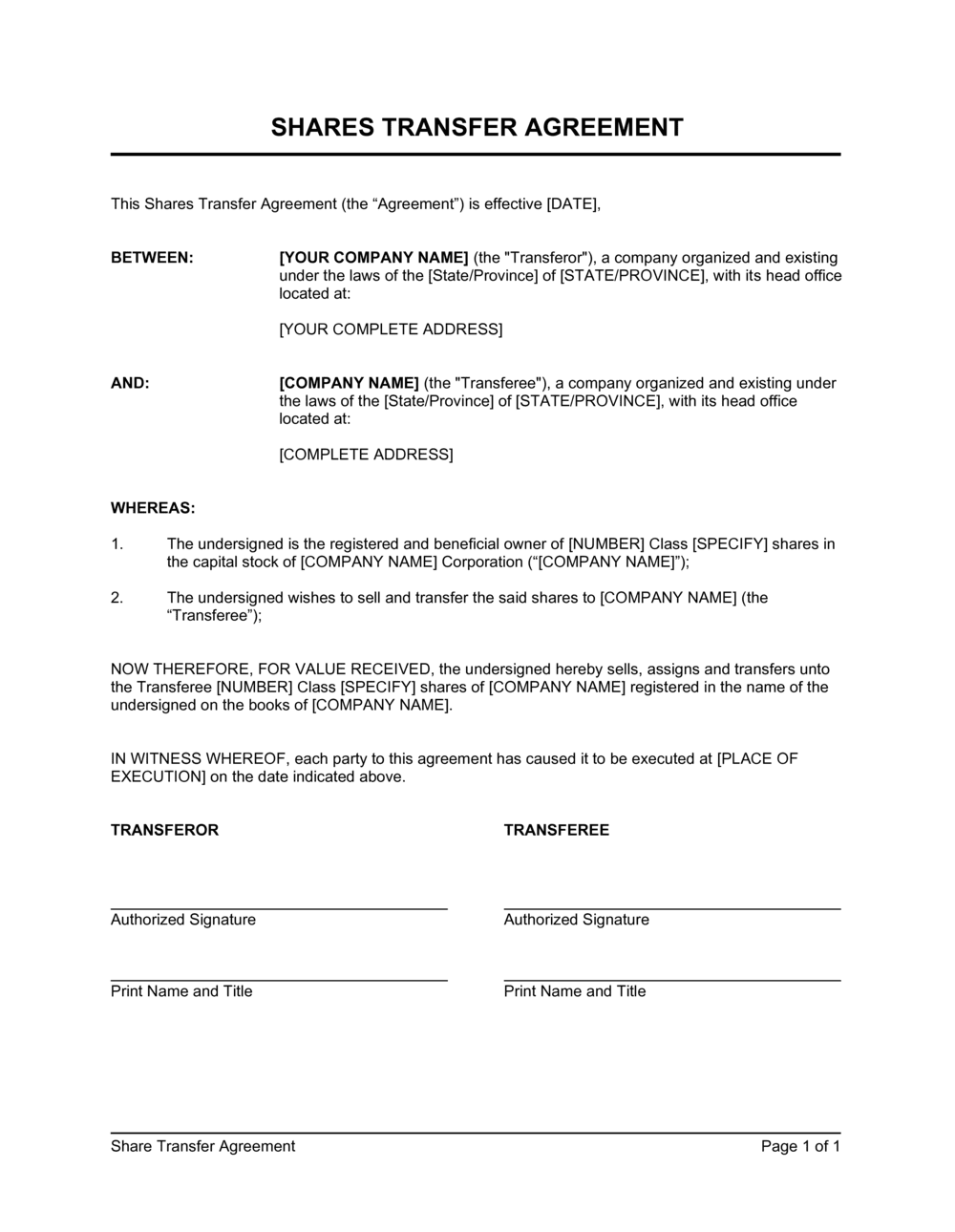
Before completing the template, review the company's articles of association and any shareholders agreement to identify pre-emption rights, board approval requirements, or transfer restrictions that must be satisfied.
💡 Request a certified copy of the current articles from the company secretary — not the version filed at incorporation, which may have been amended.
2
Enter the legal names and addresses of all parties
Use the full registered legal name for any corporate party and the full legal name as it appears on government-issued ID for individuals. Include addresses that match registration or residency records.
💡 For intra-group transfers, confirm each entity's registration number and jurisdiction of incorporation — corporate groups often have similarly named entities that are easy to confuse.
3
Identify the shares with precision
State the exact number of shares, their class (e.g., ordinary, common, Series A preferred), and nominal or par value. Cross-reference the company's current register of members to confirm the Transferor holds exactly the shares described.
💡 If the shares carry different rights depending on class, attach the relevant section of the articles as a schedule so both parties have the rights on record at signing.
4
Set the purchase price and document the basis for valuation
Enter the total consideration and the per-share price. If the transfer is not at arm's length — for example, intra-group or to a family member — note the basis for the agreed price (e.g., board-approved valuation, accountant's certificate, or nominal consideration with a gift intent).
💡 In most jurisdictions, transfers at below-market value between related parties trigger a deemed disposition at fair market value for tax purposes — document your valuation basis before signing.
5
Complete the representations and warranties for both parties
Review each representation in Clauses 4 and 5. If any statement is not accurate — for example, if a consent is still outstanding — amend the language or add a condition precedent rather than signing a false warranty.
💡 A false representation at closing gives the injured party a claim for misrepresentation — potentially unwinding the transfer and triggering damages well beyond the share price.
6
Confirm pre-emption compliance and obtain any required consents
Document the waiver or compliance with any right of first refusal in the pre-emption clause. Attach written waivers from all eligible shareholders or the relevant board resolution authorizing the transfer.
💡 Keep the waiver letters with the executed agreement — if the transfer is ever challenged, the paper trail demonstrating pre-emption compliance is your primary defence.
7
Execute the agreement and the stock transfer form simultaneously
Both parties sign the agreement, and the Transferor simultaneously executes the prescribed stock transfer form (Form J30 in the UK, or equivalent). Deliver both documents to the company secretary together with the share certificate.
💡 Never sign the agreement without also completing the stock transfer form on the same day — holding a signed agreement without the form leaves the Transferee without legal title.
8
Pay stamp duty and submit for registry update
If stamp duty applies, stamp or adjudicate the document within the required period (30 days in the UK, for example). Deliver the stamped transfer form to the company secretary and confirm that the register of members has been updated.
💡 Request written confirmation from the company secretary that the register has been updated and, where share certificates are issued, request a new certificate in the Transferee's name.