Notice of Intent to Exercise Option(s) to Acquire Partnership Interests Template

Free Word download β€’ Edit online β€’ Save & share with Drive β€’ Export to PDF

1 pageβ€’20–25 min to fillβ€’Difficulty: Standard
Learn more ↓
FreeNotice of Intent to Exercise Option(s) to Acquire Partnership Interests Template

At a glance

What it is
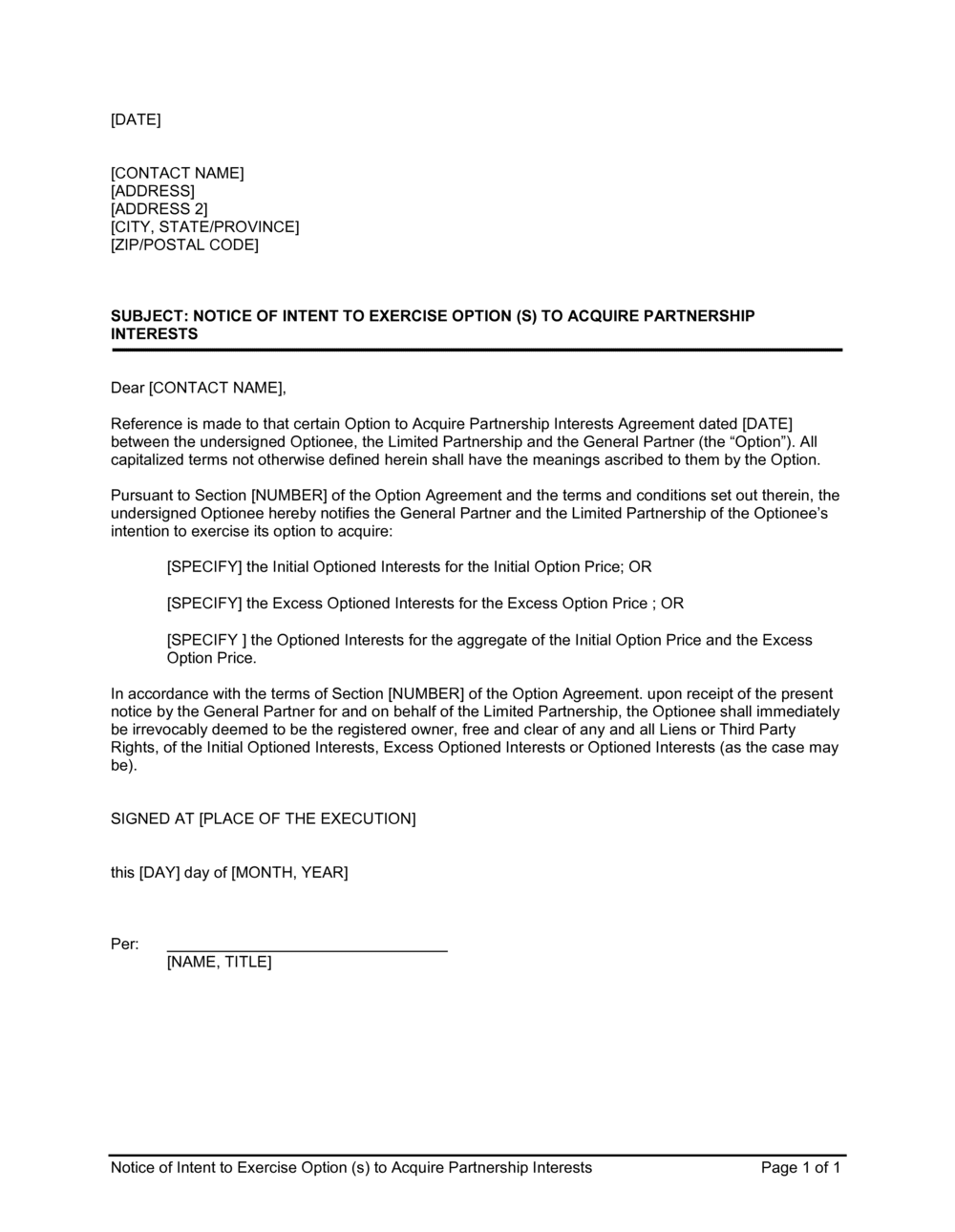
A Notice of Intent to Exercise Option(s) to Acquire Partnership Interests is a formal business letter sent by an option holder to a partnership or its partners, declaring the sender's intention to exercise a previously granted option to purchase one or more partnership interests. This free Word download is pre-structured with the essential components β€” parties, option reference, interests to be acquired, and proposed closing details β€” so you can edit online and send a professionally formatted notice in minutes.
When you need it
Use it when you hold a valid option to acquire a partnership interest and the triggering condition or election period has arrived. It is the formal first step that puts the partnership on notice and starts the clock on any closing timeline specified in the underlying agreement.
What's inside
The letter covers the option holder's and partnership's identifying details, a precise reference to the governing option agreement, a description of the interests being acquired, the exercise price and payment method, the proposed closing date, and a request for confirmation from the receiving party.

What is a Notice of Intent to Exercise Option(s) to Acquire Partnership Interests?

A Notice of Intent to Exercise Option(s) to Acquire Partnership Interests is a formal business letter sent by an option holder to a partnership or its managing partners, declaring an unconditional election to exercise a previously granted contractual right to purchase one or more partnership interests. The notice references the governing option agreement, identifies the specific interests being acquired, states the exercise price and payment method, and proposes a closing date for the transfer. Unlike a negotiated purchase agreement, this letter does not create a new obligation β€” it activates an obligation that already exists, converting a contingent right into a binding transaction both parties are required to complete.

Why You Need This Document

Failing to send a properly structured exercise notice β€” or sending one that is defective β€” can extinguish a valuable contractual right entirely. Courts interpret option exercise notices strictly: tentative language, an incorrect party name, or a notice sent one day outside the option period can all be held legally insufficient. A timely, precisely worded notice, on the other hand, locks in the transaction and gives the option holder a documented record of the exercise date, the interests claimed, and the price tendered. For investors, partners, and advisors with real money riding on the exercise, this template provides the structure to send a notice that holds up β€” without starting from a blank page.

Which variant fits your situation?

If your situation is…Use this template
Exercising a call option granted by a partner or the partnershipNotice of Intent to Exercise Option to Acquire Partnership Interests
Notifying a partner of intent to buy out their entire interestPartnership Buyout Agreement
Exercising a right of first refusal on a partner's departing stakeRight of First Refusal Notice
Offering to sell your own partnership interest to remaining partnersNotice of Intent to Transfer Partnership Interest
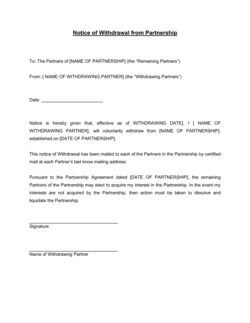
Formally withdrawing from a partnership and triggering buyout provisionsNotice of Withdrawal from Partnership
Documenting the completed transfer of a partnership interest after exercisePartnership Interest Assignment Agreement

Common mistakes to avoid

❌ Sending the notice outside the option period

Why it matters: An option exercised after the expiry date is void in virtually every jurisdiction β€” the right lapses and the recipient is under no obligation to honor it.

Fix: Confirm the option period's start and end dates before drafting the notice, and send it with enough lead time to allow for delivery delays.
❌ Using tentative or conditional language in the exercise declaration

Why it matters: Courts interpret option exercise notices strictly. Phrases like 'subject to further review' or 'we intend to exercise' can be held insufficient to constitute a valid exercise.

Fix: Use present-tense, unconditional language: '[OPTION HOLDER] hereby exercises the option to acquire [INTERESTS]' β€” nothing more, nothing less.

❌ Misidentifying the interests to be acquired

Why it matters: If the description does not match the option agreement, the partnership may reject the notice or claim a different (less favorable) set of interests applies.

Fix: Copy the interest description verbatim from the option agreement and insert it into the notice without paraphrasing.

❌ Failing to confirm condition satisfaction when conditions are required

Why it matters: If the option agreement requires a condition precedent β€” regulatory approval, board consent, minimum holding period β€” an exercise notice that ignores it may be rejected as premature.

Fix: Read the option agreement's conditions section before sending and include an express representation that each condition has been met or waived.

The 9 key clauses, explained

Date and party identification

In plain language: States the date the notice is sent, the full legal name of the option holder giving notice, and the full legal name and address of the partnership or partner receiving it.

Sample language
Date: [DATE]. From: [OPTION HOLDER FULL NAME / ENTITY NAME]. To: [PARTNERSHIP FULL LEGAL NAME], [PARTNERSHIP ADDRESS], Attention: [MANAGING PARTNER / GENERAL PARTNER NAME].

Common mistake: Using a trade name instead of the registered legal entity name. If the named party does not match the option agreement, the notice may be challenged as defective.

Reference to the governing option agreement

In plain language: Identifies the specific agreement that granted the option β€” by title, date, and parties β€” so the recipient can locate and verify the right being exercised.

Sample language
This notice is delivered pursuant to Section [X] of the Option Agreement dated [DATE], entered into between [OPTION HOLDER] and [PARTNERSHIP / GRANTING PARTNER] (the 'Option Agreement').

Common mistake: Omitting the agreement date or section number. A vague reference to 'our agreement' leaves room for the recipient to dispute which document or right applies.

Declaration of intent to exercise

In plain language: The operative sentence β€” an unambiguous statement that the option holder is exercising the option as of the notice date.

Sample language
By this notice, [OPTION HOLDER NAME] hereby exercises the option granted under the Option Agreement to acquire [DESCRIPTION OF INTERESTS] in [PARTNERSHIP NAME].

Common mistake: Using tentative language such as 'intends to consider exercising' or 'may wish to exercise.' Courts interpret option notices strictly β€” the declaration must be unconditional.

Description of the interests being acquired

In plain language: Specifies precisely which partnership interests are being acquired β€” percentage, unit count, class, or dollar value β€” as described in the option agreement.

Sample language
The interests to be acquired consist of a [X]% limited partnership interest in [PARTNERSHIP NAME], representing [X] units of Class [A/B] interest (the 'Acquired Interests').

Common mistake: Describing interests in general terms without matching the exact terminology of the option agreement. Discrepancies can trigger disputes about whether the correct interests were identified.

Exercise price and payment method

In plain language: States the exercise price payable for the interests and how payment will be made β€” wire transfer, certified check, or other agreed method β€” referencing the formula or fixed price in the option agreement.

Sample language
The exercise price payable for the Acquired Interests is $[AMOUNT], calculated in accordance with Section [X] of the Option Agreement. Payment will be made by [WIRE TRANSFER / CERTIFIED CHECK] on or before the Closing Date.

Common mistake: Stating a price without showing how it was calculated when the option agreement uses a formula. Omitting the calculation method invites a dispute about whether the right price was applied.

Proposed closing date

In plain language: Sets the date by which the parties will complete the transfer and payment, either as specified in the option agreement or as proposed by the option holder.

Sample language
The Option Holder proposes a Closing Date of [DATE], being [X] business days following the date of this notice, subject to the requirements of the Option Agreement.

Common mistake: Proposing a closing date that is shorter than any minimum closing period set out in the option agreement β€” this can make the notice technically non-compliant.

Conditions and representations

In plain language: Confirms that the option holder meets any conditions precedent to exercise β€” such as regulatory approval or continued partnership standing β€” and makes any required representations.

Sample language
The Option Holder represents and warrants that all conditions to exercise set forth in the Option Agreement have been satisfied or waived as of the date hereof, including [SPECIFIC CONDITION, e.g., 'receipt of required regulatory approval'].

Common mistake: Skipping this paragraph entirely when conditions are required. Failing to confirm condition satisfaction gives the partnership grounds to reject the notice.

Request for confirmation and closing instructions

In plain language: Asks the receiving party to confirm receipt of the notice and to provide closing instructions β€” wire details, assignment documents, or any required consents β€” by a specified date.

Sample language
Please confirm receipt of this notice in writing by [DATE] and provide wiring instructions and any documents required to complete the transfer of the Acquired Interests on or before the Closing Date.

Common mistake: Not specifying a deadline for confirmation. Without a deadline, the recipient has no urgency to respond, and the option holder has no basis to follow up or escalate.

Signature block and contact details

In plain language: Closes the letter with the option holder's signature, printed name, title if applicable, and contact information for follow-up correspondence.

Sample language
Sincerely, [SIGNATURE] / [OPTION HOLDER PRINTED NAME] / [TITLE, if applicable] / [EMAIL] / [PHONE]

Common mistake: Leaving the signature block unsigned or sending the letter electronically without a clear indication of authorization. Even for a non-binding notice, an unsigned letter weakens the sender's position if timing of exercise is later disputed.

How to fill it out

  1. 1

    Enter the date and both parties' legal names

    Insert today's date (the exercise date), the option holder's full registered name, and the partnership's full legal name exactly as they appear in the option agreement.

    πŸ’‘ The date on the notice is the official exercise date β€” double-check it falls within the option period before sending.

  2. 2

    Reference the option agreement precisely

    Insert the exact title, date, and relevant section number of the option agreement. If the option was granted in a schedule or exhibit to a larger agreement, reference the parent document and the schedule.

    πŸ’‘ Attach a copy of the relevant option agreement section to the notice if there is any possibility the recipient does not have it readily accessible.

  3. 3

    Write an unconditional declaration of exercise

    State clearly that you are exercising the option. Avoid hedging language. The sentence should read as a firm, present-tense election.

    πŸ’‘ Have one other person read the declaration sentence aloud. If it sounds tentative to them, rewrite it.

  4. 4

    Describe the interests using the option agreement's exact terminology

    Copy the description of the interests from the option agreement β€” percentage, unit count, class designation β€” and use those exact terms in this clause.

    πŸ’‘ If the option agreement covers multiple classes or tranches, specify which tranche you are exercising, even if you are exercising all of them.

  5. 5

    Calculate and state the exercise price

    Apply the pricing formula or fixed price from the option agreement, show the calculation in a brief parenthetical, and state the payment method you will use.

    πŸ’‘ For formula-based prices, retain the valuation or calculation supporting your number in case the recipient disputes it.

  6. 6

    Propose a closing date that complies with the agreement

    Check the option agreement for any minimum or maximum closing window. Propose a date within that window β€” typically 10–30 business days from the notice date.

    πŸ’‘ If no closing window is specified, 15–20 business days is a commercially reasonable default for most partnership interest transfers.

  7. 7

    Confirm conditions and request closing instructions

    Confirm in writing that all conditions to exercise have been satisfied, then ask the recipient to confirm receipt and provide any documents needed to close.

    πŸ’‘ Send the notice by a method that creates a delivery record β€” email with read receipt, courier with signature, or certified mail β€” so you can prove the exercise date if challenged.

Frequently asked questions

What is a notice of intent to exercise an option to acquire partnership interests?

It is a formal written letter sent by an option holder to a partnership or its partners, declaring the holder's decision to exercise a contractual right to purchase one or more partnership interests. The notice triggers the acquisition process and starts the clock on any closing timeline set out in the underlying option agreement.

When should this notice be sent?

The notice must be sent while the option is still in effect β€” within the option period specified in the governing option agreement. Sending it even one day after the option period expires typically renders the exercise void. Plan to send the notice several days before any deadline to allow for delivery time.

Does the notice need to be signed to be valid?

Most option agreements require the notice to be in writing and delivered by the option holder or an authorized representative, but they do not always require a wet signature. A signed letter is best practice and the safest approach. Sending by email with a clear authorization line is acceptable when the option agreement permits email notice.

What happens after the notice is sent?

The receiving party should confirm receipt and provide closing instructions β€” wiring details, the form of assignment agreement, and any required consents. Both parties then proceed to close the transfer by the proposed closing date, at which point the exercise price is paid and the partnership interest is formally assigned to the option holder.

Can the partnership refuse to honor the notice?

If the notice is validly delivered within the option period and all conditions are satisfied, the partnership generally cannot refuse. A valid notice creates a binding obligation to complete the transfer. The partnership may challenge the notice if it is defective β€” wrong parties named, outside the option period, conditions unmet β€” which is why precision in drafting matters.

What is the difference between this notice and a purchase agreement?

This notice is a unilateral declaration that triggers the exercise of an existing right. A purchase agreement is a bilateral contract negotiated between parties to create a new obligation to buy and sell. Here, the obligation to sell already exists in the option agreement β€” this letter simply activates it.

Do I need a lawyer to send this notice?

For straightforward exercises of clearly documented options, a well-drafted template is typically sufficient. Consider engaging a lawyer when the option agreement has complex conditions precedent, the exercise price involves a disputed formula, the interests being acquired are significant in value, or the partnership is likely to challenge the exercise.

How should this notice be delivered?

Deliver by any method specified in the option agreement β€” often certified mail, overnight courier, or email to a designated address. If the agreement is silent on delivery method, use a method that creates a timestamped delivery record (courier with signature confirmation or email with read receipt) to prove the exercise date.

How this compares to alternatives

vs Partnership Interest Purchase Agreement

A purchase agreement is a bilateral contract that creates the obligation to buy and sell, negotiated between parties who have not yet committed. This notice exercises an option that already exists β€” the obligation to transfer was created when the option was granted. Use this notice when the right exists; use a purchase agreement when you are negotiating a new transaction from scratch.

vs Notice of Intent to Transfer Partnership Interest

A transfer notice is sent by a selling partner who wants to transfer their own interest β€” typically to trigger a right of first refusal among remaining partners. This notice is sent by the buyer exercising an option granted to them. The direction and the party initiating the process are reversed.

vs Right of First Refusal Notice

A right of first refusal notice notifies existing partners that a third-party offer has been received and gives them the chance to match it. This option exercise notice activates a pre-granted purchase right without any competing offer. The triggering event is different: a ROFR is reactive; an option exercise is affirmative.

vs Notice of Withdrawal from Partnership

A withdrawal notice communicates a partner's intent to exit the partnership, which may trigger buyout provisions. This notice does the opposite β€” it signals the sender's intent to acquire more of the partnership. One reduces exposure; the other increases it.

Industry-specific considerations

Real Estate

Exercising options to acquire limited partnership interests in real estate funds, joint ventures, or property-holding partnerships where buy-in rights are common.

Private Equity and Investment

Triggering structured options to step up or complete ownership in portfolio partnerships, often tied to performance milestones or investment tranches.

Professional Services

Law firm, accounting, and consulting partnership admissions where incoming partners exercise pre-granted options to acquire equity stakes.

Family Business and Succession

Formalizing the transfer of a departing family member's partnership interest to a successor under a pre-agreed buy-sell or succession option.

Template vs pro β€” what fits your needs?

PathBest forCostTime
Use the templateOption holders exercising a clearly documented, straightforward option with no disputed conditions or pricing formulaFree15–30 minutes
Template + professional reviewExercises involving a formula-based price, multiple interest classes, or any condition precedent that requires confirmation$150–$400 (brief attorney review)1–2 business days
Custom draftedHigh-value or contested exercises, complex partnership structures, or situations where the partnership is likely to challenge the notice$500–$2,000+3–7 business days

Glossary

Option to Acquire
A contractual right β€” but not obligation β€” to purchase a specified interest at a set price or formula within a defined time window.
Partnership Interest
An ownership stake in a partnership, representing a proportional share of profits, losses, and voting rights as defined in the partnership agreement.
Option Exercise Date
The specific date on which the option holder formally elects to exercise the option, triggering the acquisition process.
Exercise Price
The pre-agreed price at which the option holder may purchase the partnership interest, as stated in the underlying option agreement.
Option Period
The window of time during which the option holder may validly exercise the option; exercise outside this window is typically void.
Closing Date
The date on which the transfer of the partnership interest and the payment of the exercise price are completed.
General Partner (GP)
A partner with unlimited personal liability and management authority over the partnership's operations.
Limited Partner (LP)
A partner whose liability is capped at their capital contribution and who typically has no management role.
Option Agreement
The underlying contract that granted the option, specifying the interests covered, exercise price, option period, and notice requirements.
Assignment of Interest
The formal transfer of a partnership interest from the seller to the buyer, typically documented in a separate assignment agreement after exercise.

Part of your Business Operating System

This document is one of 3,000+ business & legal templates included in Business in a Box.

  • Fill-in-the-blanks β€” ready in minutes
  • 100% customizable Word document
  • Compatible with all office suites
  • Export to PDF and share electronically

Create your document in 3 simple steps.

From template to signed document β€” all inside one Business Operating System.
1
Download or open template

Access over 3,000+ business and legal templates for any business task, project or initiative.

2
Edit and fill in the blanks with AI

Customize your ready-made business document template and save it in the cloud.

3
Save, Share, Send, Sign

Share your files and folders with your team. Create a space of seamless collaboration.

Save time, save money, and create top-quality documents.

β˜…β˜…β˜…β˜…β˜…

"Fantastic value! I'm not sure how I'd do without it. It's worth its weight in gold and paid back for itself many times."

Managing Director Β· Mall Farm
Robert Whalley
Managing Director, Mall Farm Proprietary Limited
β˜…β˜…β˜…β˜…β˜…

"I have been using Business in a Box for years. It has been the most useful source of templates I have encountered. I recommend it to anyone."

Business Owner Β· 4+ years
Dr Michael John Freestone
Business Owner
β˜…β˜…β˜…β˜…β˜…

"It has been a life saver so many times I have lost count. Business in a Box has saved me so much time and as you know, time is money."

Owner Β· Upstate Web
David G. Moore Jr.
Owner, Upstate Web

Run your business with a system β€” not scattered tools

Stop downloading documents. Start operating with clarity. Business in a Box gives you the Business Operating System used by over 250,000 companies worldwide to structure, run, and grow their business.

Free Forever PlanΒ Β·Β No credit card required