Board Resolution Approving Sale Agreement Sole Director Template

Free Word download • Edit online • Save & share with Drive • Export to PDF

1 page20–30 min to fillDifficulty: StandardSignature requiredLegal review recommended
Learn more ↓
FreeBoard Resolution Approving Sale Agreement Sole Director Template

At a glance

What it is
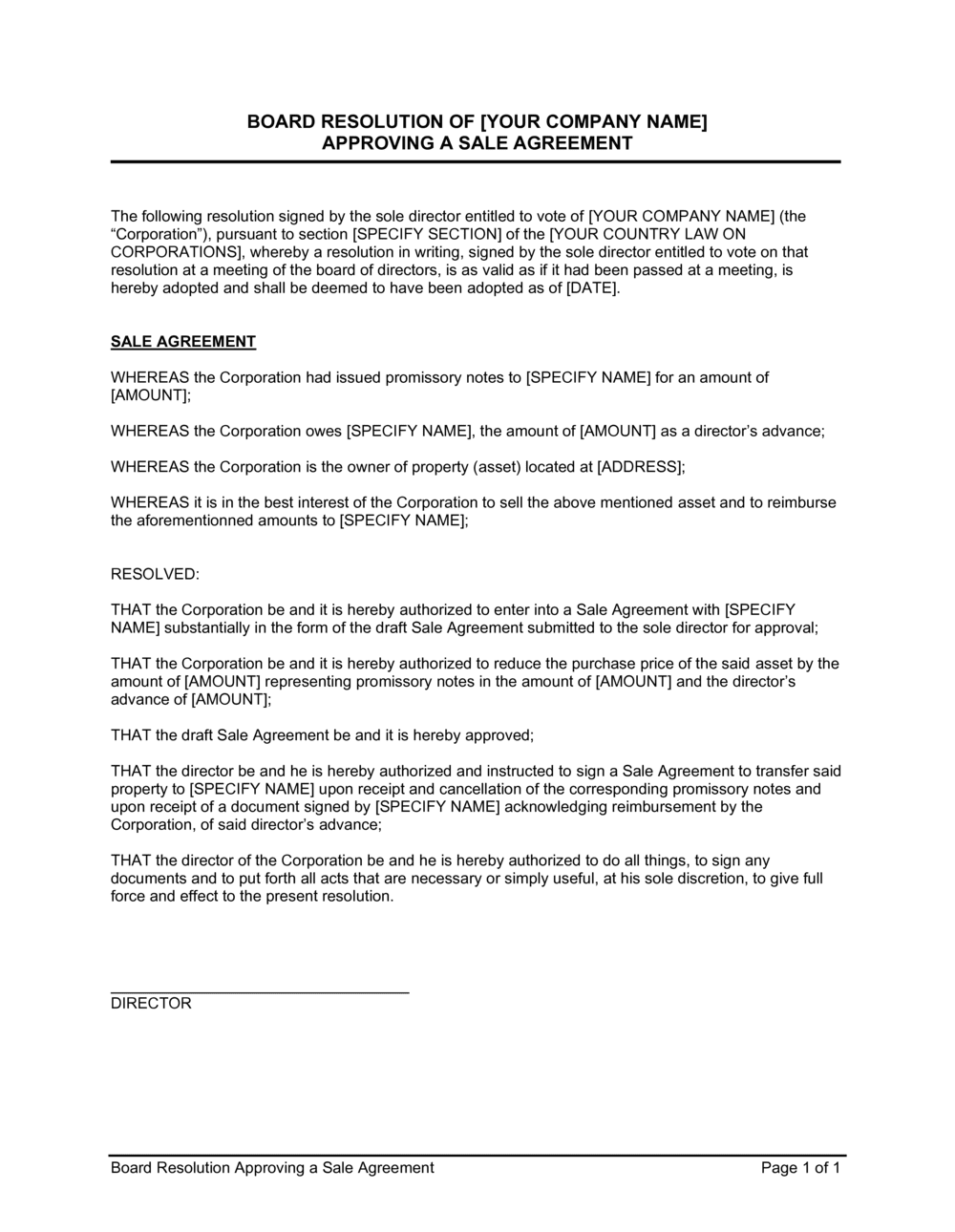
A Board Resolution Approving a Sale Agreement (Sole Director) is a formal corporate record in which a single-director company officially documents its decision to authorize and enter into a sale agreement. This free Word download gives the sole director a structured, legally formatted written resolution they can edit online, sign, and file in the company's minute book.
When you need it
Use it when your company has a single director who needs to formally authorize the sale of assets, a business unit, or other property under a sale agreement — especially when the counterparty, a lender, or a regulatory body requires written board authorization before the transaction closes.
What's inside
Company identification, recitals establishing director authority, a description of the sale agreement and transaction terms, the formal resolution clause approving and authorizing the agreement, officer signing authority, and the director's dated signature block.

What is a Board Resolution Approving Sale Agreement (Sole Director)?

A Board Resolution Approving Sale Agreement (Sole Director) is a formal written corporate record in which the single director of a company officially authorizes the business to enter into and execute a sale agreement. Because a company is a separate legal entity, any significant transaction — including the sale of assets, property, or a business unit — requires documented authorization from the governing body. For a sole-director company, that governing body is a single person, but the corporate formality of a written resolution is still legally required to establish that the director acted in their corporate capacity, not as a private individual.

The document identifies the company and its sole director, recites the background and terms of the proposed sale, passes a formal resolution approving the agreement, names the authorized signatory, ratifies any prior acts taken in connection with the transaction, and grants authority to execute ancillary closing documents. It is signed and dated by the sole director and filed in the company's minute book as part of the permanent corporate record.

Why You Need This Document

Without a properly executed board resolution, a sole director's signature on a sale agreement may lack the documented corporate authorization that counterparties, lenders, title companies, and regulators require before a transaction can close. Buyers' lawyers will routinely request a certified copy of the authorizing resolution as a standard closing condition — and a missing or defective resolution can delay or derail a deal at the worst possible moment. Beyond closing mechanics, a resolution creates an evidentiary record that the director acted within their authority, protecting both the company and the director personally from later claims of ultra vires action or unauthorized disposition of company assets. For regulated industries or transactions subject to bulk-sale notice or tax clearance requirements, the resolution also provides the pre-approved authority to handle post-signing compliance steps without additional documentation. This template gives sole directors a professionally structured, legally formatted resolution they can complete in under 30 minutes and rely on with confidence as part of any asset sale closing package.

Which variant fits your situation?

If your situation is…Use this template
Company has multiple directors who must vote on the saleBoard Resolution Approving Sale Agreement (Multiple Directors)
Resolution needed to authorize a purchase rather than a saleBoard Resolution Approving Purchase Agreement
Sale involves real property requiring specific authorityBoard Resolution Authorizing Sale of Real Property
Sole director authorizing a merger or acquisitionBoard Resolution Approving Merger Agreement
Director needs to authorize execution of a general contractBoard Resolution Authorizing Contract Execution
Shareholder approval is also required for the saleShareholder Resolution Approving Sale
Sale of shares rather than assetsBoard Resolution Approving Share Transfer

Common mistakes to avoid

❌ Dating the resolution after the sale agreement is signed

Why it matters: A resolution that postdates the agreement it purports to authorize is evidence of a corporate formality violation, not genuine pre-authorization. Buyers' lawyers will flag it and may require rectification.

Fix: Always execute the resolution on or before the date the sale agreement is signed. If circumstances require a later resolution, include an express ratification clause covering the earlier execution.

❌ Vague asset description that does not match the sale agreement

Why it matters: If the resolution describes assets differently from the sale agreement's schedules, title companies, registries, and counterparty counsel will require an amended resolution, adding time and cost to closing.

Fix: Copy the asset description verbatim from the sale agreement's schedule and attach the agreement as an exhibit to eliminate any ambiguity.

❌ Omitting the ancillary documents authority clause

Why it matters: Asset sales routinely require transfer deeds, bill of sale forms, assignment agreements, and tax certificates not contemplated in the original resolution. Without pre-authorized authority, the director must pass additional resolutions on closing day.

Fix: Include a broad ancillary authority clause authorizing the signatory to execute 'such other documents as may be required to consummate the transaction.'

❌ Failing to cite the statutory or articles authority for written resolutions

Why it matters: A resolution with no cited authority for the sole director to act without a meeting can be challenged as improperly passed, rendering authorizations in it potentially void.

Fix: Reference the specific article number in the company's articles or the applicable statutory provision that permits sole-director written resolutions in the recitals block.

❌ Using a trade name instead of the registered legal entity name

Why it matters: The resolution must identify the same legal entity that is party to the sale agreement. A name mismatch creates a gap in the corporate authorization chain that delays or blocks closing.

Fix: Retrieve the company's registered name from the official corporate registry and use it exactly as it appears, including punctuation and legal suffix.

❌ Filing the resolution only after closing rather than before

Why it matters: Corporate records must reflect authorization before the act — not as a post-closing housekeeping exercise. Late filing can be treated as evidence that the resolution was backdated.

Fix: Execute and file the resolution in the minute book before the signing meeting. Provide a certified copy to counsel in advance of the closing date.

The 9 key clauses, explained

Company identification and recitals

In plain language: Opens the resolution by stating the company's full legal name, jurisdiction of incorporation, and the background facts establishing why the resolution is being passed.

Sample language
WHEREAS, [COMPANY LEGAL NAME] (the 'Company'), a [ENTITY TYPE] incorporated under the laws of [JURISDICTION], is considering entering into a Sale Agreement (the 'Agreement') with [COUNTERPARTY NAME] dated [DATE];

Common mistake: Using the company's trade name instead of its registered legal name. A mismatch between the resolution and the sale agreement can delay closing or trigger a requisition from the buyer's solicitors.

Sole director authority recital

In plain language: Confirms that the signatory is the sole director of the company and is therefore authorized to act as the entire board without a formal meeting.

Sample language
WHEREAS, the undersigned is the sole director of the Company and is authorized to act on behalf of the board of directors without a formal meeting pursuant to [ARTICLES / APPLICABLE LAW];

Common mistake: Failing to cite the specific authority — articles of incorporation, bylaws, or statutory provision — that permits a sole director to pass written resolutions. Without this citation, the resolution's validity can be challenged.

Description of the sale agreement

In plain language: Identifies the sale agreement by name, date, parties, and subject matter so there is no ambiguity about which transaction the resolution authorizes.

Sample language
WHEREAS, the Company desires to enter into the Sale Agreement dated [DATE] between the Company and [BUYER NAME], pursuant to which the Company agrees to sell [DESCRIPTION OF ASSETS / PROPERTY / BUSINESS UNIT] for a purchase price of [AMOUNT / CONSIDERATION];

Common mistake: Describing the asset in vague terms such as 'certain assets.' If the resolution description does not match the sale agreement schedules, counterparties and title companies may require an amended resolution, adding days to closing.

Formal resolution and approval clause

In plain language: The operative heart of the document — a clearly worded 'BE IT RESOLVED' clause that formally approves and authorizes the company to enter into the sale agreement.

Sample language
BE IT RESOLVED, that the Sale Agreement, in substantially the form presented to and reviewed by the sole director, is hereby approved, ratified, and authorized, and that the Company is hereby authorized to enter into and perform its obligations under the Agreement.

Common mistake: Using ambiguous approval language such as 'the director agrees to proceed.' The resolution must use definitive corporate authorization language to satisfy legal and title review requirements.

Authorization of signatory

In plain language: Names the specific officer or director authorized to sign the sale agreement and any ancillary closing documents on behalf of the company.

Sample language
BE IT FURTHER RESOLVED, that [NAME / TITLE] is hereby authorized and directed to execute and deliver the Sale Agreement and all related documents, instruments, and certificates on behalf of the Company.

Common mistake: Authorizing 'any officer' without naming a specific individual. Some buyers and title companies require a named signatory to match the execution block on the agreement.

Ratification of prior acts

In plain language: Confirms that any actions already taken by the director or officers in connection with the sale agreement — negotiations, due diligence, draft exchange — are ratified as acts of the company.

Sample language
BE IT FURTHER RESOLVED, that all actions previously taken by the director or officers of the Company in connection with the Sale Agreement are hereby ratified, confirmed, and approved in all respects.

Common mistake: Omitting ratification language when negotiations or draft exchanges occurred before the resolution was formally passed. Without it, pre-resolution acts technically lack board authorization and may be challenged.

Ancillary documents authority

In plain language: Grants the authorized signatory the power to execute any additional documents required to complete the transaction — transfer deeds, assignment agreements, certificates of title, or escrow instructions.

Sample language
BE IT FURTHER RESOLVED, that the authorized officer is hereby authorized to execute and deliver such additional agreements, instruments, certificates, and documents as may be required or advisable to consummate the transactions contemplated by the Sale Agreement.

Common mistake: Limiting authority to the main sale agreement only. Closings routinely require ancillary documents not listed in the original agreement; a narrow resolution forces the director to pass supplemental resolutions at closing.

Filing and compliance authority

In plain language: Authorizes the director or officers to take all actions necessary to comply with applicable law — regulatory filings, tax notifications, or corporate registry updates — arising from the sale.

Sample language
BE IT FURTHER RESOLVED, that the officers of the Company are authorized to take all steps and execute all documents required to comply with applicable federal, state, and local laws and regulations in connection with the transaction.

Common mistake: Ignoring post-closing compliance steps in the resolution. Asset sales frequently trigger bulk-sale notice requirements, tax clearance filings, or transfer tax returns — authority to handle these should be pre-approved.

Effective date and director signature block

In plain language: States the date the resolution takes effect and provides a signature block for the sole director to execute the resolution as a written consent.

Sample language
This Written Resolution is effective as of [DATE] and is executed by the undersigned as the sole director of [COMPANY LEGAL NAME]. _________________________________ [DIRECTOR FULL NAME], Sole Director

Common mistake: Leaving the effective date blank or using a date after the sale agreement is signed. The resolution should be dated on or before the date the director executes the sale agreement to preserve the correct chronology of authorization.

How to fill it out

  1. 1

    Insert the company's full legal name and jurisdiction

    Enter the company's exact registered legal name and jurisdiction of incorporation as they appear on the certificate of incorporation or articles. Do not use trade names or abbreviations.

    💡 Cross-reference the corporate registry filing — a single word difference between the resolution and the sale agreement can trigger a requisition from the buyer's lawyers.

  2. 2

    Confirm sole director status and cite the authority for written resolutions

    Verify that the company's articles or bylaws explicitly permit a sole director to pass written resolutions without a meeting. Cite the specific article number or statutory provision in the recitals.

    💡 If the company's governing documents are silent on written resolutions, check the applicable corporate statute — most jurisdictions permit them by default for sole directors.

  3. 3

    Describe the sale agreement with specificity

    Enter the sale agreement's full title, date, counterparty's legal name, and a clear description of the assets or property being sold, matching the language used in the agreement's schedules.

    💡 Attach the sale agreement as an exhibit to the resolution so there is no dispute about which version was authorized.

  4. 4

    Draft the formal approval resolution clause

    Use clear 'BE IT RESOLVED' language to approve and authorize the company to enter into and perform its obligations under the sale agreement. Avoid tentative or conditional language.

    💡 If the final agreement differs materially from the draft reviewed at the time of the resolution, pass an amended resolution before execution rather than relying on the original.

  5. 5

    Name the authorized signatory explicitly

    Insert the full name and title of the individual authorized to sign the sale agreement and closing documents. If the sole director and signatory are the same person, state both capacities.

    💡 Match the signatory's name exactly to how it will appear in the execution block of the sale agreement — variations create title insurance and registration issues.

  6. 6

    Add ratification and ancillary authority clauses

    Include clauses ratifying prior acts and granting authority to execute ancillary closing documents. This prevents the need for supplemental resolutions on closing day.

    💡 Have your lawyer or company secretary review the list of expected closing documents against the ancillary authority clause before the resolution is signed.

  7. 7

    Set and insert the effective date

    Date the resolution on or before the date the director will sign the sale agreement. The resolution must authorize the act before — or simultaneously with — its performance.

    💡 For time-sensitive closings, use the same date as the sale agreement execution date and ensure both documents are signed on that day.

  8. 8

    Execute and file in the minute book

    The sole director signs the resolution in the signature block. File the executed original in the company's minute book and provide a certified copy to the counterparty's lawyers as part of the closing deliverables.

    💡 Prepare a certified copy of the resolution — signed by the director as secretary — at the same time as the original. Most closings require a certified copy, not the original.

Frequently asked questions

What is a board resolution approving a sale agreement?

A board resolution approving a sale agreement is a formal corporate document in which the company's board of directors — in this case, a sole director — officially authorizes the company to enter into and execute a sale agreement. It creates a written record that the correct corporate authority reviewed and approved the transaction, which is required by counterparties, lenders, title companies, and regulatory bodies before the deal can close.

Why does a sole director need a separate resolution to approve a sale?

Even when a company has only one director, corporate law in most jurisdictions requires that significant transactions — particularly asset sales — be formally authorized by the board of directors as a corporate act. A sole director cannot simply sign a sale agreement in their personal capacity; the authorization must be documented as a resolution of the company's governing body. This protects the company, the director, and the counterparty by establishing a clear chain of corporate authority.

Is a board resolution legally binding on the company?

Yes — a properly passed and executed board resolution is generally binding on the company. It authorizes the named signatory to execute documents on the company's behalf, and the company is bound by those documents once signed. For a sole director, a written resolution signed in accordance with the company's articles and applicable law has the same effect as a resolution passed at a formal board meeting.

Does a sole director need to hold a meeting to pass this resolution?

No. In most jurisdictions, a sole director may pass a written resolution without convening a physical or virtual meeting. The director simply signs the written resolution, which has the same legal effect as a unanimous resolution at a board meeting. The company's articles of incorporation or bylaws, and the applicable corporate statute, typically authorize this procedure — the resolution should cite the specific authority.

When should the resolution be signed relative to the sale agreement?

The resolution should be signed on or before the date the director signs the sale agreement. Authorization must precede — or be contemporaneous with — the authorized act. A resolution signed after the sale agreement creates a corporate formality gap. If the resolution is signed after the agreement for practical reasons, include a ratification clause expressly confirming and ratifying the earlier execution.

What documents should be attached to or filed with the resolution?

Best practice is to attach a copy of the sale agreement — or at minimum its key terms — as an exhibit to the resolution so the authorized transaction is unambiguous. The executed original resolution should be filed in the company's minute book. A certified copy is typically required as a closing deliverable and may also be needed by the counterparty's title insurer, lender, or registrar.

Can this resolution be used for the sale of real property?

This template can provide the corporate authorization for a real property sale, but real property transactions typically require additional documentation: a transfer deed, land registry forms, and potentially specific statutory authority language. Consider having a property lawyer review the resolution against the jurisdiction's land transfer requirements and confirm that the resolution's authority language satisfies the title insurer's requirements.

Do shareholders need to approve the sale agreement as well?

In some circumstances, yes. Many corporate statutes and company articles require shareholder approval for the sale of all or substantially all of the company's assets, even if the board has authorized the transaction. Check the company's articles and the applicable corporate statute to determine whether shareholder approval is required. If it is, a separate shareholder resolution must be obtained in addition to this board resolution.

Does this resolution need to be notarized?

Notarization is not typically required for a board resolution in most common-law jurisdictions. However, some foreign counterparties, certain regulated industries, and real property transactions in specific jurisdictions may require a notarized or apostilled resolution. If the transaction is cross-border or the counterparty's jurisdiction requires it, confirm the authentication requirements with local counsel before closing.

How this compares to alternatives

vs Board Resolution Approving Purchase Agreement (Sole Director)

A purchase resolution authorizes the company to buy assets or property rather than sell them. The corporate formality structure is identical, but the operative clause authorizes an acquisition. Use the sale resolution when the company is the vendor; use the purchase resolution when the company is the buyer. Both are needed when the same transaction involves an asset swap.

vs Board Resolution Approving Share Transfer

A share transfer resolution authorizes the transfer of shares in the company's share register — it governs ownership of the company itself, not its assets. A sale agreement resolution authorizes the company to sell its assets or business. If the deal is structured as a share purchase rather than an asset sale, the share transfer resolution is the correct document.

vs Sale Agreement

The sale agreement is the binding contract between buyer and seller setting out price, terms, representations, and warranties. The board resolution is the internal corporate authorization record that permits the sole director to sign that agreement on the company's behalf. The resolution and the sale agreement are complementary — neither replaces the other.

vs Shareholder Resolution Approving Sale

A shareholder resolution is passed by the company's owners — not its directors — and is required when the sale involves all or substantially all of the company's assets under the applicable corporate statute or articles. A board resolution alone is insufficient in those circumstances. Check whether shareholder approval is required before relying solely on this director resolution.

Industry-specific considerations

Technology / SaaS

Sole-director startups frequently use this resolution to authorize IP asset sales, acqui-hires, or the sale of a product line to a larger acquirer as part of a wind-down or pivot.

Real Estate

Property-holding companies with a sole director require a formal resolution before a transfer deed can be registered, and title insurers routinely require a certified copy as a closing condition.

Professional Services

Sole-director consulting and advisory firms use this resolution to authorize the sale of a client book, practice group, or operational assets when winding down or merging with another firm.

Manufacturing

Single-owner manufacturing companies pass this resolution when selling equipment, inventory, or a production facility, often required by the buyer's lender as a condition of financing.

Jurisdictional notes

United States

Most US states permit sole directors to act by written consent under the applicable Business Corporation Act or LLC statute without a formal meeting. Delaware, for example, expressly permits written consents under DGCL §141(f). Some states require the written consent to be filed in the minute book within a specified period. Asset sales representing all or substantially all of a company's assets may trigger a shareholder vote requirement under DGCL §271 or equivalent state statutes — confirm applicability before relying on a director resolution alone.

Canada

Under the Canada Business Corporations Act (CBCA) and most provincial corporate statutes, a sole director may pass a written resolution in lieu of a meeting. The resolution must be signed by the director and kept with the company's corporate records. A sale of all or substantially all of the company's property outside the ordinary course of business requires shareholder approval under CBCA §189 — this is a common trap for sole-director owner-operated companies. Quebec-incorporated companies follow the Business Corporations Act (Quebec) with substantively similar requirements.

United Kingdom

Under the Companies Act 2006, a sole director of a private limited company may pass decisions without a meeting provided the company's articles do not require more than one director. Model Articles (Part 2, Article 7) permit a sole director to take decisions without a meeting. Substantial property transactions between the company and its director — including sales above the lesser of £100,000 or 10% of asset value — require prior shareholder approval under CA 2006 §190. Board minutes or written resolutions must be retained for at least 10 years.

European Union

EU member states vary significantly in their treatment of sole-director companies and written resolutions. Germany (GmbH) and France (SAS/SARL) permit sole management organs but may require specific formalities for asset disposals above statutory thresholds. Cross-border transactions may trigger GDPR data-room considerations and — for regulated sectors — sector-specific regulatory clearance. In some civil-law jurisdictions, a notarized resolution or notarial deed is required for the sale of real property or certain business assets; consult local counsel before relying on a non-notarized resolution.

Template vs lawyer — what fits your deal?

PathBest forCostTime
Use the templateSole-director companies authorizing a straightforward asset sale with a domestic counterparty where the transaction value is modest and no regulatory approval is requiredFree15–30 minutes
Template + legal reviewAsset sales above $100K, real property transactions, transactions requiring shareholder sign-off, or where the counterparty's lawyers will scrutinize the corporate authorization$300–$8001–2 days
Custom draftedCross-border asset sales, regulated industry transactions, deals involving IP or real property with complex title requirements, or M&A transactions above $500K$1,000–$3,500+3–7 days

Glossary

Board Resolution
A formal written record of a decision made by a company's board of directors, which becomes part of the company's official corporate records.
Sole Director
A single individual who serves as the only member of a company's board of directors and holds all directorial decision-making authority.
Written Resolution
A resolution passed without a physical meeting, executed by signature, permissible for sole-director companies in most jurisdictions.
Corporate Authority
The legal power granted to an individual or body — such as a director — to bind a company to agreements and obligations.
Minute Book
The official repository of a company's corporate records, including resolutions, meeting minutes, share registers, and organizational documents.
Recitals
Background clauses at the opening of a resolution or agreement that establish context, authority, and the factual basis for the decision being made.
Ultra Vires
A Latin term meaning 'beyond the powers' — an act is ultra vires when it exceeds the authority granted to a director or company under its governing documents.
Sale Agreement
A binding contract under which one party transfers ownership of assets, goods, or a business to another party in exchange for consideration.
Authorized Signatory
The individual designated by the company's resolution to sign the sale agreement and any related closing documents on behalf of the company.
Corporate Seal
An embossed or stamped impression used by some companies to formally authenticate executed documents, still required in certain jurisdictions.
Ratification
The formal approval of a prior act or agreement by the appropriate corporate authority, confirming it as binding on the company.

Part of your Business Operating System

This document is one of 3,000+ business & legal templates included in Business in a Box.

  • Fill-in-the-blanks — ready in minutes
  • 100% customizable Word document
  • Compatible with all office suites
  • Export to PDF and share electronically

Create your document in 3 simple steps.

From template to signed document — all inside one Business Operating System.
1
Download or open template

Access over 3,000+ business and legal templates for any business task, project or initiative.

2
Edit and fill in the blanks with AI

Customize your ready-made business document template and save it in the cloud.

3
Save, Share, Send, Sign

Share your files and folders with your team. Create a space of seamless collaboration.

Save time, save money, and create top-quality documents.

★★★★★

"Fantastic value! I'm not sure how I'd do without it. It's worth its weight in gold and paid back for itself many times."

Managing Director · Mall Farm
Robert Whalley
Managing Director, Mall Farm Proprietary Limited
★★★★★

"I have been using Business in a Box for years. It has been the most useful source of templates I have encountered. I recommend it to anyone."

Business Owner · 4+ years
Dr Michael John Freestone
Business Owner
★★★★★

"It has been a life saver so many times I have lost count. Business in a Box has saved me so much time and as you know, time is money."

Owner · Upstate Web
David G. Moore Jr.
Owner, Upstate Web

Run your business with a system — not scattered tools

Stop downloading documents. Start operating with clarity. Business in a Box gives you the Business Operating System used by over 250,000 companies worldwide to structure, run, and grow their business.

Start free · No credit card required