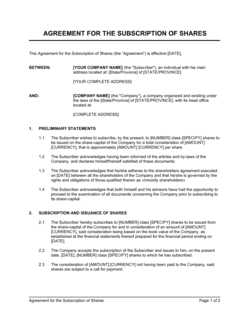
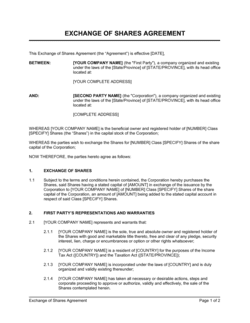
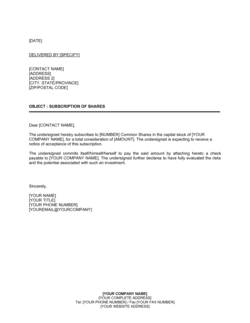
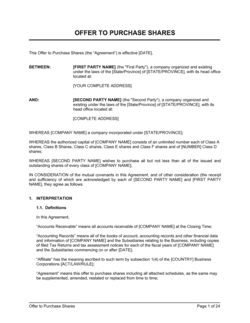
Tender of Shares for Acquisition Template

Free Word download • Edit online • Save & share with Drive • Export to PDF

1 page20–30 min to fillDifficulty: StandardSignature requiredLegal review recommended
Learn more ↓
FreeTender of Shares for Acquisition Template

At a glance

What it is
A Tender of Shares for Acquisition is a legally binding document through which a shareholder formally agrees to sell and transfer their shares to an acquiring party at a specified price, subject to defined conditions. This free Word download gives you a structured, attorney-ready starting point you can edit online and export as PDF for use in private acquisitions, buyouts, or tender offer processes.
When you need it
Use it when an acquirer has made an offer to purchase shares and one or more shareholders need to formally commit to tendering their holdings. It is typically executed as part of a broader acquisition transaction, alongside a share purchase agreement or merger documentation.
What's inside
Parties and share details, tender price and payment mechanics, representations and warranties from the tendering shareholder, conditions to closing, transfer procedures, governing law, and indemnification provisions — all in a single enforceable instrument.

What is a Tender of Shares for Acquisition?

A Tender of Shares for Acquisition is a legally binding document through which a shareholder formally elects to sell and transfer a specified number of shares in a target company to an acquiring party at a defined price, on agreed terms and conditions. It records the tendering shareholder's individual commitment to participate in the acquisition, confirms that the shares are owned free and clear, and sets out the mechanics of how and when the transfer and payment will occur. Unlike a general share purchase agreement — which governs the transaction at the company level across all sellers — a tender document is a shareholder-specific instrument that creates an enforceable obligation tied to each individual seller's holdings.

Why You Need This Document

Without a signed tender of shares for acquisition, a shareholder's verbal or informal agreement to sell carries no enforceable weight. Acquirers who proceed without binding written commitments from each seller risk a shareholder withdrawing at closing, disputing the agreed price, or asserting that a lien or third-party right prevents a clean transfer — any of which can collapse a transaction after significant legal and advisory fees have been incurred. A properly executed tender document eliminates those risks by locking in price, confirming clean title through representations and warranties, and establishing the exact conditions and timeline for closing. For transactions involving multiple selling shareholders, it is the instrument that turns a negotiated deal into a series of irrevocable, documented commitments — giving the acquirer the certainty needed to fund and complete the acquisition. This template gives you an attorney-ready starting point that covers every essential clause in a format you can tailor, review with counsel, and execute in days rather than weeks.

Which variant fits your situation?

If your situation is…Use this template
Acquiring 100% of a private company's sharesShare Purchase Agreement
Purchasing a minority stake without full acquisitionStock Purchase Agreement (Minority)
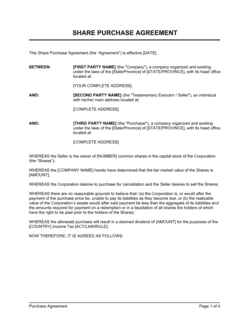
Merging two entities rather than buying shares outrightMerger Agreement
Shareholder agreeing not to tender to a competing offerLock-Up Agreement
Acquiring assets rather than shares of the target companyAsset Purchase Agreement
Multiple shareholders collectively selling to one buyerDrag-Along Agreement
Binding a shareholder to sell if other shareholders sellTag-Along Agreement

Common mistakes to avoid

❌ Imprecise share identification

Why it matters: Referring to shares without stating class, certificate numbers, and exact count creates a title dispute at closing and can prevent the transfer agent from processing the transfer.

Fix: List the exact class, number, and certificate or account reference for every share being tendered, and attach a copy of the share register entry or certificate as a schedule.

❌ Omitting third-party consent requirements

Why it matters: Many shareholder agreements include rights of first refusal, co-sale rights, or drag-along provisions that require notice to or consent from other shareholders before a transfer can occur — skipping this exposes the acquirer to a voided transaction.

Fix: Review the target company's shareholder agreement, articles, and any side letters before execution, and disclose or obtain all required consents in writing prior to closing.

❌ No survival period for representations and warranties

Why it matters: Without an express survival clause, the window to bring an indemnification claim may be cut short by the jurisdiction's general contract limitation period, which may be as short as one year in some states.

Fix: Include a clause stating that representations and warranties survive closing for a defined period — typically 12–24 months for a private share acquisition.

❌ Setting no expiration date on the tender offer

Why it matters: An open-ended offer gives the shareholder the option to accept at any time, potentially locking the acquirer into an outdated price long after market conditions or the target's value have changed.

Fix: Always include a specific expiration date and time, with a provision making the offer null and void if not accepted before that deadline.

❌ Selecting a governing law with no connection to the transaction

Why it matters: Courts in multiple jurisdictions have declined to apply a chosen governing law that has no meaningful relationship to the parties or the subject matter, leaving the agreement in a legal grey zone.

Fix: Choose the jurisdiction of the target company's incorporation or the seller's domicile, and ensure the selected jurisdiction's mandatory employment or securities rules are not inadvertently displaced.

❌ Failing to obtain a corporate authorization for entity sellers

Why it matters: A shareholder that is itself a company must be authorized by board resolution to execute a transfer — without it, the signatory may have acted without authority and the agreement may be voidable.

Fix: Request and attach a copy of the entity seller's board resolution or written consent authorizing the sale and naming the signatory before execution.

The 10 key clauses, explained

Parties and Share Identification

In plain language: Identifies the tendering shareholder and the acquirer as legal parties, and specifies the exact class, series, and number of shares being tendered.

Sample language
This Tender of Shares for Acquisition ('Agreement') is entered into as of [DATE] between [TENDERING SHAREHOLDER FULL NAME / ENTITY] ('Seller') and [ACQUIRER LEGAL NAME], a [STATE / JURISDICTION] [ENTITY TYPE] ('Acquirer'). Seller holds [NUMBER] shares of [CLASS] stock of [TARGET COMPANY LEGAL NAME] ('Company'), certificate number(s) [CERTIFICATE NUMBER(S)] ('Shares').

Common mistake: Describing shares by informal reference such as 'my shares in the company' rather than by class, certificate number, and exact count — leaving ambiguity about what is actually being tendered.

Tender Price and Payment Terms

In plain language: States the per-share purchase price, the total consideration, the payment method, and the timing of payment upon closing.

Sample language
Acquirer shall pay Seller [CURRENCY] $[PER-SHARE PRICE] per Share, for an aggregate consideration of $[TOTAL AMOUNT], payable by [wire transfer / certified check] to the account designated by Seller no later than [X] business days following the Closing Date.

Common mistake: Omitting the payment currency for cross-border transactions, creating ambiguity when USD and CAD or GBP and EUR are equally plausible from the contract's face.

Representations and Warranties of the Seller

In plain language: The tendering shareholder confirms that they own the shares free and clear, have authority to sell, and that no third party has any claim on or right of first refusal over the shares.

Sample language
Seller represents and warrants that: (a) Seller is the sole legal and beneficial owner of the Shares; (b) the Shares are free and clear of all liens, pledges, encumbrances, and third-party claims; (c) Seller has full authority to execute this Agreement and transfer the Shares; and (d) no consent or approval of any third party is required for the transfer.

Common mistake: Failing to include a warranty that no right of first refusal, co-sale right, or preemptive right exists — allowing a third party to unwind the transfer after closing.

Conditions to Closing

In plain language: Lists the prerequisites that must be satisfied before either party is obligated to complete the transfer — such as regulatory clearance, minimum tender thresholds, or board approval.

Sample language
The obligation of Acquirer to purchase the Shares and of Seller to transfer the Shares is conditioned upon: (a) no governmental authority having issued an order prohibiting the transaction; (b) the representations and warranties of Seller being true and correct as of the Closing Date; and (c) [ADDITIONAL CONDITIONS, IF ANY].

Common mistake: Leaving conditions undefined or overly broad — giving one party an unchecked right to walk away for any reason, which courts may interpret as illusory consideration.

Transfer of Shares and Closing Mechanics

In plain language: Describes the physical or electronic steps for delivering the shares to the acquirer — including stock certificate endorsement, book-entry transfer instructions, and any required corporate approvals.

Sample language
At Closing, Seller shall deliver to Acquirer: (a) original stock certificate(s) representing the Shares duly endorsed for transfer or accompanied by a stock power; (b) any instrument required by the Company's transfer agent; and (c) a certificate confirming Seller's representations remain accurate as of the Closing Date.

Common mistake: Ignoring the target company's shareholder agreement or articles of incorporation, which may require board consent or a legal opinion before the transfer agent will record the change of ownership.

Acceptance Period and Expiration

In plain language: Sets the deadline by which the tendering shareholder must sign and return the agreement, and what happens — automatic withdrawal or negotiated extension — if that deadline lapses.

Sample language
This Agreement must be executed and returned by Seller to Acquirer no later than [EXPIRATION DATE AND TIME] ('Expiration Deadline'). If Seller fails to tender the Shares by the Expiration Deadline, this Agreement shall be null and void and neither party shall have any obligation hereunder.

Common mistake: Setting no expiration date at all, creating an open-ended offer that a shareholder can accept months later at a time disadvantageous to the acquirer.

Indemnification

In plain language: Obligates the tendering shareholder to reimburse the acquirer for losses caused by a breach of the seller's representations or warranties.

Sample language
Seller shall indemnify, defend, and hold harmless Acquirer from and against any losses, damages, or costs arising out of or relating to any breach by Seller of any representation, warranty, or covenant in this Agreement, including reasonable attorneys' fees.

Common mistake: Omitting a survival period for representations and warranties — without one, indemnification claims may be barred by the general statute of limitations, which varies unpredictably by jurisdiction.

Withdrawal Rights

In plain language: Specifies the circumstances under which a tendering shareholder may withdraw their tender before the closing — such as a material adverse change or a competing superior offer.

Sample language
Seller may withdraw the tender of the Shares at any time prior to the Expiration Deadline by providing written notice to Acquirer. After the Expiration Deadline, Seller's tender shall be irrevocable unless Acquirer extends the acceptance period or a Withdrawal Event as defined in Schedule A occurs.

Common mistake: Providing no withdrawal right at all, which in regulated tender offer contexts may violate securities law requirements that shareholders be permitted to withdraw during specific windows.

Governing Law and Dispute Resolution

In plain language: Specifies which jurisdiction's law governs the agreement and how disputes — whether through arbitration, mediation, or courts — will be resolved.

Sample language
This Agreement shall be governed by and construed in accordance with the laws of [STATE / PROVINCE / COUNTRY], without regard to conflict-of-law principles. Any dispute shall be resolved by [binding arbitration before [AAA/JAMS] in [CITY] / the courts of [JURISDICTION]], and each party consents to personal jurisdiction therein.

Common mistake: Choosing a governing law that has no connection to either party or the target company's place of incorporation — courts may decline to apply it, creating uncertainty about which rules govern the transaction.

Entire Agreement and Amendments

In plain language: Confirms that this document, along with any referenced schedules, constitutes the full agreement between the parties and supersedes all prior discussions, term sheets, or letters of intent.

Sample language
This Agreement, together with any schedules attached hereto, constitutes the entire agreement between the parties with respect to the subject matter hereof and supersedes all prior negotiations, representations, and understandings. No amendment shall be binding unless in writing and signed by both parties.

Common mistake: Failing to reference and attach the governing shareholder agreement or rights schedule, allowing a seller to later argue that side agreements or term sheet language remains operative.

How to fill it out

  1. 1

    Identify all parties with legal precision

    Enter the tendering shareholder's full legal name — individual or entity — and the acquirer's full registered corporate name, jurisdiction of incorporation, and entity type. Avoid using trade names or shortened forms.

    💡 Cross-reference the target company's share register to confirm the seller's name matches the registered holder of the shares being tendered.

  2. 2

    Specify the shares being tendered in exact detail

    State the class of shares (e.g., common, Series A preferred), the exact number of shares, and the certificate number(s) or book-entry account reference. Attach a copy of the relevant share certificate or register extract as Schedule A.

    💡 If shares are held in street name through a brokerage, obtain a position statement confirming the holdings before completing this section.

  3. 3

    State the tender price and payment mechanics

    Enter the per-share price, the total aggregate consideration, the currency, the payment method (wire transfer is standard for significant transactions), and the exact deadline for payment after closing.

    💡 For cross-border transactions, include an exchange rate reference date or specify that the amount is fixed in the stated currency regardless of fluctuation.

  4. 4

    Complete and review the representations and warranties

    Work through each seller representation — ownership, absence of liens, authority to sell, no third-party consents required — and confirm each one is accurate before signing. Flag any that cannot be made truthfully and negotiate a carve-out or disclosure schedule.

    💡 Check the target company's shareholder agreement and articles for rights of first refusal, drag-along, tag-along, or co-sale rights that may affect the seller's ability to transfer freely.

  5. 5

    Define closing conditions with specificity

    List every prerequisite to closing — regulatory approvals, minimum tender thresholds, board consents — and assign responsibility for satisfying each condition. Vague conditions invite disputes; enumerate them precisely.

    💡 Include a long-stop date: a date by which all conditions must be satisfied, after which either party may terminate without penalty.

  6. 6

    Set the acceptance deadline and withdrawal rights

    Enter a specific expiration date and time for the tender offer. Confirm whether withdrawal rights are permitted before that deadline and, if so, specify the written notice requirement.

    💡 In regulated tender offer contexts in the US (subject to SEC Rules 14d and 14e), shareholders must be permitted to withdraw tendered shares for at least 20 business days — confirm applicability before setting terms.

  7. 7

    Choose governing law aligned with the transaction

    Select the jurisdiction whose law will govern the agreement. This should typically match the state or country where the target company is incorporated or where the majority of the transaction value originates.

    💡 Delaware is the most litigated and predictable corporate law jurisdiction in the US — preferred when the target is a Delaware corporation, even if the parties operate elsewhere.

  8. 8

    Execute before the closing date with both parties signing

    Obtain signatures from the tendering shareholder and an authorized representative of the acquirer before the closing date. Use wet signatures or a qualified eSign platform with timestamped audit trails.

    💡 If the seller is an entity rather than an individual, obtain a board resolution or written consent authorizing the named signatory to execute the agreement on the entity's behalf.

Frequently asked questions

What is a tender of shares for acquisition?

A tender of shares for acquisition is a legally binding document through which a shareholder formally agrees to sell and transfer a specified number of shares to an acquirer at a defined price and on agreed terms. It is used in private and public acquisition transactions to create an enforceable commitment from each participating seller, documenting the mechanics of the share transfer, payment, representations, and closing conditions in a single instrument.

When is a tender of shares for acquisition used?

It is used whenever an acquirer has made a formal offer to purchase shares and one or more shareholders need to commit to selling. Common contexts include corporate acquisitions of private companies, buyout transactions, acqui-hires of startups, and structured tender offer processes where the acquirer seeks to reach a minimum ownership threshold. It is typically executed alongside or as part of a broader share purchase agreement or merger documentation.

What is the difference between a tender of shares and a share purchase agreement?

A share purchase agreement is the primary transactional document governing the acquisition of a company, addressing price, representations, indemnities, and post-closing obligations in comprehensive detail. A tender of shares for acquisition is typically a shorter, shareholder-specific document that records each seller's individual commitment to tender their specific holdings on the terms set out in the main agreement. In many transactions, both documents are used together.

Does this document need to be notarized?

In most jurisdictions, a tender of shares for acquisition does not require notarization to be legally enforceable. However, some jurisdictions or transfer agents may require a medallion signature guarantee or notarized stock power for the physical transfer of certificated shares. Always check the target company's transfer agent requirements and applicable corporate statutes in the governing jurisdiction before closing.

Can a shareholder withdraw a tender after signing?

Whether a tendering shareholder can withdraw depends on the withdrawal rights clause in the agreement and the applicable law. In privately negotiated transactions, withdrawal rights are generally a matter of contract — the agreement will specify if and when withdrawal is permitted. In regulated public tender offers in the US subject to SEC rules, shareholders typically have the right to withdraw tendered shares for at least 20 business days. Always review both the contractual terms and applicable securities regulations before executing.

What representations must the seller make?

A tendering shareholder typically represents that they are the sole legal and beneficial owner of the shares being tendered, that the shares are free and clear of all liens and encumbrances, that they have full authority to execute the agreement and complete the transfer, that no third-party consent or right of first refusal applies, and that there is no pending litigation affecting the shares. A breach of any of these representations generally triggers the indemnification obligation.

What happens if closing conditions are not met?

If a specified closing condition is not satisfied by the agreed long-stop date — such as a regulatory approval that is denied or a minimum tender threshold that is not reached — the agreement typically provides that either or both parties are relieved of their obligations, and tendered shares are returned to the seller without penalty. The specific consequences depend on how the conditions and termination rights are drafted.

Do I need a lawyer to use this template?

For straightforward private transactions where both parties are sophisticated and the share transfer is uncomplicated, a well-drafted template provides a strong starting point. Legal review is recommended when the transaction involves significant consideration, multiple selling shareholders, complex capitalization structures, regulated industries, or cross-border elements. An experienced M&A attorney can typically review and tailor this template in two to four hours.

Is this document used in public company tender offers?

Public company tender offers in the US are heavily regulated under SEC Sections 14(d) and 14(e) and related rules, which mandate specific disclosure documents, acceptance periods, withdrawal rights, and proration mechanics. This template is designed for private company share acquisitions and private tender processes. Public company tender offers require purpose-built SEC-compliant offering documents prepared by securities counsel.

How this compares to alternatives

vs Share Purchase Agreement

A share purchase agreement is the comprehensive governing transaction document covering all sellers collectively, including price adjustments, due diligence conditions, indemnity caps, and post-closing covenants. A tender of shares for acquisition is a shareholder-specific commitment instrument, shorter in scope, recording each seller's individual election to participate on the agreed terms. Both are typically used together in multi-shareholder acquisitions.

vs Asset Purchase Agreement

An asset purchase agreement transfers specific business assets — equipment, IP, contracts, inventory — rather than shares in the company. A share tender transfers ownership of the legal entity itself, including all its liabilities and obligations. The choice between the two structures has significant tax, liability, and regulatory implications that should be evaluated by a tax advisor and M&A counsel.

vs Letter of Intent (LOI)

A letter of intent outlines proposed transaction terms at the pre-negotiation stage and is typically non-binding except for exclusivity and confidentiality provisions. A tender of shares for acquisition is fully binding on both parties and governs the actual transfer of shares. The LOI precedes the tender document; the tender document executes the deal the LOI described.

vs Stockholder Agreement

A stockholder agreement governs the ongoing relationship among shareholders — voting rights, transfer restrictions, drag-along and tag-along rights, and pre-emption rights — while shares remain in the company. A tender of shares for acquisition documents the exit transaction itself, transferring shares out of the existing shareholder group. The stockholder agreement may need to be reviewed and waived before the tender can proceed.

Industry-specific considerations

Technology / SaaS

Founder share tenders in acqui-hire transactions require IP assignment coordination and vesting acceleration clauses to be addressed alongside or within the tender documentation.

Private Equity

PE firms collect binding tender commitments from all existing shareholders during portfolio company exits, often requiring drag-along enforcement and proration mechanics across multiple share classes.

Professional Services

Partner buyouts and ownership transitions in law firms, accounting practices, and consultancies frequently use share tender mechanics to document the transfer of equity from retiring to acquiring partners.

Manufacturing

Strategic acquisitions in manufacturing often involve sellers with physical asset liens that must be discharged before shares can be transferred with clean title, making the representations and warranties clause particularly critical.

Jurisdictional notes

United States

Private share tenders are primarily governed by state corporate law — Delaware law is most commonly chosen and is highly developed. Public company tender offers must comply with SEC Rules 14d and 14e, including mandatory disclosure periods and withdrawal rights. Some states impose securities registration requirements on private transfers above certain thresholds; confirm applicable blue-sky laws before closing.

Canada

Private share tenders in Canada are governed by provincial corporate and securities statutes — the Canada Business Corporations Act and provincial equivalents set out transfer mechanics and shareholder rights. The Competition Act requires merger notification for transactions exceeding the applicable size thresholds. Quebec-based entities should ensure French-language compliance for any documents delivered to Quebec parties.

United Kingdom

Share transfers in the UK are governed by the Companies Act 2006 and must be executed on a stock transfer form (Form J30) for certificated shares. Stamp Duty of 0.5% applies to the consideration and must be paid before the transfer is registered. The Takeover Code administered by the Takeover Panel applies to acquisitions of public companies and imposes strict timetable, disclosure, and equality-of-treatment obligations.

European Union

Share tender procedures vary significantly by EU member state — German GmbH share transfers require notarization, while French and Dutch law impose different formalities and pre-emption right regimes. The EU Takeovers Directive (2004/25/EC) harmonizes certain aspects of public company tender offers across member states but leaves private transactions largely to national law. GDPR considerations arise when personal data of selling shareholders is processed by the acquirer during due diligence.

Template vs lawyer — what fits your deal?

PathBest forCostTime
Use the templateSimple private share transfers between two sophisticated parties with a straightforward cap table and no regulatory complicationsFree1–2 hours
Template + legal reviewAcquisitions involving multiple sellers, preferred share classes, third-party consent requirements, or cross-border elements$500–$1,500 for a targeted attorney review2–5 business days
Custom draftedSignificant acquisitions above $1M, regulated industries, complex indemnity structures, or transactions requiring SEC compliance$3,000–$15,000+1–4 weeks

Glossary

Tender Offer
A public or private bid by an acquirer to purchase shares from existing shareholders at a specified price, typically above market value, within a defined acceptance window.
Tendering Shareholder
The current owner of shares who agrees, through this document, to sell and transfer those shares to the acquirer at the stated tender price.
Tender Price
The per-share price the acquirer agrees to pay, stated in the agreement and binding on both parties upon acceptance.
Acceptance Period
The window of time during which shareholders may formally elect to tender their shares in response to an acquisition offer.
Representations and Warranties
Factual statements made by the tendering shareholder — such as confirming ownership, absence of liens, and authority to sell — that the acquirer relies upon to close the transaction.
Closing Conditions
Specific events or thresholds that must occur before the share transfer and payment are completed — such as regulatory approval or a minimum acceptance threshold.
Lien
A legal claim or encumbrance on shares, such as a pledge to a lender, that could prevent or complicate a clean transfer of title to the acquirer.
Indemnification
A contractual obligation by which the tendering shareholder agrees to compensate the acquirer for losses arising from a breach of the representations or warranties.
Proration
A mechanism used when an acquirer seeks fewer shares than are tendered — each participating shareholder sells a proportionate fraction of their offered shares.
Drag-Along Right
A provision in a shareholder agreement that compels minority shareholders to sell their shares on the same terms as the majority, facilitating a clean acquisition.
Good Title
Clear, unencumbered legal ownership of shares, free from liens, disputes, or third-party claims, which the seller must confirm and transfer to the buyer.

Part of your Business Operating System

This document is one of 3,000+ business & legal templates included in Business in a Box.

  • Fill-in-the-blanks — ready in minutes
  • 100% customizable Word document
  • Compatible with all office suites
  • Export to PDF and share electronically

Create your document in 3 simple steps.

From template to signed document — all inside one Business Operating System.
1
Download or open template

Access over 3,000+ business and legal templates for any business task, project or initiative.

2
Edit and fill in the blanks with AI

Customize your ready-made business document template and save it in the cloud.

3
Save, Share, Send, Sign

Share your files and folders with your team. Create a space of seamless collaboration.

Save time, save money, and create top-quality documents.

★★★★★

"Fantastic value! I'm not sure how I'd do without it. It's worth its weight in gold and paid back for itself many times."

Managing Director · Mall Farm
Robert Whalley
Managing Director, Mall Farm Proprietary Limited
★★★★★

"I have been using Business in a Box for years. It has been the most useful source of templates I have encountered. I recommend it to anyone."

Business Owner · 4+ years
Dr Michael John Freestone
Business Owner
★★★★★

"It has been a life saver so many times I have lost count. Business in a Box has saved me so much time and as you know, time is money."

Owner · Upstate Web
David G. Moore Jr.
Owner, Upstate Web

Run your business with a system — not scattered tools

Stop downloading documents. Start operating with clarity. Business in a Box gives you the Business Operating System used by over 250,000 companies worldwide to structure, run, and grow their business.

Start free · No credit card required