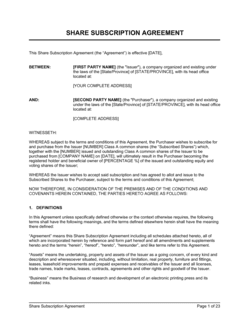
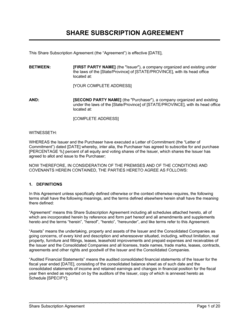
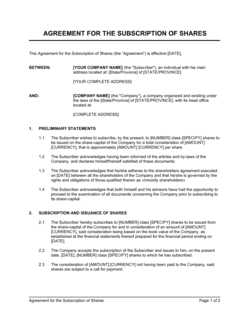
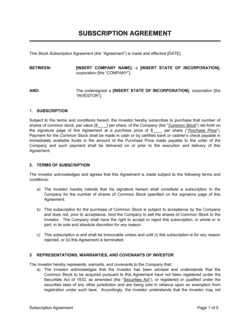
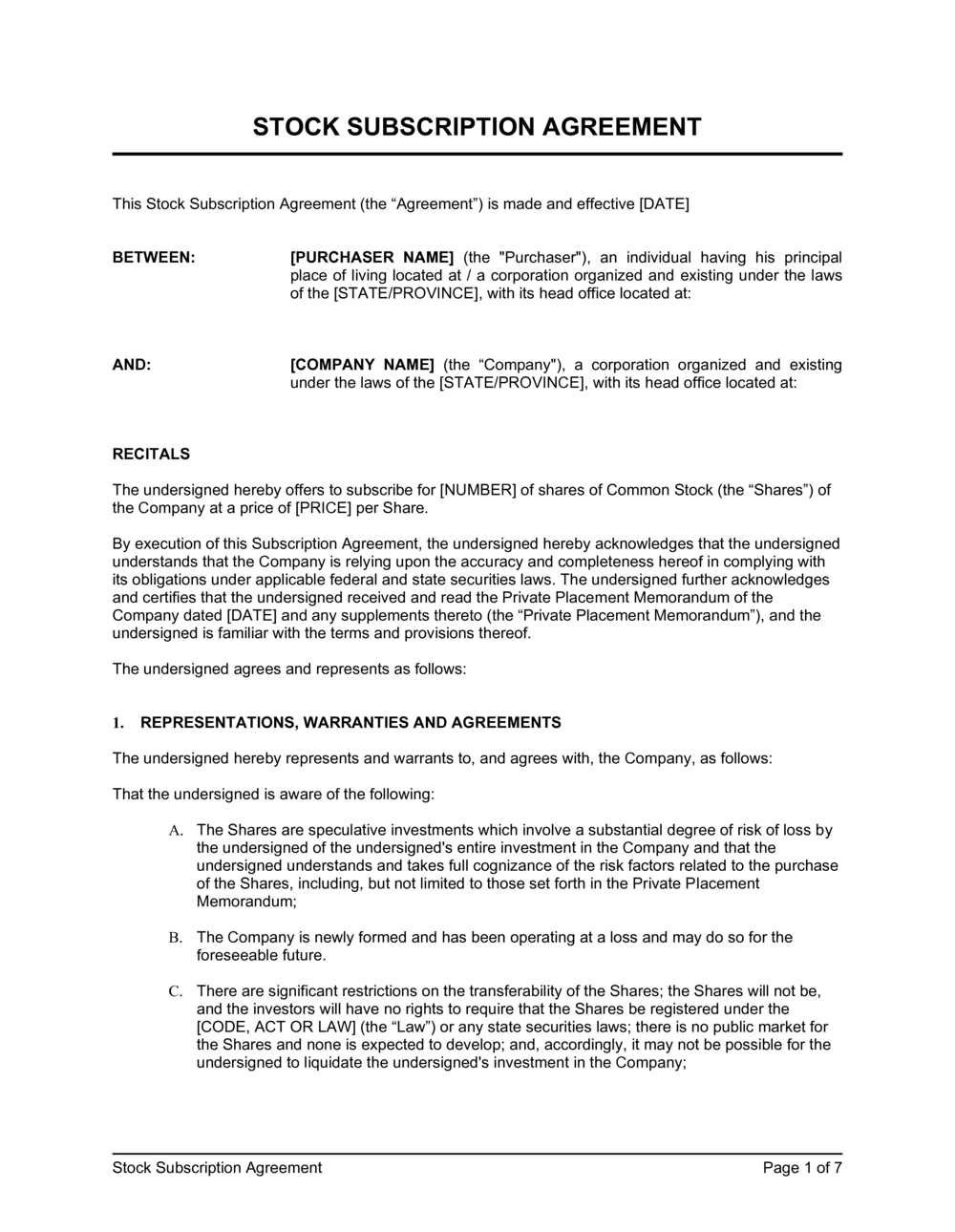
Stock Subscription Agreement Template

Free Word download • Edit online • Save & share with Drive • Export to PDF

6 pages30–40 min to fillDifficulty: ComplexSignature requiredLegal review recommended
Learn more ↓
FreeStock Subscription Agreement Template

At a glance

What it is
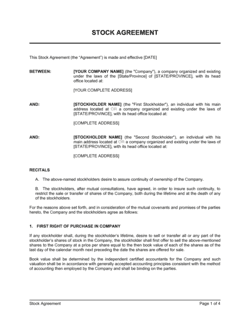
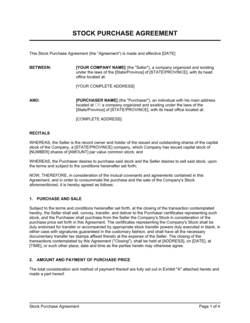
A Stock Subscription Agreement is a legally binding contract through which an investor agrees to purchase a specified number of shares in a company at an agreed price, and the company agrees to issue those shares upon receipt of payment. This free Word download gives you a structured, investor-ready template you can edit online and export as PDF to execute with shareholders at closing.
When you need it
Use it whenever a private company issues new shares to an investor — during a seed round, a Series A or later funding round, or a private placement to angel investors or strategic partners. It is also required when adding a new shareholder to a closely held corporation or LLC converting to a share structure.
What's inside
Identification of the issuing company and subscriber, the number of shares and subscription price, representations and warranties from both parties, closing conditions, transfer restrictions, anti-dilution provisions, and governing law. The template also includes signature blocks for both parties and a schedule for share certificate delivery.

What is a Stock Subscription Agreement?

A Stock Subscription Agreement is a legally binding contract through which an investor — the subscriber — agrees to purchase a specified number of newly issued shares in a company at an agreed price per share, and the company agrees to issue and deliver those shares upon receipt of full payment. Unlike a share purchase agreement, which documents the transfer of existing shares between shareholders, a stock subscription agreement creates new equity: the company's share capital increases, and the subscriber's funds flow directly to the company. The agreement captures every material term of the transaction — share class, subscription price, closing mechanics, investor representations, transfer restrictions, and post-closing rights — in a single enforceable instrument.

Why You Need This Document

Without a signed stock subscription agreement, a company accepting investor funds has no documented basis for the terms of the issuance — no agreed price per share, no transfer restrictions, and no investor representations confirming securities law compliance. The consequences are concrete: a cap table entry without a supporting agreement is disputed territory in any future acquisition or follow-on financing due diligence review. Investor representations confirming accredited investor status are required for US Regulation D exemptions — missing them exposes the company to SEC enforcement and investor rescission rights. Transfer restrictions that exist only in a verbal understanding are unenforceable against a subscriber who sells to a third party. This template gives you a complete, investor-ready document that satisfies securities law compliance requirements, protects the company's cap table integrity, and gives both parties a clear record of exactly what was purchased, at what price, and under what conditions — closing the legal gaps that a wire transfer and a handshake leave wide open.

Which variant fits your situation?

If your situation is…Use this template
Issuing common shares to an angel or seed investorStock Subscription Agreement (Common Shares)
Issuing preferred shares with liquidation preferences to a VCPreferred Stock Subscription Agreement
Issuing shares subject to a vesting schedule to a founder or key employeeRestricted Stock Purchase Agreement
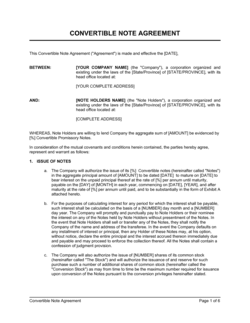
Investor converting a loan into equity at a discounted priceConvertible Note Agreement
Future equity grant at a valuation cap without a priced roundSAFE Agreement
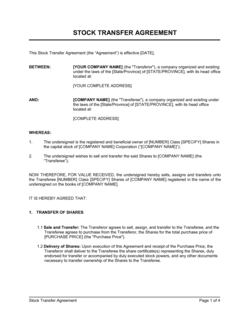
Transferring existing shares between shareholders rather than issuing new onesStock Transfer Agreement
Documenting the rights of all shareholders in a single governing documentShareholders Agreement

Common mistakes to avoid

❌ Omitting the accredited investor representation

Why it matters: Selling securities in a US private placement to a non-accredited investor without registration violates the Securities Act of 1933 and exposes the company to rescission rights, SEC enforcement, and state blue-sky law penalties.

Fix: Include a written accredited investor representation in the subscriber warranties section and collect a completed investor questionnaire as supporting documentation at closing.

❌ Issuing shares beyond the authorized share capital

Why it matters: Shares issued in excess of the number authorized in the company's articles of incorporation are void as a matter of corporate law — the subscriber receives nothing and the company faces a governance crisis.

Fix: Confirm the current authorized and issued share counts against the cap table before finalizing the subscription amount. If additional authorization is needed, pass an articles amendment before closing.

❌ No closing date or payment deadline

Why it matters: An open-ended obligation leaves the cap table in limbo — the company cannot accurately represent its ownership structure to future investors, lenders, or acquirers.

Fix: State a specific closing date — typically 10 to 30 days from signing — and provide that the agreement terminates automatically if payment is not received by that date.

❌ Using a full-ratchet anti-dilution formula

Why it matters: A full-ratchet adjustment resets the per-share price to the lowest price in any subsequent issuance, which can wipe out existing common shareholders and make it nearly impossible to raise a follow-on round.

Fix: Replace full-ratchet language with broad-based weighted-average anti-dilution, which is the market standard in institutional venture deals and far less punitive to the company.

❌ Transfer restrictions not mirrored in the share register

Why it matters: If the transfer restriction exists in the agreement but is not noted in the share register or on the share certificate, a subsequent purchaser of the shares may claim they took free of the restriction.

Fix: Ensure the restrictive legend appears on any physical share certificate and that the restriction is noted in the company's share register at the time of issuance.

❌ Signing the agreement after funds are wired

Why it matters: Payment before execution means the subscriber has parted with funds under a transaction with no enforceable written terms — the company's reps and warranties, transfer restrictions, and closing conditions have no contractual force.

Fix: Execute the agreement — with wet or electronic signatures from both parties — before any funds are transferred. Use escrow if timing makes same-day signing and payment impractical.

The 10 key clauses, explained

Parties and Recitals

In plain language: Identifies the issuing company and the subscriber by their full legal names, and states the background context of the share issuance.

Sample language
This Stock Subscription Agreement is entered into as of [DATE] between [COMPANY LEGAL NAME], a [STATE/PROVINCE] [ENTITY TYPE] ('Company'), and [SUBSCRIBER FULL NAME / ENTITY NAME] ('Subscriber').

Common mistake: Using a trade name or DBA instead of the registered legal entity name. If the corporate name on the agreement doesn't match the share register or articles of incorporation, the issuance can be challenged during due diligence or a future acquisition.

Subscription and Issuance

In plain language: States the exact number of shares the subscriber agrees to purchase, the class of shares, the price per share, and the total subscription amount.

Sample language
Subscriber hereby subscribes for [NUMBER] shares of [CLASS] stock of the Company at a price of $[PRICE PER SHARE] per share, for a total subscription amount of $[TOTAL AMOUNT] ('Subscription Price').

Common mistake: Failing to specify the share class. Common and preferred shares carry different rights — leaving the class undefined creates disputes over dividends, voting, and liquidation preferences.

Payment Terms and Closing

In plain language: Sets out when and how the subscriber delivers payment — wire transfer, check, or installment — and the date on which shares are issued in return.

Sample language
Subscriber shall deliver the Subscription Price to the Company by [PAYMENT METHOD] on or before [CLOSING DATE]. Upon receipt of full payment, the Company shall issue the shares and deliver a share certificate or book-entry confirmation within [X] business days.

Common mistake: No specified closing date or payment deadline. An open-ended obligation allows either party to delay indefinitely, leaving the company with an unresolved cap table entry and potential securities law compliance issues.

Company Representations and Warranties

In plain language: Statements the company makes to the subscriber confirming that the shares are duly authorized, the company is validly incorporated, no litigation is pending, and the financial information provided is accurate.

Sample language
The Company represents and warrants that: (a) it is duly organized and in good standing under the laws of [JURISDICTION]; (b) the Shares have been duly authorized and, when issued and paid for, will be validly issued, fully paid, and non-assessable; (c) no material litigation is pending or threatened against the Company.

Common mistake: Overstating representations — for example, warranting that no competitor threatens the business. If any rep is inaccurate at closing, the subscriber may rescind the deal or claim damages. Limit reps to facts within the company's knowledge and control.

Subscriber Representations and Warranties

In plain language: Statements the investor makes to the company confirming their legal authority to invest, their understanding of the risks, and — critically — their status as an accredited investor where required by securities law.

Sample language
Subscriber represents and warrants that: (a) Subscriber is an accredited investor as defined in Rule 501 of Regulation D; (b) Subscriber is acquiring the Shares for investment purposes only and not with a view to distribution; (c) Subscriber has sufficient knowledge and experience to evaluate the merits and risks of this investment.

Common mistake: Omitting the accredited investor representation for US private placements. Selling securities to non-accredited investors without a registered prospectus is a federal violation under the Securities Act of 1933 — the agreement must capture this representation in writing.

Transfer Restrictions and Legends

In plain language: Restricts the subscriber from selling or transferring the shares without board approval, compliance with securities laws, or satisfaction of a right-of-first-refusal obligation to existing shareholders.

Sample language
The Shares may not be sold, transferred, or otherwise disposed of without the prior written consent of the Company's board of directors and compliance with applicable securities laws. The share certificate shall bear the following legend: 'THE SHARES REPRESENTED HEREBY HAVE NOT BEEN REGISTERED UNDER THE SECURITIES ACT OF 1933 AND MAY NOT BE SOLD, TRANSFERRED, OR ASSIGNED ABSENT REGISTRATION OR AN APPLICABLE EXEMPTION.'

Common mistake: Omitting the restrictive legend on physical or book-entry share certificates. Without the legend, a subsequent transferee may claim they had no notice of restrictions — complicating enforcement and potentially triggering inadvertent public distribution.

Conditions to Closing

In plain language: Lists the prerequisites that must be satisfied before either party is obligated to complete the transaction — typically board resolutions, legal opinions, updated cap table, and any required regulatory filings.

Sample language
The obligations of each party to close are conditioned upon: (a) approval of the share issuance by the Company's board of directors; (b) delivery by the Company of a legal opinion confirming the shares are validly authorized; (c) completion of any required securities law filings in the applicable jurisdiction.

Common mistake: No conditions to closing at all. Without them, a party that discovers a problem — undisclosed litigation, a missing board resolution — has no contractual basis to walk away without breaching the agreement.

Anti-Dilution and Pre-Emptive Rights

In plain language: Protects the subscriber's ownership percentage or per-share price if the company subsequently issues shares at a lower valuation, or grants the subscriber the right to participate in future rounds to maintain their stake.

Sample language
If the Company issues additional shares at a price per share less than $[PRICE] within [X] months of Closing, the Subscription Price shall be adjusted on a [broad-based weighted-average / full-ratchet] basis. Subscriber shall have the right, but not the obligation, to participate in any subsequent equity financing on a pro-rata basis.

Common mistake: Using a full-ratchet anti-dilution formula instead of broad-based weighted-average. Full ratchet severely penalizes the company and all other shareholders in a down round — most sophisticated investors accept broad-based weighted-average as market standard.

Confidentiality

In plain language: Prohibits both parties from disclosing the terms of the agreement or any non-public company information shared during due diligence to third parties without consent.

Sample language
Each party agrees to keep the terms of this Agreement and any Confidential Information received in connection with this transaction strictly confidential and not to disclose it to any third party without the prior written consent of the other party, except as required by law or to each party's legal and financial advisors.

Common mistake: No carve-out for required legal or regulatory disclosure. A subscriber who receives a government subpoena or regulatory inquiry needs the ability to disclose without breaching the agreement — the clause must include a compelled-disclosure exception.

Governing Law and Dispute Resolution

In plain language: Specifies the jurisdiction whose law governs the agreement and how disputes will be resolved — litigation, arbitration, or mediation — including the venue.

Sample language
This Agreement shall be governed by and construed in accordance with the laws of [STATE / PROVINCE / COUNTRY]. Any dispute arising out of or in connection with this Agreement shall be resolved by binding arbitration administered by [AAA / JAMS / ICC] in [CITY], except that either party may seek injunctive relief in any court of competent jurisdiction.

Common mistake: Choosing a governing law with no connection to where the company is incorporated or the subscriber is located. Courts sometimes refuse to enforce a foreign governing-law clause, particularly in consumer or employment contexts — and in securities matters, mandatory local law often applies regardless.

How to fill it out

  1. 1

    Enter the company and subscriber's legal details

    Insert the company's full registered legal name, jurisdiction of incorporation, and registered address. Do the same for the subscriber — use a legal entity name if the investor is a fund or corporation, not a personal name.

    💡 Cross-reference the company name against the state or provincial corporate registry before execution. A single word difference from the registered name can complicate share registration.

  2. 2

    Define the share class, number of shares, and subscription price

    Specify whether the shares are common or preferred, the exact number being issued, and the price per share. Confirm the total subscription amount by multiplying shares by price. Cross-check that the issuance does not exceed the company's authorized share capital.

    💡 Pull the current cap table before filling in this section — issuing shares you don't have authorized is a corporate law violation that requires an articles amendment to cure.

  3. 3

    Set the closing date and payment mechanics

    Enter a specific closing date no more than 30 days from signing. Specify the payment method — wire transfer is standard — and include the company's bank account details or escrow instructions in a schedule rather than the body of the agreement.

    💡 Never put banking details directly in the agreement body if it will be shared broadly. Use a separate, countersigned payment schedule delivered at closing.

  4. 4

    Confirm and complete the subscriber representations

    If the subscriber is investing in a US private placement, confirm they meet the accredited investor definition under Rule 501 of Regulation D. For Canadian investors, confirm their eligibility under the applicable provincial exemption. Have the subscriber initial the representations section separately.

    💡 Collect a completed investor questionnaire alongside the signed agreement — this creates a separate paper trail for securities law compliance that the agreement alone does not fully satisfy.

  5. 5

    Tailor the transfer restrictions and legend

    Confirm the transfer restriction language matches any existing shareholders agreement or right-of-first-refusal provisions. Add the required restrictive legend verbatim — securities regulators specify the exact wording in some jurisdictions.

    💡 If the company already has a shareholders agreement, incorporate the transfer restriction provisions by reference rather than restating them — divergent language in two documents creates ambiguity.

  6. 6

    Review and complete conditions to closing

    List every condition that must be satisfied before closing — board resolution, legal opinion, updated cap table, any required regulatory filings. Assign responsibility for satisfying each condition and set a deadline.

    💡 Obtain and attach the board resolution authorizing the share issuance before the agreement is signed, not after. A resolution dated after the closing is a red flag for investors in any future due diligence review.

  7. 7

    Confirm governing law and execute before funds are transferred

    Select a governing jurisdiction connected to the company's place of incorporation. Both parties must sign before any funds are transferred — an unsigned agreement combined with a wire transfer creates a constructive obligation without enforceable terms.

    💡 Use a timestamped electronic signature platform to capture execution date and IP address for each signatory — this is essential evidence if a party later disputes the date of signing.

Frequently asked questions

What is a stock subscription agreement?

A stock subscription agreement is a legally binding contract through which an investor agrees to purchase newly issued shares in a company at a specified price, and the company agrees to issue those shares upon receipt of payment. It documents the terms of the share issuance — including the number of shares, class, price, closing conditions, and investor representations — and serves as the primary legal record of the transaction for both parties' cap tables and corporate registers.

What is the difference between a stock subscription agreement and a share purchase agreement?

A stock subscription agreement governs the issuance of new shares directly from the company to an investor — the company creates new equity and receives cash in return. A share purchase agreement governs the transfer of existing shares between a seller and a buyer — the company is not a party and receives no proceeds. Use a subscription agreement when the company is raising new capital; use a share purchase agreement when an existing shareholder is selling their stake.

Do I need a lawyer to prepare a stock subscription agreement?

For straightforward seed investments between a single investor and a closely held company, a well-structured template is a practical starting point. However, securities law compliance — particularly the accredited investor determination, applicable exemptions, and required filings — varies by jurisdiction and is fact-specific. Legal review is strongly recommended for any round above $100K, for preferred share issuances, or when investors are located in different jurisdictions from the company.

What representations and warranties should a company include?

Standard company representations cover valid incorporation and good standing, due authorization of the shares being issued, absence of pending material litigation, accuracy of financial information provided to the investor, compliance with applicable laws, and no conflict with existing agreements. Representations should be limited to facts within the company's actual knowledge and control — overbroad representations expose the company to rescission or damages claims if any statement turns out to be inaccurate.

What does 'accredited investor' mean and why does it matter?

In the United States, an accredited investor is an individual with annual income exceeding $200,000 (or $300,000 jointly with a spouse) for the past two years, or a net worth exceeding $1 million excluding their primary residence, or certain professional certifications. The designation matters because private placements under Regulation D are exempt from SEC registration only when shares are sold exclusively to accredited investors (or to a limited number of non-accredited investors with additional disclosure requirements). Selling to unqualified investors without a registered offering is a federal securities violation.

What transfer restrictions are typically included in a stock subscription agreement?

Common restrictions include a prohibition on any sale or transfer without prior board approval, a right of first refusal giving the company or existing shareholders the opportunity to purchase shares before any third-party sale, a lock-up period preventing any transfer for 12 to 24 months after issuance, and a mandatory securities law compliance requirement for any permitted transfer. These restrictions are typically noted on the share certificate with a restrictive legend and reflected in the company's share register.

Can a stock subscription agreement include anti-dilution protection?

Yes, and it is common in investor-negotiated rounds. The two standard approaches are broad-based weighted-average, which adjusts the subscriber's per-share price based on the weighted average of all shares outstanding before and after the dilutive issuance, and full-ratchet, which resets the price to the lowest subsequent issuance price. Broad-based weighted-average is the market standard for institutional deals because it is less punitive to the company and existing common shareholders.

What happens if a company issues shares beyond its authorized capital?

Shares issued in excess of the authorized share capital stated in the company's articles of incorporation are void under corporate law in most jurisdictions — the subscriber receives no valid equity, and the company faces a governance breach. The company must pass a shareholder resolution to amend its articles and increase authorized share capital before the issuance can be cured. Always confirm available authorized shares against the current cap table before execution.

Is a stock subscription agreement the same as a SAFE or convertible note?

No. A stock subscription agreement documents an immediate priced equity issuance — shares are issued at a known price per share on a known closing date. A SAFE (Simple Agreement for Future Equity) and a convertible note are instruments that convert into equity at a future priced round, typically at a discount or subject to a valuation cap. SAFEs and convertible notes are used when the company's valuation is not yet established; subscription agreements are used once a price per share has been agreed.

What filings are required after a stock subscription agreement is signed?

In the US, companies relying on Regulation D must file a Form D with the SEC within 15 days of the first sale and comply with applicable state blue-sky notice filings. In Canada, issuers must file applicable exempt distribution reports with provincial securities commissions, typically within 10 days of closing. In the UK, certain share allotments must be reported to Companies House within one month. Failing to make required post-closing filings can disqualify the exemption relied upon and expose the company to regulatory action.

How this compares to alternatives

vs Shareholders Agreement

A stock subscription agreement documents a single share issuance transaction — who buys, at what price, and under what conditions. A shareholders agreement is the ongoing governance document that governs how all shareholders relate to each other and the company after shares are issued, covering voting rights, drag-along, tag-along, and exit provisions. Both documents are typically executed together at the same closing.

vs Stock Transfer Agreement

A stock subscription agreement governs the issuance of new shares from the company to an investor, with the company receiving the proceeds. A stock transfer agreement governs the sale of existing shares from one shareholder to another — the company is not a party and no new equity is created. Use a subscription agreement for capital raises; use a transfer agreement for secondary sales between shareholders.

vs Convertible Note Agreement

A stock subscription agreement closes a priced equity round — shares are issued at an agreed valuation on a defined closing date. A convertible note is a debt instrument that converts into equity at a future priced round, usually at a discount or subject to a valuation cap. Convertible notes are appropriate when the company's valuation is not yet established; subscription agreements are used once a per-share price has been negotiated.

vs Investment Agreement

An investment agreement is a broader document that may combine subscription mechanics, shareholder rights, board representation, information rights, and exit provisions into a single instrument — common in UK and European deal structures. A stock subscription agreement is narrower, focusing on the mechanics of the share issuance itself. Many US deals split these into a subscription agreement plus a separate shareholders agreement, while UK deals often combine them.

Industry-specific considerations

Technology / SaaS

Seed and Series A share issuances tied to SaaS revenue milestones, with anti-dilution and pro-rata rights negotiated by institutional investors.

Life Sciences / Biotech

Preferred share subscriptions structured around clinical trial milestones, with FDA regulatory risk disclosures embedded in company representations.

Real Estate

Private placements for real estate operating companies or project-level SPVs, with securities law exemptions specific to real estate investment structures.

Financial Services / Fintech

Heightened regulatory licensing representations, potential FINRA or FCA implications, and compliance with securities dealer registration requirements before any share offering.

Manufacturing

Closely held family business share issuances to strategic investors or management buyout participants, with right-of-first-refusal and board seat provisions.

Professional Services

Partner buy-ins and equity expansion in law, accounting, and consulting firms, where professional licensing rules may restrict who can hold shares.

Jurisdictional notes

United States

Private share issuances must qualify for an exemption from SEC registration — most commonly Regulation D Rule 506(b) or 506(c). Shares may only be sold to accredited investors under 506(b) (or up to 35 sophisticated non-accredited investors with full disclosure). A Form D must be filed with the SEC within 15 days of the first sale, and applicable state blue-sky notice filings are required. State securities laws vary significantly — California, for example, applies additional requirements under its Corporations Code.

Canada

Each province regulates securities independently under its own Securities Act, though national instruments harmonize many rules. Common exemptions include the accredited investor exemption, the family, friends, and business associates exemption, and the offering memorandum exemption. Issuers must file a Report of Exempt Distribution with the applicable provincial commission, typically within 10 days of closing. Quebec imposes additional French-language requirements on certain investor-facing documents.

United Kingdom

Share issuances to more than 150 persons generally require a prospectus under the UK Prospectus Regulation unless an exemption applies — most commonly the offers to qualified investors exemption or the small offers exemption (below £5 million in 12 months). New share allotments must be reported to Companies House on Form SH01 within one month of allotment. The Financial Services and Markets Act 2000 restricts financial promotions, so subscriber-facing materials must be approved by an FCA-authorized person.

European Union

Private placements to fewer than 150 persons per member state are generally exempt from the EU Prospectus Regulation (2017/1129), but each member state applies its own private placement rules. Germany, France, and the Netherlands impose notification or registration requirements for certain exempt offerings. GDPR applies to any personal data of subscribers collected during due diligence and closing — the agreement should include a data processing or privacy reference. Anti-money-laundering (AML) verification of investor identity is mandatory across the EU under the 6th AML Directive.

Template vs lawyer — what fits your deal?

PathBest forCostTime
Use the templateStraightforward common share issuances to a single accredited investor in a single jurisdiction under $100KFree30–60 minutes
Template + legal reviewSeed rounds up to $500K, preferred share issuances, or investors in a different jurisdiction from the company$500–$1,500 for a securities attorney review3–7 days
Custom draftedSeries A or later rounds, multiple investors, cross-border placements, or preferred shares with complex liquidation preferences$3,000–$15,000+2–6 weeks

Glossary

Subscriber
The investor or individual who agrees to purchase newly issued shares from the company under the terms of the agreement.
Subscription Price
The price per share the subscriber pays to acquire the newly issued shares, agreed upon at the time of signing.
Closing
The date on which the subscriber delivers payment and the company issues the shares, completing the transaction.
Representations and Warranties
Factual statements made by each party — such as the company's authorized share capital or the investor's accredited status — that must be true at signing and closing.
Accredited Investor
A person or entity meeting minimum income or net-worth thresholds set by securities regulators, allowing them to participate in private placements without full prospectus disclosure.
Authorized Share Capital
The maximum number of shares a company is permitted to issue under its articles of incorporation or corporate charter.
Pre-Money Valuation
The agreed value of the company immediately before the investor's capital is added — used to calculate the subscription price per share.
Anti-Dilution Provision
A clause protecting an investor's ownership percentage or purchase price if the company later issues shares at a lower price.
Transfer Restriction
A provision limiting when and to whom the subscriber may sell or transfer the shares acquired under the agreement — typically requiring board or shareholder approval.
Right of First Refusal
A contractual right giving existing shareholders the opportunity to purchase shares before the subscriber may sell them to a third party.
Private Placement
A sale of securities directly to a select group of investors without a public offering — exempt from full securities registration under Regulation D in the US or equivalent exemptions elsewhere.
Closing Conditions
Prerequisites that must be satisfied before the transaction can complete — such as board approval, regulatory filings, or delivery of a legal opinion.

Part of your Business Operating System

This document is one of 3,000+ business & legal templates included in Business in a Box.

  • Fill-in-the-blanks — ready in minutes
  • 100% customizable Word document
  • Compatible with all office suites
  • Export to PDF and share electronically

Create your document in 3 simple steps.

From template to signed document — all inside one Business Operating System.
1
Download or open template

Access over 3,000+ business and legal templates for any business task, project or initiative.

2
Edit and fill in the blanks with AI

Customize your ready-made business document template and save it in the cloud.

3
Save, Share, Send, Sign

Share your files and folders with your team. Create a space of seamless collaboration.

Save time, save money, and create top-quality documents.

★★★★★

"Fantastic value! I'm not sure how I'd do without it. It's worth its weight in gold and paid back for itself many times."

Managing Director · Mall Farm
Robert Whalley
Managing Director, Mall Farm Proprietary Limited
★★★★★

"I have been using Business in a Box for years. It has been the most useful source of templates I have encountered. I recommend it to anyone."

Business Owner · 4+ years
Dr Michael John Freestone
Business Owner
★★★★★

"It has been a life saver so many times I have lost count. Business in a Box has saved me so much time and as you know, time is money."

Owner · Upstate Web
David G. Moore Jr.
Owner, Upstate Web

Run your business with a system — not scattered tools

Stop downloading documents. Start operating with clarity. Business in a Box gives you the Business Operating System used by over 250,000 companies worldwide to structure, run, and grow their business.

Free Forever Plan · No credit card required