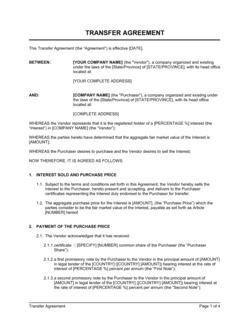
Stock Transfer Agreement Template

Free Word download β€’ Edit online β€’ Save & share with Drive β€’ Export to PDF

4 pagesβ€’25–35 min to fillβ€’Difficulty: Complexβ€’Signature requiredβ€’Legal review recommended
Learn more ↓
FreeStock Transfer Agreement Template

At a glance

What it is
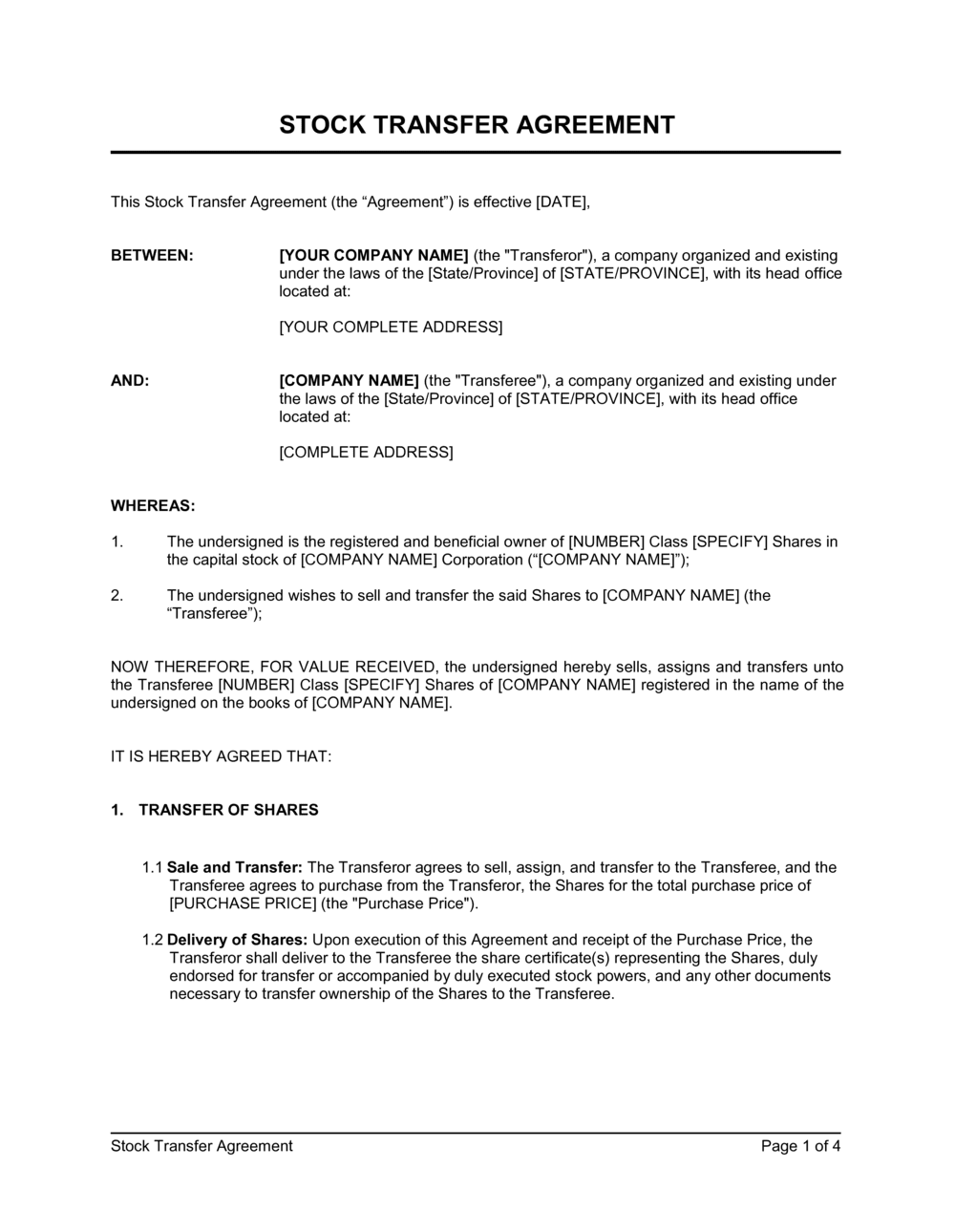
A Stock Transfer Agreement is a legally binding contract that documents the sale or transfer of shares in a corporation from one party (the transferor) to another (the transferee). This free Word download lets you specify the number of shares, the purchase price, representations and warranties from both sides, transfer conditions, and closing mechanics β€” all in a single document you can edit online and export as PDF.
When you need it
Use it any time shares in a private company change hands β€” whether through a sale, gift, estate transfer, or buyout β€” and you need a written record that satisfies corporate formalities, co-owner rights, and applicable securities regulations.
What's inside
Party identification and share details, purchase price and payment terms, representations and warranties from transferor and transferee, conditions to closing, indemnification obligations, governing law, and signature blocks for both parties plus any required spousal or board consent.

What is a Stock Transfer Agreement?

A Stock Transfer Agreement is a legally binding contract that documents the sale or transfer of shares in a corporation from one party β€” the transferor β€” to another β€” the transferee. It records the exact number and class of shares changing hands, the purchase price and payment terms, representations and warranties from both sides confirming clear title and authority to transact, the conditions that must be met before closing can occur, and the mechanics of completing the transfer itself. Unlike a verbal arrangement or a simple endorsement on the back of a share certificate, a properly drafted stock transfer agreement creates an enforceable record of every material term and protects both parties if disputes arise after the fact.

Why You Need This Document

Transferring shares without a written agreement exposes both parties to serious legal and financial risk. The transferor has no documented proof that consideration was paid or that the transferee accepted the shares subject to resale restrictions β€” creating securities law exposure on any subsequent sale. The transferee has no written evidence of ownership if the transferor later disputes the transaction, pledges the same shares as collateral, or becomes insolvent. Without a signed agreement that satisfies corporate formalities β€” board approval, ROFR waivers, and share register update β€” many transfers are voidable under the company's own governing documents, meaning the deal can be unwound long after consideration has changed hands. A completed Stock Transfer Agreement eliminates all of these gaps, gives the company's register a reliable basis for updating legal ownership, and provides both parties with a defensible paper trail for tax, regulatory, and litigation purposes.

Which variant fits your situation?

If your situation is…Use this template
Selling a majority or controlling interest in a private companyShare Purchase Agreement
Transferring shares as part of a full business acquisitionBusiness Purchase Agreement
Buying out a co-founder or departing partnerStock Buyback Agreement
Gifting shares to a family member or charitable organizationStock Transfer Agreement (Gift)
Transferring shares under an employee stock option planStock Option Agreement
Documenting a right of first refusal before an outside saleRight of First Refusal Agreement
Transferring LLC membership units instead of corporate sharesLLC Membership Interest Transfer Agreement

Common mistakes to avoid

❌ Skipping the ROFR waiver before transfer

Why it matters: If the company or co-shareholders hold an unwaived right of first refusal, the completed transfer may be voidable at their election β€” potentially requiring the shares to be returned and the deal unwound.

Fix: Before executing the agreement, review the shareholders' agreement and bylaws for any ROFR provisions. Obtain written waivers from every holder of such rights and attach them to the agreement as exhibits.

❌ Failing to update the share register at closing

Why it matters: A signed agreement transfers contractual rights, but in most jurisdictions the share register update is what constitutes legal transfer of title. An unrecorded transfer leaves the transferee exposed if the transferor subsequently pledges or re-sells the same shares.

Fix: Make share register update a mandatory closing deliverable with a specific deadline. Have the company secretary or a director countersign the agreement to acknowledge the update.

❌ Omitting the restrictive legend on unregistered shares

Why it matters: Without the restrictive legend clause, the transferee may attempt to resell the shares without complying with registration or exemption requirements, creating securities law violations for both parties.

Fix: Include a transfer restrictions clause specifying the legend language and requiring any new certificate to carry it. Attach a copy of the current certificate with the legend already endorsed.

❌ Setting no cap on indemnification liability

Why it matters: An uncapped indemnification clause means a minor warranty breach β€” such as a small undisclosed lien on shares worth $50,000 β€” could theoretically expose a party to claims far exceeding the deal value.

Fix: Cap indemnification liability at the purchase price for general breaches. Exclude fraud and willful misconduct from the cap so bad-faith conduct remains fully compensable.

❌ Using percentage ownership instead of share count

Why it matters: A transfer described as '20% of the company' is ambiguous if shares have been issued, cancelled, or converted between signing and closing β€” resulting in a different share count than intended.

Fix: Always describe the transfer by the exact number of shares and class. Include a representation confirming the total issued and outstanding share count as of the signing date.

❌ Signing without required board or shareholder approval

Why it matters: Many shareholder agreements and corporate bylaws require board or majority-shareholder approval before any share transfer is effective. A transfer completed without it is typically voidable and can trigger breach-of-contract claims against both parties.

Fix: Make board approval a condition precedent, secure it before or simultaneously with signing, and attach the written consent or board resolution to the closing package.

The 10 key clauses, explained

Parties and recitals

In plain language: Identifies the transferor and transferee by full legal name and address, states the name of the corporation whose shares are being transferred, and confirms both parties' intent to enter into the agreement.

Sample language
This Stock Transfer Agreement ('Agreement') is entered into as of [DATE] between [TRANSFEROR FULL NAME], residing at [ADDRESS] ('Transferor'), and [TRANSFEREE FULL NAME], residing at [ADDRESS] ('Transferee'), with respect to shares of [CORPORATION NAME], a [STATE] corporation ('Company').

Common mistake: Using informal names or trade names instead of legal names. If the transferor's name does not match the share certificate or corporate register exactly, the transfer can be challenged as defective.

Description of shares transferred

In plain language: Specifies the exact number of shares, class of shares (e.g., common, preferred, Class A), and any associated certificate numbers being transferred.

Sample language
Transferor hereby sells, assigns, and transfers to Transferee [NUMBER] shares of [CLASS] stock of the Company, represented by Certificate No(s). [CERTIFICATE NUMBERS] ('Shares'), free and clear of all liens, claims, and encumbrances.

Common mistake: Describing shares generically as 'a [X]% interest' without specifying the exact share count and class. Percentage-only descriptions create ambiguity if the cap table changes between signing and closing.

Purchase price and payment terms

In plain language: States the total consideration, how and when it will be paid, and what happens if payment is not made on time.

Sample language
In consideration for the Shares, Transferee shall pay to Transferor the sum of $[PURCHASE PRICE] ('Purchase Price'), payable in full by [WIRE TRANSFER / CHECK / PROMISSORY NOTE] on or before the Closing Date. If payment is not received by [DATE], this Agreement shall be null and void.

Common mistake: Omitting a specific payment deadline or method. 'Upon closing' without a defined closing date leaves both parties in limbo and can create disputes about when obligations were triggered.

Transferor's representations and warranties

In plain language: The seller confirms they legally own the shares, the shares are free of liens, no other party has a right to purchase them first (or that right has been waived), and they have authority to complete the transfer.

Sample language
Transferor represents and warrants that: (a) Transferor is the sole record and beneficial owner of the Shares; (b) the Shares are free and clear of all liens, pledges, security interests, or third-party claims; (c) no right of first refusal, co-sale right, or other restriction applies to the Shares that has not been waived in writing; and (d) Transferor has full legal authority to execute this Agreement.

Common mistake: Excluding the ROFR waiver confirmation. If the company or co-shareholders hold a right of first refusal and it is not documented as waived, the transfer may be voidable β€” even after closing.

Transferee's representations and warranties

In plain language: The buyer confirms they have authority to purchase, understand the investment is illiquid and unregistered, and β€” where required β€” meet any accredited investor thresholds or residency requirements.

Sample language
Transferee represents and warrants that: (a) Transferee has full legal authority to execute this Agreement and acquire the Shares; (b) Transferee is acquiring the Shares for investment purposes only and not with a view to public distribution; (c) Transferee [is / is not] an 'accredited investor' as defined in Rule 501 of Regulation D under the Securities Act of 1933; and (d) Transferee understands the Shares are subject to restrictions on resale under applicable securities laws.

Common mistake: Omitting the investment-intent representation for unregistered private shares. Without it, the transferor faces potential securities law liability for an unlawful distribution.

Conditions to closing

In plain language: Lists the prerequisites each party must satisfy before the transfer becomes effective β€” such as board approval, ROFR waivers, spousal consent, and regulatory clearance.

Sample language
The obligations of the parties to consummate the transfer are conditioned upon: (a) written approval of the Board of Directors of the Company; (b) written waiver of any right of first refusal by all holders of such rights; (c) delivery of executed spousal consent, if applicable under [STATE] law; and (d) receipt of all required regulatory approvals, if any.

Common mistake: Skipping board approval as a closing condition when the company's shareholder agreement or bylaws require it. A transfer completed without required board approval may be invalidated retroactively.

Closing mechanics and deliverables

In plain language: Defines the closing date, the documents to be exchanged at closing (endorsed certificates, stock powers, updated register), and who is responsible for filing or recording the transfer.

Sample language
Closing shall occur on [DATE] (the 'Closing Date'). At Closing: (a) Transferor shall deliver to Transferee the original Share Certificate(s), duly endorsed for transfer or accompanied by a duly executed Stock Power; (b) Transferee shall deliver the Purchase Price to Transferor; and (c) the Company shall update its share register to reflect Transferee as the registered holder of the Shares.

Common mistake: Failing to update the company's share register at closing. The register update β€” not the signed agreement β€” is what officially changes legal ownership in most jurisdictions.

Indemnification

In plain language: Each party agrees to compensate the other for losses arising from a breach of their own representations, warranties, or obligations under the agreement.

Sample language
Each party ('Indemnifying Party') shall indemnify, defend, and hold harmless the other party ('Indemnified Party') from and against any losses, damages, costs, and expenses (including reasonable attorneys' fees) arising out of or relating to any breach of the Indemnifying Party's representations, warranties, or obligations under this Agreement.

Common mistake: No cap on indemnification liability. Without a cap β€” typically set at the purchase price β€” a breach of a minor warranty can expose a party to unlimited damages disproportionate to the transaction value.

Transfer restrictions and legends

In plain language: Notifies the transferee that the shares carry resale restrictions under securities law and that any new certificate issued will bear a restrictive legend reflecting those restrictions.

Sample language
Transferee acknowledges that the Shares have not been registered under the Securities Act of 1933 or any applicable state securities law. Any certificate representing the Shares shall bear a legend substantially as follows: 'THE SHARES REPRESENTED BY THIS CERTIFICATE HAVE NOT BEEN REGISTERED UNDER THE SECURITIES ACT OF 1933 AND MAY NOT BE SOLD, TRANSFERRED, OR OTHERWISE DISPOSED OF EXCEPT IN COMPLIANCE WITH THE REGISTRATION REQUIREMENTS OF SUCH ACT OR AN APPLICABLE EXEMPTION THEREFROM.'

Common mistake: Omitting the restrictive legend clause entirely for private-company transfers. Failure to include it leaves the transferee unaware of resale restrictions and may expose both parties to securities law violations on a later sale.

Governing law and dispute resolution

In plain language: Specifies which state's or country's laws govern the agreement and how disputes will be resolved β€” litigation, arbitration, or mediation.

Sample language
This Agreement shall be governed by and construed in accordance with the laws of the State of [STATE], without regard to its conflict-of-laws principles. Any dispute arising out of or relating to this Agreement shall be resolved by binding arbitration in [CITY, STATE] under the rules of the American Arbitration Association, except that either party may seek injunctive relief in any court of competent jurisdiction.

Common mistake: Choosing a governing law that differs from the state of incorporation without any rational basis. Courts may apply the law of the state of incorporation regardless, creating unpredictable outcomes.

How to fill it out

  1. 1

    Identify the parties and the corporation

    Enter the transferor's and transferee's full legal names and addresses exactly as they appear on government-issued ID or corporate documents. Include the corporation's full legal name and state of incorporation.

    πŸ’‘ Cross-check the transferor's name against the existing share certificate β€” any discrepancy will require a separate correction affidavit before the transfer can proceed.

  2. 2

    Specify the shares being transferred

    Enter the exact number of shares, the share class (common, preferred, Class A, etc.), and the certificate number(s). If multiple certificates are involved, list each one.

    πŸ’‘ Pull the current cap table before drafting to confirm the exact share count and class. Errors here are the most common source of post-closing disputes.

  3. 3

    Set the purchase price and payment method

    State the total consideration in the currency of the transaction, specify the payment method (wire transfer, check, promissory note, or nominal consideration for a gift), and enter a specific payment deadline tied to the closing date.

    πŸ’‘ For gift transfers, state consideration as $1.00 or 'other good and valuable consideration' β€” a zero-dollar figure can create gift tax complications without documentation.

  4. 4

    Confirm and document ROFR waivers

    Review the company's shareholders' agreement and bylaws to identify any right of first refusal. Obtain written waiver from all holders before or concurrently with executing the transfer agreement.

    πŸ’‘ Attach the executed ROFR waivers as an exhibit to the agreement so both parties have a complete record in one document.

  5. 5

    Tailor the representations and warranties

    Complete both the transferor's and transferee's rep-and-warranty sections. For transferee, confirm whether accredited investor status applies and fill in the appropriate checkbox. Remove any rep that is factually inapplicable.

    πŸ’‘ Never delete the investment-intent warranty for private shares β€” it protects the transferor from securities law exposure even when both parties know each other well.

  6. 6

    List all conditions to closing

    Identify every prerequisite β€” board approval, spousal consent, regulatory filings β€” and list them explicitly. Set a deadline by which all conditions must be satisfied.

    πŸ’‘ Call a board meeting or obtain written consent in lieu of a meeting before signing, so board approval is secured and not a lingering open condition.

  7. 7

    Execute the agreement and closing deliverables

    Both parties sign the agreement. The transferor endorses the share certificate(s) on the reverse or executes a separate stock power. The company secretary or officer countersigns to acknowledge the transfer and updates the share register.

    πŸ’‘ Use a wet-ink or verified electronic signature β€” not a scanned image pasted over the document β€” to ensure the execution is legally valid in the governing jurisdiction.

  8. 8

    File any required tax or regulatory forms

    In the US, check whether a federal or state transfer tax return is required. In Canada, confirm whether the transfer triggers a T2057 election or capital gains reporting. In the UK, file a Stock Transfer Form with HMRC and pay any applicable stamp duty.

    πŸ’‘ Missing a post-closing filing deadline β€” especially stamp duty in the UK or provincial transfer tax in Canada β€” can result in penalties that exceed the cost of the original legal review.

Frequently asked questions

What is a stock transfer agreement?

A stock transfer agreement is a binding contract that documents the sale or transfer of shares in a corporation from one party (the transferor) to another (the transferee). It records the share details, purchase price, representations from both sides, conditions to closing, and indemnification obligations. It is the primary evidence of a private share transfer and the document used to update the corporate share register.

When do I need a stock transfer agreement?

You need one any time private company shares change hands β€” in a founder buyout, a sale to an outside investor, a family gift, an estate transfer, or an employee equity repurchase. Even transfers between parties who know each other well require a written agreement to satisfy corporate formalities, protect against future disputes, and comply with applicable securities and tax regulations.

What is the difference between a stock transfer agreement and a share purchase agreement?

The terms are often used interchangeably for private transactions. 'Share purchase agreement' typically refers to a more complex transaction β€” often involving representations about the company itself, not just the shares β€” and is common in majority or controlling-interest deals. A 'stock transfer agreement' usually refers to a cleaner, narrower document focused solely on the mechanics of the share transfer between two parties, without extensive company-level diligence reps. For minority transfers between known parties, the stock transfer form is usually sufficient.

Is a stock transfer agreement legally binding?

Yes β€” a properly executed stock transfer agreement is generally enforceable as a binding contract when it identifies the parties, the shares, the consideration, and includes signatures from both parties. However, enforceability also depends on compliance with corporate formalities: board approval where required, ROFR waivers, and share register updates. A technically correct contract can still be challenged if corporate prerequisites were skipped.

Does a stock transfer need to be notarized?

In most US states, notarization is not required for a private stock transfer agreement to be enforceable. However, some states and certain corporate bylaws may require a medallion signature guarantee on the stock power β€” a bank-certified form of signature authentication. In the UK, stamp duty requires the original Stock Transfer Form to be submitted to HMRC. Always check the company's governing documents and local law before assuming notarization is optional.

What taxes apply to a stock transfer?

In the US, a seller typically recognizes capital gains on the difference between sale price and adjusted cost basis β€” long-term rates apply if shares were held more than 12 months. The buyer generally pays no federal tax on acquisition but may owe state transfer taxes depending on jurisdiction. In the UK, the buyer pays 0.5% stamp duty on the purchase price, rounded up to the nearest Β£5. In Canada, the seller reports a capital gain; certain rollovers may defer tax under section 85 of the Income Tax Act. Always consult a tax advisor for the specific transaction.

What is a right of first refusal and how does it affect a stock transfer?

A right of first refusal (ROFR) is a contractual right held by existing shareholders or the company to purchase shares at the same price and terms before the selling shareholder may transfer them to an outside party. If the shareholders' agreement or bylaws contain a ROFR and it is not waived in writing before the transfer closes, the transfer may be voidable. Confirm ROFR status and obtain written waivers from every holder before executing any stock transfer agreement.

Can shares in a private company be transferred freely?

Generally no. Most private companies restrict share transfers through their shareholders' agreement, bylaws, or both. Common restrictions include rights of first refusal, board approval requirements, lock-up periods for founders and employees, drag-along and tag-along rights, and securities law holding periods. A stock transfer agreement must confirm that all applicable restrictions have been satisfied or waived before the transfer is effective.

Do I need a lawyer to prepare a stock transfer agreement?

For straightforward minority transfers between parties with no ROFR complications and a simple cash consideration, a high-quality template is typically sufficient. Legal review is strongly recommended when the transfer involves a controlling interest, complex consideration such as a promissory note or equity rollover, cross-border parties, potential securities law issues, or when the company has a shareholders' agreement with detailed transfer restrictions. A 1–2 hour review typically costs $400–$800 and is worthwhile for any transfer above $50,000 in value.

How this compares to alternatives

vs Business Purchase Agreement

A business purchase agreement transfers ownership of an entire business β€” its assets, liabilities, contracts, and goodwill β€” through either an asset sale or a share sale. A stock transfer agreement is narrower: it transfers only specified shares between two shareholders. When buying a controlling interest with full company-level diligence and representations about the business itself, a full share purchase agreement is more appropriate than a simple transfer form.

vs Stock Option Agreement

A stock option agreement grants an employee or advisor the right to purchase shares at a fixed price in the future, subject to vesting conditions. A stock transfer agreement documents an already-agreed transfer of currently owned shares. Options contemplate a future event; a transfer agreement closes a present one. When an employee exercises vested options, both documents may be used together.

vs Shareholders' Agreement

A shareholders' agreement governs the ongoing relationship between all co-owners of a company β€” voting rights, dividend policy, transfer restrictions, and dispute resolution. A stock transfer agreement handles a single transaction: moving specific shares from one party to another. The shareholders' agreement typically defines the rules that the stock transfer agreement must comply with, including ROFR procedures and approval requirements.

vs LLC Membership Interest Transfer Agreement

An LLC membership interest transfer agreement conveys economic and governance rights in a limited liability company, governed by the operating agreement. A stock transfer agreement transfers shares in a corporation, governed by corporate law and the shareholders' agreement. The two documents are structurally similar but legally distinct β€” corporate shares and LLC membership interests are different instruments with different transfer rules and tax treatment.

Industry-specific considerations

Technology / SaaS

Founder equity buyouts and early-investor secondary sales are common; IP-related representations and vesting cliff language are frequently added to standard transfer mechanics.

Professional Services

Partner buyouts and succession transfers in law, accounting, and consulting firms require coordination with partnership agreements and may trigger client-consent obligations.

Manufacturing

Family-business succession and management buyouts often involve installment payment structures and require coordination with lender consent under existing credit facilities.

Retail / Franchise

Franchise agreements frequently prohibit or restrict share transfers without franchisor approval, adding a third-party consent layer to standard corporate closing conditions.

Jurisdictional notes

United States

Private share transfers in the US must comply with federal securities laws β€” typically relying on the Section 4(a)(1) exemption for non-issuer resales or Rule 144 for restricted securities. State blue-sky laws may impose additional filing or notice requirements. Some states β€” including California and New York β€” require a medallion signature guarantee on the stock power rather than a simple endorsement. Capital gains tax applies at the federal level; state taxes vary.

Canada

Share transfers in Canadian private corporations must comply with the Canada Business Corporations Act (CBCA) or the applicable provincial corporate statute. The seller reports a capital gain or loss in the year of transfer; a section 85 rollover election may defer tax in certain restructurings. Quebec-incorporated companies must ensure shareholder agreements and transfer documents comply with the Civil Code of Quebec. Provincial securities exemptions apply to most private transfers between parties known to each other.

United Kingdom

In the UK, a Stock Transfer Form (STF) is the statutory instrument for transferring certificated shares and must be submitted to HMRC within 30 days of execution. Stamp Duty of 0.5% of the consideration (rounded up to the nearest Β£5) is payable by the buyer on transfers above Β£1,000. Companies House does not register individual share transfers, but the company's register of members must be updated. Pre-emption rights under the company's articles of association must be checked and waived before transfer.

European Union

Share transfer rules vary significantly by EU member state β€” German GmbH share transfers require notarial certification, while French and Dutch private share transfers have their own statutory forms. The EU's Alternative Investment Fund Managers Directive (AIFMD) and prospectus regulation may apply to transfers involving funds or large investor groups. GDPR requires that any personal data of the parties processed in connection with the transfer be handled under an appropriate legal basis and disclosed in a privacy notice.

Template vs lawyer β€” what fits your deal?

PathBest forCostTime
Use the templateMinority share transfers between known parties with straightforward cash consideration and no complex ROFR or regulatory issuesFree30–60 minutes
Template + legal reviewTransfers above $50,000 in value, transactions with promissory note consideration, or situations where the shareholders' agreement contains detailed transfer restrictions$400–$8002–5 business days
Custom draftedControlling-interest sales, cross-border transfers, complex capital structures with multiple share classes, or transactions requiring simultaneous securities law filings$2,000–$10,000+1–4 weeks

Glossary

Transferor
The current shareholder who is selling or giving away their shares under the agreement.
Transferee
The party receiving the shares β€” whether by purchase, gift, or other transfer.
Consideration
The price or other value exchanged for the shares, which may be cash, a promissory note, other securities, or nominal value for a gift.
Share Certificate
A physical or electronic document issued by the corporation evidencing a shareholder's ownership of a specified number of shares.
Right of First Refusal (ROFR)
A contractual right held by existing shareholders or the company to purchase shares before the owner may sell them to an outside third party.
Representations and Warranties
Factual statements made by each party that are true as of the signing date β€” such as clear title to the shares and authority to transfer β€” which form the basis for indemnification if false.
Indemnification
A contractual obligation by one party to reimburse the other for losses, damages, or legal costs arising from a breach of the agreement.
Drag-Along Right
A provision in a shareholders' agreement allowing majority owners to require minority owners to sell their shares on the same terms in a company-wide sale.
Closing
The date and event at which the share transfer is completed β€” consideration is paid, share certificates are exchanged, and the company's register is updated.
Cap Table
A spreadsheet or register listing all shareholders, their share classes, and ownership percentages, which must be updated to reflect any completed transfer.
Accredited Investor
A person or entity meeting SEC (or equivalent) financial thresholds β€” typically $200,000 annual income or $1M net worth β€” who may legally purchase unregistered securities.

Part of your Business Operating System

This document is one of 3,000+ business & legal templates included in Business in a Box.

  • Fill-in-the-blanks β€” ready in minutes
  • 100% customizable Word document
  • Compatible with all office suites
  • Export to PDF and share electronically

Create your document in 3 simple steps.

From template to signed document β€” all inside one Business Operating System.
1
Download or open template

Access over 3,000+ business and legal templates for any business task, project or initiative.

2
Edit and fill in the blanks with AI

Customize your ready-made business document template and save it in the cloud.

3
Save, Share, Send, Sign

Share your files and folders with your team. Create a space of seamless collaboration.

Save time, save money, and create top-quality documents.

β˜…β˜…β˜…β˜…β˜…

"Fantastic value! I'm not sure how I'd do without it. It's worth its weight in gold and paid back for itself many times."

Managing Director Β· Mall Farm
Robert Whalley
Managing Director, Mall Farm Proprietary Limited
β˜…β˜…β˜…β˜…β˜…

"I have been using Business in a Box for years. It has been the most useful source of templates I have encountered. I recommend it to anyone."

Business Owner Β· 4+ years
Dr Michael John Freestone
Business Owner
β˜…β˜…β˜…β˜…β˜…

"It has been a life saver so many times I have lost count. Business in a Box has saved me so much time and as you know, time is money."

Owner Β· Upstate Web
David G. Moore Jr.
Owner, Upstate Web

Run your business with a system β€” not scattered tools

Stop downloading documents. Start operating with clarity. Business in a Box gives you the Business Operating System used by over 250,000 companies worldwide to structure, run, and grow their business.

Start freeΒ Β·Β No credit card required