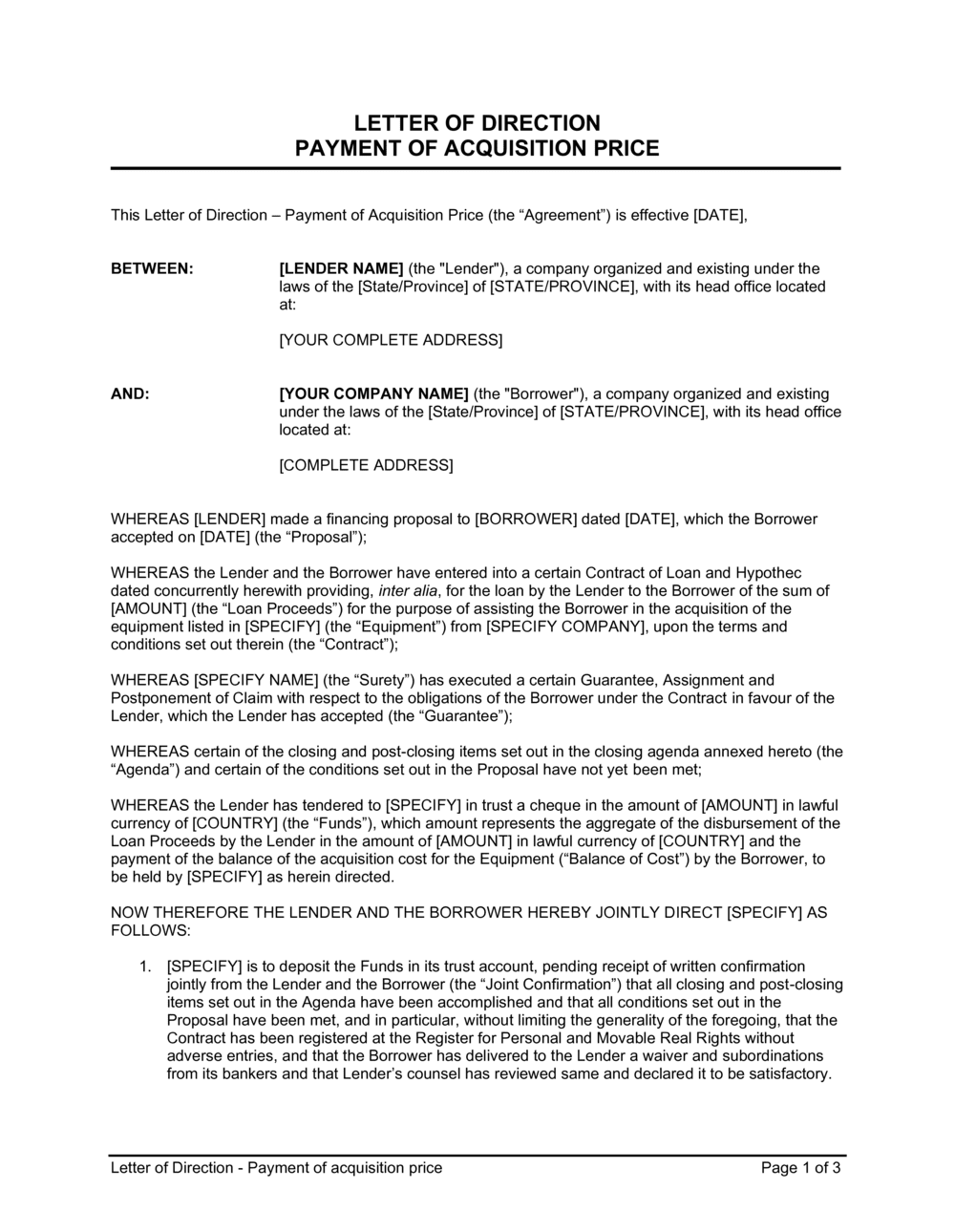
Letter of Direction Payment of Acquisition Price Template

Free Word download β€’ Edit online β€’ Save & share with Drive β€’ Export to PDF

3 pagesβ€’25–35 min to fillβ€’Difficulty: Complex
Learn more ↓
FreeLetter of Direction Payment of Acquisition Price Template

At a glance

What it is
A Letter of Direction β€” Payment of Acquisition Price is a formal written instruction issued by the seller or an authorized party in a business acquisition, directing the buyer or escrow agent to remit the purchase price to a specified recipient, account, or creditor. This free Word download gives you a ready-to-use letter you can edit online and send the same day.
When you need it
Use it at closing when the acquisition funds need to be split across multiple recipients β€” such as lenders, shareholders, or escrow accounts β€” or whenever the party receiving payment differs from the entity named as seller in the purchase agreement.
What's inside
Date and recipient block, reference to the underlying purchase agreement, specific payment instructions with account details or payee names, the authorized amount, and a confirmation request from the receiving party.

What is a Letter of Direction β€” Payment of Acquisition Price?

A Letter of Direction β€” Payment of Acquisition Price is a formal written instruction issued by the seller or an authorized representative at the closing of a business acquisition, directing the buyer, escrow agent, or closing attorney to remit the purchase price to a specified payee, account, or creditor. It supplements the underlying purchase agreement by providing the exact banking details, payee names, and authorized amounts needed to execute payment β€” and it creates a documented instruction trail that all parties can rely on if a disbursement dispute arises. In transactions where the receiving party differs from the seller named in the agreement β€” for example, when proceeds must first satisfy a lender payoff β€” this letter is the operative document that makes that redirect legally clear.

Why You Need This Document

Without a written letter of direction, the buyer or escrow agent has no formal authorization to pay anyone other than the named seller, and wire transfers made on informal instructions are a common source of closing-day fraud and error. A missing or incomplete payment direction can stall funding past the closing deadline, trigger default provisions in the purchase agreement, or result in funds being wired to the wrong account with no easy path to recovery. This template gives you a ready-to-use letter that captures every required element β€” payee identification, exact amount, wire details, authority confirmation, and a written acknowledgment request β€” so closing-day disbursements proceed without delay or ambiguity.

Which variant fits your situation?

If your situation is…Use this template
Directing full proceeds to a single seller bank accountLetter of Direction β€” Payment of Acquisition Price
Splitting proceeds across multiple payees at closingClosing Funds Flow Memorandum
Directing a portion of proceeds to pay off a business loanPayoff Letter
Instructing release of funds held in escrowEscrow Release Letter
Confirming receipt and distribution of acquisition fundsClosing Statement
Formally authorizing a third party to act on payment mattersLetter of Authorization
Notifying a bank of an incoming acquisition wire transferWire Transfer Instruction Letter

Common mistakes to avoid

❌ Incomplete wire transfer details

Why it matters: A missing routing number, wrong account number, or absent SWIFT code causes the wire to be returned or credited to the wrong account, delaying closing and potentially triggering default under the purchase agreement.

Fix: Obtain wire instructions directly from the receiving bank in writing and verify them by phone before including them in the letter.

❌ Using trade names instead of registered legal entity names

Why it matters: Banks process wires against the exact account holder name on record. A mismatch between the payee name in the letter and the registered account name causes processing delays or outright rejection.

Fix: Confirm the exact legal entity name from a corporate registry or the bank directly before completing the payee identification clause.

❌ Sending the letter without requesting written confirmation

Why it matters: Without a signed acknowledgment from the recipient, you have no evidence the instruction was received and accepted before funds were released, leaving you exposed if a payment dispute arises.

Fix: Include a dated confirmation request and follow up by phone if the signed copy is not returned within the specified window.

❌ Signing without proper corporate authority

Why it matters: A letter signed by someone not authorized under the company's board resolution or operating agreement may be invalid, giving the recipient grounds to refuse compliance or seek indemnification.

Fix: Confirm the signatory's authority in advance and, if required, attach a certified copy of the relevant board resolution or authorization letter.

The 8 key clauses, explained

Date and party identification

In plain language: States the date the letter is issued and identifies the sender and the recipient β€” typically the buyer, escrow agent, or closing attorney β€” by full legal name.

Sample language
[DATE] [BUYER LEGAL NAME] [BUYER ADDRESS] Re: Letter of Direction β€” Payment of Acquisition Price under Purchase Agreement dated [DATE]

Common mistake: Addressing the letter to a contact person by name rather than the legal entity. If the contact changes, the instruction may be questioned as addressed to the wrong party.

Reference to the underlying agreement

In plain language: Cites the specific purchase agreement β€” by title, parties, and date β€” that gives rise to the acquisition price being directed.

Sample language
This letter relates to the Asset Purchase Agreement (the 'Agreement') entered into on [DATE] between [SELLER LEGAL NAME] ('Seller') and [BUYER LEGAL NAME] ('Buyer').

Common mistake: Referencing the agreement by a generic description instead of its exact title and date, which creates ambiguity if multiple transactions are in progress simultaneously.

Statement of authority

In plain language: Confirms that the issuing party is authorized under the agreement or applicable corporate resolution to direct the payment.

Sample language
Pursuant to the Agreement and in accordance with the authority vested in the undersigned, Seller hereby directs Buyer to remit the Acquisition Price as set out below.

Common mistake: Omitting the authority statement entirely. Without it, the recipient has no written basis to confirm the instruction is legitimate and may delay payment pending verification.

Payment amount

In plain language: States the exact dollar amount to be remitted, including currency, so there is no ambiguity about the sum being directed.

Sample language
You are hereby directed to pay the total Acquisition Price of [CURRENCY] [AMOUNT] (e.g., USD $2,500,000.00) in immediately available funds.

Common mistake: Writing the amount in words only without the numerical figure β€” or vice versa. Discrepancies between word and number representations create processing errors.

Payee identification

In plain language: Names the specific individual, company, or creditor to whom the funds should be paid β€” which may differ from the seller named in the purchase agreement.

Sample language
Payment shall be made to [PAYEE FULL LEGAL NAME], [PAYEE ADDRESS], for the account and benefit of [SELLER / LENDER / OTHER PARTY].

Common mistake: Using a trade name or abbreviated entity name instead of the full registered legal name, causing banks to reject the wire or delay processing for verification.

Wire transfer or payment instructions

In plain language: Provides the complete banking details β€” bank name, account number, routing or SWIFT number, and any reference memo β€” required to execute the transfer.

Sample language
Bank: [BANK NAME] | Account Name: [ACCOUNT HOLDER NAME] | Account Number: [ACCOUNT NUMBER] | ABA Routing: [ROUTING NUMBER] | SWIFT: [SWIFT CODE] | Reference: [ACQUISITION/DEAL REFERENCE]

Common mistake: Providing incomplete banking details β€” for example, omitting the SWIFT code for an international transfer β€” causing the wire to be returned or credited to the wrong account.

Confirmation request

In plain language: Asks the recipient to acknowledge receipt of the direction and confirm their intent to comply, creating a paper trail of acceptance.

Sample language
Please confirm receipt of this direction letter by signing and returning a copy to [CONTACT NAME] at [EMAIL / FAX] no later than [DATE / TIME].

Common mistake: Not requesting confirmation at all. Without a written acknowledgment, you have no evidence the instruction was received before the closing deadline.

Closing and authorized signature

In plain language: Closes the letter with the issuing party's signature block, including the signatory's name, title, and the legal entity on whose behalf they are signing.

Sample language
Yours sincerely, [AUTHORIZED SIGNATORY NAME] [TITLE] [SELLER LEGAL NAME] Date: [DATE]

Common mistake: Signing without stating the signatory's title or the entity they represent. A bare signature without corporate authority identification can be challenged as personally binding rather than binding on the company.

How to fill it out

  1. 1

    Enter the date and address the correct recipient

    Add today's date and address the letter to the buyer's legal entity name, escrow agent, or closing attorney β€” whichever party will be disbursing the funds. Use the full registered legal name, not a trade name.

    πŸ’‘ Confirm the recipient's legal name against the purchase agreement rather than relying on prior email correspondence.

  2. 2

    Reference the purchase agreement precisely

    Insert the exact title, parties, and execution date of the underlying purchase agreement so the letter is unambiguously tied to a single transaction.

    πŸ’‘ If the agreement was amended, reference the amendment date as well β€” 'as amended on [DATE]' β€” to avoid any gap between the original and current terms.

  3. 3

    State the exact payment amount in words and figures

    Enter the acquisition price in both numerical and written form, and specify the currency. Confirm the amount matches the closing statement or funds flow memorandum.

    πŸ’‘ Cross-reference the figure against the latest signed closing statement before sending β€” last-minute adjustments for working capital or holdbacks are common.

  4. 4

    Identify the payee by full legal name

    Enter the complete registered name of the entity or individual to receive the funds. If the proceeds are split across multiple payees, list each on a separate line with their respective amounts.

    πŸ’‘ For lender payoffs, request a formal payoff letter confirming the exact amount due as of the closing date β€” this figure may include per-diem interest that changes daily.

  5. 5

    Enter complete wire transfer details

    Provide the bank name, account holder name, account number, ABA routing number, and β€” for international transfers β€” SWIFT or IBAN code. Add a reference note matching the deal or invoice number.

    πŸ’‘ Call the receiving bank to verbally verify the account details before inserting them β€” wire fraud via spoofed payment instructions is a known closing-day risk.

  6. 6

    Add a confirmation request with a deadline

    Ask the recipient to sign and return a copy of the letter by a specific time on closing day, confirming they have received the direction and will act on it.

    πŸ’‘ Set the confirmation deadline at least two hours before the wire must be initiated so there is time to resolve discrepancies.

  7. 7

    Sign and send from an authorized signatory

    Have the authorized officer or authorized representative of the seller sign the letter. Include their full name, title, and the entity name below the signature.

    πŸ’‘ If the seller is an entity, confirm beforehand that the signatory is authorized under the relevant board resolution or operating agreement β€” lenders and escrow agents routinely verify this.

Frequently asked questions

What is a letter of direction for payment of acquisition price?

A letter of direction for payment of acquisition price is a formal written instruction issued by the seller β€” or an authorized representative β€” telling the buyer, escrow agent, or closing attorney exactly where to send the acquisition funds at closing. It specifies the payee, the amount, and the banking details required to execute the transfer, and it may redirect payment to a party other than the seller named in the purchase agreement, such as a lender receiving a payoff.

When should a letter of direction be issued?

It should be issued at or immediately before the closing of a business acquisition β€” typically on the closing day or the business day before. The letter should be confirmed in writing by the recipient before funds are released to ensure the instruction has been received and will be followed.

Is a letter of direction legally binding?

A properly issued letter of direction is generally treated as a binding instruction when it is signed by an authorized party and references the underlying agreement. However, it does not replace the purchase agreement β€” it supplements it. Consider having counsel review the letter when large sums or multiple payees are involved.

Does the letter need to be notarized or witnessed?

In most commercial transactions, notarization is not required for a letter of direction. A signature from the authorized representative of the issuing entity is typically sufficient. Some escrow agents or lenders may request a certified corporate resolution alongside the letter to confirm the signatory's authority.

What happens if the wire details in the letter are incorrect?

An incorrect account number or routing number can cause the wire to be returned to the sender, credited to a wrong account, or β€” in fraud scenarios β€” intercepted entirely. Always verify wire details by calling the receiving bank directly before including them in any payment instruction letter, and never rely solely on details received by email.

Can a letter of direction direct funds to multiple payees?

Yes. A letter of direction can list multiple payees with their respective amounts and banking details. For complex multi-party disbursements, a separate funds flow memorandum is often prepared alongside the letter to map every dollar of the acquisition price to its recipient and confirm all amounts sum to the total purchase price.

Who should sign a letter of direction?

The letter should be signed by an officer or authorized representative of the issuing entity β€” typically the seller's CEO, CFO, or legal counsel acting under a power of attorney. The signatory's title and the full legal name of the entity should appear below the signature to confirm corporate authority.

What is the difference between a letter of direction and a funds flow memorandum?

A letter of direction is a short, direct instruction to one recipient to pay a specified amount to a specified payee. A funds flow memorandum is a comprehensive closing document that maps every disbursement β€” seller proceeds, lender payoffs, broker fees, transaction costs β€” across all parties. The two documents often work together at closing, with the funds flow serving as the master schedule and the letter of direction as the operative payment instruction.

How this compares to alternatives

vs Funds Flow Memorandum

A funds flow memorandum is a comprehensive closing schedule mapping every disbursement across all parties in the transaction. A letter of direction is a shorter, operative instruction sent to one recipient directing a specific payment. The two documents typically work together β€” the funds flow defines the full picture; the letter of direction carries out each individual payment instruction.

vs Wire Transfer Instruction Letter

A wire transfer instruction letter focuses purely on banking details for a single electronic transfer. A letter of direction for acquisition price payment also cites the governing purchase agreement, states the authority to issue the direction, and may cover multi-payee disbursements β€” making it more formal and legally complete for M&A closings.

vs Escrow Release Letter

An escrow release letter instructs an escrow agent to release funds already held in escrow once specified conditions are met. A letter of direction for acquisition price payment directs the buyer or paying party to send funds in the first instance β€” before or at the moment of closing, rather than releasing funds already deposited.

vs Letter of Authorization

A letter of authorization grants a third party the general authority to act on someone's behalf across a range of matters. A letter of direction for acquisition price payment is transaction-specific β€” it authorizes one payment action tied to one purchase agreement. The letter of direction is narrower in scope and more appropriate at a defined closing event.

Industry-specific considerations

Mergers and Acquisitions

Used at every acquisition closing to direct proceeds to sellers, lender payoffs, and escrow holdbacks in a single coordinated disbursement.

Real Estate

Directs purchase price proceeds to mortgage payoffs, title company accounts, or co-sellers at the closing table.

Private Equity

Coordinates multi-tier fund disbursements across management rollover pools, lenders, and selling shareholders at leveraged buyout closings.

Financial Services

Used by banks and brokers to confirm payment routing for securities or loan portfolio acquisitions where the receiving institution differs from the named seller.

Template vs pro β€” what fits your needs?

PathBest forCostTime
Use the templateSingle-payee acquisition closings with straightforward domestic wire instructionsFree10–15 minutes
Template + professional reviewMulti-payee disbursements, cross-border transfers, or transactions where lender payoff amounts vary daily$150–$400 (attorney or closing agent review)Same day
Custom draftedLarge or complex acquisitions with multiple lenders, international wires, and escrow holdback structures$500–$1,500+ (M&A attorney preparation)1–2 business days

Glossary

Letter of Direction
A formal written instruction authorizing a third party to take a specific action β€” such as making or receiving a payment β€” on behalf of the issuing party.
Acquisition Price
The total consideration agreed upon by buyer and seller in a purchase agreement for the transfer of a business, asset, or ownership interest.
Payee
The individual, entity, or account designated to receive a payment under a payment instruction or direction letter.
Closing
The final stage of an acquisition transaction at which ownership transfers, documents are executed, and funds are disbursed according to agreed terms.
Escrow
An arrangement in which a neutral third party holds funds or documents on behalf of transacting parties until specified conditions are met.
Wire Transfer Instructions
Banking details β€” including account number, routing number, bank name, and beneficiary β€” required to electronically transfer funds to a specific account.
Purchase Agreement
The binding contract that sets out the terms of a business or asset sale, including price, conditions, representations, and closing obligations.
Disbursement
The act of paying out funds from an account or escrow to the designated recipients at or after closing.
ABA Routing Number
A nine-digit code identifying a US financial institution for the purpose of routing wire transfers and ACH payments to the correct bank.
Funds Flow Memorandum
A closing document that maps every dollar of the acquisition price to its intended recipient, serving as the master disbursement schedule for all parties.

Part of your Business Operating System

This document is one of 3,000+ business & legal templates included in Business in a Box.

  • Fill-in-the-blanks β€” ready in minutes
  • 100% customizable Word document
  • Compatible with all office suites
  • Export to PDF and share electronically

Create your document in 3 simple steps.

From template to signed document β€” all inside one Business Operating System.
1
Download or open template

Access over 3,000+ business and legal templates for any business task, project or initiative.

2
Edit and fill in the blanks with AI

Customize your ready-made business document template and save it in the cloud.

3
Save, Share, Send, Sign

Share your files and folders with your team. Create a space of seamless collaboration.

Save time, save money, and create top-quality documents.

β˜…β˜…β˜…β˜…β˜…

"Fantastic value! I'm not sure how I'd do without it. It's worth its weight in gold and paid back for itself many times."

Managing Director Β· Mall Farm
Robert Whalley
Managing Director, Mall Farm Proprietary Limited
β˜…β˜…β˜…β˜…β˜…

"I have been using Business in a Box for years. It has been the most useful source of templates I have encountered. I recommend it to anyone."

Business Owner Β· 4+ years
Dr Michael John Freestone
Business Owner
β˜…β˜…β˜…β˜…β˜…

"It has been a life saver so many times I have lost count. Business in a Box has saved me so much time and as you know, time is money."

Owner Β· Upstate Web
David G. Moore Jr.
Owner, Upstate Web

Run your business with a system β€” not scattered tools

Stop downloading documents. Start operating with clarity. Business in a Box gives you the Business Operating System used by over 250,000 companies worldwide to structure, run, and grow their business.

Start freeΒ Β·Β No credit card required