Share Purchase Agreement Deemed Dividend Template

Free Word download • Edit online • Save & share with Drive • Export to PDF

4 pages25–35 min to fillDifficulty: ComplexSignature requiredLegal review recommended
Learn more ↓
FreeShare Purchase Agreement Deemed Dividend Template

At a glance

What it is
A Share Purchase Agreement Deemed Dividend is a legally binding contract governing the acquisition or redemption of shares in a corporation where the purchase price paid to the selling shareholder exceeds the paid-up capital of those shares, triggering a deemed dividend under applicable tax law. This free Word download provides a structured, attorney-ready starting point covering purchase price mechanics, deemed dividend calculation, tax withholding obligations, representations and warranties, and closing conditions — ready to edit online and export as PDF.
When you need it
Use it when a corporation is repurchasing, redeeming, or cancelling its own shares at a price above their paid-up capital, creating a deemed dividend to the selling shareholder rather than a straight capital gain. It is also appropriate when structuring a purchase of shares between non-arm's-length parties where tax authorities may re-characterize the excess consideration as a dividend distribution.
What's inside
Identification of parties and shares, purchase price and deemed dividend calculation, tax elections and withholding obligations, representations and warranties from both parties, closing mechanics and conditions, indemnification for tax liabilities, and governing law.

What is a Share Purchase Agreement Deemed Dividend?

A Share Purchase Agreement Deemed Dividend is a legally binding contract that governs the repurchase or redemption of shares by a corporation from one of its shareholders at a price that exceeds the shares' paid-up capital, causing the excess consideration to be characterized as a dividend for tax purposes rather than a capital gain. The agreement documents the purchase price, calculates the deemed dividend amount, allocates responsibility for withholding and remitting applicable taxes, and sets out the representations, closing conditions, and indemnification obligations required to complete the transaction on a sound legal and tax footing. It is used primarily in closely-held private corporations undergoing shareholder exits, succession transactions, or capital restructurings where retaining capital gains treatment on the full redemption price is either legally unavailable or tax-inefficient.

Why You Need This Document

Proceeding with a share redemption without a properly structured agreement exposes both the corporation and the selling shareholder to serious consequences. Without an explicit deemed dividend calculation and acknowledgment, the parties risk conflicting tax filings that attract reassessment — and the corporation, not the selling shareholder, is on the hook for any unremitted withholding tax on amounts paid to non-residents. Missing a tax election filing deadline can convert a tax-free capital dividend into a fully taxable one, eliminating the benefit the transaction was structured to achieve. Directors who approve a share repurchase without confirming the statutory solvency test face personal liability if the corporation cannot pay its creditors. This template provides the clause-by-clause structure — deemed dividend acknowledgment, withholding mechanics, solvency representation, and closing deliverables — that transforms a routine share buyback into a documented, defensible transaction ready for tax authority scrutiny.

Which variant fits your situation?

If your situation is…Use this template
Corporation repurchasing its own shares from a departing shareholderShare Purchase Agreement Deemed Dividend
Straight arm's-length sale of shares between two private parties with no deemed dividendShare Purchase Agreement
Purchase of an entire business including assets and goodwillAsset Purchase Agreement
Transfer of shares among existing shareholders under a pre-agreed valuationShareholders Agreement
Redemption of preferred shares at a fixed redemption pricePreferred Share Redemption Agreement
Share buyback executed on the open market by a public companyShare Repurchase Plan (Public Company)
Freeze transaction where shares are exchanged for fixed-value preferred sharesEstate Freeze Share Exchange Agreement

Common mistakes to avoid

❌ Treating the entire redemption price as a capital gain

Why it matters: When a corporation repurchases its own shares at a price above paid-up capital, the excess is a deemed dividend by law — not a capital gain. Mischaracterizing it triggers reassessments, penalties, and interest that can exceed the original tax savings.

Fix: Always calculate the paid-up capital per share from the corporate records and document the deemed dividend amount explicitly in the agreement before closing.

❌ Failing to withhold tax on a deemed dividend paid to a non-resident

Why it matters: The paying corporation — not the selling shareholder — is liable for unremitted withholding tax on dividends paid to non-residents. Regulators can assess the full withholding amount plus interest against the corporation even after the funds have left the country.

Fix: Identify the seller's residency status before drafting, apply the correct treaty rate, and remit withheld amounts to the tax authority on or before the prescribed due date.

❌ Missing a joint tax election filing deadline

Why it matters: In Canada, a late capital dividend account election under subsection 83(2) converts the entire dividend into a taxable dividend and triggers penalty tax — eliminating the tax-free treatment the election was designed to achieve.

Fix: Include a specific filing deadline in the agreement and assign one party responsibility for initiating the joint filing. Set a calendar reminder for at least 30 days before the statutory deadline.

❌ No independent valuation supporting the purchase price

Why it matters: In non-arm's-length transactions, tax authorities can substitute fair market value for the stated purchase price if the parties cannot demonstrate how the price was determined. A reassessment of the purchase price changes both the deemed dividend amount and any capital gain calculation.

Fix: Commission or document a current business valuation or use a pre-agreed formula in the shareholders' agreement, and attach the supporting calculation as a schedule to the agreement.

❌ Omitting the solvency representation by the corporation

Why it matters: Most corporate statutes prohibit a corporation from repurchasing shares if doing so would render it insolvent. Directors who approve a repurchase in breach of the solvency test face personal liability for resulting creditor losses.

Fix: Include an express representation that the corporation passes the applicable solvency test as of the closing date, and have management confirm this in writing in the board resolution authorizing the repurchase.

❌ Not cancelling share certificates and updating the share register at closing

Why it matters: Uncancelled certificates leave the shares in a legally ambiguous state — they may be treated as outstanding for quorum, voting, or further transfer purposes, and the tax filing position can be challenged if the register does not match the transaction date.

Fix: Make certificate delivery and cancellation an express closing condition, and update the corporate share register the same day the purchase price is paid.

The 10 key clauses, explained

Parties, Recitals, and Share Description

In plain language: Identifies the corporation and the selling shareholder as legal entities, describes the class and number of shares being purchased, and explains the background and purpose of the transaction.

Sample language
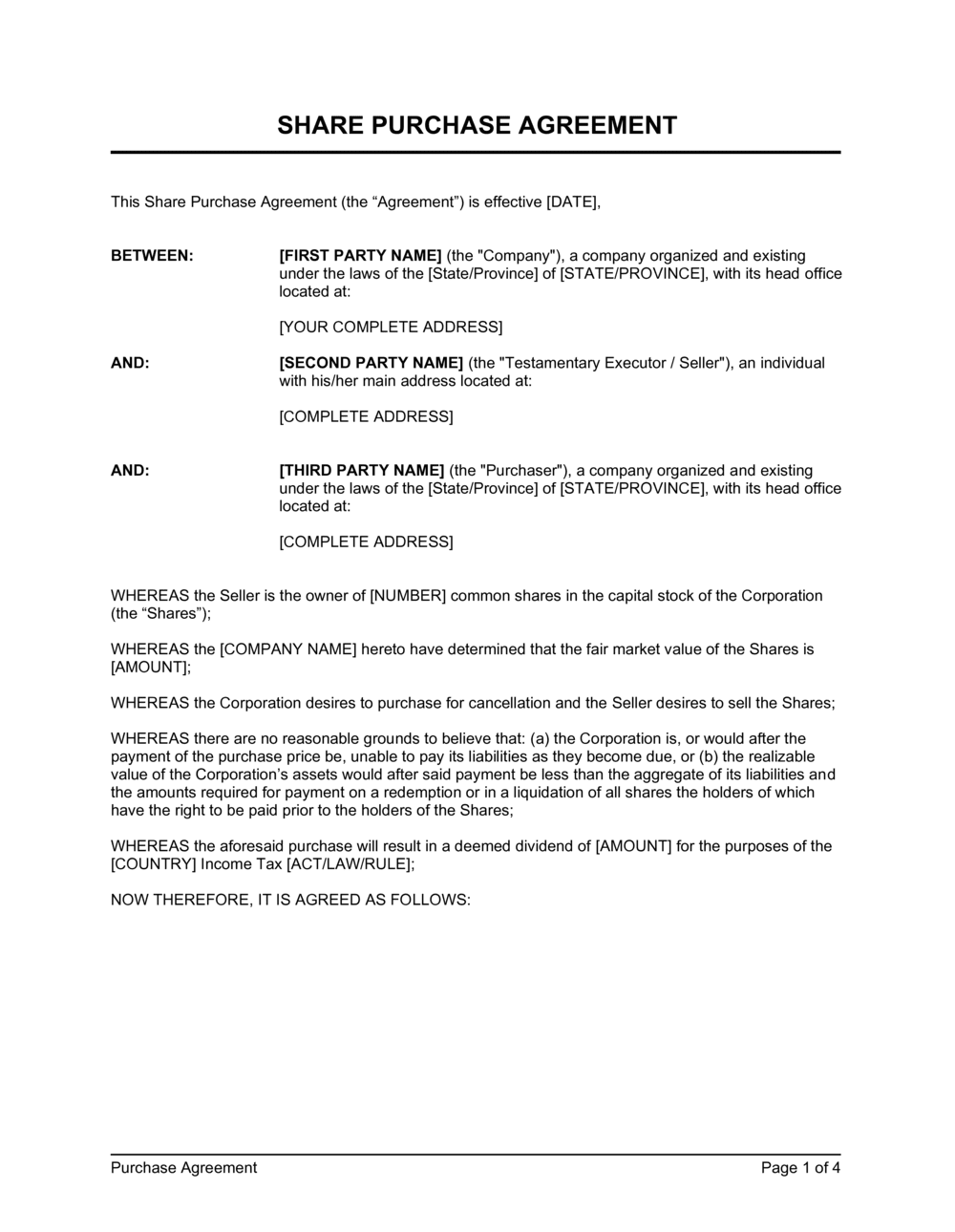
This Share Purchase Agreement is entered into as of [DATE] between [CORPORATION LEGAL NAME], a corporation incorporated under the laws of [JURISDICTION] ('Corporation'), and [SHAREHOLDER FULL NAME / ENTITY NAME] ('Seller'). The Corporation agrees to purchase from Seller [NUMBER] [CLASS] shares (the 'Purchased Shares') of the Corporation's share capital.

Common mistake: Describing shares by certificate number alone without confirming the class and series. If the corporation has multiple share classes, an ambiguous description can invalidate the redemption or create disputes about which shares were sold.

Purchase Price and Payment Mechanics

In plain language: States the total price the corporation will pay per share and in aggregate, specifies the payment method and timing, and identifies whether the price is above, at, or below fair market value.

Sample language
The aggregate purchase price for the Purchased Shares shall be $[AMOUNT] (the 'Purchase Price'), representing $[AMOUNT] per share. Payment shall be made by [wire transfer / certified cheque / promissory note] on the Closing Date to the account or address specified in Schedule A.

Common mistake: Setting the purchase price without documenting the valuation basis. Tax authorities routinely challenge non-arm's-length share prices; attaching a current independent valuation or referencing an agreed formula reduces reassessment risk.

Deemed Dividend Calculation and Acknowledgment

In plain language: Calculates the deemed dividend amount — the excess of the purchase price over the paid-up capital of the shares — and confirms both parties' acknowledgment of the tax characterization.

Sample language
The parties acknowledge that the Deemed Dividend Amount is calculated as follows: Purchase Price ($[AMOUNT]) less Paid-Up Capital of the Purchased Shares ($[AMOUNT]) equals Deemed Dividend ($[AMOUNT]). Seller acknowledges that the Deemed Dividend Amount will be included in Seller's income as a taxable dividend for the taxation year in which Closing occurs.

Common mistake: Omitting the deemed dividend calculation entirely and treating the full redemption price as a capital gain. This is the most common source of costly tax reassessments in private corporation share repurchases.

Tax Withholding and Remittance

In plain language: Allocates responsibility for calculating, withholding, and remitting applicable taxes on the deemed dividend — critical for non-resident shareholders subject to withholding tax.

Sample language
The Corporation shall withhold from the Purchase Price and remit to [TAX AUTHORITY] withholding tax equal to [X]% of the Deemed Dividend Amount, as required under [APPLICABLE TAX LEGISLATION]. The net amount payable to Seller after withholding shall be $[NET AMOUNT].

Common mistake: Paying the full purchase price to the selling shareholder without withholding and remitting applicable dividend withholding tax, leaving the corporation exposed to penalties and interest from the tax authority.

Tax Elections

In plain language: Documents any joint or unilateral elections the parties are making in connection with the transaction, including elections to treat proceeds as a dividend, capital dividend account elections, or other prescribed filings.

Sample language
The parties agree to jointly execute and file [ELECTION FORM / DESIGNATION] with [TAX AUTHORITY] within [NUMBER] days of the Closing Date, electing [SPECIFIC TREATMENT] in respect of the Deemed Dividend Amount. Each party shall bear its own costs of filing.

Common mistake: Missing the filing deadline for a joint tax election. In Canada, for example, a late-filed section 83(2) capital dividend election triggers penalty tax on the entire dividend amount.

Representations and Warranties of the Seller

In plain language: The selling shareholder confirms they legally own the shares free of encumbrances, have authority to sell, and are aware of the tax treatment — and that no third-party consent is required to complete the transfer.

Sample language
Seller represents and warrants that: (a) Seller is the registered and beneficial owner of the Purchased Shares, free and clear of all liens, claims, and encumbrances; (b) Seller has full power and authority to sell the Purchased Shares; and (c) no consent, approval, or authorization of any third party is required to complete the transactions contemplated herein.

Common mistake: Omitting a representation that the shares are free of security interests or liens. A pledged share transferred without lender consent can expose the buyer corporation to a priority claim from the secured creditor.

Representations and Warranties of the Corporation

In plain language: The corporation confirms it has legal authority to repurchase the shares, that the repurchase complies with its articles and applicable corporate law (solvency tests), and that no shareholders' agreement restricts the transaction.

Sample language
The Corporation represents and warrants that: (a) the repurchase of the Purchased Shares has been duly authorized by the Corporation's board of directors; (b) following the repurchase, the Corporation will not be insolvent and will be able to pay its liabilities as they come due; and (c) the repurchase does not violate any shareholders' agreement, unanimous shareholders' agreement, or restriction in the Corporation's articles.

Common mistake: Failing to confirm the solvency test required by corporate statute. Most jurisdictions prohibit a corporation from repurchasing its shares if doing so would render it unable to pay its debts — proceeding without this confirmation exposes directors to personal liability.

Conditions to Closing

In plain language: Lists the specific steps that must be completed before the share transfer is finalized — typically board resolutions, delivery of share certificates, regulatory approvals, and confirmation of no material adverse change.

Sample language
The obligation of the Corporation to purchase the Purchased Shares is conditional upon: (a) delivery by Seller of the share certificate(s) representing the Purchased Shares duly endorsed for transfer; (b) passage of a board resolution approving the purchase; and (c) receipt of any required consents from [REGULATORY AUTHORITY / LENDER].

Common mistake: Not requiring cancellation of the share certificate as a closing deliverable. If the certificates are not cancelled and recorded in the share register, the sold shares can be treated as still outstanding for corporate and tax purposes.

Indemnification

In plain language: Sets out each party's obligation to compensate the other for losses arising from breaches of representations and warranties or from tax reassessments attributable to the deemed dividend mechanics.

Sample language
Each party (the 'Indemnifying Party') agrees to indemnify and hold harmless the other party from any losses, damages, penalties, or interest arising from: (a) any breach of such party's representations and warranties; or (b) any tax reassessment by [TAX AUTHORITY] resulting from the Deemed Dividend Amount being re-characterized or the withholding tax being found insufficient.

Common mistake: Including indemnification for tax reassessments without a time limit or cap. Open-ended indemnities expose the indemnifying party to unlimited liability years after closing — tie them to the relevant statutory limitation period.

Governing Law and Entire Agreement

In plain language: Specifies the jurisdiction whose laws govern the agreement, where disputes will be resolved, and confirms that this document supersedes all prior discussions and agreements relating to the share purchase.

Sample language
This Agreement is governed by the laws of [PROVINCE / STATE / COUNTRY] and the parties submit to the exclusive jurisdiction of the courts of [JURISDICTION]. This Agreement constitutes the entire agreement between the parties with respect to the subject matter hereof and supersedes all prior negotiations, representations, and understandings.

Common mistake: Selecting a governing law that differs from both the corporation's jurisdiction of incorporation and the seller's residence, creating uncertainty about which tax legislation and corporate statute actually governs the transaction.

How to fill it out

  1. 1

    Identify all parties with full legal names

    Enter the corporation's exact registered name, jurisdiction of incorporation, and registered address. Enter the selling shareholder's full legal name — or entity name and jurisdiction if the seller is a corporation or trust.

    💡 Cross-reference the corporation's current share register and articles to confirm the exact class name and number of shares being repurchased before filling in any share description.

  2. 2

    Confirm the paid-up capital of the shares

    Obtain the corporation's stated capital account balance for the relevant share class from the corporate minute book or audited financial statements. This figure is the baseline for calculating the deemed dividend.

    💡 Paid-up capital per share is rarely the same as the original subscription price — stock dividends, reorganizations, and adjustments can alter it. Confirm the current figure with the corporation's accountant before drafting.

  3. 3

    Calculate and document the deemed dividend amount

    Subtract the paid-up capital attributable to the purchased shares from the agreed purchase price. Insert both figures and the resulting deemed dividend amount into the deemed dividend clause, and confirm both parties have reviewed and acknowledged the calculation.

    💡 Round-number estimates are a red flag in tax audits. Use the precise figures from the corporate records, not approximations.

  4. 4

    Determine and insert the applicable withholding rate

    Establish whether the selling shareholder is a resident or non-resident of the taxing jurisdiction. For non-residents, apply the treaty withholding rate (commonly 15–25% depending on the applicable tax treaty) and insert the net payment amount in the withholding clause.

    💡 For Canadian private corporations, the gross-up and dividend tax credit rules apply to resident individuals — confirm with a tax advisor whether a capital dividend account election can shelter any portion of the deemed dividend.

  5. 5

    Complete the representations and warranties for both parties

    Work through each representation methodically. Confirm share ownership via the share register, verify board authorization in the minute book, and ensure the solvency test has been met by reviewing recent financial statements.

    💡 Have the corporate secretary confirm in writing that the share certificate numbers match the register before execution — certificate discrepancies are a common closing-day delay.

  6. 6

    List all closing conditions and deliverables

    Itemize every document and action required at closing: board resolution, share certificates endorsed for transfer, wire transfer confirmation, and any third-party consents. Attach a closing checklist as a schedule.

    💡 Set a firm closing date with a cut-off time, not just 'on or before' language. Vague closing mechanics create disputes when one party delays.

  7. 7

    Attach and cross-reference all schedules

    Complete Schedule A (payment instructions), Schedule B (share description and certificate numbers), and any tax election forms. Ensure every schedule referenced in the body is attached and initialled by both parties.

    💡 Number schedules sequentially and confirm the body of the agreement references each schedule by its correct letter or number — mismatched references invalidate schedules in some jurisdictions.

  8. 8

    Execute before closing and update the share register

    Both parties must sign the agreement before the purchase price is paid. Immediately after closing, update the corporation's share register to reflect the cancellation of the purchased shares.

    💡 File the share cancellation in the corporate minute book the same day as closing — delayed register updates have caused tax reassessment disputes when the tax year turns before the records are corrected.

Frequently asked questions

What is a share purchase agreement deemed dividend?

A share purchase agreement deemed dividend is a contract under which a corporation repurchases or redeems its own shares from a shareholder at a price that exceeds the shares' paid-up capital, causing the excess amount to be treated as a dividend for tax purposes rather than a capital gain. The agreement documents the purchase price, the deemed dividend calculation, applicable tax withholding, and the closing mechanics in a single binding document. It is most commonly used in private corporation share redemptions, succession planning, and shareholder exit transactions.

How is the deemed dividend amount calculated?

The deemed dividend equals the purchase price paid to the shareholder minus the paid-up capital of the shares being repurchased. For example, if a corporation pays $500,000 to buy back shares with a paid-up capital of $100,000, the deemed dividend is $400,000. The remaining $400,000 is taxed as a dividend in the seller's hands, not as a capital gain. The adjusted cost base of the shares still determines whether there is any remaining capital gain or loss on the disposition.

Why is a share redemption treated as a deemed dividend rather than a capital gain?

Most tax codes treat the excess proceeds of a share redemption as a dividend because the corporation is distributing accumulated earnings to its shareholders — economically the same as paying a dividend. Taxing it as a capital gain instead would allow shareholders to access retained earnings at the lower capital gains rate, which most tax systems treat as preferential treatment reserved for genuine property dispositions, not corporate earnings distributions.

What taxes apply to a deemed dividend?

For resident individual shareholders, the deemed dividend is grossed up and taxed at dividend rates, which are often lower than ordinary income rates due to dividend tax credits or preferential rates in many jurisdictions. For non-resident shareholders, the paying corporation must withhold tax — typically 15–25% depending on the applicable tax treaty — and remit it to the tax authority. Corporate shareholders may benefit from an inter-corporate dividend deduction, potentially reducing tax to near zero depending on the jurisdiction and the relationship between the companies.

Does the seller also have a capital gain when shares are redeemed?

Potentially yes. After stripping out the deemed dividend amount, the seller's proceeds of disposition for capital gains purposes are reduced to the paid-up capital of the shares. If that reduced figure exceeds the seller's adjusted cost base, there is still a capital gain. If the adjusted cost base exceeds the reduced proceeds, the seller may realize an allowable capital loss. The interaction between deemed dividend and capital gain treatment makes this a complex area requiring careful calculation for each transaction.

Is a share purchase agreement deemed dividend different from a regular share purchase agreement?

Yes. A standard share purchase agreement covers the sale of shares from one shareholder to another third party at fair market value, where the proceeds are typically treated as capital gains. A deemed dividend agreement is specifically structured for a corporation repurchasing its own shares at a price above paid-up capital, adding clauses covering the deemed dividend calculation, tax withholding obligations, and any associated tax elections that do not appear in an arm's-length share sale.

Do I need a lawyer to prepare a share purchase agreement with a deemed dividend?

Given the tax complexity and the indemnification exposure involved, legal and accounting review is strongly recommended. A tax advisor should confirm the paid-up capital figure, review the withholding tax obligation, and advise on any elections available to reduce the tax cost. A lawyer should review the representations and warranties, closing conditions, and indemnification provisions. Using this template as a starting point typically reduces professional fees by providing a structured first draft that advisors can review and annotate rather than draft from scratch.

What happens if the corporation pays more than fair market value for the shares?

If the purchase price exceeds the fair market value of the shares, tax authorities in most jurisdictions can recharacterize the excess as an additional benefit conferred on the shareholder — potentially triggering shareholder benefit rules in addition to the deemed dividend, and exposing both parties to reassessment. In non-arm's-length transactions, the purchase price should be supported by an independent valuation or a formula in the shareholders' agreement to demonstrate that fair market value was respected.

What corporate approvals are required before a corporation can repurchase its shares?

Typically, the corporation's board of directors must pass a resolution authorizing the repurchase, confirming that the transaction complies with the solvency tests in the applicable corporate statute. Depending on the jurisdiction and the corporation's articles or shareholders' agreement, shareholder approval may also be required. The agreement should make these approvals express conditions to closing, and certified copies of the board resolution should be delivered at closing as a closing deliverable.

Can a capital dividend account election reduce the tax on a deemed dividend in Canada?

Yes, in certain circumstances. If the corporation has a positive capital dividend account balance — built up from tax-free capital gains, life insurance proceeds, or other eligible amounts — it can elect to pay all or part of the deemed dividend as a capital dividend, which is received tax-free by the shareholder. This election must be filed jointly with the tax authority on a prescribed form before or concurrently with the dividend payment; a late election triggers penalty tax and eliminates the benefit. Including a tax election clause and a strict filing deadline in the agreement protects both parties.

How this compares to alternatives

vs Share Purchase Agreement (Standard)

A standard share purchase agreement governs the sale of shares from one shareholder to another unrelated buyer, with proceeds typically treated as capital gains. A deemed dividend agreement is used when the corporation itself is the buyer and the price exceeds paid-up capital, triggering dividend tax treatment on the excess. The tax analysis, withholding obligations, and elections required are fundamentally different between the two structures.

vs Asset Purchase Agreement

An asset purchase agreement transfers specific business assets — equipment, IP, contracts, goodwill — rather than the shares of the corporation. There is no deemed dividend in an asset purchase; instead, the seller may realize ordinary income or capital gains depending on the asset class. Buyers generally prefer asset purchases for liability protection; sellers often prefer share sales for capital gains treatment, making the choice between the two a central deal negotiation point.

vs Shareholders Agreement

A shareholders agreement governs the ongoing relationship among shareholders — voting rights, transfer restrictions, drag-along and tag-along provisions, and pre-emptive rights. It may include a share valuation formula and trigger events for mandatory buybacks, but it does not itself execute a redemption or document the deemed dividend. The share purchase agreement is the transactional document used to implement a buyback already contemplated by the shareholders agreement.

vs Business Purchase Agreement

A business purchase agreement governs the acquisition of an entire business — which may be structured as either a share purchase or an asset purchase — and typically involves due diligence schedules, material contract consents, and employment transition terms not present in a share redemption. A deemed dividend share purchase agreement is narrower in scope, focused on the tax mechanics of the corporation repurchasing its own shares from a specific shareholder rather than a full business acquisition.

Industry-specific considerations

Private Equity and Venture Capital

Investor share redemptions upon exit or restructuring frequently trigger deemed dividends when carried-interest or premium pricing exceeds low paid-up capital on preferred shares issued at incorporation.

Professional Services

Accounting, legal, and consulting firm partners commonly redeem shares upon retirement, with the deemed dividend calculation tied to retained earnings accumulated over long partnerships.

Family Business and Succession Planning

Generational share transfers in family-owned corporations regularly use share redemptions above paid-up capital, with estate freeze and pipeline planning strategies interacting closely with deemed dividend rules.

Technology / SaaS

Founder share buybacks following a partial liquidity event or cap table clean-up often involve shares with nominal paid-up capital, resulting in large deemed dividends that require careful withholding and treaty analysis for non-resident founders.

Jurisdictional notes

United States

Under the US Internal Revenue Code, a corporate redemption is treated as a dividend to the extent of the corporation's current and accumulated earnings and profits (E&P), with any excess treated as a return of capital or capital gain. The redemption may qualify for capital gain treatment under IRC Section 302 if it meets specific tests — complete termination of interest, substantially disproportionate redemption, or not essentially equivalent to a dividend. Non-resident alien shareholders are subject to a 30% withholding tax on dividend amounts, reducible by applicable tax treaty.

Canada

The deemed dividend rules in Canada are found in subsection 84(3) of the Income Tax Act, which applies whenever a private corporation redeems shares at a price exceeding their paid-up capital. The deemed dividend reduces the seller's proceeds of disposition for capital gains purposes. If the corporation has a positive capital dividend account, it may elect under subsection 83(2) to pay all or part of the deemed dividend as a tax-free capital dividend — but the election must be filed before or concurrent with the payment. Non-resident shareholders are subject to Part XIII withholding tax, typically 25% or reduced by treaty.

United Kingdom

In the UK, a company purchasing its own shares is generally treated as a distribution (dividend) to the extent the consideration exceeds the share's original issue price, under the Companies Act 2006 and Income Tax Act 2007 rules. However, qualifying unquoted trading companies may apply for capital gains treatment under HMRC's purchase of own shares rules, provided strict conditions are met — including a minimum five-year ownership period and genuine commercial purpose. Advance clearance from HMRC is strongly recommended before relying on capital gains treatment.

European Union

There is no harmonized EU treatment for deemed dividends on share repurchases; rules vary significantly by member state. Germany taxes the excess redemption proceeds as a hidden distribution; France applies withholding tax on dividend distributions including redemption proceeds above nominal value; the Netherlands uses the participation exemption to shelter corporate shareholders in qualifying structures. Cross-border transactions within the EU may qualify for the Parent-Subsidiary Directive withholding tax exemption where the parent corporation holds at least 10% of the subsidiary's capital for a minimum 12-month period.

Template vs lawyer — what fits your deal?

PathBest forCostTime
Use the templateSimple domestic share redemptions between a resident shareholder and a closely-held private corporation where a tax advisor has already confirmed the paid-up capital and deemed dividend amountFree1–2 hours to complete
Template + legal reviewMost private corporation share repurchases, including those involving non-resident shareholders, capital dividend account elections, or succession planning transactions$500–$2,000 for combined legal and tax advisor review3–7 business days
Custom draftedComplex transactions involving multiple share classes, earn-outs, cross-border withholding, estate freezes, or significant indemnification exposure above $500,000$3,000–$10,000+2–4 weeks

Glossary

Deemed Dividend
An amount treated as a dividend for tax purposes even though it is paid as part of a share purchase or redemption price, typically arising when proceeds exceed the shares' paid-up capital.
Paid-Up Capital (PUC)
The amount recorded in a corporation's stated capital account for a class of shares, representing the original capital contribution — distinct from fair market value or redemption price.
Redemption Price
The amount a corporation agrees to pay a shareholder to repurchase or cancel their shares, which may be set by the corporation's articles, a shareholder agreement, or negotiation.
Capital Gain
The profit realized on the disposition of a capital property; in a share redemption, only the proceeds in excess of the adjusted cost base and not classified as a deemed dividend qualify as a capital gain.
Adjusted Cost Base (ACB)
The cost of a shareholder's shares for tax purposes, including the original purchase price plus any adjustments prescribed by the applicable tax code.
Withholding Tax
Tax deducted at source by the paying corporation on a dividend or deemed dividend paid to a non-resident shareholder, remitted directly to the tax authority.
Non-Arm's-Length Transaction
A transaction between related parties — such as a shareholder and a corporation they control — where tax authorities may scrutinize the pricing and re-characterize proceeds.
Tax Election
A formal filing made jointly or unilaterally by a seller and buyer (or corporation) to select specific tax treatment for a transaction, such as electing to treat proceeds as a dividend rather than a capital gain.
Representations and Warranties
Factual statements made by each party in a contract that are true as of the signing date and closing date, creating indemnification liability if false.
Closing Conditions
Specific events or confirmations that must occur before the share transfer and payment are completed, such as board approval, tax clearance, or regulatory consent.
Indemnification
A contractual obligation by one party to compensate the other for specified losses — in this context, commonly covering tax reassessments or undisclosed liabilities arising from the deemed dividend.

Part of your Business Operating System

This document is one of 3,000+ business & legal templates included in Business in a Box.

  • Fill-in-the-blanks — ready in minutes
  • 100% customizable Word document
  • Compatible with all office suites
  • Export to PDF and share electronically

Create your document in 3 simple steps.

From template to signed document — all inside one Business Operating System.
1
Download or open template

Access over 3,000+ business and legal templates for any business task, project or initiative.

2
Edit and fill in the blanks with AI

Customize your ready-made business document template and save it in the cloud.

3
Save, Share, Send, Sign

Share your files and folders with your team. Create a space of seamless collaboration.

Save time, save money, and create top-quality documents.

★★★★★

"Fantastic value! I'm not sure how I'd do without it. It's worth its weight in gold and paid back for itself many times."

Managing Director · Mall Farm
Robert Whalley
Managing Director, Mall Farm Proprietary Limited
★★★★★

"I have been using Business in a Box for years. It has been the most useful source of templates I have encountered. I recommend it to anyone."

Business Owner · 4+ years
Dr Michael John Freestone
Business Owner
★★★★★

"It has been a life saver so many times I have lost count. Business in a Box has saved me so much time and as you know, time is money."

Owner · Upstate Web
David G. Moore Jr.
Owner, Upstate Web

Run your business with a system — not scattered tools

Stop downloading documents. Start operating with clarity. Business in a Box gives you the Business Operating System used by over 250,000 companies worldwide to structure, run, and grow their business.

Start free · No credit card required