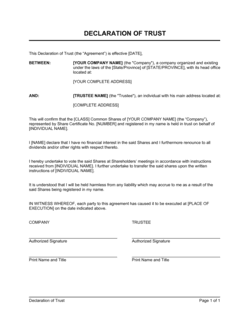
Declaration of the Sole Shareholder Template

Free Word download • Edit online • Save & share with Drive • Export to PDF

1 page20–30 min to fillDifficulty: StandardSignature requiredLegal review recommended
Learn more ↓
FreeDeclaration of the Sole Shareholder Template

At a glance

What it is
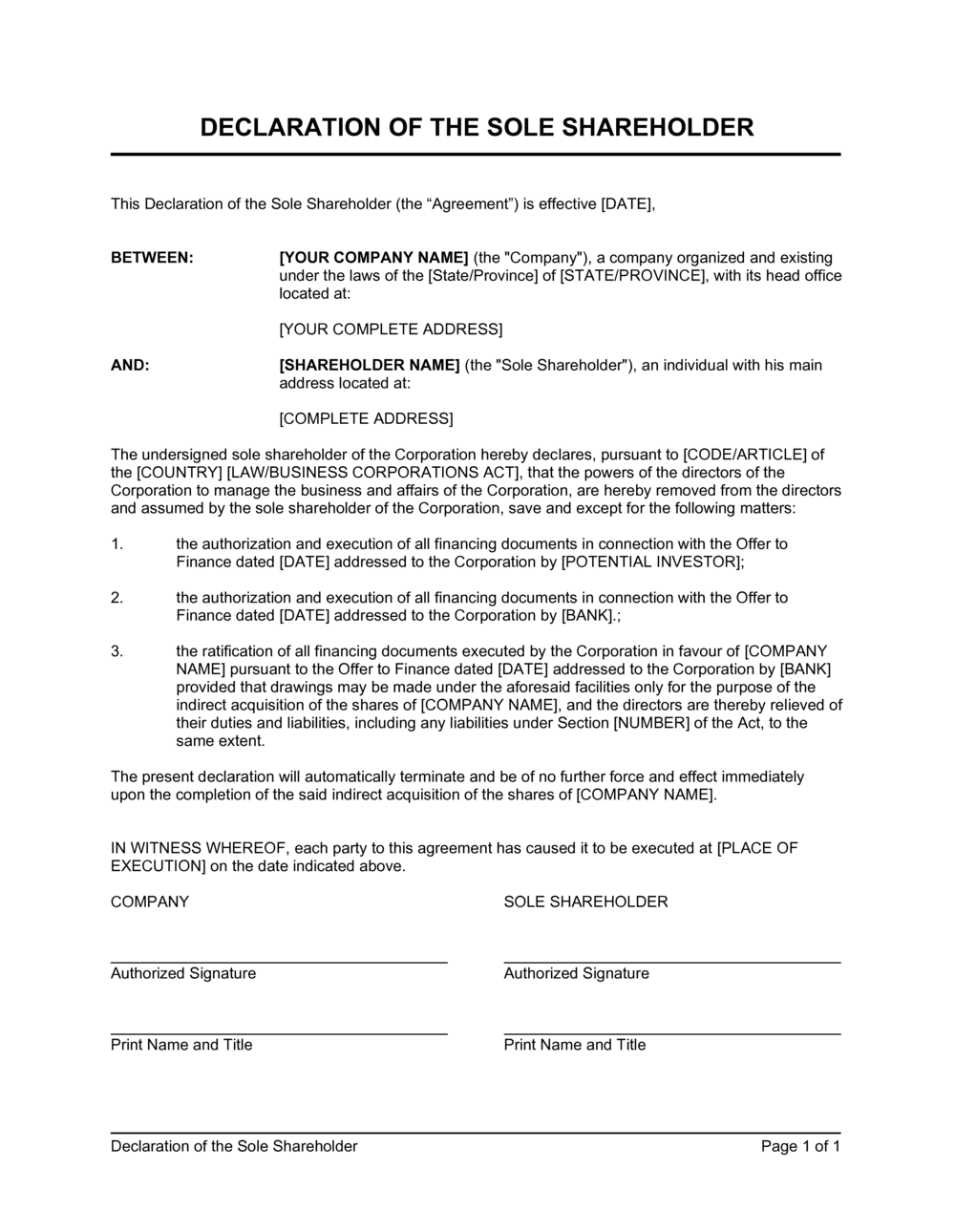
A Declaration of the Sole Shareholder is a formal corporate document in which the single owner of a corporation records a binding resolution without convening a shareholders' meeting. This free Word download provides a structured template you can edit online and export as PDF, giving you a legally recognized written record of any decision that would ordinarily require a shareholder vote.
When you need it
Use it whenever your single-owner corporation needs to formally approve a major decision — such as appointing or removing a director, authorizing a bank account, approving an acquisition, or amending the articles — and you need a documented record that satisfies corporate law requirements.
What's inside
Corporation identification, declaration of sole ownership, resolution recitals stating the purpose and authority, the operative resolution text, the effective date, and the shareholder's signature block with capacity.

What is a Declaration of the Sole Shareholder?

A Declaration of the Sole Shareholder is a formal written corporate document in which the single owner of 100% of a corporation's issued and outstanding shares records and passes a binding resolution without convening a formal shareholders' meeting. Because a sole shareholder constitutes quorum by definition, corporate statutes in most common-law and civil-law jurisdictions expressly permit this type of written declaration to substitute for a meeting, giving it the same legal effect as a resolution voted on and approved at a duly called general meeting. The document identifies the corporation and its governing statute, confirms the signatory's ownership of all shares, states the specific decision being made in operative resolution language, sets an effective date, and is executed by the shareholder in their capacity as owner of record.

Why You Need This Document

Without a signed, filed Declaration of the Sole Shareholder, your corporate decisions exist only in your memory and your email inbox — neither of which satisfies a bank, an auditor, a tax authority, or a prospective buyer. Financial institutions routinely require written shareholder authorization before opening accounts, activating signing authorities, or processing large transactions. Missing or informal corporate records are among the most common deficiencies identified during acquisition due diligence, and they can delay or kill a sale. Tax authorities in Canada, the US, and the UK scrutinize owner-managed corporations closely; undocumented dividends and management fees are regularly reclassified as employment income when the corporate record does not support the characterization. A consistently maintained minute book — anchored by properly executed declarations — also supports the argument that the corporation is a genuine separate legal entity, strengthening the liability shield that incorporation is meant to provide. This template gives you a correctly structured, jurisdiction-aware starting point that takes 15 minutes to complete and creates a permanent, enforceable corporate record.

Which variant fits your situation?

If your situation is…Use this template
Corporation has two or more shareholders who must all consent in writingWritten Consent of Shareholders in Lieu of Meeting
Decision is made by the board of directors, not the shareholdersBoard of Directors Resolution
Annual corporate housekeeping for a sole shareholder corporationAnnual General Meeting Minutes (Sole Shareholder)
Sole member LLC rather than a corporationSole Member LLC Resolution
Appointing the sole shareholder as a directorResolution to Appoint Director
Authorizing a specific banking arrangement or signing authorityBanking Resolution
Approving a dividend distribution to the sole shareholderDividend Declaration Resolution

Common mistakes to avoid

❌ Using a trade name instead of the registered legal name

Why it matters: Banks, registries, and counterparties match documents against the corporate registry. A name discrepancy can cause a bank to reject the resolution or a regulator to flag the record as invalid.

Fix: Pull a current corporate registry certificate and copy the legal name character-for-character, including the legal element (Inc., Ltd., Corp., S.A.S.).

❌ Signing in a personal capacity rather than as sole shareholder

Why it matters: A signature without the capacity designation does not create a corporate record — it may be treated as a personal undertaking with no binding effect on the corporation.

Fix: Ensure the signature block clearly states the signer's full legal name followed by 'Sole Shareholder' on a separate line. Never omit the capacity designation.

❌ Drafting an operative resolution in vague or general terms

Why it matters: Financial institutions and government agencies routinely reject resolutions that authorize 'any necessary transactions' without naming specific parties, amounts, or accounts — they need a precise grant of authority.

Fix: Name every person, account number, dollar amount, and counterparty that the resolution authorizes. If the scope is genuinely broad (e.g., general banking authority), use standard banking resolution language your bank has pre-approved.

❌ Failing to file the signed declaration in the minute book

Why it matters: An unrecorded resolution is invisible to buyers, lenders, and auditors conducting due diligence. Missing minute book entries are one of the most common deficiencies found in corporate acquisition due diligence.

Fix: Build a consistent practice of filing every executed resolution within one week of signing. If using a lawyer to maintain the minute book, send executed copies promptly and confirm receipt.

❌ Backdating the resolution without legal justification

Why it matters: Backdating to capture a tax election window, regulatory deadline, or pre-litigation date can constitute fraud or misrepresentation and may expose the corporation and its shareholder to serious civil and criminal liability.

Fix: If a prior action needs to be retroactively authorized, use a ratification clause with the actual signing date as the execution date. Consult a lawyer if a specific earlier effective date is required for a tax or regulatory purpose.

❌ Omitting the authority recital citing the governing statute or by-law

Why it matters: Without citing the legal basis for passing a resolution without a meeting, the document's validity is open to challenge — particularly relevant if the corporation later has multiple shareholders or is sold.

Fix: Research the applicable provision of the corporate statute in the corporation's home jurisdiction and include it verbatim in the authority recital before execution.

The 9 key clauses, explained

Corporation identification

In plain language: States the full legal name of the corporation, its jurisdiction of incorporation, and the date of incorporation — confirming the exact entity to which the declaration applies.

Sample language
[CORPORATION LEGAL NAME] (the 'Corporation'), a corporation duly incorporated under the laws of [JURISDICTION] on [DATE OF INCORPORATION], corporate number [REGISTRATION NUMBER].

Common mistake: Using a trade name or operating name instead of the registered legal name. A mismatch between the declaration and the corporate registry renders the document unreliable for third parties such as banks or regulators.

Declaration of sole ownership

In plain language: Confirms that the signatory is the registered holder of all issued and outstanding shares of the corporation, establishing their authority to act without a formal meeting.

Sample language
The undersigned, [SHAREHOLDER FULL LEGAL NAME], hereby declares that they are the registered holder of all [NUMBER] issued and outstanding shares of the Corporation, being 100% of the issued share capital.

Common mistake: Omitting the share count or class. If the corporation has issued multiple classes of shares, each class must be identified to confirm that all voting rights are held by the sole shareholder.

Authority recital

In plain language: Cites the specific provision of the applicable corporate statute or the company's by-laws that permits the sole shareholder to pass a resolution by written declaration rather than by holding a meeting.

Sample language
WHEREAS, pursuant to Section [X] of the [APPLICABLE CORPORATE STATUTE] and Article [X] of the Corporation's By-Laws, the sole shareholder may pass a resolution in writing in lieu of holding a meeting of shareholders.

Common mistake: Referencing the wrong statutory provision or omitting the citation entirely. Without a valid authority recital, the document may not satisfy a bank's or auditor's requirement for properly authorized corporate action.

Purpose recital

In plain language: Explains why this declaration is being made — the specific matter the shareholder is resolving — so the record is clear about the business context and intention.

Sample language
WHEREAS, it is desirable and in the best interests of the Corporation that the undersigned pass a resolution in writing to [STATE PURPOSE — e.g., appoint a director / authorize a bank account / approve a transaction].

Common mistake: Writing a purpose recital so vague that it covers any action. An overly broad recital can create ambiguity about the scope of authorization when the document is reviewed later in litigation or an audit.

Operative resolution

In plain language: The core of the document — the specific decision being made, stated in clear, actionable language that creates the corporate authority being granted.

Sample language
RESOLVED, that [SPECIFIC ACTION — e.g., [NAME] be and is hereby appointed as a director of the Corporation effective [DATE] / the Corporation be and is hereby authorized to open a bank account with [BANK NAME] and that [NAME], [TITLE], be authorized to sign on behalf of the Corporation].

Common mistake: Drafting the resolution in general terms rather than naming specific individuals, amounts, or dates. Vague resolutions are regularly rejected by financial institutions and create enforcement difficulties if the decision is later disputed.

Ratification clause

In plain language: Confirms that any actions already taken in anticipation of this resolution are retroactively approved, preventing a gap between when the action occurred and when it was formally authorized.

Sample language
FURTHER RESOLVED, that all actions heretofore taken by the officers and directors of the Corporation in connection with the matters contemplated by the foregoing resolution are hereby ratified, confirmed, and approved.

Common mistake: Including a ratification clause when no prior action has been taken — courts can construe this as evidence that the signatory knew the prior action was unauthorized, which can complicate indemnification claims.

Effective date

In plain language: Specifies the date the resolution comes into legal force, which may be the date of signing or a specified future or past date depending on the transaction.

Sample language
This Declaration shall be effective as of [EFFECTIVE DATE], and shall be filed in the minute book of the Corporation.

Common mistake: Backdating without a legitimate legal basis. Intentionally backdating a corporate resolution to pre-date a tax election deadline or regulatory filing window can constitute fraud — distinguish lawful retroactive effectiveness from backdating.

Minute book filing direction

In plain language: Instructs that the executed declaration be placed in the corporation's minute book, ensuring it becomes part of the official corporate record.

Sample language
The Secretary of the Corporation is hereby directed to file a copy of this Declaration in the minute book of the Corporation and to take all such steps as may be necessary to give effect to the foregoing resolutions.

Common mistake: Skipping the filing direction and storing the document only in email or a personal folder. Without minute book filing, the resolution may be invisible to a purchaser conducting due diligence on the corporation.

Signature block

In plain language: The sole shareholder's signed acknowledgment of the declaration, including their full legal name, capacity as sole shareholder, and the date of execution.

Sample language
IN WITNESS WHEREOF, the undersigned, being the sole shareholder of the Corporation, has executed this Declaration as of the date first written above. ______________________ [SHAREHOLDER FULL LEGAL NAME], Sole Shareholder

Common mistake: Signing in a personal capacity rather than in the capacity of sole shareholder. The capacity line is not cosmetic — it is what distinguishes a binding corporate record from a personal statement.

How to fill it out

  1. 1

    Confirm the corporation's full legal name and registration details

    Look up the corporation's registered name exactly as it appears on the articles of incorporation or corporate registry. Enter the jurisdiction of incorporation and the corporate registration number.

    💡 Cross-check the name against the most recent certificate of incorporation or a current corporate registry search — even a missing 'Inc.' or 'Ltd.' can create document-matching problems with banks.

  2. 2

    Verify and state your share ownership

    Confirm from the share register the exact number and class of shares you hold. Enter the total number of issued and outstanding shares and confirm they represent 100% of the issued share capital.

    💡 If any shares were previously transferred back to treasury or cancelled, update the share register first — the declaration must reflect the current, not historic, capitalization.

  3. 3

    Identify the applicable statutory authority

    Look up the section of the corporate statute in your jurisdiction that permits sole shareholder written resolutions. Enter the statute name and section number in the authority recital.

    💡 In Canada, the applicable section is typically in the corporation's provincial or federal statute (e.g., CBCA s. 142); in the US, check the relevant state business corporation act; in the UK, the Companies Act 2006 ss. 288–300.

  4. 4

    Draft the operative resolution with specific details

    Write the resolution in plain, precise language naming every person, amount, account, or asset involved. Avoid generalities — each resolution should authorize one specific action.

    💡 If you need to authorize multiple unrelated actions, use separately numbered resolution paragraphs rather than one compound sentence — this makes each authorization independently readable.

  5. 5

    Decide whether a ratification clause is needed

    Include a ratification clause only if a director or officer has already taken the action being authorized. If the action is prospective, omit it to avoid implying the prior action was unauthorized.

    💡 Document the specific date and nature of the prior action in a brief recital before the ratification clause, so the record is clear about what is being ratified.

  6. 6

    Set the effective date deliberately

    Enter the date the resolution should take legal effect. For most transactions, this is the date of signing. For tax elections with a statutory deadline, confirm the permissible effective date with your accountant before executing.

    💡 Never backdate a resolution to capture a tax benefit without explicit advice from a qualified tax professional — the risk of reassessment or fraud exposure outweighs the benefit in most cases.

  7. 7

    Sign in your capacity as sole shareholder

    Sign the document in the signature block and write your full legal name and 'Sole Shareholder' as your capacity. Use a wet signature or a legally recognized electronic signature depending on your jurisdiction's requirements.

    💡 Some banks and notaries require a wet signature even when electronic signatures are legally valid — confirm the requirement with the third party receiving the document before signing digitally.

  8. 8

    File the executed declaration in the minute book

    Place the signed original (or a certified copy) in the corporation's minute book in the shareholder resolutions section. Keep a separate digital copy indexed by date and subject matter.

    💡 If your minute book is maintained by a lawyer or corporate service provider, send them the executed copy within 5 business days to keep the record current and satisfy any annual compliance review.

Frequently asked questions

What is a Declaration of the Sole Shareholder?

A Declaration of the Sole Shareholder is a formal written document in which the single owner of 100% of a corporation's issued shares records and passes a binding corporate resolution without convening a shareholders' meeting. Because a sole shareholder constitutes quorum by definition, corporate statutes in most jurisdictions expressly permit decisions to be made by written declaration in lieu of a formal meeting. The signed declaration carries the same legal weight as a resolution passed at a duly convened shareholders' meeting.

When do I need a Declaration of the Sole Shareholder?

You need one whenever your corporation is required by law, by its by-laws, or by a third party to produce evidence of shareholder approval for a significant decision. Common triggers include appointing or removing a director, authorizing a bank account or signing authority, approving the sale or purchase of major assets, declaring a dividend, amending the by-laws, or approving an annual financial statement. Banks, lawyers, and government agencies routinely ask for a shareholder resolution as a condition of processing these transactions.

Is a Declaration of the Sole Shareholder legally binding?

Yes, a Declaration of the Sole Shareholder is generally binding when it meets the requirements of the applicable corporate statute — including being in writing, signed by the shareholder in their capacity as sole shareholder, and filed in the minute book. In most jurisdictions, the statute explicitly equates a written resolution signed by all shareholders to a resolution passed at a meeting. Consult a corporate lawyer to confirm the specific requirements in your jurisdiction.

Does a sole shareholder still need to hold an annual general meeting?

In most jurisdictions, a sole shareholder can dispense with the annual general meeting entirely by passing a written resolution covering all matters that would otherwise be addressed at the AGM — typically approval of financial statements, appointment of directors, and appointment of an auditor or waiver of audit. Some jurisdictions require that the resolution be passed within the statutory timeframe for the AGM. Confirm the specific dispensation provisions of the applicable corporate statute with a lawyer.

What is the difference between a shareholders' resolution and a directors' resolution?

A shareholders' resolution records a decision made by the owners of the corporation on matters reserved to shareholders under the corporate statute or by-laws — such as electing directors, amending articles, or approving fundamental changes. A directors' resolution records a decision made by the board on matters within the board's authority — such as authorizing contracts, approving budgets, or granting signing authority. A sole shareholder corporation typically uses both types, and it is important not to use a shareholder resolution to authorize a matter that legally requires board approval, or vice versa.

Does a Declaration of the Sole Shareholder need to be notarized?

Notarization is not typically required for a Declaration of the Sole Shareholder to be valid as a corporate record. However, some banks, foreign registries, or government agencies ask for a notarized or certified copy — particularly for international transactions or real property dealings. Check the specific requirements of the institution or authority requesting the document before having it notarized.

Can I use this document if I am the sole shareholder of multiple corporations?

Yes, but you must prepare a separate Declaration for each corporation. Each document must identify the specific corporation by its full legal name, reference that corporation's governing statute, and be signed in your capacity as sole shareholder of that particular entity. Declarations for different corporations must never be combined in a single document, as doing so creates ambiguity about which corporate entity is bound.

What happens if I do not document shareholder decisions in writing?

Undocumented corporate decisions create several risks: banks may refuse to process transactions without written authorization, the corporation's minute book will fail due diligence in any acquisition or financing, the corporate veil may be harder to maintain if the corporation is ever sued, and tax authorities may challenge the characterization of transactions such as dividends or management fees. A consistent practice of passing and filing written resolutions is one of the lowest-cost, highest-value governance habits for any owner-managed corporation.

How should I store executed Declarations of the Sole Shareholder?

The signed original must be filed in the corporation's minute book under the shareholder resolutions section, in chronological order. Maintain a digital backup indexed by date and subject matter. If a lawyer or corporate service provider maintains your minute book, send them the executed original promptly and request written confirmation of filing. Keep the minute book at the corporation's registered office or with its registered agent as required by the applicable corporate statute.

Can I pass multiple resolutions in a single declaration?

Yes, a single Declaration of the Sole Shareholder can contain multiple separately numbered resolution paragraphs, each addressing a distinct matter. This is efficient for year-end housekeeping resolutions that cover several routine items at once. However, each resolution should be clearly delineated and independently readable — avoid drafting compound resolutions that bundle multiple unrelated authorizations into a single paragraph, as this creates ambiguity about the scope of each authorization.

How this compares to alternatives

vs Directors' Resolution

A Directors' Resolution records decisions made by the board of directors on matters within the board's authority — contracts, budgets, and officer appointments. A Declaration of the Sole Shareholder addresses matters reserved to shareholders under the corporate statute — director elections, by-law amendments, and fundamental corporate changes. Both are needed for a complete corporate record; using one when the other is required creates a defective authorization.

vs Minutes of Annual General Meeting

Minutes of an Annual General Meeting document decisions made at a formally convened meeting with a notice, quorum, and voting record. A Declaration of the Sole Shareholder achieves the same legal result without a meeting, relying on the statutory written-resolution mechanism. For a sole shareholder, the declaration is almost always simpler and faster, but some regulated industries and foreign jurisdictions require formal meeting minutes.

vs Unanimous Shareholders' Agreement

A Unanimous Shareholders' Agreement is a long-form governance contract that restricts or transfers certain powers from the board to the shareholders and governs relations among shareholders over the long term. A Declaration of the Sole Shareholder is a short-form transactional document that records a single decision. The agreement defines the governance framework; the declaration exercises authority within that framework.

vs Banking Resolution

A Banking Resolution is a specific type of corporate resolution tailored to the precise language and format banks require to open accounts, authorize signatories, and activate financial instruments. A Declaration of the Sole Shareholder is a general-purpose shareholder authorization. When the purpose is specifically to authorize banking arrangements, use the Banking Resolution template — banks often reject general-purpose resolutions that do not match their internal authorization checklists.

Industry-specific considerations

Professional Services

Sole practitioners who incorporate for liability protection use this document to authorize year-end dividend distributions, management fee arrangements, and changes to professional registration held through the corporation.

Technology / SaaS

Founder-owned corporations use sole shareholder declarations to authorize early equity issuances, IP assignment to the corporation, and banking arrangements required by accelerators and investors prior to a seed round.

Real Estate

Single-owner holding corporations require shareholder-level authorization for acquisition, mortgage, or disposition of real property — title companies and lenders routinely require a dated, signed declaration before closing.

Retail / E-commerce

Owner-operated incorporated retailers use declarations to authorize new payment processors, commercial leases, and inventory financing lines — third-party providers almost always require corporate authorization documentation.

Jurisdictional notes

United States

The written consent mechanism for sole shareholders is governed by each state's business corporation act — for example, Delaware General Corporation Law §228 and the Model Business Corporation Act §7.04. Most states permit a sole shareholder to act by written consent without a meeting, but the consent must be signed, dated, and filed with the corporate records. Some states require prompt notice to directors when shareholders act by written consent, even when there is only one shareholder.

Canada

Under the Canada Business Corporations Act (s. 142) and comparable provincial statutes, a resolution in writing signed by all shareholders entitled to vote is as valid as a resolution passed at a meeting. Quebec corporations governed by the Business Corporations Act (LSAQ) follow the same principle. Annual resolutions covering financial statement approval, director election, and auditor appointment must still be passed within the statutory timeframe — typically within 15 months of the previous annual resolution.

United Kingdom

Under the Companies Act 2006 (ss. 288–300), private companies may pass written resolutions without holding a meeting. A sole shareholder of a private company can pass any shareholder resolution by written confirmation. Written resolutions for ordinary matters require a simple majority of voting rights; special resolutions require 75%. The signed written resolution must be retained for at least 10 years. Public companies (PLCs) cannot use the written resolution procedure and must convene formal meetings.

European Union

The permissibility of written shareholder resolutions varies by EU member state. Germany (GmbH) and France (SAS) expressly allow written decisions by a sole associate or shareholder without a meeting. The Netherlands and Belgium similarly permit written resolutions for private companies with a single shareholder. In several member states, certain reserved matters — such as approval of annual accounts or amendments to articles — still require a formal deed executed before a notary, regardless of whether the company has a sole shareholder.

Template vs lawyer — what fits your deal?

PathBest forCostTime
Use the templateSole shareholder corporations passing routine resolutions — director appointments, banking authority, dividend declarations — with no unusual factsFree15–30 minutes
Template + legal reviewResolutions authorizing significant asset transactions, shareholder loans, or actions with tax implications in jurisdictions with strict corporate formalities$200–$5001–2 business days
Custom draftedResolutions connected to an acquisition, financing round, regulatory approval, or cross-border transaction where precise legal drafting is critical$500–$2,000+2–5 business days

Glossary

Sole Shareholder
The single individual or entity that holds 100% of the issued and outstanding shares of a corporation.
Written Resolution
A formal corporate decision recorded in writing and signed by the authorized party in lieu of holding an actual meeting.
Resolution
A formal statement of a decision made by a corporate body — shareholders or directors — that creates a binding corporate record.
Quorum
The minimum number of shareholders or directors required to be present at a meeting for decisions to be validly made; a sole shareholder always constitutes quorum by definition.
Minute Book
The official corporate record — maintained at the registered office — that contains the company's constating documents, share register, and all resolutions.
Recital
A preliminary clause in a legal document that sets out the background facts and authority for the resolution that follows.
Constating Documents
The foundational legal documents of a corporation — typically the articles of incorporation and by-laws — that define its powers and governance structure.
Issued and Outstanding Shares
The shares that have been formally allotted and registered in the name of a shareholder, as distinct from authorized but unissued shares.
Capacity
The legal status in which a person signs a document — for example, as sole shareholder rather than as an individual — which determines the legal effect of the signature.
Effective Date
The specific date on which the resolution takes legal effect, which may differ from the date it is signed.
Ratification
Formal retroactive approval of an action already taken, giving it the same legal standing as if it had been pre-authorized.

Part of your Business Operating System

This document is one of 3,000+ business & legal templates included in Business in a Box.

  • Fill-in-the-blanks — ready in minutes
  • 100% customizable Word document
  • Compatible with all office suites
  • Export to PDF and share electronically

Create your document in 3 simple steps.

From template to signed document — all inside one Business Operating System.
1
Download or open template

Access over 3,000+ business and legal templates for any business task, project or initiative.

2
Edit and fill in the blanks with AI

Customize your ready-made business document template and save it in the cloud.

3
Save, Share, Send, Sign

Share your files and folders with your team. Create a space of seamless collaboration.

Save time, save money, and create top-quality documents.

★★★★★

"Fantastic value! I'm not sure how I'd do without it. It's worth its weight in gold and paid back for itself many times."

Managing Director · Mall Farm
Robert Whalley
Managing Director, Mall Farm Proprietary Limited
★★★★★

"I have been using Business in a Box for years. It has been the most useful source of templates I have encountered. I recommend it to anyone."

Business Owner · 4+ years
Dr Michael John Freestone
Business Owner
★★★★★

"It has been a life saver so many times I have lost count. Business in a Box has saved me so much time and as you know, time is money."

Owner · Upstate Web
David G. Moore Jr.
Owner, Upstate Web

Run your business with a system — not scattered tools

Stop downloading documents. Start operating with clarity. Business in a Box gives you the Business Operating System used by over 250,000 companies worldwide to structure, run, and grow their business.

Start free · No credit card required