Simple Agreement For Future Equity Safe Template

Free Word download β€’ Edit online β€’ Save & share with Drive β€’ Export to PDF

8 pagesβ€’30–40 min to fillβ€’Difficulty: Complexβ€’Signature requiredβ€’Legal review recommended
Learn more ↓
FreeSimple Agreement For Future Equity Safe Template

At a glance

What it is
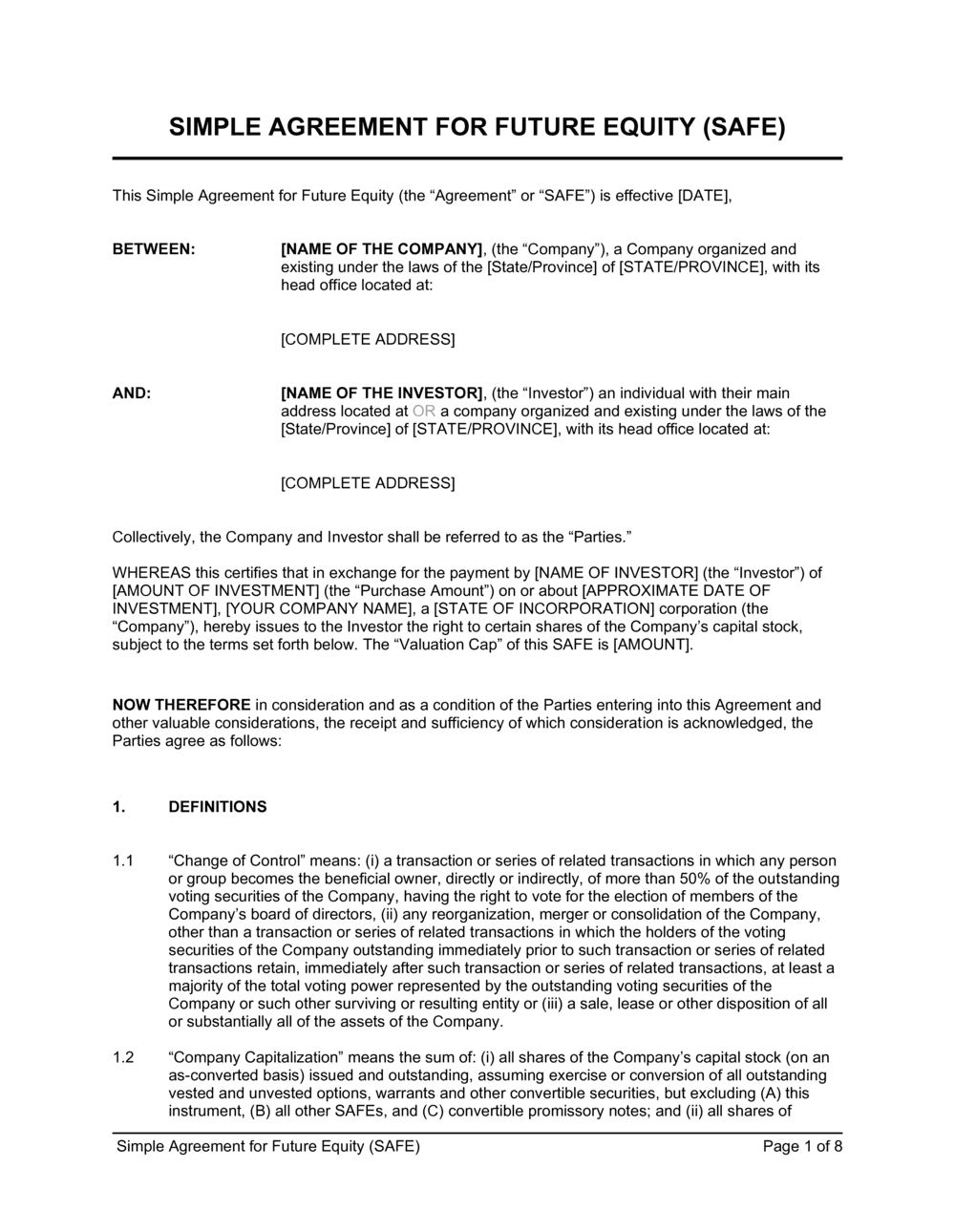
A Simple Agreement for Future Equity (SAFE) is a legally binding investment instrument in which an investor provides capital to a startup today in exchange for the right to receive equity at a future priced funding round, rather than debt repayment. This free Word download gives founders and investors a structured starting point they can edit online and export as PDF β€” covering valuation cap, discount rate, conversion mechanics, and investor rights in a compact, standardized document.
When you need it
Use a SAFE when raising pre-seed or seed capital before your company has established a formal valuation, when you want to avoid the complexity and cost of a priced equity round, or when speed of closing is critical and both parties want to defer valuation negotiations to a later financing event.
What's inside
The agreement covers the investment amount, valuation cap, discount rate, conversion triggers (qualified financing, liquidity event, dissolution), pro-rata rights, most-favored-nation provisions, and governing law. It also defines what constitutes a qualified financing round and how the SAFE converts into preferred stock on that trigger.

What is a Simple Agreement for Future Equity (SAFE)?

A Simple Agreement for Future Equity (SAFE) is a short-form investment instrument under which an investor provides capital to a startup today in exchange for a contractual right to receive equity β€” not repayment β€” at a future priced funding round or triggering event. Introduced by Y Combinator in 2013, the SAFE replaced convertible notes as the dominant pre-seed and seed financing instrument in the US startup ecosystem because it eliminates the interest accrual, maturity dates, and renegotiation risk that make notes problematic for early-stage companies. Unlike a stock purchase agreement, a SAFE issues no shares at closing β€” it is a promise to issue preferred stock in the future, at a price determined by the valuation cap, discount rate, or both, whichever gives the investor more shares at conversion.

Why You Need This Document

Raising capital without a signed SAFE exposes both founders and investors to serious legal and financial risk. Without a written instrument, the investor has no enforceable right to equity β€” a verbal commitment or email exchange is not a security and provides no protection in a dissolution or acquisition. For founders, operating on informal arrangements makes due diligence at Series A nearly impossible: lead investors and their counsel will require every prior investment to be documented with a signed instrument before closing. Beyond enforceability, a properly executed SAFE with a defined valuation cap and qualified financing threshold gives the company a clear, auditable record of its outstanding equity obligations β€” essential for accurate cap table modeling and securities law compliance. This template gives startups a structured, attorney-reviewed starting point that aligns with the YC post-money standard, so founders can close a round in days rather than weeks and move on to building the company.

Which variant fits your situation?

If your situation is…Use this template
Raising from angels with no existing valuation benchmarkSAFE β€” Valuation Cap, No Discount
Rewarding early investors who take the most riskSAFE β€” Discount Rate, No Cap
Balancing investor protection with founder dilution controlSAFE β€” Valuation Cap and Discount Rate
Raising a bridge round from existing investors at a later stageConvertible Note
Issuing equity immediately at a negotiated priceStock Purchase Agreement
Raising from a strategic corporate investor with information rightsSAFE β€” MFN, No Cap, No Discount
Formalizing investment terms for a crowdfunding campaignRegulation CF SAFE

Common mistakes to avoid

❌ Issuing SAFEs to non-accredited investors

Why it matters: A SAFE is a security under US federal law. Selling it to a non-accredited investor without qualifying under an exemption (e.g., Regulation CF) violates the Securities Act of 1933 and may require rescission β€” returning the investor's money plus interest.

Fix: Collect a completed accredited investor questionnaire before accepting any funds. If you need to accept non-accredited investors, engage a securities attorney to structure the offering under Regulation D Rule 506(b) or Regulation CF.

❌ Using the pre-money SAFE format without modeling multi-SAFE dilution

Why it matters: Pre-money SAFEs interact with each other in non-intuitive ways when multiple SAFEs convert simultaneously. Founders have discovered at Series A that their combined dilution was 15–20 percentage points higher than modeled.

Fix: Switch to the post-money SAFE (YC's 2018 version) for predictable dilution arithmetic, or build a detailed cap table model that converts all outstanding pre-money SAFEs at the expected Series A price before closing any new SAFE.

❌ Setting a valuation cap without running a post-conversion ownership model

Why it matters: A valuation cap that seems high today may imply severe founder dilution if the company raises multiple SAFEs at the same cap before a priced round β€” each investor converts as if they own the full cap denominator.

Fix: Model every SAFE in the current round through conversion simultaneously, using the expected Series A valuation and price per share, before finalizing the cap.

❌ Granting blanket pro-rata rights to every SAFE investor regardless of check size

Why it matters: An uncapped pro-rata pool across 20 angel investors can consume 10–15% of a Series A round before the lead investor can allocate. Some lead VCs will pass on a deal rather than navigate a crowded pro-rata table.

Fix: Limit pro-rata rights to investors above a meaningful threshold (e.g., $100K) or negotiate a total pro-rata pool cap, and include a side letter provision allowing the company to reduce pro-rata rights with investor consent.

❌ Failing to define 'Qualified Financing' with a specific dollar threshold

Why it matters: Without a clear threshold, any priced round β€” even a $50K angel round β€” could trigger conversion, forcing the company through Series A mechanics prematurely and at an unfavorable price.

Fix: Set the qualified financing threshold explicitly in dollars (e.g., 'aggregate gross proceeds of at least $1,000,000') and confirm it is well above the current SAFE round size.

❌ Signing after the wire has arrived

Why it matters: Executing a SAFE after funds are received creates a 'post-funding' consideration problem and may complicate securities law compliance, as the offer and sale must precede the transfer of funds under Regulation D.

Fix: Execute the SAFE first, then provide wire instructions. If funds arrive before signing, consult a securities attorney about whether a rescission and re-issuance is needed.

The 10 key clauses, explained

Investment Amount

In plain language: States the exact dollar amount the investor is contributing and confirms the company's receipt of those funds as the consideration for the SAFE.

Sample language
Investor agrees to purchase, and the Company agrees to sell, this SAFE for an aggregate purchase amount of $[INVESTMENT AMOUNT] (the 'Purchase Amount'), receipt of which is hereby acknowledged by the Company.

Common mistake: Leaving the investment amount as a range or subject to a later tranche without a separate amendment. Courts have found ambiguous amounts make the instrument unenforceable as a binding obligation.

Valuation Cap

In plain language: Sets the maximum effective company valuation for conversion purposes, ensuring the investor receives at least a minimum equity stake regardless of how high the Series A valuation is.

Sample language
The 'Valuation Cap' shall mean $[VALUATION CAP AMOUNT]. For purposes of calculating the Conversion Price, the Company's capitalization shall not be deemed to exceed the Valuation Cap.

Common mistake: Setting a valuation cap without modeling the resulting ownership percentage at conversion. A $5M cap sounds generous until founders realize it implies 20% dilution on a $25K check.

Discount Rate

In plain language: Defines the percentage discount the SAFE holder receives on the price per share paid by new investors in the qualifying financing round.

Sample language
The 'Discount Rate' shall mean [X]%. The 'Discount Price' shall mean the price per share sold in the Qualified Financing multiplied by the Discount Rate.

Common mistake: Omitting the discount rate entirely when the valuation cap is very high. In a flat or down round where the cap is irrelevant, investors with no discount rate receive no conversion benefit.

Conversion on Qualified Financing

In plain language: Describes the automatic conversion of the SAFE into preferred shares when the company closes a priced equity round above the qualifying threshold, and how the conversion price is calculated.

Sample language
Upon the closing of a Qualified Financing, the Purchase Amount shall automatically convert into the number of shares of Standard Preferred Stock equal to the Purchase Amount divided by the lower of (i) the Discount Price or (ii) the Valuation Cap Price.

Common mistake: Failing to define the 'lower of' mechanic explicitly. Ambiguity here is the most frequently litigated clause in SAFE instruments β€” if the cap and discount both apply, the investor always converts at whichever price generates more shares.

Liquidity Event Conversion

In plain language: Governs what happens to the SAFE if the company is acquired or goes public before closing a priced round β€” typically giving the investor a choice between cash at the purchase amount or conversion at the cap price.

Sample language
In the event of a Liquidity Event prior to conversion, the Investor shall, at its election, receive either (i) a cash payment equal to the Purchase Amount, or (ii) a number of shares of Common Stock equal to the Purchase Amount divided by the Liquidity Price.

Common mistake: Not including a multiplier for the cash payout option in a liquidity event. The standard YC post-money SAFE pays back only the purchase amount β€” many investors negotiate a 1Γ— or 1.5Γ— return floor.

Dissolution Event

In plain language: Sets out the SAFE holder's rights if the company winds down or goes bankrupt before any conversion trigger β€” typically a priority return of the investment ahead of common stockholders.

Sample language
In the event of a Dissolution Event, the Investor shall be entitled to receive, prior to and in preference to any distribution to holders of Common Stock, an amount equal to the Purchase Amount out of assets available for distribution.

Common mistake: Treating the SAFE as equivalent to debt in a dissolution. SAFEs are not debt instruments and typically rank below all creditors β€” including convertible notes β€” in an insolvency. Investors who misunderstand this may recover nothing.

Pro-Rata Rights

In plain language: Grants the investor the right to participate in the next priced round up to their pro-rata ownership amount, preserving their percentage stake post-conversion.

Sample language
The Investor shall have the right to purchase up to its Pro-Rata Share of the securities offered in the next Qualified Financing, where 'Pro-Rata Share' means the ratio of the Purchase Amount to the Valuation Cap.

Common mistake: Including pro-rata rights in every SAFE without restriction. Granting pro-rata to dozens of small angel investors can complicate Series A closing, as each must be offered a participation right β€” some lead VCs view this as a blocker.

Most-Favored-Nation (MFN) Provision

In plain language: Allows the SAFE holder to adopt any more favorable economic terms offered to future SAFE investors before the next priced round, protecting early investors from being disadvantaged by later, better-terms instruments.

Sample language
If the Company issues a subsequent SAFE with terms more favorable to the purchaser than those contained herein, the Investor may elect, upon written notice to the Company, to exchange this SAFE for such subsequent SAFE.

Common mistake: Including MFN with no carve-outs. Without exceptions for later-stage or strategically different instruments, even a small operational investment from a strategic partner could trigger an MFN claim across all prior SAFE holders.

Representations and Warranties

In plain language: The company confirms it is properly incorporated, has authority to issue the SAFE, and that the instrument does not violate existing agreements β€” and the investor confirms they are an accredited investor and understand the speculative nature of the investment.

Sample language
The Company represents and warrants that it is duly incorporated, validly existing, and in good standing under the laws of [STATE]. The Investor represents that it is an 'accredited investor' as defined in Rule 501 of Regulation D under the Securities Act of 1933.

Common mistake: Skipping the accredited investor representation. Selling a SAFE to a non-accredited investor without qualifying under an applicable exemption violates federal securities law and can require rescission of the investment.

Governing Law and Dispute Resolution

In plain language: Specifies the jurisdiction whose laws govern the agreement and how disputes are resolved β€” typically Delaware law for US startups, with court or arbitration as the chosen forum.

Sample language
This SAFE shall be governed by the laws of the State of Delaware, without regard to conflict-of-law principles. Any dispute arising under this SAFE shall be subject to the exclusive jurisdiction of the courts of [COUNTY], Delaware.

Common mistake: Choosing the founder's home state instead of Delaware when the company is a Delaware corporation. Applying California or New York law to a Delaware corporation creates a conflict-of-law trap that complicates enforcement.

How to fill it out

  1. 1

    Enter the company and investor legal names

    Use the company's full registered legal name exactly as it appears in the Delaware (or applicable state) certificate of incorporation. Use the investor's legal name or entity name β€” not a trade name or fund nickname.

    πŸ’‘ Confirm the exact corporate name against the most recent state filing before execution β€” a mismatch with the cap table entry creates cleanup work at Series A.

  2. 2

    Set the investment amount

    Enter the specific dollar amount the investor is wiring. If the investment is arriving in tranches, issue a separate SAFE for each tranche with its own date β€” do not leave the amount open or contingent.

    πŸ’‘ Confirm the wire amount matches what you will enter here before signing. Even a $1 discrepancy creates an amendment obligation.

  3. 3

    Negotiate and enter the valuation cap

    Model the cap using your current cap table: divide the investment amount by the cap to estimate the investor's post-conversion ownership. A $500K investment at a $5M cap implies approximately 10% dilution β€” run this scenario for every SAFE in the current round.

    πŸ’‘ Add all outstanding SAFEs to your cap table model before setting the cap. A cap that looks reasonable for one check may produce painful dilution when ten checks at the same cap convert simultaneously.

  4. 4

    Set the discount rate

    Enter the agreed discount percentage β€” 10–25% is typical. If you are using a cap-only SAFE, remove the discount rate clause entirely rather than leaving it blank, which creates ambiguity.

    πŸ’‘ For investors taking the most risk (first check in), a 20% discount is a reasonable acknowledgment β€” it costs founders nothing unless there is a down or flat round.

  5. 5

    Define the qualified financing threshold

    Enter the minimum dollar amount a priced round must reach to trigger automatic conversion β€” $1M is standard for early-stage companies, $3M–$5M for later bridge rounds.

    πŸ’‘ Set the threshold above your current SAFE round size. If you are raising $500K in SAFEs, a $500K qualified financing threshold means the SAFEs could convert on themselves β€” unintended and problematic.

  6. 6

    Confirm pro-rata rights and MFN scope

    Decide whether to grant pro-rata rights. If you are issuing SAFEs to more than 10 investors, consider limiting pro-rata to checks above a defined threshold (e.g., $50K) to keep Series A logistics manageable.

    πŸ’‘ Lead investors will scrutinize your cap table for pro-rata overhangs. Cleaning this up before Series A is far easier than negotiating waivers mid-round.

  7. 7

    Have the investor confirm accredited status

    Collect a completed accredited investor questionnaire or a written representation in the SAFE before execution. For self-certification, the investor signs the accredited investor representation in the agreement itself.

    πŸ’‘ Keep a copy of the accredited investor representation on file indefinitely β€” securities regulators can audit this years after the close.

  8. 8

    Execute before funds are wired

    Both parties must sign the SAFE before the investment is transferred. Wire a signed copy to the investor and retain the countersigned original in your corporate records folder.

    πŸ’‘ Use a timestamped e-signature platform and store the executed SAFE in the same folder as your cap table β€” you will need it at Series A due diligence, often on short notice.

Frequently asked questions

What is a Simple Agreement for Future Equity (SAFE)?

A SAFE is a short-form investment instrument that gives an investor the right to receive equity in a startup at a future priced funding round, in exchange for capital provided today. It is not a loan β€” it carries no interest rate or maturity date. Created by Y Combinator in 2013, it has become the most widely used early-stage investment instrument in the US startup ecosystem, replacing convertible notes for many angel and seed rounds.

What is the difference between a SAFE and a convertible note?

A convertible note is debt with an interest rate and a maturity date by which it must be repaid or converted. A SAFE has no interest, no maturity date, and no repayment obligation β€” it converts to equity or pays out only upon a defined trigger event. SAFEs are simpler and faster to close, but investors have less downside protection than noteholders because SAFEs are not debt and rank below creditors in a dissolution.

What is a valuation cap and why does it matter?

A valuation cap is the maximum company valuation at which a SAFE converts into equity. If a startup raises its Series A at a $20M valuation but an investor's SAFE has a $5M cap, the investor converts at the $5M price per share β€” receiving four times more shares than Series A investors at the same dollar amount. The cap is the primary economic term SAFE investors negotiate, and founders should model its dilutive impact before agreeing to any figure.

What is the difference between a pre-money and post-money SAFE?

In a pre-money SAFE (the original 2013 YC format), the valuation cap is applied before including the SAFE investment itself β€” making dilution harder to predict when multiple SAFEs are outstanding. In a post-money SAFE (the revised 2018 YC format), the cap is calculated after the SAFE amount is included, making each investor's ownership percentage at conversion mathematically fixed and predictable. Y Combinator now recommends the post-money format for most use cases.

Is a SAFE a security and do securities laws apply?

Yes. A SAFE is a security under US federal law, confirmed by the SEC in a 2017 investor bulletin. Issuers must comply with federal and state securities laws, including qualifying under a Regulation D exemption for offerings to accredited investors. Selling a SAFE to a non-accredited investor without a valid exemption exposes the company to rescission liability and potential regulatory action.

What triggers the conversion of a SAFE?

Three standard triggers exist: a Qualified Financing (a priced equity round above the defined threshold, typically $1M or more), a Liquidity Event (acquisition, merger, or IPO), and a Dissolution Event (company wind-down or bankruptcy). The investor receives equity at conversion in the first two cases; in a dissolution, they typically receive a cash return of the purchase amount ahead of common stockholders but behind creditors.

Can a SAFE be used in countries outside the United States?

SAFEs were designed for US Delaware corporations and are most commonly used in North America. In the UK and EU, equivalent instruments exist (the UK SEIS/EIS-compatible Advanced Subscription Agreement, and various national equivalents in Europe) that are structured to comply with local securities regulations. Using a US-format SAFE in a non-US company raises significant securities law and tax complications β€” local counsel should be engaged before doing so.

How does a SAFE appear on the company's cap table?

Outstanding SAFEs do not appear as shares on the cap table β€” they represent a contingent obligation to issue shares in the future. Best practice is to model SAFEs on a fully diluted, as-converted basis alongside the option pool, showing their projected ownership percentage at the expected Series A price. Failing to include SAFEs in cap table modeling is one of the most common sources of founder surprise at Series A.

Do I need a lawyer to issue a SAFE?

For a standard YC post-money SAFE with typical terms and a single investor, an experienced founder can complete and execute the template with limited legal assistance. However, legal review is strongly recommended when customizing terms (non-standard MFN, side letters, modified conversion mechanics), issuing to more than five investors, or operating outside the US. A startup attorney can review a SAFE in 1–2 hours for $300–$600 β€” typically worthwhile given the equity stakes involved.

How this compares to alternatives

vs Convertible Note

A convertible note is debt with an interest rate (typically 4–8%) and a maturity date by which repayment or conversion must occur. A SAFE has no interest accrual and no maturity date, making it simpler and faster to close. Investors who prioritize downside protection in a dissolution prefer convertible notes, which rank ahead of SAFEs as creditors. Founders generally prefer SAFEs for the same reason.

vs Stock Purchase Agreement

A stock purchase agreement transfers equity immediately at a negotiated price per share β€” a priced round. A SAFE defers both the price and the share issuance to a future round. Priced rounds provide certainty on ownership percentages but require a formal valuation, a term sheet, and significantly more legal cost (typically $15,000–$50,000 in legal fees versus under $1,000 for a SAFE closing).

vs Subscription Agreement

A subscription agreement is used to issue shares at a defined price in a Regulation D or Regulation A offering β€” the investor receives equity immediately. A SAFE is a right to future equity with no immediate share issuance. Subscription agreements are typically used for later-stage private placements, not early-stage startup rounds.

vs Term Sheet

A term sheet is a non-binding summary of the proposed terms of a priced investment round β€” it precedes the full legal documentation. A SAFE is itself the binding legal instrument, requiring no separate term sheet. For pre-seed rounds, founders often skip the term sheet stage entirely and move directly to a SAFE, saving two to four weeks of negotiation time.

Industry-specific considerations

SaaS / Technology

SAFEs are the default pre-seed instrument in SaaS, where fast execution and deferred valuation allow founders to ship product before negotiating equity terms with institutional investors.

Biotech / Life Sciences

Biotech startups use SAFEs for early grant-matching capital and angel rounds, though later-stage investors typically require priced rounds given the capital intensity and longer timelines to liquidity.

Consumer / E-commerce

Consumer startups use SAFEs for friends-and-family and accelerator rounds, where valuation is speculative and speed matters more than precise share-price negotiation.

Fintech

Fintech founders must confirm that SAFE issuance does not trigger broker-dealer or money transmitter registration obligations, particularly when the company's product involves financial instruments or payment processing.

Jurisdictional notes

United States

SAFEs were designed for Delaware C-corporations and are governed primarily by federal securities law (Securities Act of 1933, Regulation D) and Delaware corporate law. Issuers must qualify under an exemption β€” most commonly Rule 506(b) or 506(c) of Regulation D β€” and file a Form D with the SEC within 15 days of the first sale. California, New York, and Texas also impose state blue sky filing requirements. The SEC has cautioned retail investors that SAFEs carry significant risk of total loss.

Canada

Canadian startups use a functionally similar instrument called an Advanced Subscription Agreement (ASA) or adapt the YC SAFE format under Canadian securities law. Each province regulates securities independently β€” Ontario (OSC) and British Columbia (BCSC) are the most active jurisdictions. Issuers typically rely on the accredited investor exemption or the offering memorandum exemption. Quebec investors face additional French-language disclosure obligations for Quebec-based issuers.

United Kingdom

The UK equivalent is the Advanced Subscription Agreement (ASA), designed to be compatible with SEIS and EIS tax relief schemes that offer significant investor tax benefits. A standard US SAFE does not qualify for SEIS/EIS relief, making an ASA the preferred instrument for UK angels investing in eligible startups. The Financial Conduct Authority regulates securities offerings, and most SAFE-equivalent instruments rely on the high-net-worth individual or sophisticated investor exemption under the Financial Services and Markets Act 2000.

European Union

The EU has no single equivalent to the SAFE β€” member states regulate securities at the national level, though the EU Prospectus Regulation sets a common framework for public offerings above €8M. France uses the BSA-Air (Bon de Souscription d'Actions) for a similar purpose; Germany uses a convertible loan structure. GDPR considerations apply to investor data collected during the closing process. Founders raising from EU investors using a US SAFE should confirm compliance with both US securities law and the relevant member state's private placement rules.

Template vs lawyer β€” what fits your deal?

PathBest forCostTime
Use the templateStandard YC post-money SAFE with a single accredited angel investor and no custom termsFree1–2 hours
Template + legal reviewRounds with multiple investors, custom MFN or pro-rata terms, or first-time founders unfamiliar with cap table modeling$300–$8002–5 days
Custom draftedStrategic investors requiring side letters, non-US founders or investors, complex conversion mechanics, or rounds above $500K$2,000–$8,000+1–3 weeks

Glossary

Valuation Cap
The maximum company valuation at which a SAFE converts into equity, protecting the investor from excessive dilution if the company's value grows significantly before the priced round.
Discount Rate
A percentage reduction applied to the price per share in the next priced round, giving SAFE holders a lower effective purchase price than new investors β€” typically 10–25%.
Qualified Financing
A future priced equity round meeting a minimum size threshold defined in the SAFE β€” typically $1M or more β€” that triggers automatic conversion of the SAFE into preferred stock.
Conversion
The mechanism by which a SAFE transforms into preferred equity shares upon a qualifying event, calculated using whichever of the cap or discount produces more shares for the investor.
Pro-Rata Rights
An investor's contractual right to participate in future funding rounds to maintain their ownership percentage, preventing dilution beyond the initial conversion.
Most-Favored-Nation (MFN) Clause
A provision giving a SAFE holder the right to adopt any more favorable terms offered to subsequent SAFE investors before the next priced round.
Liquidity Event
A triggering event β€” typically an acquisition, merger, or IPO β€” that causes SAFE holders to either convert to equity or receive a cash payout before common stockholders.
Dissolution Event
A company wind-down or bankruptcy that triggers a SAFE holder's right to receive their investment back before any distributions to common stockholders, but typically after senior debt holders.
Post-Money SAFE
A SAFE variant introduced by Y Combinator in 2018 in which the valuation cap is calculated on a post-money basis, making dilution more predictable for both founders and investors.
Pre-Money SAFE
The original YC SAFE format in which the cap is applied on a pre-money basis, making dilution calculations more complex when multiple SAFEs are outstanding.
Cap Table
A spreadsheet tracking all equity holders, SAFE obligations, and option pools β€” essential for modeling how outstanding SAFEs will dilute founders at conversion.

Part of your Business Operating System

This document is one of 3,000+ business & legal templates included in Business in a Box.

  • Fill-in-the-blanks β€” ready in minutes
  • 100% customizable Word document
  • Compatible with all office suites
  • Export to PDF and share electronically

Create your document in 3 simple steps.

From template to signed document β€” all inside one Business Operating System.
1
Download or open template

Access over 3,000+ business and legal templates for any business task, project or initiative.

2
Edit and fill in the blanks with AI

Customize your ready-made business document template and save it in the cloud.

3
Save, Share, Send, Sign

Share your files and folders with your team. Create a space of seamless collaboration.

Save time, save money, and create top-quality documents.

β˜…β˜…β˜…β˜…β˜…

"Fantastic value! I'm not sure how I'd do without it. It's worth its weight in gold and paid back for itself many times."

Managing Director Β· Mall Farm
Robert Whalley
Managing Director, Mall Farm Proprietary Limited
β˜…β˜…β˜…β˜…β˜…

"I have been using Business in a Box for years. It has been the most useful source of templates I have encountered. I recommend it to anyone."

Business Owner Β· 4+ years
Dr Michael John Freestone
Business Owner
β˜…β˜…β˜…β˜…β˜…

"It has been a life saver so many times I have lost count. Business in a Box has saved me so much time and as you know, time is money."

Owner Β· Upstate Web
David G. Moore Jr.
Owner, Upstate Web

Run your business with a system β€” not scattered tools

Stop downloading documents. Start operating with clarity. Business in a Box gives you the Business Operating System used by over 250,000 companies worldwide to structure, run, and grow their business.

Free Forever PlanΒ Β·Β No credit card required