LLC Buyout Agreement Template

Free Word download β€’ Edit online β€’ Save & share with Drive β€’ Export to PDF

8 pagesβ€’30–40 min to fillβ€’Difficulty: Complexβ€’Signature requiredβ€’Legal review recommended
Learn more ↓
FreeLLC Buyout Agreement Template

At a glance

What it is
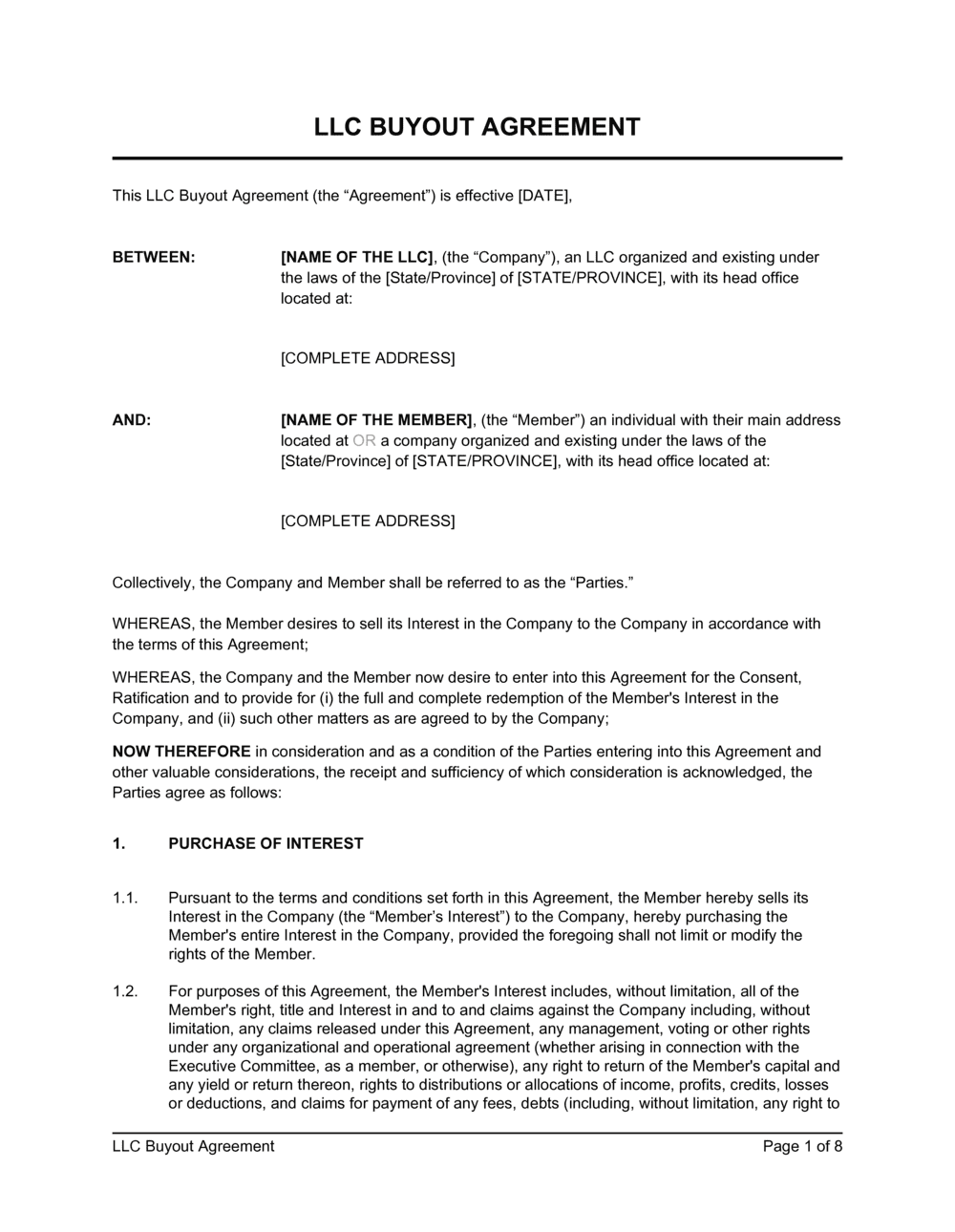
An LLC Buyout Agreement is a legally binding contract under which one or more members of a limited liability company purchase the membership interest of a departing, withdrawing, or removed member. This free Word download covers valuation methodology, installment or lump-sum payment terms, mutual releases, post-closing restrictive covenants, and the mechanics of amending the operating agreement to reflect the new ownership structure.
When you need it
Use it whenever a member voluntarily exits the LLC, is removed by the remaining members, retires, becomes incapacitated, or when a co-founder split requires a clean separation of ownership and management rights. It is also the appropriate document when a third party purchases an existing member's interest with the consent of the remaining members.
What's inside
The agreement includes an interest purchase and transfer clause, a valuation and purchase price mechanism, payment terms and promissory note reference, representations and warranties from both sides, a mutual release of claims, post-closing non-compete and non-solicitation covenants, an operating agreement amendment obligation, and governing law and dispute resolution provisions.

What is an LLC Buyout Agreement?

An LLC Buyout Agreement is a legally binding contract under which one or more members of a limited liability company purchase the full membership interest of a departing, withdrawing, or removed member. It functions as the transaction document that executes a member exit β€” fixing the purchase price through an agreed valuation methodology, setting the payment schedule, transferring the interest free and clear of encumbrances, releasing both sides from prior claims, and imposing post-closing non-compete and non-solicitation obligations on the departing member. The agreement also triggers the formal amendment of the LLC's operating agreement to reflect the revised ownership structure. Unlike the operating agreement, which sets the general rules for how buyouts work, the LLC buyout agreement closes one specific transaction between identified parties at an agreed price on a defined date.

Why You Need This Document

Without a written buyout agreement, a member's departure from an LLC creates compounding legal and operational risks on every front simultaneously. The departing member may retain legal rights in the company β€” including access to financial records and a vote on major decisions β€” because no formal transfer has been executed. Creditors who have a lien on the departing member's interest can assert claims against the LLC. The operating agreement still names the outgoing member, creating problems with banks, landlords, and future investors during due diligence. And without a mutual release, either party can later assert claims arising from the prior membership relationship with no clear statute of limitations bar. A properly executed LLC buyout agreement closes all of these gaps in a single document β€” giving the remaining members clean ownership, protecting the departing member from future LLC liabilities they no longer control, and providing the paper trail that lenders, auditors, and acquirers will require when the business changes hands or raises capital.

Which variant fits your situation?

If your situation is…Use this template
All remaining members collectively buying out one departing memberLLC Buyout Agreement
One member buying out all other members to become sole ownerLLC Membership Interest Purchase Agreement
LLC itself redeeming a member's interest (not another member)LLC Redemption Agreement
Members setting buyout rules in advance before any dispute arisesLLC Operating Agreement
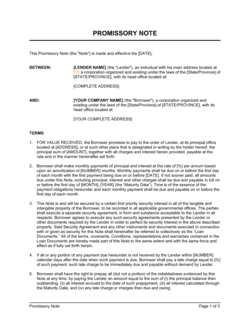
Buyout funded by a promissory note with scheduled paymentsPromissory Note
Transferring membership interest to a third-party buyerLLC Membership Interest Transfer Agreement
Dissolving the LLC entirely rather than buying out one memberLLC Dissolution Agreement

Common mistakes to avoid

❌ Skipping the operating agreement review before drafting the buyout

Why it matters: Most operating agreements contain transfer restrictions, consent requirements, or mandatory valuation formulas. Ignoring them can render the buyout void or expose the parties to breach-of-contract claims from the LLC itself.

Fix: Read the operating agreement's transfer and withdrawal sections in full before negotiating terms. If the buyout conflicts with existing provisions, amend the operating agreement first or obtain documented consent from all affected members.

❌ Leaving the valuation methodology undefined

Why it matters: An undisclosed or vague valuation process is the single most common source of post-buyout litigation β€” particularly when the business increases in value shortly after the departing member signs.

Fix: State the exact valuation method in the agreement β€” mutual agreement, independent appraisal by a named firm, book value as of a specific date, or a defined revenue or EBITDA multiple β€” and attach supporting documentation as an exhibit.

❌ Omitting a security interest when the price is paid in installments

Why it matters: Without a security agreement granting the seller a lien on the transferred membership interest, the seller becomes an unsecured creditor if the buyer misses payments β€” losing both the interest and the right to collect.

Fix: Attach a security agreement granting the seller a first-priority security interest in the transferred membership interest, perfected by UCC-1 filing, until the promissory note is paid in full.

❌ Failing to amend the operating agreement after closing

Why it matters: If the operating agreement still names the departing member, banks can freeze accounts, vendors can refuse contract amendments, and future investors will flag the discrepancy during due diligence β€” sometimes killing a deal.

Fix: Set a firm deadline β€” 15 business days is standard β€” for executing and filing the operating agreement amendment as a condition of the buyout, and make it a covenant rather than a best-efforts obligation.

❌ Using a one-sided release that covers only the LLC

Why it matters: Courts in several jurisdictions have voided releases where one party received the full benefit of protection and the other received nothing β€” undermining the entire agreement's enforceability.

Fix: Draft the release as mutual: the selling member releases the LLC and remaining members, and the LLC and remaining members release the selling member, with each side receiving genuine consideration.

❌ Applying a broad non-compete to a passive or minority member

Why it matters: A member who held a 5% passive financial interest and had no customer contact is unlikely to satisfy the 'legitimate business interest' standard courts require to enforce non-competes, making the clause worthless in litigation.

Fix: Tailor the non-compete duration, geography, and scope to the departing member's actual role. For passive investors, consider limiting restrictions to a non-solicitation of employees only, which is far more consistently enforced.

The 10 key clauses, explained

Parties, recitals, and defined terms

In plain language: Identifies the LLC, the selling member, and the purchasing member(s) by their legal names, and sets out the background facts and key definitions used throughout the agreement.

Sample language
This LLC Buyout Agreement ('Agreement') is entered into as of [DATE] by and among [LLC LEGAL NAME], a [STATE] limited liability company ('Company'), [SELLING MEMBER NAME] ('Selling Member'), and [PURCHASING MEMBER NAME(S)] ('Purchasing Members').

Common mistake: Using informal names or trade names instead of the exact legal names on the LLC's formation documents β€” creating ambiguity about which entity or individual is bound.

Transfer of membership interest

In plain language: States that the selling member irrevocably transfers, assigns, and conveys their entire membership interest to the purchasing member(s) effective upon receipt of the buyout price.

Sample language
Effective on the Closing Date, Selling Member hereby assigns, transfers, and conveys to Purchasing Members all of Selling Member's right, title, and interest in the Company, representing [X]% of total membership interests, free and clear of all liens and encumbrances.

Common mistake: Failing to specify that the transfer is 'free and clear of liens' β€” leaving the buyer exposed to undisclosed security interests a creditor filed against the departing member's interest.

Valuation and purchase price

In plain language: Establishes the agreed buyout price for the membership interest and the methodology used to reach it β€” whether by agreement, book value, independent appraisal, or an EBITDA multiple.

Sample language
The purchase price for the Membership Interest shall be $[AMOUNT] ('Purchase Price'), determined by [mutual agreement / independent appraisal dated [DATE] / [X]Γ— trailing twelve-month EBITDA of $[AMOUNT]].

Common mistake: Leaving the valuation methodology vague or undefined β€” leading to post-closing disputes when one party believes the price was unfair and seeks to unwind the transaction.

Payment terms and closing mechanics

In plain language: Specifies whether the purchase price is paid in a lump sum at closing or in installments, the payment method, the closing date, and any conditions to closing.

Sample language
The Purchase Price shall be paid as follows: (a) $[DOWN PAYMENT] by wire transfer on the Closing Date, [DATE]; and (b) the remaining balance of $[AMOUNT] pursuant to a Promissory Note bearing interest at [X]% per annum, payable in [N] equal monthly installments commencing [DATE].

Common mistake: Omitting a specific closing date and relying instead on 'upon execution.' Without a fixed date, closing can drift indefinitely while the selling member retains legal rights in the LLC.

Representations and warranties of the selling member

In plain language: Confirms that the selling member has full authority to sell, owns the interest free of encumbrances, has no undisclosed claims against the LLC, and has not pledged or assigned the interest elsewhere.

Sample language
Selling Member represents and warrants that: (i) Selling Member has full power and authority to enter into this Agreement; (ii) the Membership Interest is free of all liens, pledges, and encumbrances; (iii) no third party has any right, option, or claim with respect to the Membership Interest.

Common mistake: Limiting warranties to the selling member's authority only and omitting a warranty that the interest is unencumbered β€” allowing a pledged or liened interest to pass to the buyer.

Mutual release of claims

In plain language: Both the selling member and the purchasing members/LLC release each other from all claims arising out of the membership relationship, up to and including the closing date.

Sample language
Effective upon Closing, each party hereby releases and forever discharges the other parties and the Company from any and all claims, demands, and causes of action of any kind arising from or relating to the Membership Interest or Selling Member's participation in the Company through the Closing Date.

Common mistake: Drafting a one-sided release that only protects the LLC β€” courts in several jurisdictions have found one-sided releases to be unenforceable or unconscionable without adequate consideration flowing both ways.

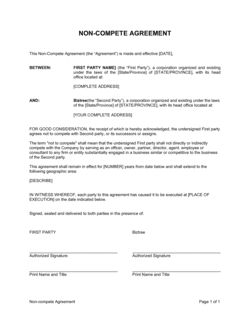
Non-compete and non-solicitation covenants

In plain language: Restricts the departing member from competing with the LLC or soliciting its customers, employees, or vendors for a defined period and within a defined geographic area after closing.

Sample language
For a period of [24] months following the Closing Date, Selling Member shall not: (a) directly or indirectly engage in any business that competes with the Company within [GEOGRAPHIC AREA]; or (b) solicit any customer, employee, or vendor of the Company with whom Selling Member had material contact during the [24] months preceding Closing.

Common mistake: Using an identical non-compete clause regardless of the departing member's actual role β€” courts regularly void overbroad restrictions applied to passive investors or members with no real customer or operational access.

Indemnification

In plain language: Each party agrees to indemnify the other against losses arising from a breach of their respective representations, warranties, or obligations in the agreement.

Sample language
Selling Member shall indemnify, defend, and hold harmless the Purchasing Members and the Company from and against any losses, claims, damages, or expenses arising from any breach of Selling Member's representations, warranties, or covenants in this Agreement.

Common mistake: Omitting a survival period for representations and warranties β€” without one, a buyer who discovers a misrepresentation after closing may be barred by the general statute of limitations.

Operating agreement amendment

In plain language: Obligates the remaining members to formally amend the LLC's operating agreement to reflect the departure, reallocation of the transferred interest, and any changes to voting or management rights.

Sample language
Within [15] business days following the Closing Date, the remaining Members shall execute and deliver an amendment to the Operating Agreement reflecting the transfer of the Membership Interest and the revised membership percentages set forth in Exhibit A.

Common mistake: Treating the buyout agreement as self-executing β€” without a formal operating agreement amendment, the LLC's internal governance document still names the departing member, creating confusion with banks, vendors, and future investors.

Governing law, dispute resolution, and entire agreement

In plain language: Identifies the state whose LLC and contract law governs the agreement, how disputes are resolved (arbitration or litigation), and confirms the written document supersedes all prior negotiations.

Sample language
This Agreement shall be governed by the laws of the State of [STATE]. Any dispute arising hereunder shall be submitted to binding arbitration administered by [AAA / JAMS] in [CITY, STATE]. This Agreement constitutes the entire agreement between the parties and supersedes all prior understandings relating to its subject matter.

Common mistake: Choosing a governing law state other than the state where the LLC is formed β€” triggering potential conflicts between the governing law chosen in the agreement and mandatory provisions of the state LLC statute that apply regardless of contractual choice.

How to fill it out

  1. 1

    Identify all parties and confirm legal names

    Enter the LLC's full legal name as it appears on its state formation certificate, the selling member's legal name, and the purchasing member(s)' legal names. Pull the exact entity name from your state's business registry.

    πŸ’‘ Confirm whether the purchasing members are buying individually or whether the LLC itself is redeeming the interest β€” the tax and legal treatment differ significantly.

  2. 2

    Review the operating agreement for buyout restrictions

    Check your LLC's operating agreement for right-of-first-refusal provisions, required consent of remaining members, valuation formulas, or transfer restrictions before completing this agreement. The buyout must comply with those existing terms.

    πŸ’‘ If the operating agreement requires a supermajority vote to approve a member transfer, document that vote in written consent form before signing the buyout agreement.

  3. 3

    Agree on the valuation methodology and purchase price

    Select the pricing method β€” mutual agreement, independent CPA appraisal, book value, or a multiple of EBITDA β€” and state the agreed purchase price explicitly. If using an appraisal, attach it as an exhibit.

    πŸ’‘ For LLCs with significant goodwill or recurring revenue, an independent appraisal reduces the risk of either party challenging the price after closing.

  4. 4

    Set payment terms and reference any promissory note

    Specify whether the full price is paid at closing or in installments. If installment payments apply, reference a separate promissory note and attach it as Exhibit B with interest rate, payment schedule, and default provisions.

    πŸ’‘ Installment buyouts should include a security interest in the transferred membership interest as collateral until the note is paid in full β€” without this, the seller is an unsecured creditor if the buyer defaults.

  5. 5

    Calibrate the non-compete scope to the departing member's actual role

    Set geographic scope, duration, and prohibited activities proportionate to the member's actual access to customers, trade secrets, and competitive information. A passive financial member requires far narrower restrictions than a managing member.

    πŸ’‘ For multi-state LLCs, list the specific states where the non-compete applies rather than using a radius β€” radius-based restrictions are harder to enforce across irregular market boundaries.

  6. 6

    Draft the mutual release with precision

    Confirm both sides are releasing claims arising specifically from the membership relationship. Consider carving out fraud, indemnification obligations under this agreement, and any pending third-party litigation the LLC is involved in.

    πŸ’‘ Have both parties' attorneys review the release language β€” a release that is too broad can inadvertently extinguish claims neither party intended to give up.

  7. 7

    Prepare the operating agreement amendment

    Complete Exhibit A with the revised membership percentage table showing each remaining member's updated interest after the transfer. The amendment must be signed by all remaining members.

    πŸ’‘ File an updated statement of authority or equivalent form with the state if the departing member was listed as a manager β€” some states require public notice of management changes.

  8. 8

    Execute at closing and update LLC records

    All parties sign the buyout agreement and promissory note (if applicable) on the closing date. Immediately update the LLC's membership ledger, internal records, and any banking or licensing accounts that referenced the departing member.

    πŸ’‘ Notify the LLC's bank, accountant, and key vendors of the ownership change in writing within 5 business days of closing to prevent operational disruptions.

Frequently asked questions

What is an LLC buyout agreement?

An LLC buyout agreement is a contract under which one or more members of a limited liability company purchase the membership interest of a departing member. It documents the purchase price, payment terms, transfer of the interest, mutual releases, post-closing restrictive covenants, and the obligation to update the LLC's operating agreement. It is used for voluntary exits, forced removals, retirement, incapacity, and co-founder separations.

Do I need a buyout agreement if the LLC operating agreement already covers member exits?

Yes. An operating agreement typically sets the framework for buyouts β€” valuation formulas, consent requirements, right-of-first-refusal provisions β€” but it does not function as the transaction document. A buyout agreement is the binding instrument that executes the specific transfer, locks in the agreed price, and includes the releases and covenants that complete the separation. Both documents are needed: the operating agreement governs the process; the buyout agreement closes the deal.

How is the buyout price determined in an LLC buyout?

The buyout price can be determined by mutual negotiation, an independent business appraisal, a formula written into the operating agreement (such as a multiple of trailing EBITDA or book value as of a specific date), or a combination of methods. For LLCs with significant intangible value β€” goodwill, client lists, proprietary processes β€” an independent CPA valuation is the most defensible approach and reduces the risk of a post-closing challenge by the selling member.

Can an LLC buyout be paid in installments?

Yes. Installment buyouts are common, particularly when the LLC lacks the liquidity for a lump-sum payment. The buyout agreement should reference a separate promissory note that specifies the payment schedule, interest rate, and default remedies. The selling member should also obtain a security interest in the transferred membership interest as collateral until the note is paid in full β€” without it, the seller is an unsecured creditor in the event of default.

What happens to the LLC operating agreement after a buyout?

The operating agreement must be formally amended to remove the departing member, update the membership percentage table, and reallocate any voting or management rights. Without this amendment, the departing member remains named in the governing document β€” creating potential liability exposure, banking complications, and due-diligence flags for future investors. Most buyout agreements include an obligation to complete the amendment within 15 business days of closing.

Are non-compete clauses in an LLC buyout agreement enforceable?

Enforceability depends on jurisdiction and scope. Non-competes tied to the sale of a business interest β€” including an LLC membership interest β€” are typically held to a more permissive standard than employment non-competes, because the seller received value in exchange. Courts generally enforce them when they are reasonable in duration (typically 12–24 months), geographic scope, and scope of prohibited activity. California remains a significant exception, banning most post-sale non-competes for individuals outside the sale-of-business safe harbor.

Does the departing member remain liable for LLC debts after a buyout?

In most cases, no β€” provided the buyout agreement includes a mutual release and the LLC's creditors have not specifically required the member to remain as a guarantor. However, if the departing member personally guaranteed bank loans, leases, or vendor contracts, those guarantees typically survive the buyout unless the creditor expressly releases the guarantor in writing. Reviewing and addressing all personal guarantees before closing is essential.

What is the difference between an LLC buyout agreement and an LLC redemption agreement?

In a buyout, one or more remaining members purchase the departing member's interest using their own funds β€” the interest passes to individual members. In a redemption, the LLC itself purchases the interest using company funds, and the interest is cancelled or reallocated among remaining members proportionally. The tax treatment differs between the two structures, and the choice can affect whether the transaction is treated as a sale or a liquidating distribution, so consulting a tax advisor before choosing the structure is advisable.

Do I need a lawyer to complete an LLC buyout agreement?

For straightforward buyouts between members with no disputed valuation, simple payment terms, and a clean operating agreement, a high-quality template with careful customization is generally sufficient for deals under $100,000. For buyouts involving complex valuation disputes, installment payments secured by collateral, regulated industries, multi-state operations, or significant restrictive covenant negotiations, engaging a business attorney for a template review or full drafting is strongly advisable given the financial and legal stakes involved.

How this compares to alternatives

vs LLC Operating Agreement

An LLC operating agreement is the foundational governance document that sets the rules for how buyouts are triggered and priced. An LLC buyout agreement is the transaction-specific contract that executes one particular buyout under those rules. You typically need both β€” the operating agreement defines the framework; the buyout agreement closes the specific deal.

vs LLC Membership Interest Transfer Agreement

A membership interest transfer agreement handles a straightforward assignment of interest β€” often to a third party β€” without the releases, restrictive covenants, or valuation mechanics that a full buyout requires. Use a transfer agreement for clean third-party sales; use a buyout agreement when a member is departing the business and a mutual release and post-closing restrictions are needed.

vs Business Purchase Agreement

A business purchase agreement transfers the entire business β€” assets or equity β€” to a new owner. An LLC buyout agreement transfers only one member's interest to the remaining members, who continue operating the business. If the goal is a complete ownership change to an outside buyer, a business purchase agreement is the correct document.

vs Promissory Note

A promissory note documents the payment obligation when a buyout price is paid in installments rather than at closing. It is a companion document to the buyout agreement, not a substitute β€” the buyout agreement governs the transfer of the interest while the promissory note governs the repayment schedule, interest, and default remedies.

Industry-specific considerations

Professional Services

Client non-solicitation covenants are critical; goodwill is the primary valuation driver and often requires an independent appraisal to prevent post-closing disputes.

Real Estate

Buyout price is typically tied to a current property appraisal or agreed percentage of appraised value; title and lender consent may be required before the interest can transfer.

Technology / SaaS

IP assignment confirmations are added alongside the buyout to ensure departing co-founders retain no claim on code, product IP, or trademarks developed during membership.

Construction and Trades

Licensing and bonding implications must be reviewed β€” if the departing member held a required contractor license, the LLC may need to obtain new licensing before the buyout closes.

Retail and Food Service

Liquor licenses, franchise agreements, and commercial lease assignments often require regulatory or franchisor approval before a membership interest transfer is effective.

Healthcare

State professional LLC statutes may restrict membership to licensed practitioners, making regulatory compliance review mandatory before any interest transfer closes.

Jurisdictional notes

United States

LLC law is state-specific β€” formation state statutes (e.g., Delaware LLC Act, California Corporations Code) govern transfer restrictions, member withdrawal rights, and valuation procedures. Non-compete enforceability varies sharply by state: California bans most post-sale non-competes outside the statutory sale-of-business exception. Tax treatment of the buyout (capital gain vs. ordinary income) depends on how LLC assets are characterized under IRC Β§751 and should be reviewed by a tax advisor.

Canada

LLCs are a US entity form β€” Canadian equivalents are limited partnerships and corporations. If the LLC was formed in a US state and has Canadian members, the buyout is governed by the US formation state's law, but Canadian tax implications (including potential withholding obligations on payments to Canadian residents) must be addressed. Quebec civil law principles apply to contracts between Quebec-resident parties regardless of governing law choice.

United Kingdom

LLCs are not a recognized UK entity structure; the nearest equivalents are limited liability partnerships (LLPs) and private limited companies (Ltd). US LLCs operating in the UK may be treated as opaque entities for UK tax purposes. Post-Brexit, English courts will enforce reasonable restrictive covenants in business sale contexts, but duration exceeding 24 months and overly broad geographic scope are regularly struck down as restraints of trade.

European Union

EU member states each have their own equivalent entity structures (GmbH in Germany, SARL in France, SL in Spain) with mandatory statutory buyout procedures that may override contractual terms. Non-compete covenants in business sale contexts generally require financial compensation to the restricted party to be enforceable β€” requirements vary by member state but commonly range from 25–50% of annual compensation for the restriction period. GDPR considerations arise if the buyout involves transfer of personal data about customers or employees.

Template vs lawyer β€” what fits your deal?

PathBest forCostTime
Use the templateTwo-member LLCs with an agreed price under $100,000, no installment payments, and a simple operating agreementFree1–3 hours
Template + legal reviewBuyouts with installment payment structures, disputed valuations, personal guarantees, or members in regulated industries$500–$1,5003–7 days
Custom draftedHigh-value buyouts above $500,000, multi-member LLCs with complex governance, contested removals, or cross-state operations$2,500–$8,000+2–4 weeks

Glossary

Membership Interest
A member's ownership stake in an LLC, expressed as a percentage or unit count, representing rights to distributions, voting, and residual value.
Buyout Price
The agreed dollar amount paid by the purchasing member(s) to acquire the departing member's full membership interest.
Valuation Methodology
The agreed formula or process used to determine the fair value of the departing member's interest β€” such as book value, agreed appraiser, or EBITDA multiple.
Promissory Note
A written promise by the buyer to pay the buyout price in scheduled installments over time, with stated interest, if not paid in full at closing.
Mutual Release
A clause in which both parties surrender all claims against each other arising from the membership relationship, effective upon closing of the buyout.
Non-Compete Covenant
A post-closing restriction preventing the departing member from owning or working for a competing business within a defined time and geographic scope.
Non-Solicitation Covenant
A restriction preventing the departing member from poaching the LLC's customers, employees, or vendors after the buyout closes.
Operating Agreement Amendment
A formal update to the LLC's governing document reflecting the departure of the selling member and the reallocation of membership percentages.
Right of First Refusal
A provision in the operating agreement giving existing members the right to purchase a member's interest before it can be offered to an outside party.
Forced Buyout
A buyout triggered involuntarily β€” for example, by a member's breach, death, incapacity, or removal vote β€” rather than by mutual agreement to exit.
Closing
The moment at which the buyout transaction is completed β€” funds are transferred, the interest is formally assigned, and the operating agreement is amended.
Indemnification
An obligation by one party to compensate the other for losses or liabilities arising from a specified event, such as a breach of representations in the buyout agreement.

Part of your Business Operating System

This document is one of 3,000+ business & legal templates included in Business in a Box.

  • Fill-in-the-blanks β€” ready in minutes
  • 100% customizable Word document
  • Compatible with all office suites
  • Export to PDF and share electronically

Create your document in 3 simple steps.

From template to signed document β€” all inside one Business Operating System.
1
Download or open template

Access over 3,000+ business and legal templates for any business task, project or initiative.

2
Edit and fill in the blanks with AI

Customize your ready-made business document template and save it in the cloud.

3
Save, Share, Send, Sign

Share your files and folders with your team. Create a space of seamless collaboration.

Save time, save money, and create top-quality documents.

β˜…β˜…β˜…β˜…β˜…

"Fantastic value! I'm not sure how I'd do without it. It's worth its weight in gold and paid back for itself many times."

Managing Director Β· Mall Farm
Robert Whalley
Managing Director, Mall Farm Proprietary Limited
β˜…β˜…β˜…β˜…β˜…

"I have been using Business in a Box for years. It has been the most useful source of templates I have encountered. I recommend it to anyone."

Business Owner Β· 4+ years
Dr Michael John Freestone
Business Owner
β˜…β˜…β˜…β˜…β˜…

"It has been a life saver so many times I have lost count. Business in a Box has saved me so much time and as you know, time is money."

Owner Β· Upstate Web
David G. Moore Jr.
Owner, Upstate Web

Run your business with a system β€” not scattered tools

Stop downloading documents. Start operating with clarity. Business in a Box gives you the Business Operating System used by over 250,000 companies worldwide to structure, run, and grow their business.

Start freeΒ Β·Β No credit card required