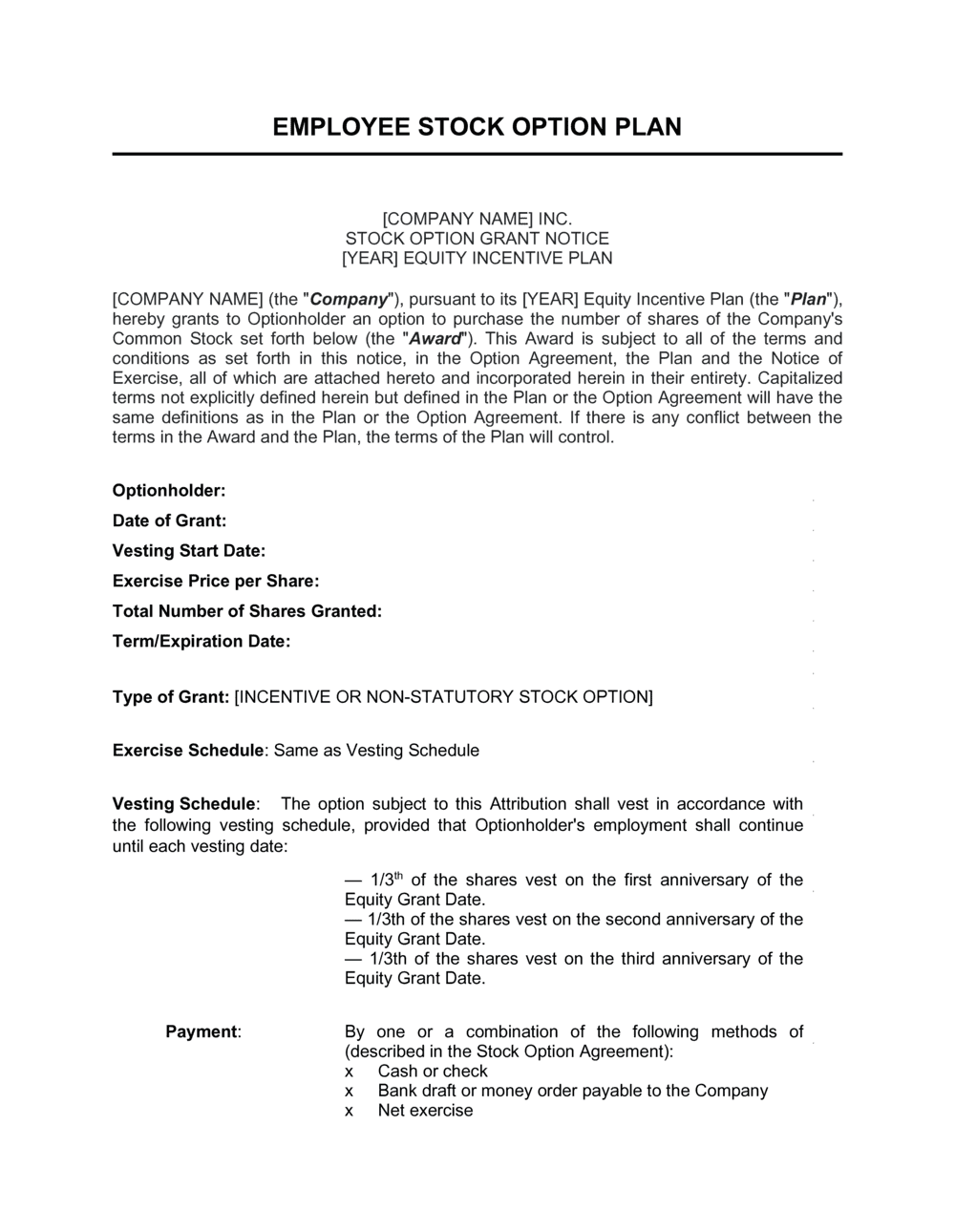
Employee Stocks Option Grant Notice Template

Free Word download β€’ Edit online β€’ Save & share with Drive β€’ Export to PDF

4 pagesβ€’20–25 min to fillβ€’Difficulty: Standard
Learn more ↓
FreeEmployee Stocks Option Grant Notice Template

At a glance

What it is
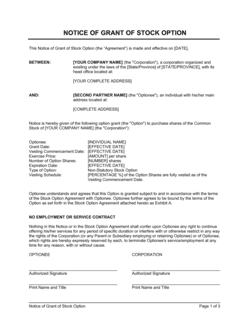
An Employee Stock Option Grant Notice is a formal written notice a company issues to an employee to confirm the award of stock options under an approved equity incentive plan. This free Word download gives you a ready-to-edit template you can customize with grant details, vesting schedules, and exercise prices, then export as PDF and deliver to grantees in minutes.
When you need it
Issue it each time you award stock options to an employee, advisor, or contractor under your equity plan β€” typically at hire, during a promotion, or as part of an annual compensation review.
What's inside
Grantee and company identification, grant date, number of options, per-share exercise price, option type (ISO or NSO), vesting schedule with cliff and monthly breakdown, expiration date, and a reference to the governing equity incentive plan and option agreement.

What is an Employee Stock Option Grant Notice?

An Employee Stock Option Grant Notice is a formal written notice a company issues to confirm that a specific stock option award has been approved and granted to a named employee or other eligible service provider. It records the essential terms of the award β€” grant date, number of shares, exercise price, option type, vesting schedule, and expiration β€” in a concise document that supplements the full stock option agreement. The notice functions as the employee's primary reference for understanding their equity position and serves as an auditable record for the company's cap table, equity accounting, and future due diligence.

Why You Need This Document

Issuing equity without a documented grant notice exposes the company and the grantee to avoidable tax, legal, and operational problems. A missing or informal notice leaves the exercise price, vesting start date, and option type open to dispute β€” disputes that typically surface at the worst possible moment: a fundraising round, an acquisition, or an employee's termination. For the company, undocumented grants create cap table discrepancies that derail investor due diligence and can require costly retroactive board resolutions to correct. For the grantee, unclear terms mean they may miss the 90-day post-termination exercise window or unknowingly trigger a Section 409A violation by exercising at an incorrect price. A properly completed grant notice β€” issued promptly after board approval and delivered alongside the plan document and option agreement β€” eliminates all of these risks and gives every grantee a clear, written record of exactly what they earned and when.

Which variant fits your situation?

If your situation is…Use this template
Granting incentive stock options (ISOs) to a full-time employeeISO Stock Option Grant Notice
Granting non-qualified stock options (NSOs) to an advisor or contractorNSO Stock Option Grant Notice
Granting restricted stock units instead of optionsRSU Award Agreement
Issuing equity to a C-suite executive with custom vesting termsExecutive Stock Option Agreement
Communicating a grant as part of an offer packageJob Offer Letter with Equity
Amending the terms of a previously issued grantStock Option Amendment Agreement
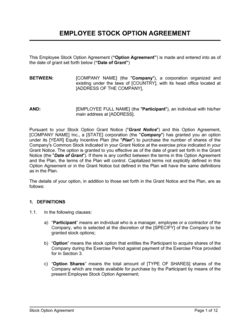
Documenting the full terms behind the noticeStock Option Agreement

Common mistakes to avoid

❌ Using a stale 409A valuation to set the exercise price

Why it matters: An exercise price below fair market value on the grant date creates a Section 409A violation β€” the grantee faces immediate income recognition and a 20% excise tax on top of ordinary income tax.

Fix: Commission a new 409A appraisal if the current one is more than 12 months old or if a material event (funding round, acquisition offer) has occurred since the last valuation.

❌ Granting ISOs to non-employees

Why it matters: ISOs can only be granted to current W-2 employees. Granting them to advisors or contractors invalidates the ISO status, stripping the grantee of favorable tax treatment without their knowledge.

Fix: Confirm employment status before selecting option type. Advisors, contractors, and board members who are not also employees must receive NSOs.

❌ Omitting the vesting commencement date

Why it matters: When the commencement date is missing, the cliff and monthly vesting amounts cannot be calculated, leading to disputes at resignation or exercise β€” particularly when a service-start credit was verbally promised.

Fix: Always populate the vesting commencement date explicitly, even when it equals the grant date, so the schedule is unambiguous.

❌ Issuing the notice without a completed board resolution

Why it matters: A grant notice issued without formal board or compensation committee approval is a legal nullity β€” it creates an expectation the company cannot honor and requires retroactive ratification to fix.

Fix: Hold or obtain written consent from the board before preparing any grant notice, and attach the resolution or consent reference to each executed notice file.

The 9 key clauses, explained

Header and parties

In plain language: Identifies the company name, the grantee's full legal name, and the date the notice is issued.

Sample language
[COMPANY LEGAL NAME] ('Company') hereby notifies [GRANTEE FULL NAME] ('Grantee') of the following stock option grant as of [GRANT DATE].

Common mistake: Using a trade name instead of the registered legal entity name β€” this creates a mismatch with the cap table and option agreement that requires a corrective amendment.

Grant type (ISO or NSO)

In plain language: States whether the options are incentive stock options or non-qualified stock options, which determines the grantee's tax treatment.

Sample language
This option is intended to be an [Incentive Stock Option ('ISO') / Non-Qualified Stock Option ('NSO')] within the meaning of the Company's [PLAN NAME].

Common mistake: Granting ISOs to advisors or contractors β€” ISOs are only available to W-2 employees; granting them to non-employees automatically converts them to NSOs without changing the notice language.

Number of shares and exercise price

In plain language: Specifies the total number of shares covered by the grant and the per-share exercise price based on the most recent 409A valuation.

Sample language
Subject to the terms of this Notice and the Option Agreement, the Company grants Grantee the option to purchase [NUMBER] shares of Common Stock at an exercise price of $[PRICE] per share.

Common mistake: Setting the exercise price below the 409A fair market value β€” this creates a Section 409A violation that triggers immediate income recognition and a 20% excise tax on the grantee.

Vesting commencement date

In plain language: Records the date from which vesting is measured, which may be the grant date or an earlier date tied to the employee's hire or role start.

Sample language
Vesting shall be measured from [VESTING COMMENCEMENT DATE], which may differ from the Grant Date.

Common mistake: Leaving the vesting commencement date blank or defaulting it to the grant date when an earlier service-start credit was promised β€” this causes disputes at exercise or termination.

Vesting schedule

In plain language: Details the cliff period and the monthly vesting cadence so the grantee knows exactly how many shares vest and when.

Sample language
[NUMBER] shares vest on the one-year anniversary of the Vesting Commencement Date (the 'Cliff'); thereafter, [NUMBER] shares vest monthly on the same day of each calendar month until fully vested, subject to Grantee's Continuous Service.

Common mistake: Omitting the monthly vesting fraction entirely and only stating the four-year total β€” grantees then calculate their own schedule incorrectly and dispute their vested balance at resignation.

Expiration date

In plain language: States the date the options expire if not exercised, and cross-references the plan's post-termination exercise window.

Sample language
This option shall expire on [EXPIRATION DATE], unless earlier terminated pursuant to the Plan or the Option Agreement, including the post-termination exercise provisions.

Common mistake: Setting a 10-year expiration without noting the plan's 90-day post-termination window β€” grantees often assume they have 10 years regardless of employment status and miss the shorter deadline.

Reference to plan and option agreement

In plain language: Confirms that the grant is governed by the equity incentive plan and the accompanying stock option agreement, which contain the full terms.

Sample language
This grant is subject in its entirety to the Company's [PLAN NAME] (the 'Plan') and the Stock Option Agreement between the Company and Grantee, each of which is incorporated herein by reference.

Common mistake: Failing to attach or deliver the plan document and option agreement alongside the notice β€” without the governing documents, grantees cannot review their full rights and obligations.

Acceptance and acknowledgment

In plain language: Invites the grantee to acknowledge receipt and acceptance of the grant terms, typically by returning a signed copy or accepting electronically.

Sample language
By acknowledging below or accepting electronically through [PLATFORM], Grantee confirms receipt of this Notice and agrees to be bound by the terms of the Plan and the Option Agreement.

Common mistake: Omitting the acknowledgment block and relying only on email delivery confirmation β€” without a formal acceptance record, the company cannot prove the grantee received or accepted the terms.

Company authorization

In plain language: Records the name and title of the company officer issuing the notice on behalf of the board or compensation committee.

Sample language
Issued on behalf of [COMPANY LEGAL NAME] by [AUTHORIZED SIGNATORY NAME], [TITLE], pursuant to authorization by the Board of Directors on [AUTHORIZATION DATE].

Common mistake: Issuing the notice without confirming board or compensation committee approval β€” grants made without proper corporate authorization are invalid and must be ratified retroactively.

How to fill it out

  1. 1

    Confirm board approval before drafting

    Verify that the board or compensation committee has approved the specific grant β€” number of shares, exercise price, and grantee β€” before filling in the notice. The grant date is the date of board approval, not the date you send the notice.

    πŸ’‘ Keep a copy of the board resolution or written consent alongside each executed grant notice in your equity records.

  2. 2

    Enter the grantee's legal name and the grant date

    Use the employee's full legal name as it appears on their tax documents, and enter the board-approved grant date in the header.

    πŸ’‘ A mismatch between the grant notice name and the cap table entry creates a correction burden during due diligence β€” confirm the name before sending.

  3. 3

    Specify ISO or NSO and confirm eligibility

    Select the option type. ISOs are available only to current W-2 employees. If the grantee is a contractor, advisor, or director who is not also an employee, select NSO.

    πŸ’‘ Check the ISO $100,000 annual vesting limit under IRC Section 422(d) β€” any amount vesting above $100,000 in a calendar year automatically converts to NSO treatment.

  4. 4

    Enter the number of shares and exercise price

    Pull the share count from the board resolution. Set the exercise price to the fair market value per share from your most recent 409A valuation β€” do not use an estimated or rounded figure.

    πŸ’‘ If your 409A valuation is more than 12 months old, commission a new one before issuing grants to avoid a stale-price 409A violation.

  5. 5

    Set the vesting commencement date and schedule

    Enter the vesting commencement date β€” typically the employee's start date or the grant date β€” then fill in the cliff period and monthly vesting amount. A standard schedule is 25% cliff at 12 months, then 1/48th per month for 36 months.

    πŸ’‘ State the monthly vesting amount as a specific number of shares rather than a fraction to prevent rounding disputes over a four-year schedule.

  6. 6

    Confirm the expiration date and post-termination window

    Enter the expiration date (typically 10 years from the grant date) and note the post-termination exercise window defined in your plan β€” usually 90 days for voluntary resignation, longer for death or disability.

    πŸ’‘ Some late-stage companies extend the post-termination window to 5–10 years for long-tenured employees β€” if your plan allows this, note it explicitly in the notice or option agreement.

  7. 7

    Attach the plan document and option agreement

    Deliver the grant notice together with a copy of the equity incentive plan and the full stock option agreement. The notice is a summary; the governing terms are in those documents.

    πŸ’‘ Use a delivery confirmation method β€” email with read receipt, e-signature platform, or physical receipt acknowledgment β€” so you have a timestamped record of when the grantee received all documents.

Frequently asked questions

What is an employee stock option grant notice?

An employee stock option grant notice is a formal written communication a company sends to an employee confirming the award of stock options under the company's equity incentive plan. It records the key terms β€” number of shares, exercise price, vesting schedule, option type, and expiration date β€” in a single document the grantee can retain and reference throughout their employment.

What is the difference between a grant notice and a stock option agreement?

The grant notice is a concise summary of the specific award β€” your name, share count, price, and vesting schedule. The stock option agreement is the full legal document that governs how options are exercised, what happens at termination, and the full set of grantee representations and restrictions. Both documents are issued together; the grant notice is not a standalone contract.

When should a company issue a stock option grant notice?

Issue the notice promptly after the board or compensation committee formally approves the grant β€” ideally within a few business days. Delayed notices create confusion about the effective grant date, vesting start, and exercise price, and can raise questions from auditors and future investors about the integrity of the equity program.

What is the difference between an ISO and an NSO?

An incentive stock option (ISO) qualifies for favorable tax treatment under IRC Section 422 β€” the grantee pays no ordinary income tax at exercise if holding-period requirements are met. A non-qualified stock option (NSO) is taxed as ordinary income on the spread at exercise, regardless of when shares are sold. ISOs can only be granted to W-2 employees; NSOs can be granted to employees, advisors, and contractors.

What exercise price should be set on a stock option grant?

The exercise price must equal the fair market value of the company's common stock on the grant date. For private companies, this is determined by an independent 409A valuation. Setting the exercise price below fair market value triggers a Section 409A tax violation that results in immediate income recognition and a 20% excise tax for the grantee.

What does a standard vesting schedule look like?

The most common vesting schedule for employee equity grants is a four-year term with a one-year cliff: 25% of the grant vests on the first anniversary of the vesting commencement date, then the remaining 75% vests monthly in equal increments over the following 36 months. Some companies use shorter schedules for executives or later-stage grants.

Does the grantee need to sign the grant notice?

Formally, the grant notice is a company communication rather than a bilateral contract β€” the stock option agreement is the binding document both parties execute. However, including an acknowledgment block on the grant notice and obtaining the grantee's signature or electronic confirmation is best practice because it proves receipt, acceptance of terms, and the agreed grant date.

What happens to unvested options when an employee leaves?

Unvested options typically terminate immediately on the last day of employment. Vested but unexercised options generally remain exercisable for a post-termination window defined in the plan β€” commonly 90 days for voluntary resignation, 12 months in the event of death or disability, and immediately on termination for cause. The grant notice should cross-reference these provisions directly.

How this compares to alternatives

vs Stock Option Agreement

The stock option agreement is the full legal contract governing exercise mechanics, representations, and post-termination rules. The grant notice summarizes the specific award terms in a readable format. Both documents are issued together β€” the grant notice is not a substitute for the full agreement.

vs Job Offer Letter

A job offer letter describes equity as a component of the total compensation package, typically referencing a share count and vesting schedule in general terms. The grant notice is the formal confirmation issued after board approval that makes the award official. The offer letter creates an expectation; the grant notice fulfills it.

vs RSU Award Agreement

Restricted stock units (RSUs) are a promise to deliver shares upon vesting β€” no exercise price and no exercise decision required. Stock options require the holder to pay an exercise price and make an active decision to buy. RSUs are simpler for employees to understand and increasingly common at later-stage companies; options are standard for early-stage startups where the exercise price can be very low.

vs Equity Incentive Plan

The equity incentive plan is the board- and stockholder-approved master document that authorizes all grants, sets the option pool size, and defines the rules that apply to every award. The grant notice is an individual communication issued under that plan for a specific grantee. You cannot issue a valid grant notice without an approved plan in place.

Industry-specific considerations

Technology / SaaS

High grant frequency at hire and promotion cycles; ISO grants standard for employees; NSOs common for advisors and international contractors outside the US.

Financial Services

Equity grants often subject to additional regulatory disclosure requirements; clawback provisions and deferred-vesting terms common for compliance with SEC and FINRA rules.

Healthcare / Biotech

Long vesting horizons aligned to clinical development timelines; grants to scientific advisors frequently structured as NSOs with milestone-based vesting rather than time-based schedules.

Professional Services

Equity used selectively to retain key partners and senior talent; grant notices must align with partnership agreement provisions to avoid conflicts between equity and profit-share entitlements.

Template vs pro β€” what fits your needs?

PathBest forCostTime
Use the templateEarly-stage startups issuing standard four-year vesting grants to employees under an existing approved equity planFree10 minutes per grant
Template + professional reviewCompanies issuing first grants, granting to international employees, or using non-standard vesting terms$200–$500 for a startup attorney review1–3 business days
Custom draftedLate-stage companies, grants with performance vesting, executive agreements with acceleration provisions, or pre-IPO equity programs$1,000–$3,000+1–2 weeks

Glossary

Stock Option
The right, but not the obligation, to purchase a specified number of company shares at a fixed price within a defined period.
Exercise Price (Strike Price)
The per-share price at which the option holder may purchase shares, set at fair market value on the grant date.
Grant Date
The date on which the company's board or compensation committee formally approves and awards the option grant.
Vesting Schedule
The timeline over which an employee earns the right to exercise their options, typically expressed as a cliff plus monthly ratable vesting.
Cliff
The minimum service period β€” typically 12 months β€” that must pass before any portion of a grant vests.
ISO (Incentive Stock Option)
A stock option that qualifies for favorable tax treatment under IRC Section 422, available only to employees and subject to holding-period requirements.
NSO (Non-Qualified Stock Option)
A stock option that does not meet ISO requirements; the spread at exercise is taxed as ordinary income, and NSOs can be granted to employees, advisors, and contractors.
Expiration Date
The date after which unexercised options lapse permanently β€” typically 10 years from the grant date, shortened to 90 days after termination in most plans.
Equity Incentive Plan
The board- and stockholder-approved plan document that authorizes the company to issue options and other equity awards, setting the total option pool and grant rules.
409A Valuation
An independent third-party appraisal of the company's common stock fair market value, required by IRS Section 409A to set a defensible exercise price for NSOs and ISOs.

Part of your Business Operating System

This document is one of 3,000+ business & legal templates included in Business in a Box.

  • Fill-in-the-blanks β€” ready in minutes
  • 100% customizable Word document
  • Compatible with all office suites
  • Export to PDF and share electronically

Create your document in 3 simple steps.

From template to signed document β€” all inside one Business Operating System.
1
Download or open template

Access over 3,000+ business and legal templates for any business task, project or initiative.

2
Edit and fill in the blanks with AI

Customize your ready-made business document template and save it in the cloud.

3
Save, Share, Send, Sign

Share your files and folders with your team. Create a space of seamless collaboration.

Save time, save money, and create top-quality documents.

β˜…β˜…β˜…β˜…β˜…

"Fantastic value! I'm not sure how I'd do without it. It's worth its weight in gold and paid back for itself many times."

Managing Director Β· Mall Farm
Robert Whalley
Managing Director, Mall Farm Proprietary Limited
β˜…β˜…β˜…β˜…β˜…

"I have been using Business in a Box for years. It has been the most useful source of templates I have encountered. I recommend it to anyone."

Business Owner Β· 4+ years
Dr Michael John Freestone
Business Owner
β˜…β˜…β˜…β˜…β˜…

"It has been a life saver so many times I have lost count. Business in a Box has saved me so much time and as you know, time is money."

Owner Β· Upstate Web
David G. Moore Jr.
Owner, Upstate Web

Run your business with a system β€” not scattered tools

Stop downloading documents. Start operating with clarity. Business in a Box gives you the Business Operating System used by over 250,000 companies worldwide to structure, run, and grow their business.

Start freeΒ Β·Β No credit card required