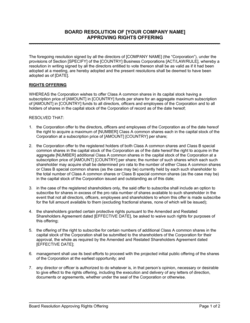
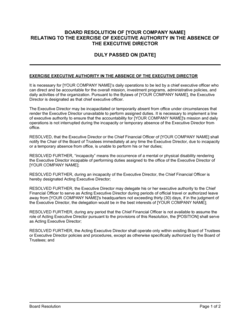
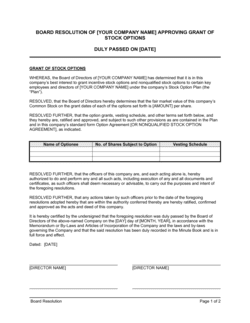
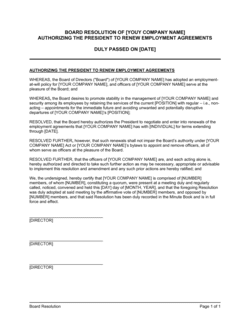
Board Resolution Approving Acquisition of Business Assets Template

Free Word download • Edit online • Save & share with Drive • Export to PDF

1 page20–30 min to fillDifficulty: StandardSignature requiredLegal review recommended
Learn more ↓
FreeBoard Resolution Approving Acquisition of Business Assets Template

At a glance

What it is
A Board Resolution Approving Acquisition of Business Assets is a formal corporate governance document in which a company's board of directors officially authorizes the purchase of identified business assets from a named seller. This free Word download captures the resolution text, the voting record, the asset description, the approved purchase price, and the names of authorized officers — creating the internal authorization record that lenders, lawyers, escrow agents, and counterparties require before the transaction can close.
When you need it
Use it whenever a corporation or LLC governed by a board is acquiring material business assets — equipment, intellectual property, customer lists, inventory, or an entire operating unit — and the transaction requires documented board approval under the company's bylaws, operating agreement, or applicable corporate statutes.
What's inside
The resolution identifies the corporation, the meeting date and quorum, the asset acquisition being approved, the seller and agreed purchase price, the specific officers authorized to execute the transaction documents, and the signatures of the directors or their written-consent certification.

What is a Board Resolution Approving Acquisition of Business Assets?

A Board Resolution Approving Acquisition of Business Assets is a formal corporate governance document in which a company's board of directors officially votes to authorize the purchase of specific assets from a named seller. It records the identities of the parties, the nature and scope of the assets being acquired, the approved purchase price and payment terms, and the names of the officers empowered to execute the Asset Purchase Agreement and all related closing documents on behalf of the corporation. Unlike an internal memo or email chain, a properly adopted board resolution creates a verifiable, certified record of corporate authority that satisfies the legal, lender, and counterparty requirements of a real-world transaction closing.

Why You Need This Document

Without a board resolution, the officers who sign an Asset Purchase Agreement may lack the actual authority to bind the corporation — exposing the company to challenges from dissenting directors or shareholders, creating title defects in transferred assets, and triggering automatic default provisions in acquisition financing. Lenders, escrow agents, and counterparty counsel treat a certified board resolution as a non-negotiable closing condition: no resolution, no closing. Beyond the transactional mechanics, a properly documented resolution protects individual directors by showing they reviewed and approved the specific deal terms — not a vague concept — reducing personal liability exposure in any subsequent dispute. This template gives you a structured, attorney-ready starting point that covers every standard clause required for domestic and cross-border asset acquisitions, so you can complete the authorization record in under an hour and focus on closing the deal.

Which variant fits your situation?

If your situation is…Use this template
Purchasing the equity of another company rather than its assetsBoard Resolution Approving Acquisition of Stock
Board authorizing a merger with another entityBoard Resolution Approving Merger
Board authorizing the sale (not purchase) of the company's own assetsBoard Resolution Approving Sale of Business Assets
Board authorizing a specific officer to sign a contract on behalf of the companyBoard Resolution Authorizing Signatory
Board approving a major capital expenditure below M&A thresholdBoard Resolution Approving Capital Expenditure
Unanimous written consent in lieu of a formal meetingUnanimous Written Consent of Directors
LLC member approval of an asset acquisition rather than a board voteLLC Member Resolution Approving Asset Acquisition

Common mistakes to avoid

❌ Using a trade name instead of the registered legal entity name

Why it matters: The resolution must match the name on the corporate charter, the APA, and any title transfer documents. A mismatch creates a gap in the authorization chain that can delay or void the closing.

Fix: Look up the exact registered name in the secretary of state's business registry and copy it character-for-character into the resolution header and signature block.

❌ Approving a general asset acquisition without referencing the specific APA

Why it matters: Lenders, escrow agents, and counterparty counsel need confirmation that the board reviewed and approved the actual deal — not just the concept. A vague resolution can be challenged as insufficient authorization.

Fix: Reference the APA by its exact title and date, and include the agreed purchase price in the resolution text so it is clear the board approved the final terms.

❌ Omitting assumed liabilities from the purchase price authorization

Why it matters: If the buyer is taking on seller debt or trade payables, those obligations must be explicitly authorized. Excluding them leaves the authorized economic commitment understated and creates a legal ambiguity about board approval.

Fix: List assumed liabilities as a separate line item in the purchase price clause with a dollar amount or reference to the APA schedule that quantifies them.

❌ Failing to obtain signatures from the required number of directors before closing

Why it matters: A resolution signed by fewer directors than required for a valid board action is void. Counterparties who discover this post-closing can challenge the transaction's authority.

Fix: Confirm the signature requirement in the bylaws before circulating — majority of total directors, not just directors present at the meeting, is often required for major asset acquisitions.

The 9 key clauses, explained

Corporation Identification and Meeting Recitals

In plain language: Identifies the corporation by full legal name, state of incorporation, and the date, time, and manner (in-person, virtual, or written consent) of the board meeting or action.

Sample language
The undersigned, being all of the directors of [CORPORATION LEGAL NAME], a [STATE] corporation (the 'Company'), hereby adopt the following resolutions at a duly noticed meeting held on [DATE] at which a quorum was present, or by unanimous written consent in lieu thereof.

Common mistake: Using the trade name or DBA instead of the registered corporate name — the resolution will not match the corporate charter or any title document, creating a gap in the authorization chain.

Recitals — Purpose and Background

In plain language: Narrates the business rationale for the acquisition: what assets are being acquired, from whom, and why the board considers the transaction in the company's best interest.

Sample language
WHEREAS, the Company desires to acquire certain business assets of [SELLER LEGAL NAME] (the 'Seller'), as more particularly described in the Asset Purchase Agreement dated [DATE] (the 'APA'), for the purpose of [BUSINESS RATIONALE]; and WHEREAS, the Board has reviewed the terms of the APA and determined the acquisition to be in the best interests of the Company and its shareholders.

Common mistake: Omitting the seller's legal name and relying only on a trade name. If the seller is an LLC or subsidiary, the resolution must name the exact contracting entity.

Approval of the Acquisition

In plain language: The operative resolution clause formally approving the acquisition and authorizing the company to proceed with the asset purchase on the described terms.

Sample language
RESOLVED, that the acquisition of the assets described in the APA from [SELLER LEGAL NAME] for an aggregate purchase price of [PURCHASE PRICE] (the 'Acquisition') is hereby approved, ratified, and authorized in all respects.

Common mistake: Approving a generic 'asset acquisition' without referencing a specific APA or purchase price — this forces counterparties and lenders to question whether the board actually reviewed the final deal terms.

Description of Assets Being Acquired

In plain language: Identifies the categories or specific list of assets being purchased — equipment, inventory, intellectual property, customer lists, contracts, real property interests — either inline or by reference to a schedule.

Sample language
The assets to be acquired include, without limitation: [LIST OF ASSET CATEGORIES], as more fully described in Schedule A to the APA, which schedule is incorporated herein by reference.

Common mistake: Listing assets too narrowly in the resolution without Schedule A attached. Any asset not identified — such as software licenses or domain names — may need a separate authorization at closing.

Purchase Price and Payment Terms Authorization

In plain language: Approves the total consideration, the payment structure (cash at closing, earn-out, seller note, or assumed liabilities), and any adjustment mechanisms such as a working-capital true-up.

Sample language
RESOLVED FURTHER, that the Company is hereby authorized to pay aggregate consideration of $[AMOUNT], payable as follows: $[CASH AT CLOSING] in cash at closing and $[DEFERRED AMOUNT] by [PROMISSORY NOTE / EARN-OUT], subject to adjustment as provided in Section [X] of the APA.

Common mistake: Approving only the headline price without authorizing assumed liabilities. If the buyer is taking on seller debt, that obligation must be explicitly authorized to avoid a later dispute about whether the board approved the full economic burden.

Authorization of Officers to Execute Documents

In plain language: Names the specific officers — by title and optionally by name — authorized to sign the APA, ancillary agreements, transfer instruments, and any financing documents on behalf of the corporation.

Sample language
RESOLVED FURTHER, that the [CEO / PRESIDENT] and [CFO / SECRETARY] of the Company (each, an 'Authorized Officer') are hereby authorized and directed, on behalf of the Company, to execute and deliver the APA and all agreements, instruments, and documents as may be necessary or appropriate to consummate the Acquisition.

Common mistake: Authorizing only one officer when the APA or lender requires dual signatures. Confirm execution requirements in the APA before drafting this clause.

Financing Authorization (if applicable)

In plain language: If the acquisition is being funded by debt, this clause authorizes the company to borrow the necessary funds, grant security interests, and execute loan documents in connection with the acquisition.

Sample language
RESOLVED FURTHER, that the Authorized Officers are hereby authorized to negotiate, execute, and deliver any credit agreements, security agreements, or other financing documents required to fund the Acquisition, and to grant such security interests in the Company's assets as may be required by any lender.

Common mistake: Omitting the financing authorization clause when lender counsel requires it as a closing condition. Without it, the lender's funds cannot be released on the closing date.

Ratification of Prior Acts

In plain language: Ratifies and confirms any actions taken by officers or agents in connection with the acquisition prior to the formal board resolution, such as signing term sheets or letters of intent.

Sample language
RESOLVED FURTHER, that all acts and things heretofore taken by the officers, directors, and agents of the Company in connection with the Acquisition are hereby ratified, confirmed, and approved in all respects.

Common mistake: Skipping this clause when the CEO has already signed an LOI or exclusivity agreement. Without ratification, those prior acts technically lacked board authority.

Certification and Director Signatures

In plain language: The signature block where each director signs to evidence their vote, or the corporate secretary certifies the resolution as a true extract of the minutes.

Sample language
IN WITNESS WHEREOF, the undersigned directors, constituting all of the directors of [CORPORATION LEGAL NAME], hereby adopt the foregoing resolutions as of [DATE]. [DIRECTOR NAME]: _____________________ [DIRECTOR NAME]: _____________________

Common mistake: Having only the CEO sign the resolution instead of the required number of directors. Many states and most APA forms require signatures from a majority of the board, or from all directors if signed as a unanimous written consent.

How to fill it out

  1. 1

    Insert the corporation's full legal name and jurisdiction

    Enter the company's exact registered legal name — including Inc., LLC, or Corp. — and the state or province of incorporation. Verify this against the most recent certificate of incorporation or articles.

    💡 Cross-check the name against the state business registry online. A one-word discrepancy between the resolution and the charter can stall a closing.

  2. 2

    Record the meeting date, format, and quorum confirmation

    State whether this is an in-person meeting, telephonic, virtual, or a unanimous written consent in lieu of meeting. Confirm that quorum was present or that all directors are signing.

    💡 Check your bylaws for the quorum requirement before the meeting — typically a majority of directors. A resolution adopted without quorum is void.

  3. 3

    Identify the seller and describe the assets being acquired

    Enter the seller's full legal entity name and describe the assets by category — equipment, IP, inventory, contracts, real property — or reference the APA's Schedule A.

    💡 Attach Schedule A to the resolution even if it duplicates the APA. Counterparties and lenders review the resolution in isolation and need the asset list visible.

  4. 4

    Enter the approved purchase price and payment structure

    State the total consideration and break it into components: cash at closing, seller note principal and interest rate, earn-out formula, and any assumed liabilities with their amounts.

    💡 If the price includes an earn-out or adjustment mechanism, summarize the formula in one sentence — do not reproduce the full APA mechanics in the resolution.

  5. 5

    Name the authorized officers and scope their authority

    List each authorized officer by title (and optionally by name). Confirm the scope covers signing the APA, ancillary documents, transfer instruments, consents, and financing documents.

    💡 If your lender requires a specific officer to execute loan documents, name that officer explicitly — generic 'any officer' language is sometimes rejected by institutional lenders.

  6. 6

    Add a financing authorization clause if acquisition debt is involved

    If the purchase is funded by a bank loan or seller financing, include the clause authorizing officers to execute credit agreements and grant security interests.

    💡 Request a checklist from lender's counsel at least five business days before closing — financing authorization gaps are the most common last-minute closing delay.

  7. 7

    Include the ratification clause for prior acts

    Add language ratifying any LOI, term sheet, exclusivity agreement, or other action taken by management before the formal board vote.

    💡 If the CEO signed an LOI more than 90 days before the resolution, note that gap — some M&A counsel want a refreshed ratification at closing.

  8. 8

    Collect director signatures before the closing date

    Route the resolution to each director for signature, confirm signature pages are returned, and have the corporate secretary certify the final document. File it in the minute book.

    💡 Use a certified copy stamp or corporate seal if the counterparty's jurisdiction requires it. Some title companies and foreign registries will not accept uncertified resolutions.

Frequently asked questions

What is a board resolution approving acquisition of business assets?

A board resolution approving acquisition of business assets is a formal corporate document in which the board of directors of a corporation officially votes to authorize the purchase of specific assets from a named seller. It records the resolution text, the vote count, the approved purchase price, and the officers designated to sign the transaction documents. Most asset purchase agreements and lenders require a copy of this resolution as a condition of closing.

When is a board resolution required for an asset acquisition?

A board resolution is typically required whenever a corporation's bylaws designate material asset acquisitions as a matter requiring board approval — which is standard for any transaction above a defined dollar threshold. In addition, lenders financing the acquisition, escrow agents, and counterparty counsel almost universally demand a certified board resolution as a closing condition, regardless of what the bylaws require.

What is the difference between an asset acquisition and a stock acquisition?

In an asset acquisition, the buyer purchases specific assets — equipment, IP, contracts, customer lists — and assumes only agreed liabilities. The seller's entity continues to exist. In a stock acquisition, the buyer purchases the equity of the target company and inherits all of its assets and liabilities automatically. Asset deals are more common for smaller transactions because buyers can select what they want and leave behind unknown liabilities. Each type requires its own board resolution.

Does an LLC need a board resolution to acquire assets?

LLCs are typically governed by a members' or managers' resolution rather than a board resolution. The functional document is similar — it records the vote of the managing members or managers to authorize the acquisition — but it references the operating agreement instead of bylaws. Some multi-member LLCs require a supermajority or unanimous vote for significant asset acquisitions depending on the operating agreement terms.

What documents should be attached to or referenced in the board resolution?

At minimum, the resolution should reference the Asset Purchase Agreement by title and date. If the APA includes a Schedule A listing specific assets, that schedule should be attached to or incorporated by reference into the resolution. Lenders may also require that the resolution reference any credit agreement being entered in connection with the acquisition.

Do I need a lawyer to prepare a board resolution for an asset acquisition?

For straightforward domestic asset purchases where the buyer and seller are negotiating directly, a high-quality template reviewed by the corporate secretary is often sufficient. A lawyer is strongly recommended when the transaction involves cross-border elements, significant assumed liabilities, complex financing, regulatory approvals, or when the resolution must satisfy an institutional lender's closing checklist. The cost of a one-hour legal review — typically $200–$500 — is negligible relative to the risk of a defective authorization.

How is a board resolution certified for use in a transaction?

The corporate secretary signs a certification statement attesting that the resolution is a true, correct, and complete extract of the minutes of the board, that the board had the required quorum, and that the resolution has not been amended or revoked. Many counterparties and lenders require this certification on the same page as, or immediately following, the resolution text. Some jurisdictions require a corporate seal on certified resolutions used in real property transactions.

What happens if a corporation completes an asset acquisition without a board resolution?

Without a valid board resolution, the officers who signed the APA may have lacked actual authority to bind the corporation. This can expose the company to a challenge from dissenting shareholders or directors, create a title defect for transferred assets, trigger a lender default, or give the counterparty grounds to void the transaction. Courts generally apply a ratification doctrine if the board later acknowledges the deal, but relying on after-the-fact ratification is a significant and avoidable risk.

How this compares to alternatives

vs Asset Purchase Agreement

An Asset Purchase Agreement is the binding contract between buyer and seller that governs the transfer — what is sold, for how much, with what representations, and on what closing conditions. A board resolution is the internal corporate authorization document that gives the buyer's officers the legal authority to sign that agreement. You need both: the APA creates the deal; the resolution authorizes it.

vs Board Resolution Approving Sale of Business Assets

The sale resolution authorizes the company to transfer its own assets to a buyer; the acquisition resolution authorizes the company to purchase assets from a seller. The structure is mirror-image: the acquiring board approves the purchase price, authorized purchaser, and officer authority to buy, while the selling board approves the same economics from the disposition side. Both documents are required at closing for each respective entity.

vs Letter of Intent

A Letter of Intent (LOI) records the preliminary, often non-binding terms of a proposed acquisition and is signed by officers before a full APA is negotiated. A board resolution is the formal governance document that authorizes the final, binding transaction. LOIs are sometimes signed without a board resolution, which is why acquisition resolutions typically include a ratification clause covering prior acts like the LOI.

vs Minutes of a Board Meeting

Board minutes are the full narrative record of an entire meeting — agenda items, discussion points, attendance, and all votes taken. A board resolution is a standalone document containing only the operative resolution text and director signatures, designed to be extracted, certified, and delivered to third parties. Most counterparties and lenders require the standalone resolution, not the full minutes, as a closing deliverable.

Industry-specific considerations

Technology / SaaS

Boards acquiring software IP, source code, customer databases, or domain portfolios must clearly identify each intangible asset and confirm IP assignment authority in the resolution.

Manufacturing

Equipment-heavy acquisitions require the resolution to authorize UCC fixture filings and lien releases, and to reference any environmental indemnities assumed by the buyer.

Healthcare / MedTech

Asset acquisitions involving patient records, medical licenses, or DEA registrations require the resolution to reference regulatory transfer approvals as a condition of the authorization.

Retail / E-commerce

Acquiring inventory, brand assets, and e-commerce accounts requires the resolution to address assumed supplier contracts and any sales tax liabilities that transfer with the business.

Professional Services

Acquisitions of client lists, non-compete agreements, and goodwill from a retiring practitioner require the resolution to confirm the APA's non-solicitation and transitional services terms are approved.

Real Estate

When acquired assets include real property or leasehold interests, the resolution must specifically authorize the execution of deeds, assignments of lease, and any title-company-required certifications.

Jurisdictional notes

United States

Corporate authority to acquire assets is typically set by state corporation law and company bylaws. Delaware and most states require board approval for asset acquisitions that are 'not in the ordinary course of business.' Some states — including California — require shareholder approval for acquisitions of all or substantially all assets. Lenders routinely require a certified board resolution as a closing deliverable regardless of statutory minimums.

Canada

Under the Canada Business Corporations Act and provincial equivalents, the board has broad authority to manage corporate affairs including acquisitions, but certain extraordinary transactions require shareholder approval. Quebec civil law imposes different formalities for asset transfers, and French-language versions of resolutions may be required for provincially regulated Quebec corporations. Certified copies of resolutions are required by most Canadian lenders and title insurers.

United Kingdom

Under the Companies Act 2006, directors may approve asset acquisitions within the scope of the company's objects clause. Substantial property transactions with directors or connected persons require additional shareholder approval under s.190. Board resolutions must comply with the procedures set out in the company's articles of association, and written resolutions require the approval of the majority or unanimity threshold specified in the articles.

European Union

Corporate governance requirements for asset acquisitions vary significantly across EU member states. Germany requires supervisory board co-determination for major acquisitions; France and the Netherlands impose board-level approval thresholds defined in the statuts or articles. GDPR is directly relevant when acquired assets include personal data — the resolution should reference the data processing transfer agreement required under Article 28. In all member states, notarized or apostilled certified copies of resolutions are typically required for cross-border closing deliverables.

Template vs lawyer — what fits your deal?

PathBest forCostTime
Use the templateClosely held corporations with a simple board structure acquiring domestic assets in a straightforward cash dealFree30–60 minutes
Template + legal reviewTransactions with lender financing, multiple asset categories, assumed liabilities, or a corporate secretary who wants a one-hour attorney check before circulating$200–$6001–2 business days
Custom draftedCross-border acquisitions, heavily regulated industries (healthcare, financial services), transactions requiring regulatory consents, or deals with complex equity consideration$1,000–$3,500+3–7 business days

Glossary

Board Resolution
A formal written record of a decision made by a company's board of directors, establishing corporate authority for the action described.
Asset Acquisition
A transaction in which the buyer purchases specific assets — rather than equity — of a target business, taking on only agreed liabilities.
Quorum
The minimum number of directors who must be present at a board meeting for votes taken at that meeting to be legally valid.
Authorized Officer
A named individual — typically the CEO, CFO, or President — whom the board designates to sign transaction documents on behalf of the corporation.
Asset Purchase Agreement (APA)
The binding contract between buyer and seller that specifies which assets are being transferred, the purchase price, representations, and closing conditions.
Unanimous Written Consent
A mechanism allowing directors to approve a resolution by signing a written document in lieu of holding a physical or virtual meeting.
Assumed Liabilities
Specific debts or obligations of the seller that the buyer agrees to take on as part of the asset purchase — everything else stays with the seller.
Purchase Price Allocation
The assignment of the total acquisition price across individual asset categories (equipment, IP, goodwill) for tax and accounting purposes.
Representations and Warranties
Statements of fact in the APA about the assets and business — if false, they give the aggrieved party a right to damages or rescission.
Closing Conditions
Specific requirements — including delivery of a board resolution — that must be satisfied before both parties are obligated to complete the transaction.
Minute Book
The official corporate record containing the charter, bylaws, share register, and all minutes and resolutions passed by the board and shareholders.

Part of your Business Operating System

This document is one of 3,000+ business & legal templates included in Business in a Box.

  • Fill-in-the-blanks — ready in minutes
  • 100% customizable Word document
  • Compatible with all office suites
  • Export to PDF and share electronically

Create your document in 3 simple steps.

From template to signed document — all inside one Business Operating System.
1
Download or open template

Access over 3,000+ business and legal templates for any business task, project or initiative.

2
Edit and fill in the blanks with AI

Customize your ready-made business document template and save it in the cloud.

3
Save, Share, Send, Sign

Share your files and folders with your team. Create a space of seamless collaboration.

Save time, save money, and create top-quality documents.

★★★★★

"Fantastic value! I'm not sure how I'd do without it. It's worth its weight in gold and paid back for itself many times."

Managing Director · Mall Farm
Robert Whalley
Managing Director, Mall Farm Proprietary Limited
★★★★★

"I have been using Business in a Box for years. It has been the most useful source of templates I have encountered. I recommend it to anyone."

Business Owner · 4+ years
Dr Michael John Freestone
Business Owner
★★★★★

"It has been a life saver so many times I have lost count. Business in a Box has saved me so much time and as you know, time is money."

Owner · Upstate Web
David G. Moore Jr.
Owner, Upstate Web

Run your business with a system — not scattered tools

Stop downloading documents. Start operating with clarity. Business in a Box gives you the Business Operating System used by over 250,000 companies worldwide to structure, run, and grow their business.

Start free · No credit card required