Proposal of Determination of the Fair Market Value of Share Template

Free Word download • Edit online • Save & share with Drive • Export to PDF

4 pages25–30 min to fillDifficulty: Complex
Learn more ↓
FreeProposal of Determination of the Fair Market Value of Share Template

At a glance

What it is
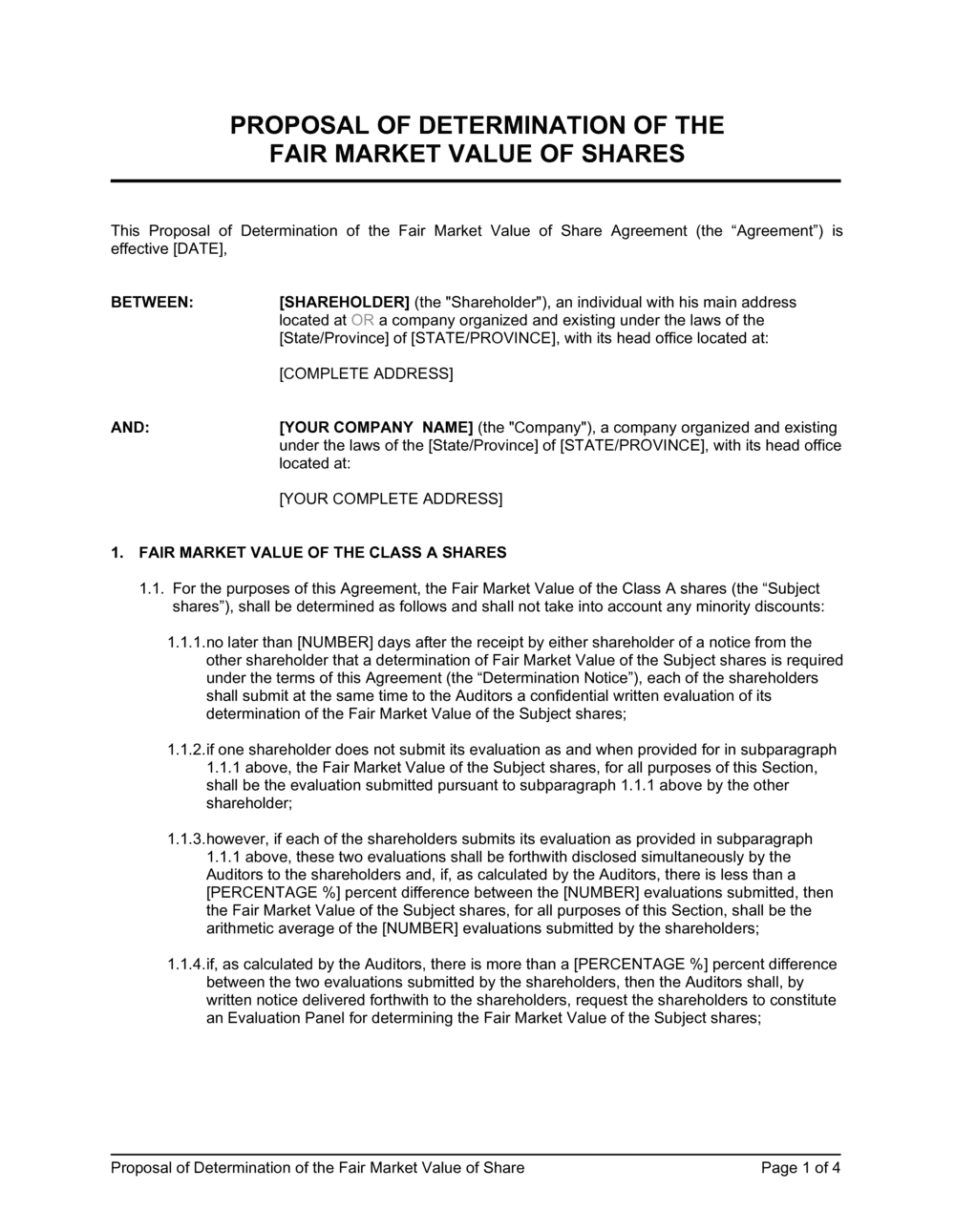
A Proposal of Determination of the Fair Market Value of Share is a structured operational document that sets out the methodology, financial data, and reasoned conclusions used to arrive at a defensible per-share value for a private company. This free Word download gives you a ready-to-edit framework for presenting a share valuation to shareholders, buyers, boards, or advisors in a clear, professional format you can export as PDF.
When you need it
Use it when a shareholder exit, share buyout, equity transfer, or internal restructuring requires a documented and communicable valuation basis. It is also appropriate when a board needs to approve a share price for an employee equity plan or when parties to a shareholders agreement must resolve a valuation dispute.
What's inside
The proposal covers the purpose and scope of the valuation, a description of the company and its shares, the valuation date, the methodology selected (income, market, or asset approach), the key financial inputs and assumptions, the calculated fair market value per share, and a conclusion with supporting rationale. Each section is designed so that a reader unfamiliar with the underlying negotiations can follow the logic from data to conclusion.

What is a Proposal of Determination of the Fair Market Value of Share?

A Proposal of Determination of the Fair Market Value of Share is a structured operational document that presents the methodology, financial data, and reasoned conclusions used to establish a defensible per-share value for shares in a private company. It typically covers the purpose of the valuation, a description of the company and its share structure, the valuation date, the analytical approach selected — income, market, or asset — and the resulting per-share conclusion with supporting assumptions and limitations. Because private company shares have no quoted market price, this document creates the evidential record that replaces the market mechanism, giving all parties a transparent basis on which to agree, negotiate, or challenge a proposed price.

Why You Need This Document

Without a documented valuation proposal, share transactions in private companies are vulnerable on every front. A verbal or undocumented price is unenforceable if a shareholder later disputes it, and a price with no methodology attached will be dismissed by any advisor, auditor, or court asked to assess its reasonableness. Tax authorities in most jurisdictions scrutinize non-arm's-length share transfers and may reassess a price that cannot be tied to a documented FMV analysis. For employee equity plans, a per-share price unsupported by analysis creates liability if participants later claim the price was understated. This template gives you a professionally structured starting point that covers every material component of a defensible share valuation — saving the time and cost of building the framework from scratch while ensuring the final document is rigorous enough to withstand review by the other party's advisors.

Which variant fits your situation?

If your situation is…Use this template
Valuing shares for a minority shareholder exit under a shareholders agreementProposal of Determination of the Fair Market Value of Share
Documenting a full company valuation for a merger or acquisitionBusiness Valuation Report
Setting a share price for an employee stock option planStock Option Plan
Formalizing the terms of a share purchase between existing shareholdersShare Purchase Agreement
Summarizing equity ownership and share classes for investor diligenceCap Table
Restructuring shareholder rights alongside a share transferShareholders Agreement
Transferring shares from one party to another with a recorded priceShare Transfer Agreement

Common mistakes to avoid

❌ Using the proposal preparation date as the valuation date

Why it matters: Market conditions, company performance, and comparable transaction multiples can shift meaningfully between a triggering event and the date the document is prepared. The wrong date produces a value that neither party can rely on.

Fix: Set the valuation date to the specific triggering event — the date of the exit notice, the offer date, or the date specified in the shareholders agreement — and source all financial data as of that date.

❌ Presenting a single valuation method with no cross-check

Why it matters: A one-method proposal is structurally weak. Opposing advisors will apply an alternative method, get a different number, and use the discrepancy to reject or renegotiate the entire valuation.

Fix: Apply a primary method and at least one cross-check method. Where the two methods produce different results, disclose both and explain the weighting applied to reach the final conclusion.

❌ Omitting minority and marketability discounts for private company shares

Why it matters: Private company shares have no ready market and, in the case of minority interests, limited ability to influence distributions or an exit. Ignoring these factors overstates value and will be challenged immediately by any informed counterparty.

Fix: Explicitly address marketability and control in the adjustments section. If you are not applying a discount, state the reason — for example, a drag-along right that effectively makes the minority shares fully liquid.

❌ Hiding normalization adjustments without explanation

Why it matters: Adjusting EBITDA upward without documenting what was removed and why looks like manipulation. The other party's advisors will reverse the adjustments and rebuild the model from scratch, destroying the proposal's credibility.

Fix: List every normalization item in a table: the reported figure, the adjustment, the adjusted figure, and a one-line justification for each change.

The 10 key sections, explained

Purpose and scope

Company description and share structure

Valuation date and relevant financial period

Valuation methodology selected

Key financial inputs and assumptions

Enterprise value calculation

Adjustments for control and marketability

Per-share value conclusion

Assumptions, limitations, and reliance

Conclusion and recommendation

How to fill it out

  1. 1

    Define the purpose and identify the subject shares

    State clearly why the valuation is being prepared — buyout, equity transfer, option plan, or dispute resolution. Specify the exact number of shares and the share class being valued.

    💡 Locking the purpose in Section 1 prevents scope creep and limits the document's use to the intended transaction.

  2. 2

    Describe the company and its share structure

    Summarize the business, its industry, legal form, and jurisdiction. List all issued share classes with their voting rights, economic rights, and the percentage the subject shares represent.

    💡 Pull this data directly from the company's most recent shareholders register and articles of incorporation to ensure consistency with governing documents.

  3. 3

    Set the valuation date and gather financial statements

    Choose a valuation date that is defensible for the transaction — typically the date of the triggering event (notice of exit, offer date) — and assemble audited financials for the three most recent fiscal years plus the latest interim period.

    💡 Using audited rather than management-prepared financials increases credibility significantly when the proposal is reviewed by the other party's advisors.

  4. 4

    Select and justify your valuation methodology

    Choose a primary method (income, market, or asset) and at least one cross-check method. Write one paragraph explaining why the primary method best reflects value for this company given its stage, industry, and cash flow profile.

    💡 For asset-heavy businesses (real estate, manufacturing), lead with the asset approach. For recurring-revenue businesses (SaaS, professional services), the income approach is typically more persuasive.

  5. 5

    Input and normalize the financial data

    Enter the company's historical revenue, EBITDA, and net income. Adjust for one-time items, above-market owner compensation, and non-recurring expenses to arrive at normalized earnings that reflect sustainable performance.

    💡 Document every normalization adjustment with a brief explanation — unexplained adjustments are the most common source of valuation disputes.

  6. 6

    Calculate enterprise value and apply adjustments

    Run the enterprise value calculation using your selected method, then apply any control premium or minority and marketability discounts appropriate to the interest being valued. Show each step numerically.

    💡 Reference published discount studies (e.g., Duff & Phelps DLOM studies) if challenged on the discount percentages you apply.

  7. 7

    State the per-share conclusion

    Divide the adjusted equity value by the precise number of subject shares to arrive at a per-share figure. State this number explicitly and tie it back to the total equity value and share count.

    💡 Express the per-share value to two decimal places and include a sensitivity table showing how a ±1% change in the discount rate or growth rate affects the conclusion.

  8. 8

    Add assumptions, limitations, and a recommendation

    List all material assumptions the proposal relies on, state who may rely on it and for what purpose, and include a clear recommendation on how the parties should use the concluded value.

    💡 Have the preparer sign and date the final section — an unsigned proposal carries less weight in a negotiation or dispute.

Frequently asked questions

What is a proposal of determination of the fair market value of share?

It is a formal document that presents the methodology, financial inputs, and reasoned conclusions used to arrive at a per-share fair market value for a private company's shares. It differs from a full independent appraisal in that it is typically prepared by one party to a transaction — such as the company or a major shareholder — as a proposed basis for negotiation or board approval, rather than as an independent third-party opinion.

When do you need to determine the fair market value of shares?

Common triggers include a shareholder exit under a buy-sell provision in a shareholders agreement, an internal share transfer between existing shareholders, the issuance of shares under an employee equity plan, a partial acquisition by a third party, a shareholder dispute requiring independent valuation, and year-end board approval of equity compensation. In each case, a documented valuation basis protects all parties from later disputes about the price paid.

What valuation methods are typically used in a share FMV proposal?

Three approaches are standard: the income approach (discounting projected future cash flows to present value), the market approach (applying transaction or trading multiples from comparable companies), and the asset approach (adjusting the net book value of assets and liabilities to their fair market values). Most proposals apply one primary method and use a second as a cross-check. The income approach is most common for profitable operating businesses; the asset approach is preferred for holding companies and real-estate-heavy businesses.

What is the difference between fair market value and fair value?

Fair market value assumes a hypothetical willing buyer and willing seller in an arm's-length transaction, with no compulsion to act. Fair value is a legal standard used in specific contexts — shareholder dissent rights, divorce proceedings, and certain statutory appraisals — that may exclude minority and marketability discounts that would apply under fair market value. The distinction matters significantly: the same share can carry a materially different value under the two standards.

Do I need an independent valuator to prepare this document?

Not necessarily. For internal transactions, equity plan approvals, or preliminary negotiations, a well-supported proposal prepared by the company's finance team or external accountant is often sufficient. An independent business valuator is recommended when the transaction involves a material amount, when the parties are adversarial, when the valuation will be reviewed by a court or regulator, or when the shareholders agreement requires an independent determination.

What is a discount for lack of marketability (DLOM) and when does it apply?

A DLOM is a downward adjustment to a private company's per-share value that reflects the fact that shares cannot be quickly converted to cash the way publicly traded shares can. It typically ranges from 15% to 35% depending on the company's size, financial health, and any transfer restrictions in the shareholders agreement. It applies to essentially all minority interests in private companies unless the shares are subject to a put right or a mandatory buyback at a defined formula price.

How is a normalized EBITDA different from reported EBITDA?

Reported EBITDA reflects what the company actually recorded in its financial statements, including one-time gains or losses, above-market owner compensation, and non-recurring items. Normalized EBITDA removes these distortions to produce a figure that represents the sustainable, ongoing earning power of the business. Common adjustments include removing a one-time litigation settlement, reducing owner salary to a market-rate replacement cost, and adding back non-recurring legal or restructuring fees.

Can this proposal be used as a final binding valuation?

A proposal of this type is typically a starting point for negotiation or board approval, not a final binding determination unless both parties agree in writing to accept it. If the shareholders agreement specifies that a valuation becomes binding after a stated period without objection, include that notice mechanism explicitly in the document. For transactions where finality is required, the parties should either accept the proposal by written agreement or commission an independent appraisal whose findings are agreed to be binding.

What financial statements should be attached to the proposal?

At minimum, attach the company's income statements, balance sheets, and cash flow statements for the three most recent fiscal years, plus the most recent interim period. If projections are used in an income-approach valuation, attach the management forecast with the underlying assumptions. Audited financials carry more weight than reviewed or compiled statements when the proposal is reviewed by an opposing party's advisors.

How this compares to alternatives

vs Independent Business Valuation Report

An independent valuation report is prepared by a certified, neutral third-party valuator and is typically required for court proceedings, regulatory filings, or adversarial transactions. A FMV proposal is prepared by one of the parties or their advisors as a negotiating document or internal approval record. The proposal is faster and less costly; the independent report carries more evidentiary weight.

vs Shareholders Agreement

A shareholders agreement governs the rights and obligations of shareholders, including the mechanism for determining share value on exit — such as specifying the valuation method or naming an arbitrator. The FMV proposal is the document that executes that mechanism by actually calculating the price. The two documents work in sequence: the agreement creates the obligation; the proposal fulfills it.

vs Share Purchase Agreement

A share purchase agreement is the binding contract that transfers ownership of shares at an agreed price. The FMV proposal supports that agreement by documenting how the price was determined. Without a supporting valuation proposal, the share purchase agreement's price can be challenged as arbitrary or not at arm's length.

vs Letter of Intent (LOI)

A letter of intent records the parties' preliminary agreement on the main terms of a share transaction, including an indicative price range. The FMV proposal provides the analytical backing that converts an indicative LOI price into a defensible, documented conclusion. The LOI comes first to establish intent; the FMV proposal confirms the economics before the purchase agreement is signed.

Industry-specific considerations

Professional Services

Partner buyouts in law, accounting, and consulting firms frequently require a documented FMV proposal tied to normalized EBITDA and client book values.

Technology / SaaS

Secondary share transfers and employee equity plan approvals in private tech companies require an FMV proposal anchored to ARR multiples and discounted cash flow models.

Manufacturing

Asset-heavy manufacturers often require both an income approach and an asset approach to capture the value of equipment, inventory, and real property in the per-share conclusion.

Real Estate

Holding companies with property portfolios rely primarily on the asset approach, requiring independent property appraisals to support the adjusted net asset value used in the share valuation.

Retail / E-commerce

Shareholder exits in retail businesses often use a market approach benchmarked against EBITDA multiples from comparable retail transactions, adjusted for inventory and lease liabilities.

Healthcare

Medical practice and clinic share valuations must account for regulatory restrictions on non-physician ownership, which limits the buyer pool and typically supports a meaningful marketability discount.

Template vs pro — what fits your needs?

PathBest forCostTime
Use the templateInternal equity plan approvals, preliminary shareholder negotiations, and straightforward minority share buyouts at smaller companiesFree4–8 hours
Template + professional reviewMaterial share transactions where one party may challenge the methodology or where a shareholders agreement specifies valuation standards$500–$2,500 for an accountant or business advisor review3–7 days
Custom draftedAdversarial exits, regulatory filings, court-ordered valuations, or transactions exceeding $500K in share value$3,000–$15,000+ for a certified independent business valuator2–6 weeks

Glossary

Fair Market Value (FMV)
The price at which a share would change hands between a willing buyer and a willing seller, both having reasonable knowledge of the relevant facts and neither being under compulsion to act.
Valuation Date
The specific date as of which the fair market value is determined — financial data and market conditions are assessed as of this date, not the date the proposal is prepared.
Income Approach
A valuation method that calculates share value based on the present value of expected future cash flows, discounted at a rate reflecting the risk of the business.
Market Approach
A valuation method that benchmarks the subject company against comparable publicly traded companies or recent transactions in the same industry.
Asset Approach
A valuation method that derives share value from the adjusted net asset value of the company — assets minus liabilities — adjusted to fair market values.
Discount Rate
The rate used to convert future cash flows into present value, reflecting the risk-adjusted required return for an investor in the subject company.
Control Premium
An upward adjustment to a per-share value reflecting the additional value a buyer receives when acquiring a controlling interest and the ability to direct company decisions.
Minority Discount
A downward adjustment applied to shares representing a non-controlling interest, reflecting their reduced ability to influence business decisions or force distributions.
EBITDA Multiple
A valuation shorthand expressing enterprise value as a multiple of earnings before interest, taxes, depreciation, and amortization — used as a market-approach benchmark.
Normalized Earnings
Reported earnings adjusted for one-time items, owner compensation above market rates, or non-recurring expenses to reflect the sustainable earning power of the business.
Weighted Average Cost of Capital (WACC)
The blended required return on a company's debt and equity, used as the discount rate in an income-approach valuation.

Part of your Business Operating System

This document is one of 3,000+ business & legal templates included in Business in a Box.

  • Fill-in-the-blanks — ready in minutes
  • 100% customizable Word document
  • Compatible with all office suites
  • Export to PDF and share electronically

Create your document in 3 simple steps.

From template to signed document — all inside one Business Operating System.
1
Download or open template

Access over 3,000+ business and legal templates for any business task, project or initiative.

2
Edit and fill in the blanks with AI

Customize your ready-made business document template and save it in the cloud.

3
Save, Share, Send, Sign

Share your files and folders with your team. Create a space of seamless collaboration.

Save time, save money, and create top-quality documents.

★★★★★

"Fantastic value! I'm not sure how I'd do without it. It's worth its weight in gold and paid back for itself many times."

Managing Director · Mall Farm
Robert Whalley
Managing Director, Mall Farm Proprietary Limited
★★★★★

"I have been using Business in a Box for years. It has been the most useful source of templates I have encountered. I recommend it to anyone."

Business Owner · 4+ years
Dr Michael John Freestone
Business Owner
★★★★★

"It has been a life saver so many times I have lost count. Business in a Box has saved me so much time and as you know, time is money."

Owner · Upstate Web
David G. Moore Jr.
Owner, Upstate Web

Run your business with a system — not scattered tools

Stop downloading documents. Start operating with clarity. Business in a Box gives you the Business Operating System used by over 250,000 companies worldwide to structure, run, and grow their business.

Start free · No credit card required