Restricted Stock Purchase Agreement Template

Free Word download • Edit online • Save & share with Drive • Export to PDF

7 pages30–40 min to fillDifficulty: ComplexSignature requiredLegal review recommended
Learn more ↓
FreeRestricted Stock Purchase Agreement Template

At a glance

What it is
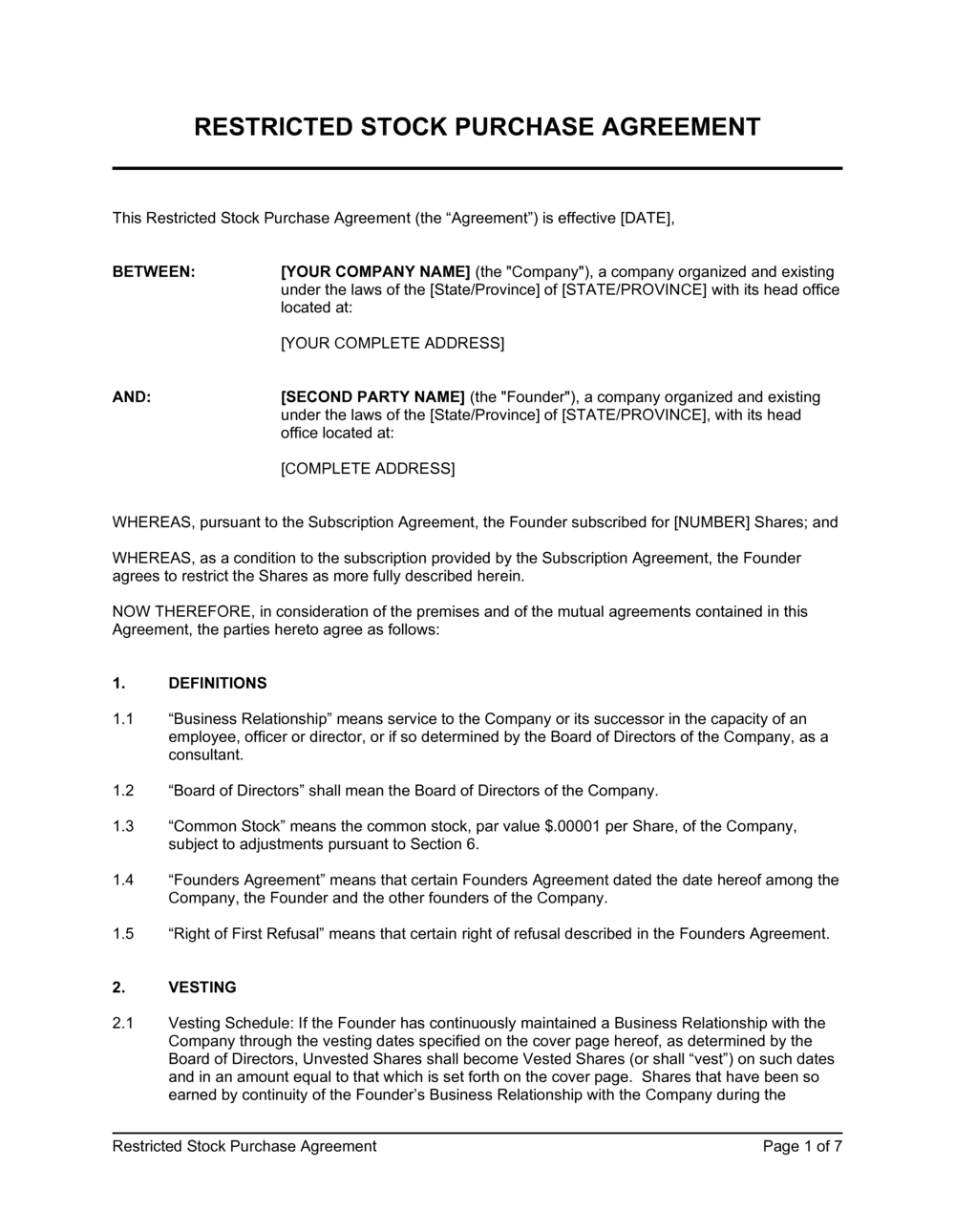
A Restricted Stock Purchase Agreement (RSPA) is a legally binding contract under which a company sells shares to a founder, employee, or advisor at a stated price, subject to a vesting schedule and a company repurchase right over unvested shares. This free Word download gives you a structured, investor-ready starting point you can edit online and export as PDF — covering purchase price, vesting, repurchase triggers, transfer restrictions, and Section 83(b) election guidance.
When you need it
Use it when issuing equity to co-founders at incorporation, granting restricted shares to early employees or advisors, or restructuring founder equity before a priced funding round. It is typically executed at or shortly after the company's formation, before shares appreciate significantly.
What's inside
Purchase price and share count, vesting schedule with cliff and monthly or quarterly release, company repurchase right on unvested shares upon termination, transfer restrictions and right of first refusal, acceleration provisions for change-of-control events, and an 83(b) election reminder and filing instructions.

What is a Restricted Stock Purchase Agreement?

A Restricted Stock Purchase Agreement (RSPA) is a legally binding contract under which a company sells shares of its common stock to a founder, employee, or advisor at a stated purchase price — typically near par value at formation — subject to a vesting schedule and the company's right to repurchase unvested shares if the recipient's service relationship ends. Unlike stock options, which grant the right to buy shares at a future date, an RSPA transfers actual share ownership immediately while imposing contractual restrictions that lapse over time as the recipient continues to serve the company. The document also provides the legal framework for the recipient to file a Section 83(b) election with the IRS, which can eliminate ongoing taxation at each future vesting date and is one of the most consequential tax decisions a founder makes at company formation.

Why You Need This Document

Without a properly executed RSPA in place before a co-founder's first day, you are exposed on several fronts simultaneously. A co-founder who departs after six months retains every share they received — there is no legal mechanism to claw any of it back, leaving your cap table with a large inactive shareholder who contributes nothing going forward. Future investors, particularly at a Series A, will require clean, documented vesting for all founders as a condition of closing; discovering an undocumented or verbal-only equity arrangement during due diligence routinely delays or kills rounds. On the tax side, every day you wait after incorporation is a day the company's FMV potentially increases — raising the cost of the missed 83(b) window if the agreement is executed late. This template gives you a structured, investor-standard starting point that covers every material provision — vesting schedule, repurchase right, transfer restrictions, acceleration, and 83(b) guidance — so your founding equity is documented correctly from day one.

Which variant fits your situation?

If your situation is…Use this template
Issuing restricted shares to a co-founder at company formationRestricted Stock Purchase Agreement (Founder)
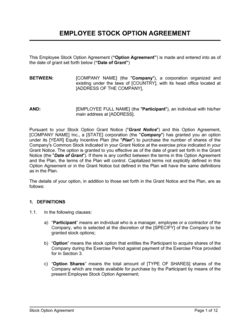
Granting stock options to employees under a formal equity planStock Option Agreement
Issuing equity to an advisor for services with a shorter vesting scheduleAdvisor Agreement with Equity
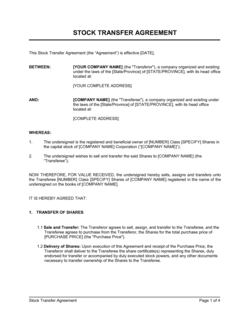
Transferring existing shares between shareholdersStock Transfer Agreement
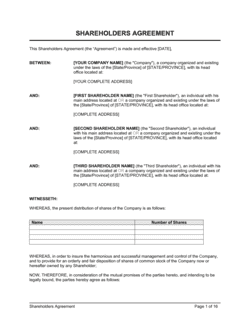
Documenting shareholder rights and drag-along / tag-along provisionsShareholders Agreement
Converting founder shares in connection with a priced equity roundStock Purchase Agreement (Series Seed / Series A)
Granting phantom equity or profit interest to a key employeePhantom Stock Plan Agreement

Common mistakes to avoid

❌ Missing the 83(b) election deadline

Why it matters: The 30-day window to file a Section 83(b) election is statutory and absolute — there are no extensions. Missing it means the founder pays ordinary income tax on the FMV of shares at each vesting date rather than at grant, which can result in a six-figure tax bill on paper gains from shares they cannot yet sell.

Fix: File the completed 83(b) election form via certified mail to the IRS within 30 days of the grant date. Retain the certified mail receipt and the IRS acknowledgment copy. Most startup attorneys send a reminder on Day 25 as a fail-safe.

❌ Executing the agreement months after incorporation

Why it matters: Delaying execution allows the company's FMV to increase, making it harder to justify a low purchase price and increasing the income recognized at the grant date — even with an 83(b). Investors who discover a gap between incorporation and RSPA execution will scrutinize the tax treatment and may require an amendment or opinion letter.

Fix: Execute RSPAs at or within 30 days of incorporation, while the company has minimal assets and a defensible near-zero FMV. Treat it as a day-one formation task alongside articles of incorporation and the initial board consent.

❌ Identical vesting terms for all co-founders regardless of role

Why it matters: A co-founder who contributes only initial IP and then steps back has the same unvested equity overhang as a full-time operating founder under a standard 4-year agreement. This misalignment becomes visible to investors and can require painful negotiation mid-round.

Fix: Tailor vesting start dates to reflect each founder's actual contribution timeline. A part-time or advisory co-founder may warrant a shorter total vesting period or a higher cliff to reflect their different commitment level.

❌ No cap-table entry or book-entry notation for restricted shares

Why it matters: Without a notation in the cap table or on the stock certificate, subsequent transfers and share issuances may proceed as if the repurchase right and ROFR do not exist — creating a clean-up problem for future investors.

Fix: Record the restricted share issuance in your equity management platform the same day the RSPA is signed, with the vesting schedule, repurchase right expiry, and transfer restrictions clearly noted. Carta and Pulley both support restricted stock ledger entries natively.

❌ Using single-trigger acceleration without board and investor alignment

Why it matters: Acquirers who see single-trigger full acceleration in founder agreements typically reprice the acquisition to account for the absence of post-close retention incentive — or exclude the founder from an earnout tied to continued service.

Fix: Default to double-trigger acceleration for active founders. Reserve single-trigger provisions for founders who will not have an ongoing role post-acquisition, and document the rationale in a board resolution.

❌ Omitting a definition of 'Continuous Service' or 'Cause'

Why it matters: If the agreement does not define what constitutes termination 'for Cause' or what breaks 'Continuous Service,' disputes about whether the repurchase right was properly triggered are resolved by a court — slowly and expensively.

Fix: Define both terms explicitly in the agreement's definitions section. Standard cause definitions cover fraud, felony conviction, willful misconduct, and material breach of duties. Continuous Service should cover employment, consulting, and board service to avoid technical forfeiture on a role change.

The 10 key clauses, explained

Parties, recitals, and purchase of shares

In plain language: Identifies the company and the purchaser as legal parties, records the number of shares sold, the price per share, the total purchase price, and the date of issuance.

Sample language
[COMPANY NAME], a [STATE] corporation ('Company'), hereby sells to [PURCHASER FULL NAME] ('Purchaser') [NUMBER] shares of Common Stock at a purchase price of $[PRICE] per share, for an aggregate purchase price of $[TOTAL], receipt of which is acknowledged.

Common mistake: Setting a purchase price of $0.00 without filing an 83(b) election. A zero-price grant is taxable as ordinary income on each future vesting date at the then-current FMV — the 83(b) election eliminates this exposure when filed within 30 days.

Vesting schedule

In plain language: States the total vesting period, the cliff date on which the first tranche vests, and the subsequent monthly or quarterly release schedule for the remaining shares.

Sample language
The shares shall vest over [48] months commencing [START DATE], with [25]% vesting on the [12]-month anniversary of the Start Date ('Cliff') and the remaining shares vesting in equal monthly installments of [1/48] of the total thereafter, subject to Purchaser's continued service.

Common mistake: Using a vesting start date that is months after the grant date without adjusting the share count. Investors expect a 4-year total vesting period from the date of grant; a shifted start date can leave founders with less-than-standard vesting credit at a Series A.

Company repurchase right on unvested shares

In plain language: Grants the company the right — but not the obligation — to repurchase unvested shares at the original purchase price if the purchaser's service relationship terminates for any reason.

Sample language
Upon termination of Purchaser's Continuous Service for any reason, the Company shall have the right, exercisable within [90] days of such termination, to repurchase all unvested shares at the lower of (a) the original purchase price per share or (b) the then-current Fair Market Value per share.

Common mistake: Omitting a deadline by which the company must exercise the repurchase right. Without a defined window, the right may be considered an indefinite encumbrance on the shares, complicating future transfers and investor due diligence.

Transfer restrictions and lock-up

In plain language: Prohibits the purchaser from selling, transferring, pledging, or otherwise disposing of any shares — vested or unvested — without prior written company consent until the restrictions lapse or an approved liquidity event occurs.

Sample language
Purchaser shall not transfer, assign, pledge, hypothecate, or otherwise dispose of any shares, whether vested or unvested, without the prior written consent of the Company, except as provided in Section [X] (Permitted Transfers).

Common mistake: Not defining 'Permitted Transfers' to cover estate planning transfers to revocable trusts or family members. Without this carve-out, founders cannot move shares into trusts for estate planning without triggering a technical breach.

Right of first refusal

In plain language: Requires the purchaser to offer the company (and sometimes existing shareholders) the right to buy any shares they propose to sell to a third party, on the same terms as the proposed sale, before completing the transfer.

Sample language
Before any proposed transfer of vested shares to a third party, Purchaser shall deliver written notice to the Company specifying the number of shares, the proposed price, and the identity of the proposed transferee. The Company shall have [30] days to exercise its right of first refusal on the same terms.

Common mistake: Drafting the ROFR without a matching right for existing shareholders (pro-rata participation). Investors who join in a later round often expect ROFR rights to cascade — omitting them can require amendment at a funding close.

Acceleration provisions

In plain language: Describes the circumstances — change of control, termination without cause, or both — that trigger early vesting of some or all unvested shares, and the percentage that accelerates under each scenario.

Sample language
In the event of a Change of Control, as defined herein, if Purchaser is terminated without Cause within [12] months following such Change of Control ('Double Trigger'), [100]% of Purchaser's then-unvested shares shall immediately vest and become free of the Company's Repurchase Right.

Common mistake: Using single-trigger acceleration without investor alignment. Acquirers frequently require key founders to continue post-acquisition; single-trigger full acceleration eliminates their retention incentive and can reduce acquisition valuations or kill deals.

Representations and warranties of purchaser

In plain language: The purchaser confirms they are acquiring shares for investment, not for resale; they understand the restrictions on transfer; they are an accredited investor if required; and they have reviewed the company's capitalization table.

Sample language
Purchaser represents and warrants that: (a) Purchaser is acquiring the shares for investment for Purchaser's own account and not with a view to resale or distribution; (b) Purchaser is an 'accredited investor' as defined in Rule 501 of Regulation D; and (c) Purchaser has had an opportunity to ask questions of and receive answers from the Company.

Common mistake: Omitting accredited investor representations when the purchaser is not a company founder or full-time employee. Issuing shares to an advisor who does not qualify as an accredited investor without proper exemption analysis can trigger securities law violations.

Tax matters and 83(b) election notice

In plain language: Notifies the purchaser of the US tax consequences of receiving restricted stock, explains the Section 83(b) election and its 30-day filing deadline, and confirms the purchaser's responsibility to consult their own tax advisor.

Sample language
Purchaser acknowledges that the Company has advised Purchaser to consult with a tax advisor regarding the advisability of making an election under Section 83(b) of the Internal Revenue Code within 30 days of the date of this Agreement. A form of 83(b) election is attached as Exhibit [A].

Common mistake: Attaching an 83(b) form but failing to confirm in writing that the election was actually filed. If a founder misses the 30-day window, the tax consequences can be severe — the company should track and confirm receipt of the IRS acknowledgment.

Legends and stop-transfer instructions

In plain language: Requires the company to place a securities-law legend on the stock certificate (or electronic book entry) and authorizes the transfer agent to reject any transfer that would violate the agreement or applicable securities laws.

Sample language
The shares represented hereby have not been registered under the Securities Act of 1933 and may not be sold, transferred, or otherwise disposed of in the absence of such registration or an applicable exemption therefrom. The Company's Repurchase Right and Right of First Refusal under the Restricted Stock Purchase Agreement dated [DATE] also apply to these shares.

Common mistake: Issuing shares with no legend or book-entry notation in a cap-table management platform. Without a notation, subsequent transfers may proceed without triggering the repurchase right or ROFR, defeating the purpose of the agreement.

Governing law, entire agreement, and amendments

In plain language: Specifies which state's law governs the agreement, confirms that this document is the entire agreement between the parties on the subject matter, and requires any amendments to be in writing and signed by both parties.

Sample language
This Agreement shall be governed by and construed in accordance with the laws of the State of [DELAWARE], without regard to conflict-of-law principles. This Agreement constitutes the entire agreement of the parties with respect to the subject matter hereof and supersedes all prior agreements, representations, and understandings.

Common mistake: Choosing the founder's home state as governing law instead of Delaware (or the state of incorporation). Most startup investors and acquirers expect Delaware corporate law to govern equity documents — a different governing-law clause can require amendment before a funding close.

How to fill it out

  1. 1

    Enter the company and purchaser details

    Use the company's full registered legal name and state of incorporation. Use the purchaser's full legal name as it appears on government-issued ID. Include the effective date of the agreement.

    💡 For co-founders, execute a separate RSPA for each individual — combining two founders into one agreement creates complications if their vesting terms or share counts ever need to be amended independently.

  2. 2

    Set the share count and purchase price

    Enter the number of shares being sold and the price per share. For founder grants at formation, the purchase price is typically the par value of the stock (e.g., $0.0001 per share). Confirm the price with a 409A valuation or board resolution.

    💡 A price at or near par value is only defensible immediately after incorporation, before the company has any assets or traction. Delaying execution increases the risk that the IRS will assert a higher FMV.

  3. 3

    Define the vesting schedule

    Set the total vesting period (standard is 48 months), the cliff (standard is 12 months), and the release cadence (monthly is most investor-friendly). Enter the vesting start date — typically the founder's original contribution date, not the contract signing date.

    💡 Back-dating the vesting start date to the day the founder began working is standard practice and generally accepted, but document the basis (e.g., a board resolution) for any start date more than 90 days before the grant.

  4. 4

    Configure the repurchase right

    Set the company's repurchase window (90 days is standard after termination of service) and confirm the repurchase price formula — the lower of original purchase price or current FMV protects the company from overpaying for unvested shares.

    💡 Include a clause requiring the departing purchaser to cooperate in the share cancellation and return within the repurchase window. Without cooperation language, enforcing the right may require court action.

  5. 5

    Specify acceleration triggers

    Choose between single-trigger (change of control alone) and double-trigger (change of control plus qualifying termination) acceleration. Define 'Change of Control' precisely — typically a merger, asset sale, or transfer of more than 50% of voting stock.

    💡 Most institutional investors and acquirers prefer double-trigger for founders remaining with the company post-acquisition. If a founder is already departing, single-trigger may be appropriate — document the rationale in the board minutes.

  6. 6

    Attach the 83(b) election form and set a reminder

    Include a completed 83(b) election form as Exhibit A. The purchaser must mail it to the IRS within 30 calendar days of the grant date — the deadline is absolute, with no extensions. Attach a copy to their personal tax return for the year of the grant.

    💡 Set a calendar reminder for Day 25 after signing to confirm the 83(b) has been filed and the IRS acknowledgment copy retained. This single action can save a founder tens of thousands of dollars in ordinary income tax.

  7. 7

    Record the issuance in the cap table and sign

    Both the company (authorized signatory) and the purchaser must sign before shares are issued. Update the cap table in your equity management platform (e.g., Carta or Pulley) immediately to reflect the new shares with their restricted status.

    💡 Store the fully executed RSPA, the board resolution authorizing the grant, and the 83(b) filing confirmation together in a single folder — investors will request all three during Series A due diligence.

Frequently asked questions

What is a restricted stock purchase agreement?

A restricted stock purchase agreement (RSPA) is a contract under which a company sells shares to a founder, employee, or advisor at a stated price, subject to a vesting schedule and a company repurchase right over unvested shares. Unlike stock options, which grant the right to buy shares in the future, restricted stock transfers actual ownership immediately — but the company can claw back unvested shares if the recipient leaves before vesting is complete. RSPAs are most commonly used at startup formation to align founder incentives with long-term company building.

What is the difference between restricted stock and stock options?

Restricted stock is issued today at the current (usually near-zero) FMV; the recipient owns the shares immediately and can file an 83(b) election to lock in a low tax basis. Stock options grant the right to purchase shares in the future at a fixed exercise price set at today's FMV — the recipient pays nothing now but owes income or AMT tax when the options vest or are exercised, depending on whether they are ISOs or NSOs. Restricted stock is generally preferred by founders at incorporation; options are the standard instrument for employees hired after the company has meaningful value.

Why is the Section 83(b) election so important?

Without an 83(b) election, the IRS treats each vesting event as a taxable compensation event — the founder owes ordinary income tax on the FMV of the shares on each vesting date. If the company's value has grown significantly, this creates a large tax liability on shares the founder cannot yet sell. An 83(b) election, filed within 30 days of the grant, moves all income recognition to the grant date — when shares are typically issued at or near par value, meaning the taxable income is negligible. The 30-day deadline is statutory and absolute; there are no exceptions.

What vesting schedule should founders use?

The investor-standard for founder vesting is a 4-year total period with a 1-year cliff and monthly vesting thereafter. Under this structure, 25% of shares vest at the 12-month mark, and the remaining 75% vest in equal monthly installments over the next 36 months. Investors expect this structure because it aligns founder incentives with the typical 4–7 year company-building horizon and ensures that a departing co-founder cannot retain a large unvested equity stake that dilutes the team and future hires.

What happens to unvested shares when a founder leaves?

The company's repurchase right allows it to buy back unvested shares at the lower of the original purchase price or current FMV — typically at or near par value for early-stage companies. The company generally has 60 to 90 days from the termination date to exercise this right. Vested shares are the founder's property; the company cannot repurchase them without the founder's consent unless a separate drag-along or forced-sale provision applies. If the company fails to exercise the repurchase right within the window, the unvested shares typically convert to fully vested shares by default.

Do I need a lawyer to prepare a restricted stock purchase agreement?

For standard founder grants at incorporation, a high-quality template reviewed by a startup attorney is typically sufficient and costs $300–$600 for a review. More complex situations — executive grants at a late-stage company, grants involving non-US jurisdictions, or grants tied to acquisition earnouts — warrant custom drafting. Given that a missed 83(b) deadline or a poorly drafted repurchase right can cost a founder far more than a legal review, consulting an attorney before the first grant is generally worthwhile.

What is double-trigger acceleration and when should I use it?

Double-trigger acceleration vests unvested shares only if two events both occur: a change of control (merger, acquisition, or asset sale) AND a qualifying termination — typically termination without cause or resignation for good reason — within a defined period after the change of control (usually 12 months). Investors and acquirers strongly prefer double-trigger because it preserves post-acquisition retention incentives. Single-trigger acceleration, which vests shares on a change of control alone, is typically reserved for founders who will not have a role in the acquiring company.

Can restricted stock be issued to advisors or consultants?

Yes, but the terms typically differ from founder grants. Advisor RSPAs usually cover a smaller share count (commonly 0.1–0.5% of fully diluted shares), a shorter vesting period (12–24 months), and a higher per-share purchase price reflecting FMV at the time of grant. Because advisor grants are often made after the company has raised capital, the FMV is higher and the 83(b) election is less clearly beneficial — the advisor should consult a tax professional before filing. Securities law exemptions (Regulation D accredited investor requirements) also apply.

What jurisdictions require special consideration for restricted stock?

In the US, the key considerations are federal securities law (Regulation D exemption) and state blue sky laws for each state where a purchaser resides. Canada has no equivalent to the 83(b) election — restricted share grants are taxed under the employment income rules of the Income Tax Act at vesting. UK EMI scheme shares and unapproved restricted shares have distinct HMRC reporting requirements. EU member states handle restricted equity compensation under local income tax and social security rules that vary significantly by country.

How this compares to alternatives

vs Stock Option Agreement

A stock option agreement grants the right to purchase shares at a fixed exercise price in the future — no shares are issued today, and no 83(b) election is needed. Restricted stock transfers ownership immediately at a low purchase price, making the 83(b) election highly valuable. Options are standard for employees hired after the company has meaningful value; restricted stock is preferred for founders at formation when FMV is near zero.

vs Shareholders Agreement

A shareholders agreement governs the ongoing relationship among all shareholders — voting rights, dividend policy, drag-along, tag-along, and board composition. A restricted stock purchase agreement governs the terms under which a specific individual acquires shares in the first place. The two documents are complementary: the RSPA creates the equity; the shareholders agreement controls how it is governed.

vs Stock Transfer Agreement

A stock transfer agreement documents the sale of existing, already-issued shares from one holder to another. A restricted stock purchase agreement covers the original issuance of new shares directly by the company, subject to vesting and repurchase rights. If a founder sells shares they already own to a co-founder, a stock transfer agreement applies; if the company issues new shares to a co-founder at formation, the RSPA is the correct instrument.

vs Advisory Board Member Agreement

An advisory board member agreement defines the scope of advisory services and typically includes an equity grant as compensation — often a smaller restricted stock award or option grant with a 1–2 year vesting schedule. A standalone RSPA is the legal instrument that actually documents and transfers the equity component. For advisor equity, both documents are typically executed together.

Industry-specific considerations

Technology / SaaS

Founder equity at incorporation almost universally uses a 4-year / 1-year cliff RSPA structure; software IP assignment is typically bundled in the same agreement or a parallel IP assignment.

Biotech / Life Sciences

Longer development timelines mean vesting periods of 5–6 years are common; milestone-based acceleration tied to IND filings or clinical trial results is sometimes added alongside time-based vesting.

Professional Services

Equity grants to senior partners or key producers use RSPAs to tie retention to multi-year client relationships; repurchase rights often include a non-compete performance condition alongside tenure.

Consumer / E-commerce

Fast-moving founding teams sometimes compress vesting to 3 years with a 6-month cliff to reflect quicker market validation cycles; acceleration tied to revenue milestones rather than acquisition events is occasionally negotiated.

Jurisdictional notes

United States

The Section 83(b) election under the Internal Revenue Code must be filed with the IRS within 30 calendar days of the grant date — there are no extensions. Shares must also qualify for a federal securities exemption, typically Regulation D Rule 506(b), and issuers must comply with state blue sky laws in each purchaser's state of residence. California, in particular, has additional disclosure requirements for equity issuances to California residents.

Canada

Canada has no equivalent to the US Section 83(b) election. Restricted share grants to employees are governed by the stock option rules of the Income Tax Act, which generally tax the benefit as employment income at vesting rather than at grant. Provincial securities laws require compliance with prospectus exemptions for each province in which a purchaser is located. Quebec's employment standards and civil law framework add additional complexity for Quebec-based founders.

United Kingdom

Restricted shares granted to UK employees are subject to HMRC's employment-related securities rules under ITEPA 2003. Income tax and National Insurance Contributions are typically triggered at vesting unless the shares are subject to a valid joint Section 431 election, which is the UK functional equivalent of a US 83(b) election and must be made within 14 days of the grant. The Enterprise Management Incentive (EMI) scheme offers a more tax-efficient alternative for qualifying UK companies and employees.

European Union

There is no pan-EU framework for restricted stock taxation — each member state applies its own rules on when equity compensation is recognized as income and at what rate. Germany, France, and the Netherlands all have different vesting-event taxation rules and social security implications. GDPR requirements apply to the processing of personal data in connection with equity plan administration. Cross-border founders should obtain local tax advice in each country of residence before executing grants.

Template vs lawyer — what fits your deal?

PathBest forCostTime
Use the templateCo-founders at incorporation in a standard 4-year vesting structure with no unusual acceleration or cross-border elementsFree30–60 minutes
Template + legal reviewFounders issuing RSPAs before a priced seed round, or granting restricted shares to advisors and non-founder employees$300–$600 for a startup attorney review2–5 business days
Custom draftedLate-stage equity grants, multi-jurisdiction founding teams, executive grants tied to acquisition earnouts, or grants with complex milestone-based vesting$1,500–$5,000+1–3 weeks

Glossary

Restricted Stock
Shares issued to a recipient that are subject to forfeiture or repurchase by the company until specified vesting conditions are met.
Vesting Schedule
The timeline over which the company's repurchase right lapses, typically expressed as a cliff period followed by monthly or quarterly release of additional shares.
Cliff
The minimum period — usually 12 months — that must pass before any shares vest; if the recipient leaves before the cliff, no shares are released.
Repurchase Right
The company's contractual right to buy back unvested shares from a departing recipient, typically at the lower of the original purchase price or current fair market value.
Section 83(b) Election
A US IRS election filed within 30 days of a restricted stock grant that causes the recipient to recognize income at the grant date fair market value rather than at each future vesting date, often minimizing total tax when shares are issued at or near zero value.
Fair Market Value (FMV)
The price at which the shares would change hands between a willing buyer and a willing seller, neither under compulsion — used to set the purchase price and tax basis.
Transfer Restriction
A contractual prohibition on selling, pledging, or otherwise transferring shares without company consent, typically in place until after an IPO or acquisition.
Right of First Refusal (ROFR)
The company's right to purchase shares a holder proposes to sell to a third party, on the same terms as the proposed third-party transaction, before the transfer may proceed.
Acceleration
A provision that causes some or all unvested shares to vest immediately upon a specified trigger event, such as a change of control or termination without cause.
Single Trigger vs. Double Trigger
Single trigger acceleration vests shares on a change of control alone; double trigger requires both a change of control and a qualifying termination event before acceleration occurs.
Capitalization Table (Cap Table)
A spreadsheet recording all equity holders, share counts, ownership percentages, and the dilutive effects of future issuances — updated every time a new RSPA or option grant is executed.

Part of your Business Operating System

This document is one of 3,000+ business & legal templates included in Business in a Box.

  • Fill-in-the-blanks — ready in minutes
  • 100% customizable Word document
  • Compatible with all office suites
  • Export to PDF and share electronically

Create your document in 3 simple steps.

From template to signed document — all inside one Business Operating System.
1
Download or open template

Access over 3,000+ business and legal templates for any business task, project or initiative.

2
Edit and fill in the blanks with AI

Customize your ready-made business document template and save it in the cloud.

3
Save, Share, Send, Sign

Share your files and folders with your team. Create a space of seamless collaboration.

Save time, save money, and create top-quality documents.

★★★★★

"Fantastic value! I'm not sure how I'd do without it. It's worth its weight in gold and paid back for itself many times."

Managing Director · Mall Farm
Robert Whalley
Managing Director, Mall Farm Proprietary Limited
★★★★★

"I have been using Business in a Box for years. It has been the most useful source of templates I have encountered. I recommend it to anyone."

Business Owner · 4+ years
Dr Michael John Freestone
Business Owner
★★★★★

"It has been a life saver so many times I have lost count. Business in a Box has saved me so much time and as you know, time is money."

Owner · Upstate Web
David G. Moore Jr.
Owner, Upstate Web

Run your business with a system — not scattered tools

Stop downloading documents. Start operating with clarity. Business in a Box gives you the Business Operating System used by over 250,000 companies worldwide to structure, run, and grow their business.

Start free · No credit card required