Recruiting and Hiring Templates

4.7from 280+ reviews Trusted by 20M+ businesses

Standardize every step of your hiring process, from job posting to first-day onboarding, with ready-to-use templates.

WordEditable onlinePDF75+ recruiting and hiring templates

Other Human Resources categories

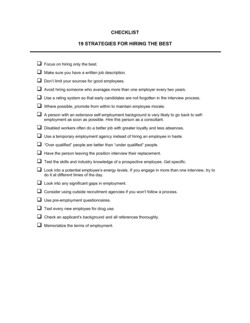
19 Strategies for Hiring the Best Checklist Template
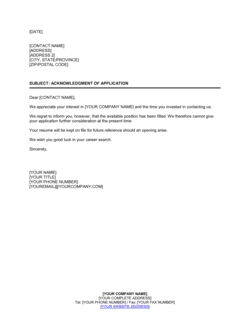
Acknowledgment of Application — Job Position Filled
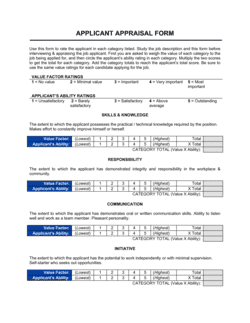
Applicant Appraisal Form Evaluation Template
Applicant Appraisal Form Questions Template
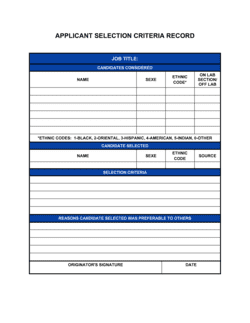
Applicant Selection Criteria Record Template
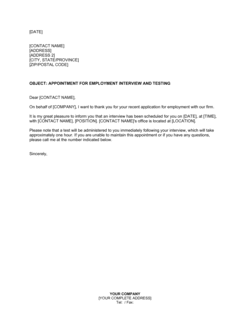
Appointment For Employment Interview And Testing
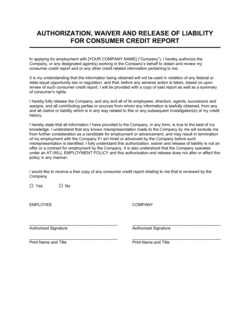
Authorization Waiver and Release for Employee Credit
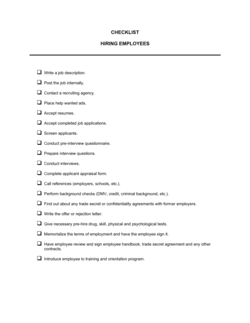
Checklist Hiring Employees Template
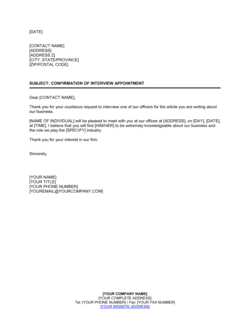
Confirmation of Interview Appointment Template
Decline to Interview Referred Job Applicant Template
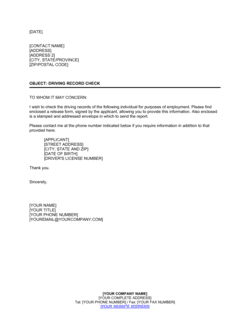
Driving Record Check Letter Template
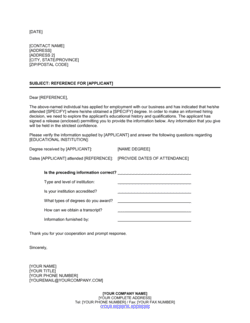
Educational Reference Check Letter Template
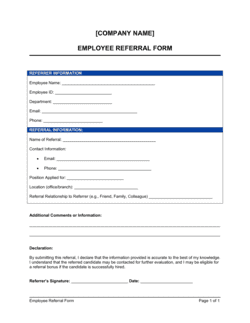
Employee Referral Form Template
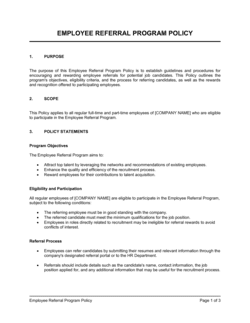
Employee Referral Program Policy Template
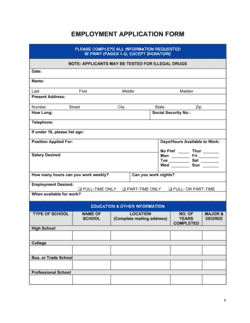
Employment Application Form Template
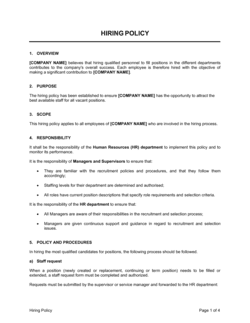
Hiring Policy Template
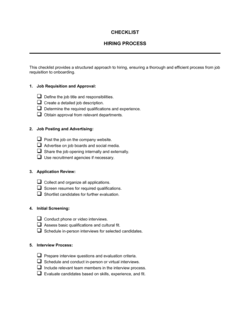
Hiring Process Checklist Template
How To Create A Staffing Plan Template
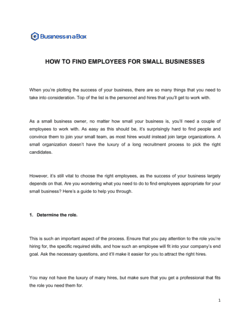
How To Find Employees For Small Business Template
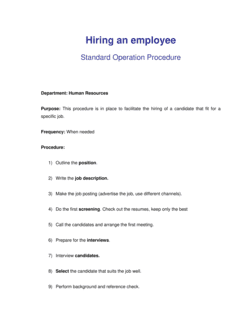
How to Hire an Employee Template
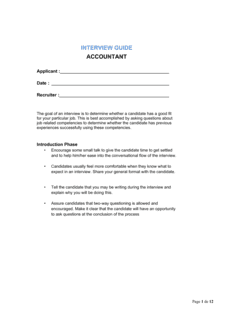
Interview Guide Accountant Template
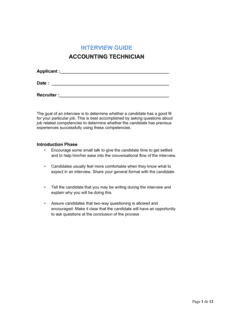
Interview Guide Accounting Technician Template
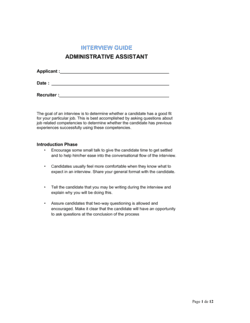
Interview Guide Administrative Assistant Template
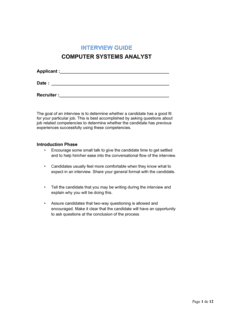
Interview Guide Computer Systems Analyst Template
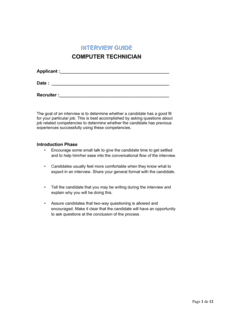
Interview Guide Computer Technician Template
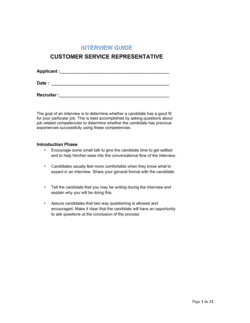
Interview Guide Customer Service Representative
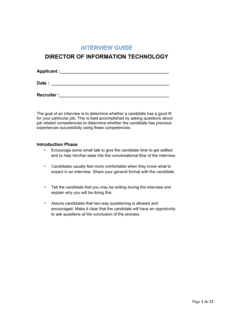
Interview Guide Director of Information Technology
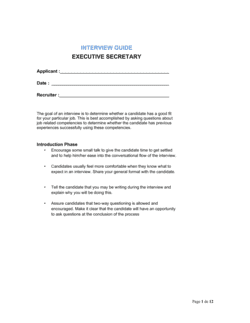
Interview Guide Executive Secretary Template
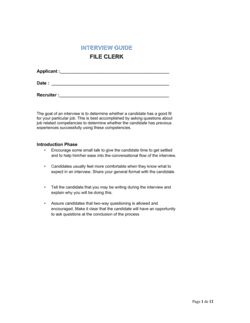
Interview Guide File Clerk Template
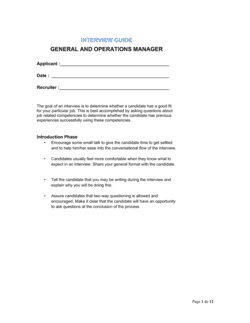
Interview Guide General and Operations Manager
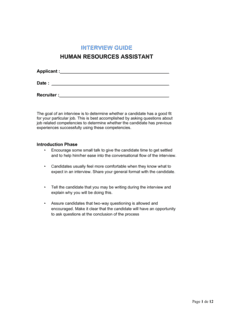
Interview Guide HR Assistant Template
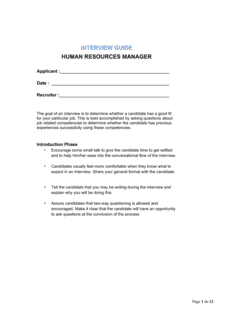
Interview Guide Human Resources Manager Template
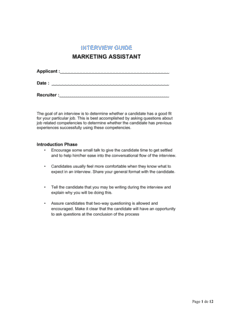
Interview Guide Marketing Assistant Template
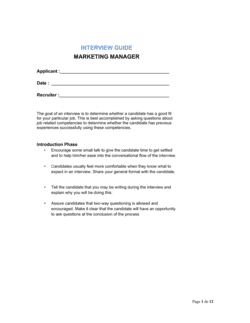
Interview Guide Marketing Manager Template
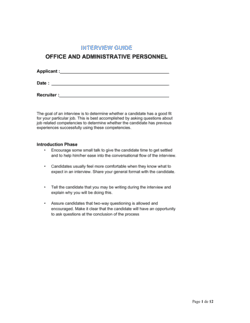
Interview Guide Office And Administrative Personnel
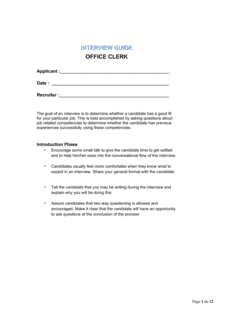
Interview Guide Office Clerk Template
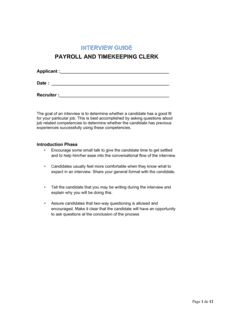
Interview Guide Payroll and Timekeeping Clerk Template
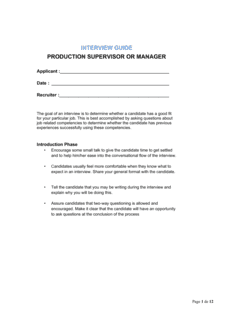
Interview Guide Production Supervisor or Manager
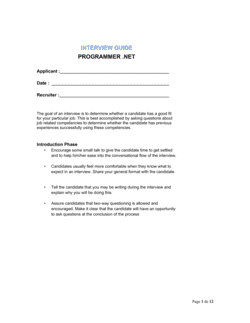
Interview Guide Programmer .NET Template
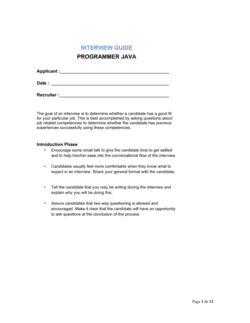
Interview Guide Programmer Java Template
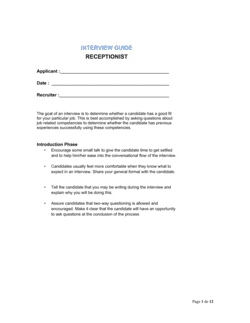
Interview Guide Receptionist Template
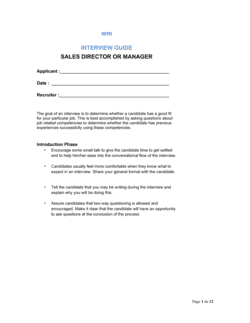
Interview Guide Sales Director or Manager Template
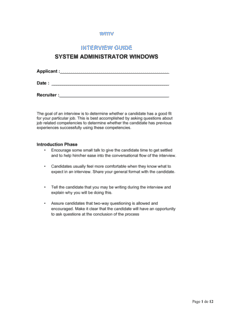
Interview Guide System Administrator Windows Template
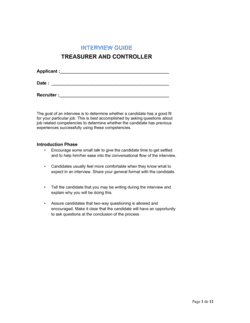
Interview Guide Treasurer and Controller Template
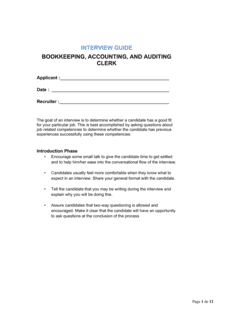
Interview Guide: Bookkeeping, Accounting & Auditing
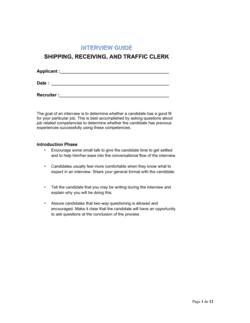
Interview Guide: Shipping, Receiving & Traffic Clerk
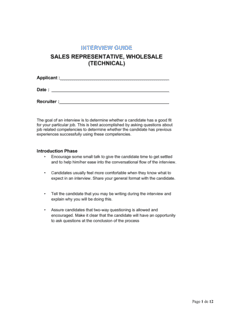
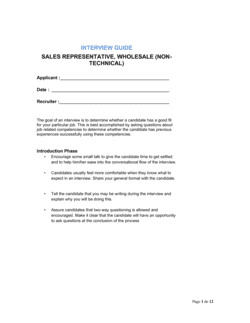
Interview Guide: Technical Sales Rep Wholesale
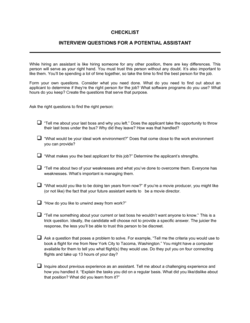
Interview Questions For A Potential Assistant
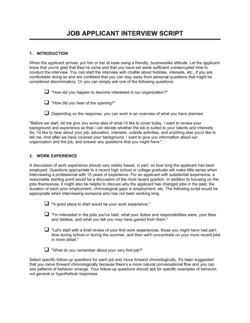
Job Applicant Interview Script Template
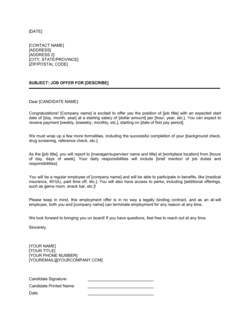
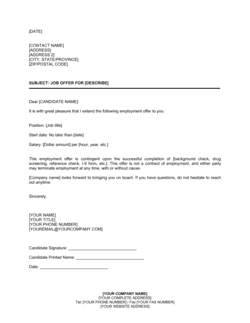
Job Offer Letter Template
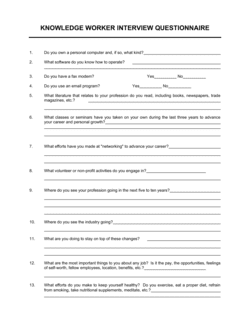
Knowledge Worker Interview Questionnaire Template
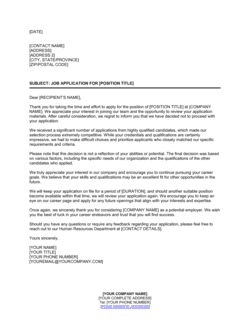
Letter of Rejection for Job Applicant Template
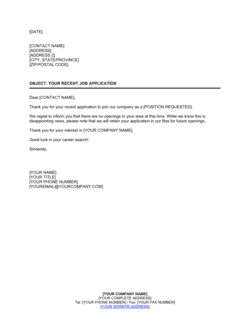
Negative Response No Opening Template
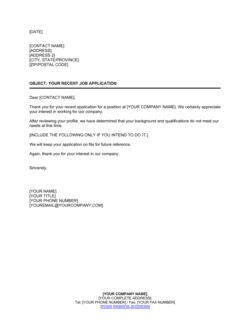
Negative Response Qualifications Template
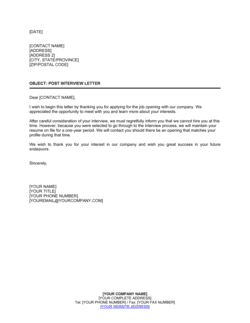
Negative Response To Job Candidate Post-Interview
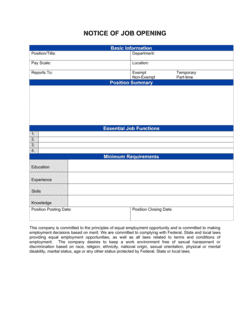
Notice of Job Opening Form Template
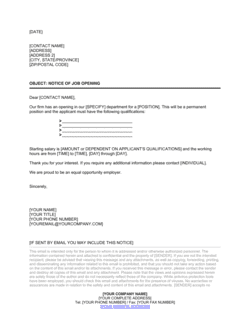
Notice Of Job Opening Letter Template
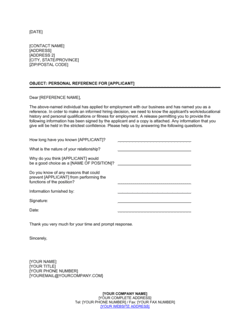
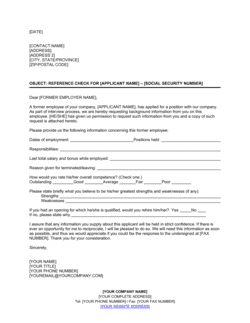
Personal Reference Check Letter Template
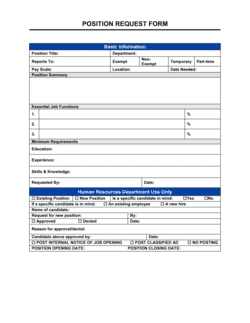
Position Request Form Template
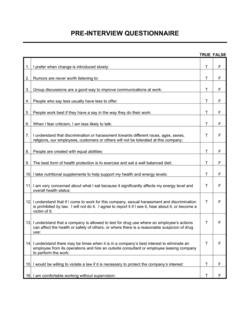
Pre Interview Questionnaire Template
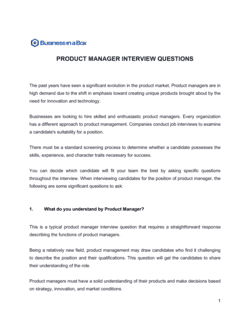
Product Manager Interview Questions Template
Questions To Avoid During An Interview Template
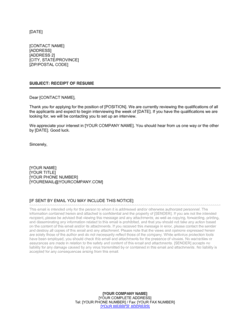
Receipt of Resume Template
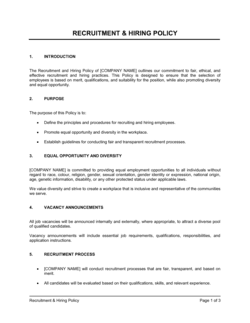
Recruitment And Hiring Policy Template
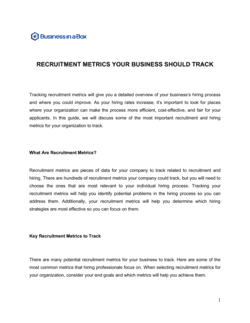
Recruitment Metrics Template
XLS
Recruitment Tracker Template
Reference Check Letter Template
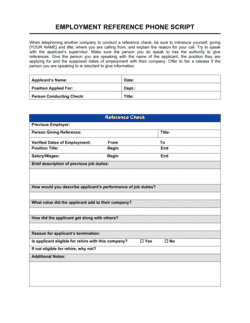
Reference Check Phone Script Template
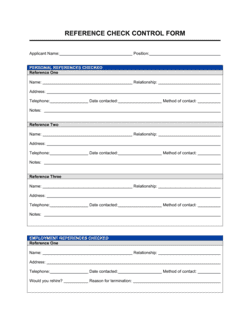
Reference Checking Form Template
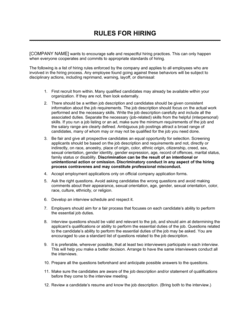
Rules For Hiring Template
Sales Rep Interview Guide Wholesale
Simple Job Offer Letter Template
Staffing Plan Template
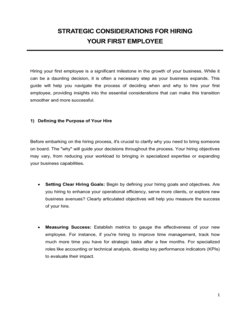
Strategic Considerations for Hiring Your First
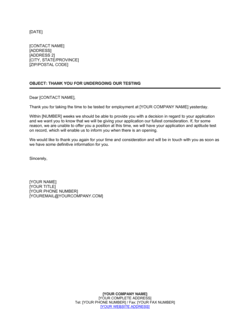
Thank You To Applicant For Testing Template
250K+Clients
20M+Free users
20+Years
190+Countries
10,000+Law firms
50M+Downloads

Trusted across review platforms

  • Capterra★★★★☆4.649 reviews
  • G2★★★★☆4.713 reviews
  • GetApp★★★★☆4.649 reviews
  • Google Play★★★★☆4.6179 ratings
  • Google Reviews★★★★☆4.567 reviews

Related categories

Frequently asked questions

What documents do I need to hire my first employee?
At minimum you need a hiring policy, a job description, and an offer letter. A hiring checklist helps ensure you do not miss steps like background checks, I-9 verification, or payroll setup. The Strategic Considerations For Hiring Your First Employee template is specifically designed to walk first-time employers through these requirements before any commitment is made.
Do I need a formal recruitment policy if I only have a few employees?
Yes, even small employers benefit from a written policy. A documented hiring process protects against discrimination claims by showing that candidates were evaluated on consistent criteria. It also ensures that whoever conducts the hire — an owner, an office manager, or a newly promoted team lead — follows the same steps every time.
What should a job description include?
A job description should include the job title, department, reporting relationship, a summary of the role, a list of key responsibilities, minimum qualifications (education, experience, and skills), preferred qualifications, compensation range (where required by law or custom), and the physical or remote work requirements. Business in a Box job description templates include all of these sections with placeholder language ready to customize.
Can I use job description templates for performance reviews?
Yes. A well-written job description doubles as a performance management tool because it defines exactly what the role is responsible for. Many HR teams attach the job description to annual review forms so managers assess employees against the stated duties and qualifications they were hired to fulfill.
What is the difference between a hiring checklist and a hiring process checklist?
The Checklist Hiring Employees focuses on screening and evaluating individual candidates — verifying qualifications, checking references, and comparing applicants. The Checklist Hiring Process covers the full operational workflow of a hire from requisition approval through onboarding, ensuring no administrative step is skipped.
Are these hiring templates compliant with employment law?
The templates are drafted to reflect widely accepted HR best practices and include standard equal-opportunity and non-discrimination language. However, employment law varies by country, state, and industry. Consider having a qualified employment lawyer review any hiring policy or job description before it is used, particularly for regulated industries or cross-border hires.
How often should a hiring policy be updated?
Review your hiring policy at least once a year, and immediately after any change in applicable employment law, a significant expansion in headcount, or a hiring-related incident or complaint. Outdated policies that conflict with current law can expose an employer to greater liability than having no policy at all.
Can I use a notice of job opening to meet internal posting requirements?
Yes. Some employment agreements, union contracts, and jurisdictions require employers to post openings internally before going to external candidates. The Notice of Job Opening templates — both letter and form versions — are designed to satisfy that requirement and create a dated record of the posting.

Recruiting and Hiring vs. related documents

Recruitment and Hiring Policy vs. Hiring Policy

A Recruitment and Hiring Policy is a comprehensive document that covers the entire talent acquisition lifecycle — requisition, sourcing, interviewing, offers, and compliance. A Hiring Policy is a shorter, more accessible ruleset suited to smaller organizations. Use the full policy when you need board-level or audit-ready documentation; use the shorter version when you need a practical guide that managers will actually read and follow.

Job description vs. job posting

A job description is an internal document that defines role responsibilities, required qualifications, and reporting relationships — it lives in HR files and forms the basis for performance reviews. A job posting is the candidate-facing advertisement derived from the job description, written to attract applicants. Business in a Box job description templates serve both purposes: use them internally and adapt them for public posting.

Hiring checklist vs. hiring policy

A hiring policy sets the rules — who approves headcount, which steps are mandatory, how decisions are documented. A hiring checklist is the operational tool used to execute those rules for each individual hire. Both are necessary: the policy sets the standard; the checklist ensures it is followed every time.

Notice of Job Opening (Letter) vs. Notice of Job Opening (Form)

The letter format is a written communication sent to current employees or posted on bulletin boards to announce an open position in narrative form. The form format provides a structured template with fillable fields, better suited for HR records, shared drives, or systems that require uniform data entry. Choose the letter for human communication and the form for process documentation.

Key clauses every Recruiting and Hiring contains

Whether you are drafting a hiring policy or a job description, every recruiting and hiring document shares a common set of structural elements that make it enforceable, useful, and legally defensible.

  • Scope and applicability. States which roles, departments, or employment types the document applies to, preventing ambiguity when edge cases arise.
  • Equal opportunity and non-discrimination statement. Confirms the organization's commitment to hiring without regard to protected characteristics, required in most jurisdictions.
  • Approval and authorization requirements. Specifies who must sign off on a new hire — typically the hiring manager, HR, and a budget authority.
  • Role responsibilities. Lists the primary duties and accountabilities of the position, forming the basis for performance evaluation later.
  • Minimum qualifications. Defines the education, experience, certifications, or skills required to be considered for the role.
  • Interview and selection process. Outlines the steps between application receipt and offer — screening, assessments, panel interviews, reference checks.
  • Background check requirements. States whether background, credit, or reference checks are required and under what conditions they apply.
  • Offer and acceptance procedure. Describes how verbal or written offers are made, what they must contain, and what constitutes formal acceptance.
  • Confidentiality of candidate information. Requires all interviewers and HR staff to keep applicant data private and limits who may access it.

How to build a recruiting and hiring process

A structured hiring process reduces time-to-fill, limits legal risk, and produces better hires — here is how to build one using the templates in this folder.

  1. 1

    Set your hiring policy first

    Define approval authorities, budget thresholds, and mandatory steps before any individual hire begins, using the Recruitment and Hiring Policy or Hiring Policy template.

  2. 2

    Write the job description

    Use a role-specific job description template to document responsibilities, required qualifications, and reporting lines for every open position.

  3. 3

    Post the opening formally

    Issue a Notice of Job Opening — in letter or form format — to communicate the vacancy internally before going external.

  4. 4

    Screen candidates against defined criteria

    Use the Checklist Hiring Employees to evaluate every applicant against the same set of qualifications and eliminate subjective bias.

  5. 5

    Conduct structured interviews

    Document interview questions and scoring criteria in advance so all candidates are evaluated on the same dimensions.

  6. 6

    Check references and run required background checks

    Follow the background check requirements in your policy and document results consistently for every finalist.

  7. 7

    Extend the offer using an authorized process

    Follow your policy's offer and acceptance procedure, confirm compensation and start date in writing, and retain signed copies.

  8. 8

    Audit and improve after each hire

    Review the completed checklist after each hire to identify steps that slowed the process or produced inconsistent results.

At a glance

What it is
Recruiting and hiring documents are the policies, checklists, job descriptions, and notices that govern how an organization finds, evaluates, and brings on new employees. Together they create a repeatable, legally defensible hiring process that treats every candidate consistently.
When you need one
Any time you open a new role, revise an existing one, or need to document your hiring standards for compliance or audit purposes, you need these templates in place before the process begins — not after.

Which Recruiting and Hiring do I need?

The right template depends on where you are in the hiring cycle — setting policy, posting a role, screening candidates, or documenting the process. Pick the scenario that matches your immediate need.

Your situation
Recommended template

Building a formal company-wide recruitment policy from scratch

Covers the full policy lifecycle from requisition approval through offer acceptance.

Creating a simpler internal ruleset for a small or growing team

Streamlined format suited to SMBs that need structure without legal complexity.

Tracking every step of an active hire to avoid missing anything

Step-by-step task list keeps HR and hiring managers aligned throughout.

Posting an open role internally to give current employees first notice

Formal letter format suitable for internal postings or bulletin announcements.

Writing a job description for a new or unfilled position

Structured template with responsibilities, qualifications, and reporting lines.

Hiring your very first employee and unsure where to start

Covers legal, financial, and HR factors before the first offer is made.

Screening and evaluating candidates with a standardized checklist

Keeps evaluation criteria consistent across all applicants and interviewers.

Hiring outside legal counsel and need structured evaluation criteria

Purpose-built questions to assess legal competence and firm fit.

Glossary

Requisition
A formal internal request to fill a position, typically requiring approval from HR and a budget authority before recruiting begins.
Job description
An internal document listing a role's responsibilities, qualifications, and reporting relationships, used for hiring and performance management.
Job posting
The candidate-facing advertisement for an open role, derived from the job description and published on job boards or internally.
Screening
The initial review of applications to determine which candidates meet the minimum qualifications for a role.
Structured interview
An interview format where every candidate is asked the same predetermined questions and scored on the same criteria.
Background check
A verification of a candidate's criminal record, employment history, education, or credit, conducted before a conditional offer becomes final.
Reference check
Contact with a candidate's former employers or colleagues to verify work history and assess past performance.
Offer letter
A written document extending employment to a selected candidate and stating the agreed compensation, start date, and key conditions.
At-will employment
An employment arrangement, common in the US, where either party may end the relationship at any time without cause, unless a contract says otherwise.
Equal opportunity employer (EOE)
A designation indicating that an employer does not discriminate based on race, sex, age, religion, disability, or other protected characteristics.
Onboarding
The process of integrating a new hire into the organization — completing paperwork, setting up systems, and introducing them to their role and team.
Headcount approval
Authorization from finance or senior leadership to add a new position to the organization's payroll budget.

What is a recruiting and hiring document?

A recruiting and hiring document is any policy, checklist, job description, or notice that governs how an organization identifies, evaluates, and selects new employees. These documents work as a system: a hiring policy sets the rules, job descriptions define what each role requires, checklists ensure every step is completed, and job opening notices communicate vacancies to internal or external candidates. Together they transform an ad hoc activity into a repeatable, auditable process.

The category spans a wide range of document types. At the policy level, a Recruitment and Hiring Policy or Hiring Policy establishes who can approve new headcount, what steps are mandatory, and how decisions must be documented. At the operational level, checklists and job descriptions translate those policies into daily practice. Job description templates — for roles from CEO to Barista — give hiring managers a consistent format for communicating responsibilities and qualifications, both internally and in public postings.

When you need a recruiting and hiring template

Every time you open a role, you need the right documents ready before the process starts — not assembled on the fly while candidates are waiting. A missing policy creates legal exposure; a vague job description attracts the wrong applicants; a skipped checklist step can delay a start date or create a compliance gap.

Common triggers:

  • Writing or updating job descriptions for new or existing roles
  • Posting an open position internally before advertising externally
  • Building a formal hiring policy ahead of a growth phase or audit
  • Standardizing your screening and interview process across multiple managers
  • Hiring your first employee and needing to understand the legal and HR requirements
  • Onboarding an HR coordinator or recruiter who needs documented procedures to follow
  • Responding to a discrimination complaint that requires proof of a consistent process

The cost of unstructured hiring is rarely visible until something goes wrong — a wrongful-hiring claim, a failed background check that was skipped, or a candidate who accepted an offer based on a role that doesn't match what they were told. Using standardized templates from the first interaction to the signed offer letter closes those gaps before they become problems.

Award-winning platform

  • Great Place to Work 2025
  • BIG Award — Product of the Year 2025
  • Smartest Companies 2025
  • Global 100 Excellence 2026
  • Best of the Best 2025

Create your document in 3 simple steps.

From template to signed document — all inside one Business Operating System.
1
Download or open template

Access over 3,000+ business and legal templates for any business task, project or initiative.

2
Edit and fill in the blanks with AI

Customize your ready-made business document template and save it in the cloud.

3
Save, Share, Send, Sign

Share your files and folders with your team. Create a space of seamless collaboration.

Save time, save money, and create top-quality documents.

★★★★★

"Fantastic value! I'm not sure how I'd do without it. It's worth its weight in gold and paid back for itself many times."
Managing Director · Mall Farm
Robert Whalley
Managing Director, Mall Farm Proprietary Limited
★★★★★

"I have been using Business in a Box for years. It has been the most useful source of templates I have encountered. I recommend it to anyone."
Business Owner · 4+ years
Dr Michael John Freestone
Business Owner
★★★★★

"It has been a life saver so many times I have lost count. Business in a Box has saved me so much time and as you know, time is money."

Owner · Upstate Web
David G. Moore Jr.
Owner, Upstate Web

Run your business with a system — not scattered tools

Stop downloading documents. Start operating with clarity. Business in a Box gives you the Business Operating System used by over 250,000 companies worldwide to structure, run, and grow their business.

Free Forever Plan · No credit card required