Checklist Hiring Process

Free download β€’ Use as a template β€’ Print or share

2 pagesβ€’20–25 min to useβ€’Difficulty: Standard
Learn more ↓
FreeChecklist Hiring Process Template

At a glance

What it is
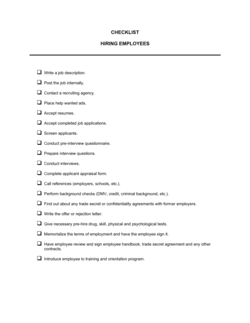
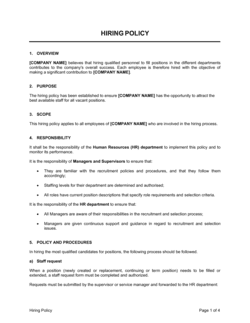
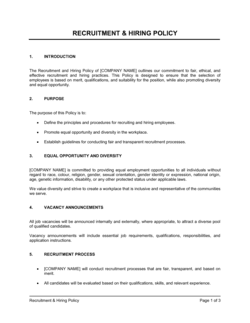
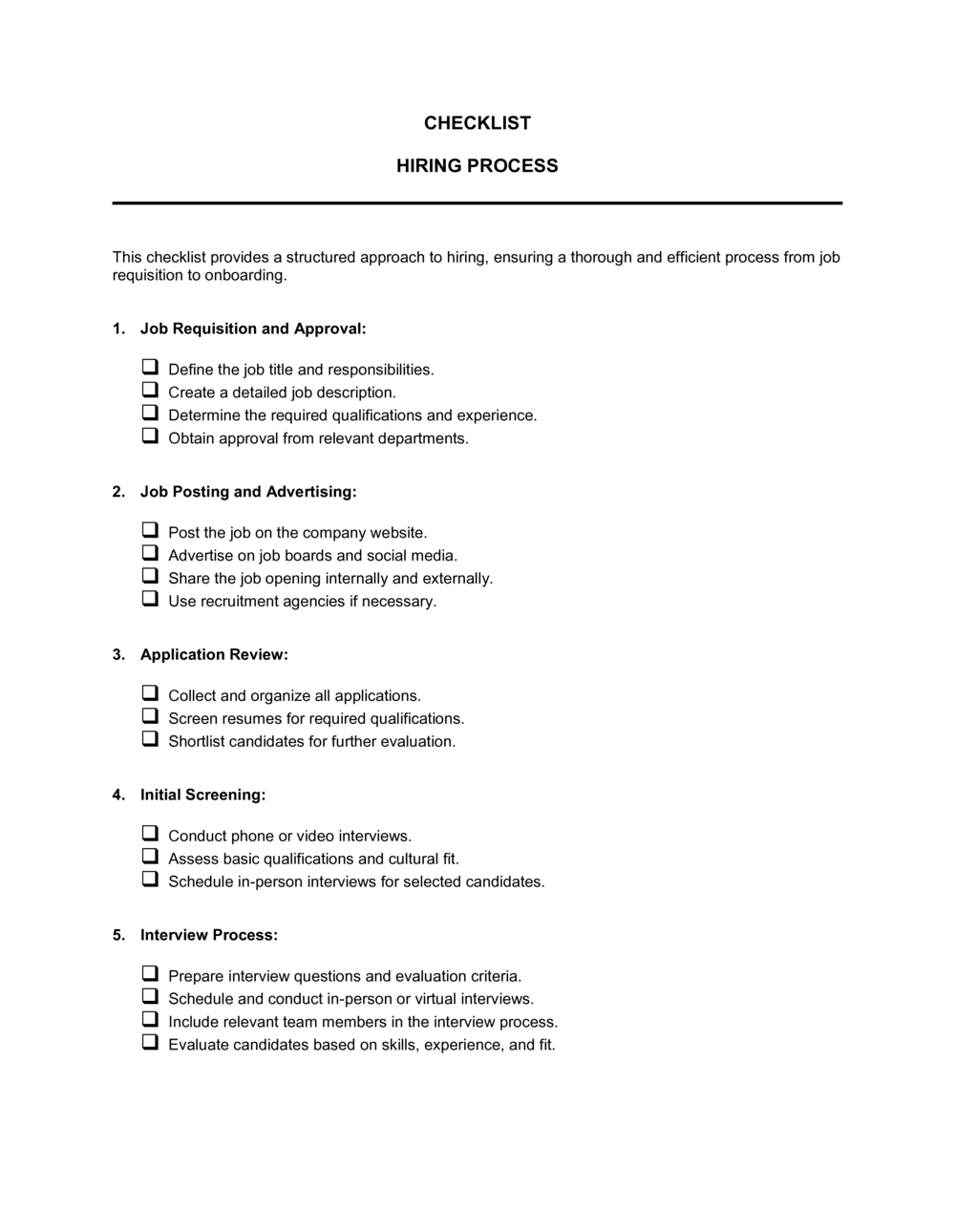
A Hiring Process Checklist is a structured form that guides hiring managers and HR teams through every stage of recruiting β€” from writing the job description to completing the new-hire's first-day paperwork. This free Word download lets you customize each stage, assign owners, and track completion status for every open role.
When you need it
Use it whenever you open a new position or backfill a role. It ensures no step is missed across sourcing, screening, interviewing, offer, and onboarding β€” even when multiple people share recruiting responsibilities.
What's inside
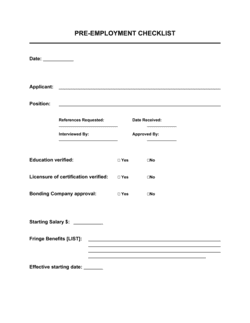
Job requisition approval, job posting details, candidate screening log, interview scheduling tracker, reference check record, offer letter status, background check confirmation, and onboarding task list β€” all in a single printable or digital form.

What is a Hiring Process Checklist?

A Hiring Process Checklist is a structured form that tracks every step of recruiting a new employee β€” from opening a job requisition through posting, screening, interviewing, extending an offer, and completing pre-start onboarding tasks. It assigns a named owner and completion status to each step, turning a process that typically spans 15 to 25 tasks across multiple departments into a single, manageable document. This free Word download lets you customize stages to match your company's workflow and reuse it for every open role.

Why You Need This Document

Without a documented hiring process, steps get missed β€” background checks are initiated after offers are signed, onboarding paperwork lands on a new hire's desk on their first morning, or a role is posted before the job description is approved. Each gap costs time, creates legal exposure, or damages your employer brand with the candidates you most want to hire. A consistent checklist also produces sourcing and pipeline data β€” which channels generated qualified candidates, how long each stage took β€” that makes the next hire faster and cheaper. This template gives you the structure to run a professional recruiting process from day one, whether you are making your third hire or your thirtieth.

Which variant fits your situation?

If your situation is…Use this template
Tracking a single candidate through all hiring stagesCandidate Evaluation Form
Comparing multiple candidates against consistent criteriaInterview Scoring Sheet
Documenting a structured job offerJob Offer Letter
Formalizing employment terms after the offer is acceptedEmployment Contract
Completing first-day and first-week onboarding tasksEmployee Onboarding Checklist
Logging performance during a probationary periodEmployee Probation Review Form
Documenting job duties before posting the roleJob Description Template

Common mistakes to avoid

❌ Skipping the requisition approval step

Why it matters: Starting a search without budget sign-off means you may advance candidates to offer stage only to have the role frozen, damaging your employer brand.

Fix: Treat a signed requisition as a hard gate β€” do not post the role externally until approval is confirmed and logged on the checklist.

❌ Not recording decline reasons in the candidate log

Why it matters: Blank decline fields create compliance exposure if a candidate later alleges discriminatory screening, leaving you with no documented rationale.

Fix: Write a single factual, qualification-based sentence for every decline β€” 'required 5 years of experience; candidate had 2' is sufficient.

❌ Extending a formal offer before the background check clears

Why it matters: An unconditional written offer that you later rescind due to a background check result can expose the company to a wrongful-offer claim in some jurisdictions.

Fix: Issue only a conditional offer letter that explicitly states employment is subject to satisfactory background check results before the check is complete.

❌ Leaving onboarding tasks until the new hire's first day

Why it matters: A new employee who cannot access systems or get equipment on day one loses a full productive day and immediately questions the organization's competence.

Fix: Build a two-business-day buffer into the checklist β€” all system access and equipment should be confirmed ready before the start date, not on it.

The 9 key fields, explained

Position and requisition details

Job description status

Posting channels log

Candidate screening log

Interview schedule and panel

Reference check record

Background check status

Offer details and acceptance

Onboarding task completion

How to fill it out

  1. 1

    Complete the requisition and role details

    Fill in the job title, department, requisition number, and hiring manager before any other step. Confirm budget approval is on file.

    πŸ’‘ Assign a req number using YYYY-NNN format β€” it ties every downstream document (offer letter, contract) to a single trackable record.

  2. 2

    Confirm the job description is approved

    Check the box only after the JD has been reviewed by the hiring manager and, where applicable, an HR business partner. Log the approver's name and date.

    πŸ’‘ A finalized JD before posting reduces mid-process scope changes that frustrate candidates and interviewers alike.

  3. 3

    Log each posting channel with the date

    Record every channel used β€” job boards, internal postings, agencies, and employee referral programs β€” with the post date and the URL or contact name.

    πŸ’‘ Track cost-per-channel if you use paid postings; even one hiring cycle of data helps you cut underperforming sources next time.

  4. 4

    Update the candidate log after each screening

    Record each applicant's name, application date, screen outcome, and a one-line reason for the decision β€” advance or decline β€” immediately after the call.

    πŸ’‘ Brief, factual decline reasons ('did not meet minimum years of experience') protect you far more than a blank field if a hiring decision is ever questioned.

  5. 5

    Assign interviewers and competency areas before scheduling

    Map each interview round to specific competencies before booking. Assign different areas to each panelist so the debrief produces complementary, not redundant, feedback.

    πŸ’‘ A 30-minute pre-brief where panelists agree on must-have versus nice-to-have criteria cuts debrief time by half.

  6. 6

    Initiate background checks before issuing a written offer

    Log the provider, checks ordered, and initiation date. Note any flags and confirm results are clear β€” or cleared per your policy β€” before sending the offer letter.

    πŸ’‘ Make offers contingent on background check completion using conditional language in the offer letter to protect your position if results come back problematic.

  7. 7

    Record offer details and track acceptance

    Log the offer date, salary, start date, and expiry. Update the field immediately when the candidate accepts, declines, or counter-offers.

    πŸ’‘ A 48–72 hour offer expiry is standard for most roles; extending it indefinitely stalls other candidates in your pipeline unnecessarily.

  8. 8

    Complete onboarding tasks before the start date

    Work through every onboarding item β€” paperwork, system access, equipment β€” and mark each complete at least two business days before the new hire's first day.

    πŸ’‘ Send the new hire a short welcome email on their last day before starting that confirms their schedule, parking or access instructions, and who to ask for on arrival.

Frequently asked questions

What is a hiring process checklist?

A hiring process checklist is a structured form that tracks every step of recruiting a new employee β€” from requisition approval and job posting through candidate screening, interviewing, reference and background checks, offer, and onboarding. It ensures no step is skipped, assigns accountability to specific team members, and creates a documented record for each open role.

Why should I use a hiring checklist instead of tracking from memory?

Hiring involves 15 to 25 distinct steps across multiple people β€” HR, the hiring manager, IT, payroll, and legal. Missing a single step, such as initiating a background check or sending an offer expiry date, can delay a start date by days or create legal exposure. A checklist externalizes the process so no one person has to hold it in their head.

What stages should a hiring process checklist cover?

A complete checklist covers six stages: requisition and role approval, job posting and sourcing, candidate screening and tracking, interview scheduling and panel coordination, offer and background check, and onboarding task completion. Each stage should have named owners and completion dates, not just checkboxes.

Who is responsible for completing the hiring checklist?

Responsibility is shared. HR typically owns requisition approval, posting channels, background checks, and onboarding paperwork. The hiring manager owns job description sign-off, interview coordination, and final candidate selection. Assigning each field a named owner β€” not just a department β€” eliminates the most common source of delays.

Can I use this checklist for both new positions and backfills?

Yes. The checklist applies to any open role, regardless of whether it is new headcount or a replacement hire. For backfills, add a field for the departing employee's last day to help coordinate onboarding timing so there is minimal knowledge-transfer gap between the outgoing and incoming employee.

How does a hiring process checklist differ from an onboarding checklist?

A hiring process checklist spans from requisition to offer acceptance β€” it documents the recruiting and selection workflow. An onboarding checklist starts after the offer is accepted and covers first-day and first-week integration tasks. The hiring checklist's final section overlaps with early onboarding tasks, but a dedicated onboarding checklist covers the full 30 to 90-day ramp in more detail.

How many candidates should I track per role?

Track every candidate who reaches the screening stage β€” not just those who advance. Maintaining a complete log of all screened applicants, including those declined early, gives you sourcing data (which channels produced the most qualified candidates) and a defensible record of the full applicant pool if the hiring decision is ever reviewed.

How this compares to alternatives

vs Job Offer Letter

A job offer letter is the document sent to a candidate to formally extend an offer with salary and start date. The hiring checklist is the operational form that tracks when the offer letter was sent, whether it was accepted, and every step before and after. The checklist manages the process; the offer letter is one artifact produced by it.

vs Employee Onboarding Checklist

An onboarding checklist covers the 30 to 90-day integration period after a new hire accepts an offer. The hiring process checklist covers everything from requisition to offer acceptance. The two documents are sequential β€” the hiring checklist closes when the onboarding checklist opens.

vs Job Description Template

A job description defines the responsibilities, qualifications, and expectations for a role. The hiring checklist references the job description as one early-stage deliverable it tracks for approval status. The job description is input to the hiring process; the checklist is the management tool that runs the process.

vs Employment Contract

An employment contract is the legally binding agreement signed by the new hire before their start date. The hiring checklist tracks when the contract was sent and countersigned as a late-stage task. The checklist is a coordination tool; the contract is a legal document with enforceable obligations.

Industry-specific considerations

Technology / SaaS

Multi-round technical interviews, take-home assessments, and fast-moving pipelines where candidate drop-off between stages needs to be tracked precisely.

Healthcare

Credentialing and license verification steps added alongside standard background checks, with mandatory compliance sign-offs before clinical staff begin work.

Retail / Hospitality

High-volume, fast-cycle hiring where the checklist must handle dozens of simultaneous candidates with minimal HR overhead per role.

Professional Services

Reference checks are especially critical given client-facing roles; conflict-of-interest disclosures and non-solicit agreements are tracked alongside standard offer steps.

Template vs pro β€” what fits your needs?

PathBest forCostTime
Use the templateSmall businesses, startups, and hiring managers running recruiting without a dedicated HR systemFree10 minutes to set up per role
Template + professional reviewCompanies adding role-specific compliance steps, multi-jurisdiction background checks, or EEO documentation fields$100–$300 (HR consultant review)Half a day
Custom draftedEnterprises integrating the checklist into an ATS, HRIS, or compliance workflow with automated task assignment$500–$2,000+ (HR systems configuration)1–2 weeks

Glossary

Job Requisition
An internal approval request to open a new or backfill position, typically including budget sign-off and a target start date.
Applicant Tracking
The process of logging each candidate's application status, contact details, and stage in the hiring pipeline.
Screening Interview
A short initial conversation β€” typically 15–30 minutes by phone or video β€” used to confirm basic qualifications before advancing a candidate.
Interview Panel
Two or more interviewers who collectively assess a candidate, each assigned specific competency areas to evaluate.
Reference Check
A structured conversation with a candidate's former manager or colleague to verify employment history and assess past performance.
Background Check
A third-party verification of a candidate's criminal record, employment history, education credentials, and sometimes credit history.
Offer Letter
A written document extending a job offer that states the role, start date, salary, and key conditions of employment.
Onboarding
The structured process of integrating a new hire into the organization β€” covering paperwork, system access, training, and introductions.
Time-to-Fill
The number of calendar days between opening a requisition and a candidate accepting an offer, used as a recruiting efficiency metric.
Candidate Pipeline
The pool of active applicants at each stage of a hiring process, from applied through offer-accepted.

Part of your Business Operating System

This document is one of 3,000+ business & legal templates included in Business in a Box.

  • Fill-in-the-blanks β€” ready in minutes
  • 100% customizable Word document
  • Compatible with all office suites
  • Export to PDF and share electronically

Create your document in 3 simple steps.

From template to signed document β€” all inside one Business Operating System.
1
Download or open template

Access over 3,000+ business and legal templates for any business task, project or initiative.

2
Edit and fill in the blanks with AI

Customize your ready-made business document template and save it in the cloud.

3
Save, Share, Send, Sign

Share your files and folders with your team. Create a space of seamless collaboration.

Save time, save money, and create top-quality documents.

β˜…β˜…β˜…β˜…β˜…

"Fantastic value! I'm not sure how I'd do without it. It's worth its weight in gold and paid back for itself many times."

Managing Director Β· Mall Farm
Robert Whalley
Managing Director, Mall Farm Proprietary Limited
β˜…β˜…β˜…β˜…β˜…

"I have been using Business in a Box for years. It has been the most useful source of templates I have encountered. I recommend it to anyone."

Business Owner Β· 4+ years
Dr Michael John Freestone
Business Owner
β˜…β˜…β˜…β˜…β˜…

"It has been a life saver so many times I have lost count. Business in a Box has saved me so much time and as you know, time is money."

Owner Β· Upstate Web
David G. Moore Jr.
Owner, Upstate Web

Run your business with a system β€” not scattered tools

Stop downloading documents. Start operating with clarity. Business in a Box gives you the Business Operating System used by over 250,000 companies worldwide to structure, run, and grow their business.

Free Forever PlanΒ Β·Β No credit card required