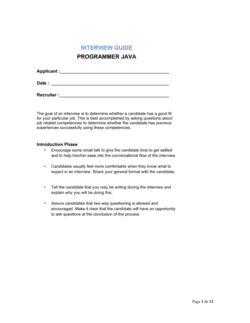
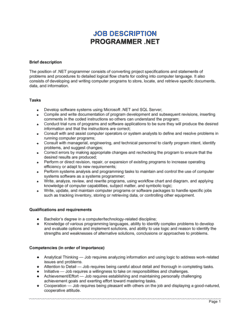
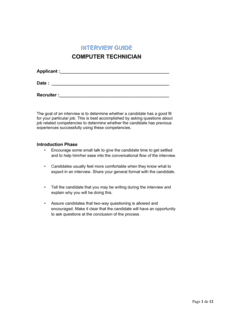
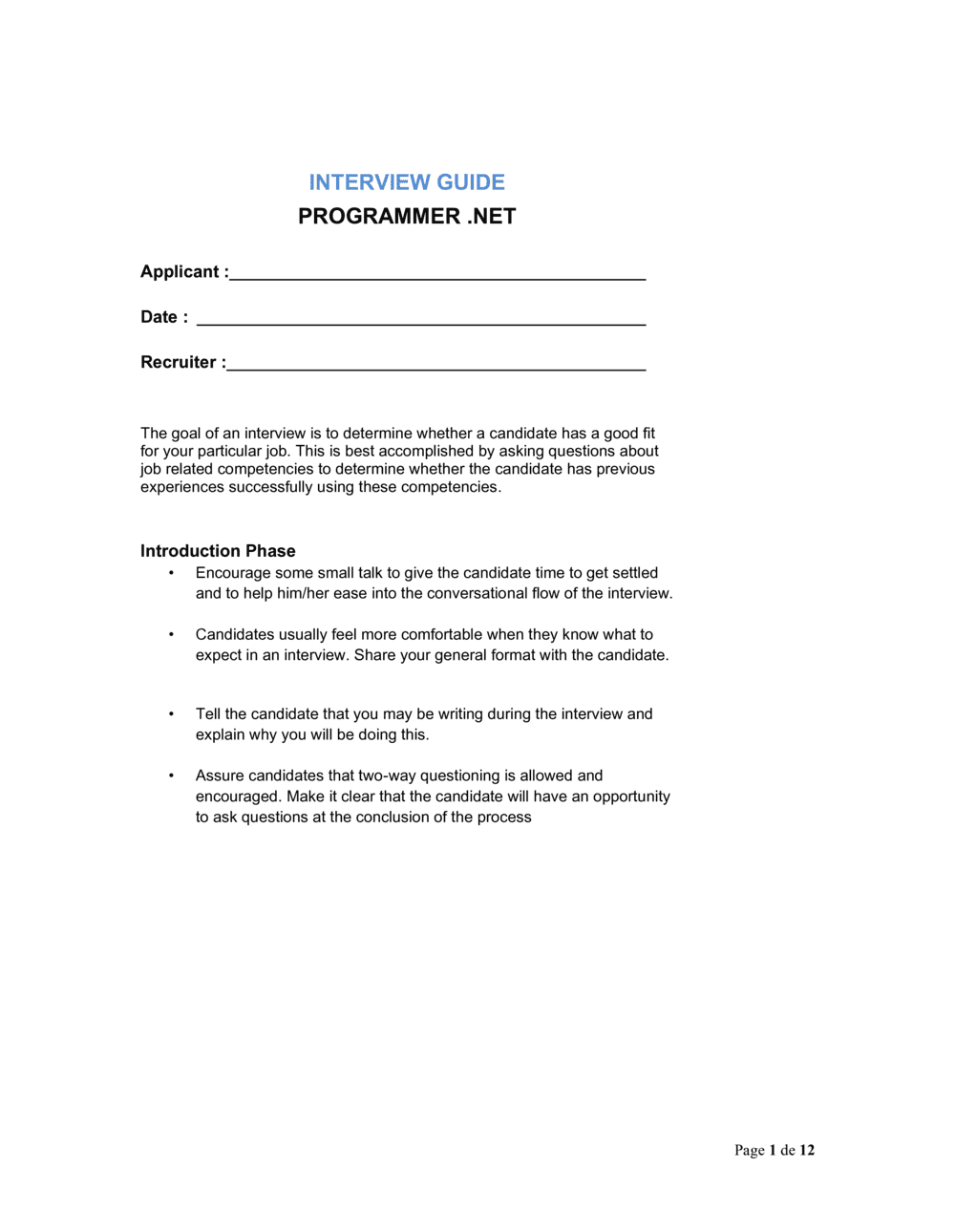
Interview Guide Programmer .Net

Free Word download • Edit online • Save & share with Drive • Export to PDF

12 pages25–30 min to fillDifficulty: Complex
Learn more ↓
FreeInterview Guide Programmer .Net Template

At a glance

What it is
An Interview Guide Programmer .NET is a structured evaluation template interviewers use to assess candidates for .NET developer roles in a consistent, scored format. This free Word download organizes technical questions, competency ratings, and interviewer notes into a single document you can edit online and export as PDF for use across your hiring panel.
When you need it
Use it whenever you are interviewing candidates for a .NET, C#, or ASP.NET developer position and need a repeatable process that produces comparable scores across multiple interviewers or hiring rounds.
What's inside
Candidate and role information, a structured question bank covering C#, ASP.NET, SQL, system design, and soft skills, a numeric scoring rubric for each competency, space for interviewer observations, and a final hire/no-hire recommendation section.

What is an Interview Guide Programmer .NET?

An Interview Guide Programmer .NET is a structured evaluation document that gives interviewers a standardized set of scored questions, a consistent rubric, and a recorded recommendation framework specifically designed for assessing .NET developer candidates. It organizes the interview into distinct technical competency sections — covering C#, ASP.NET, SQL and data access, system design, and behavioral fit — so that every candidate for the same role is evaluated on identical criteria and scores can be meaningfully compared across interviewers. Rather than relying on each interviewer's improvised questions, a completed guide produces a documented, defensible record of exactly how and why a hiring decision was reached.

Why You Need This Document

Unstructured technical interviews produce inconsistent results: one interviewer probes database optimization while another focuses entirely on design patterns, and the hiring committee is left comparing scores that measured different things. The practical cost is concrete — strong candidates get rejected because the interview missed their strengths, weak candidates pass because the session never probed their gaps, and the company repeats the cycle with a new hire who fails within 90 days. A structured .NET interview guide closes these gaps by locking in the competency scope before the first session begins, giving all panel members the same questions and rubric, and requiring a written rationale for every hire or no-hire decision. It also creates an audit trail that protects the organization if a rejected candidate raises a bias complaint. This template gives you a ready-to-use framework you can customize to your stack and seniority level in under 30 minutes.

Which variant fits your situation?

If your situation is…Use this template
Interviewing a senior .NET architect or team leadInterview Guide Senior Developer
Evaluating a junior or entry-level .NET candidateInterview Guide Junior Programmer
Screening a full-stack developer with .NET backend and JavaScript frontendInterview Guide Full-Stack Developer
Conducting a phone or video pre-screen before a technical roundPhone Screen Interview Guide
Assessing a .NET developer for a contract or freelance engagementContractor Technical Interview Guide
Evaluating multiple candidates using a side-by-side comparisonCandidate Comparison Matrix
Conducting a final culture-fit interview after technical rounds are completeBehavioral Interview Guide

Common mistakes to avoid

❌ Skipping the scoring rubric calibration with interviewers

Why it matters: Without calibration, a score of 3 means 'strong' to one interviewer and 'borderline pass' to another. Aggregated panel scores become meaningless and the best candidate may be passed over.

Fix: Hold a 15-minute calibration session before the first candidate interview where all panel members score the same sample answer independently, then compare and align on the rubric.

❌ Asking only theoretical .NET questions with no hands-on component

Why it matters: Candidates who can define dependency injection or LINQ fluently may still be unable to implement them correctly under time pressure — the scenario that matters most on the job.

Fix: Add at least one code-reading or short code-completion exercise to the technical sections. Even a 10-line snippet with a deliberate bug reveals more than five verbal questions.

❌ Treating behavioral questions as lower priority than technical sections

Why it matters: Technical skill predicts what a developer can do in isolation; behavioral questions predict how they perform on a team. Most early-tenure failures trace to collaboration and communication gaps, not technical shortfalls.

Fix: Allocate at least 20% of the total interview time to behavioral questions and score them with the same rigor as technical sections.

❌ Sharing scores with other interviewers before each person has completed their own guide

Why it matters: Anchor bias causes later interviewers to adjust their scores toward the first score they hear, producing a false consensus that obscures genuine disagreement among panelists.

Fix: Require all interviewers to submit completed, signed guides before the debrief meeting begins. Use the debrief to discuss divergent scores, not to build consensus from scratch.

The 9 key sections, explained

Candidate and role information

Role overview and evaluation criteria

Technical screening questions — C# and .NET core

Technical questions — ASP.NET and Web API

Technical questions — data access and SQL

System design and architecture questions

Behavioral and soft-skills questions

Scoring rubric

Overall evaluation summary

How to fill it out

  1. 1

    Customize the role overview before the interview season begins

    Update the role title, key responsibilities, and the list of evaluated competencies to match the specific job description. Share the finalized guide with every interviewer before the first candidate session.

    💡 Pin the competency list to the job description — if the JD changes, update the guide at the same time so interviewers are not evaluating on outdated criteria.

  2. 2

    Complete the candidate and role header before each session

    Fill in the candidate's full name, the interview date, your name as interviewer, and the round number at the top of the form before the candidate enters the room or joins the call.

    💡 Pre-fill everything except the scores and notes before the session starts. A blank header at the top of a submitted form is the most common cause of misfiled interview records.

  3. 3

    Ask each question as written — do not paraphrase

    Structured interviews require that every candidate hears the same question in the same form. Paraphrasing changes the difficulty or scope of the question and invalidates score comparisons.

    💡 If a candidate asks for clarification, read the question again — do not add hints or context that other candidates did not receive.

  4. 4

    Score each answer immediately after it is given

    Record the numeric score and one or two concrete observation notes right after the candidate answers, while the response is fresh. Do not wait until the end of the interview to score all questions at once.

    💡 Write down a specific phrase or fact the candidate said, not just a score. 'Correctly described async/await as syntactic sugar over Task' is more useful than 'knows async' when debrief discussions happen days later.

  5. 5

    Assign the system design section enough time

    Reserve at least 15 minutes for the system design question. Candidates who rush through it without probing produce scores that understate or overstate their actual architecture skills.

    💡 Ask one follow-up probe — 'How would your design change if the load increased 10×?' — to separate candidates who memorized an answer from those who reason in real time.

  6. 6

    Complete the behavioral section before moving to the summary

    Do not skip behavioral questions even if the candidate performed strongly in technical sections. Record a score and at least one observation note per question.

    💡 If a candidate struggles to give a specific past example and speaks only hypothetically, note this explicitly — it is a meaningful data point for the hiring committee.

  7. 7

    Write the evaluation summary and recommendation independently

    Complete the overall summary and hire/no-hire recommendation before discussing the candidate with other interviewers. Independent assessments prevent groupthink during the debrief.

    💡 Set a 5-minute timer after the session ends to write the summary while memory is fresh. Summaries written from memory 24 hours later tend to collapse toward the candidate's first impression rather than their actual performance.

  8. 8

    Submit the completed guide to the hiring manager within 24 hours

    File the completed, signed guide with the hiring manager or recruiter no later than the business day after the interview. Late submissions delay decisions and allow score recollection to degrade.

    💡 Attach the guide as a PDF to the candidate's ATS record immediately after submission so it is retrievable during reference and offer stages.

Frequently asked questions

What is a .NET programmer interview guide?

A .NET programmer interview guide is a structured evaluation document that provides interviewers with a standardized set of technical and behavioral questions, a scoring rubric, and space for observation notes specific to .NET developer roles. It ensures every candidate for a given position is assessed on the same criteria, producing comparable scores that support defensible hiring decisions.

What topics should a .NET developer interview cover?

A complete .NET developer interview typically covers five areas: C# and .NET runtime fundamentals (memory management, async/await, generics), ASP.NET and Web API design, data access and SQL including Entity Framework, system design and architecture reasoning, and behavioral competencies such as handling technical debt and collaborating under pressure. Omitting any of these leaves blind spots that structured guides are specifically designed to close.

How many interviewers should use the guide for a single candidate?

Most .NET hiring processes use two to three technical interviewers plus a hiring manager, each completing their own independent copy of the guide. Having at least two independent technical scorecards reduces the impact of individual interviewer bias and creates a richer data set for the debrief discussion. More than four interviewers per candidate tends to increase scheduling friction without proportionate improvement in signal quality.

Should the same guide be used for junior and senior .NET developers?

No. A junior .NET developer guide should weight C# fundamentals and code-reading exercises more heavily, with lighter system design questions. A senior guide should include architecture trade-off questions, questions about leading code reviews, and discussions of cross-team technical decisions. Using a senior guide for a junior candidate will consistently produce artificially low scores and discourage qualified early-career candidates.

How do I score candidates fairly when interviewers have different technical backgrounds?

Run a rubric calibration session before the interview cycle begins. Provide all interviewers with a sample answer for one technical question and have them score it independently. Discuss the scores and agree on what a 3 versus a 4 looks like in concrete terms. This 15-minute exercise is the single highest-return investment in interview consistency you can make before a hiring round opens.

Can a non-technical HR manager use this guide effectively?

Yes, with preparation. An HR manager can administer the behavioral and soft-skills sections independently. For technical sections, the guide includes expected answer notes that allow a non-technical interviewer to recognize a complete answer even without being able to evaluate depth. For technical depth assessment, pair the HR manager with at least one engineering interviewer who scores the technical sections directly.

What should I do with completed interview guides after a hiring decision is made?

Retain all completed interview guides in the candidate's HR file for at least 12 months — longer in jurisdictions with extended employment discrimination claim windows. Guides document the objective, criteria- based rationale for hire and no-hire decisions and are the primary defense if a rejected candidate raises a bias or discrimination complaint. Never discard them immediately after a decision is made.

How is this guide different from a generic technical interview template?

A generic technical interview template covers broad programming concepts applicable to any language or stack. This guide is scoped specifically to the .NET ecosystem — C#, ASP.NET, Entity Framework, LINQ, and .NET runtime behavior — with question prompts and expected answer notes calibrated to that stack. Using a stack-specific guide reduces the preparation time for interviewers and produces more meaningful scores than a general template adapted on the fly.

How often should the interview guide be updated?

Review the guide at least once per year or whenever the .NET technology stack in your organization changes materially — for example, when migrating from .NET Framework to .NET 6+ or adopting new patterns like minimal APIs. Questions that reference deprecated features or outdated frameworks will penalize candidates who have correctly kept their skills current.

How this compares to alternatives

vs Generic developer interview template

A generic developer interview template covers language-agnostic concepts like data structures and algorithms applicable to any stack. This guide is scoped to the .NET ecosystem specifically, with C#, ASP.NET, and Entity Framework question prompts and rubric notes. Use the generic template for polyglot roles; use this one whenever the position requires .NET-specific production experience.

vs Job application form

A job application form captures a candidate's work history, education, and self-reported skills before an interview occurs. This interview guide is used during the live evaluation session to score observed competency. Both documents are part of the same hiring workflow but serve entirely different stages — application screening happens first, structured interviewing second.

vs Employee performance review template

A performance review evaluates an existing employee's output, growth, and behavior over a defined period. An interview guide evaluates a candidate's potential and skill level before any employment begins. The scoring criteria may overlap on soft skills, but the context, stakes, and timing are entirely different.

vs Offer letter template

An offer letter documents the terms of employment extended to a selected candidate after the hiring decision is made. The interview guide is the evaluation instrument used to reach that decision. The guide feeds the decision; the offer letter communicates it. Both are required for a complete, documented hiring process.

Industry-specific considerations

Software and SaaS

Emphasis on ASP.NET Web API design, microservices architecture, cloud deployment patterns (Azure, AWS), and CI/CD integration familiarity.

Financial Services

Additional questions on data security, high-availability system design, transaction integrity, and compliance-aware coding practices.

Healthcare and MedTech

Evaluation covers HIPAA-aware data handling, HL7/FHIR API integration knowledge, and experience with regulated software development processes.

Manufacturing and Enterprise

Focus on ERP integration (.NET to SAP or Dynamics 365), batch processing, and legacy .NET Framework modernization experience.

Template vs pro — what fits your needs?

PathBest forCostTime
Use the templateHR managers, engineering managers, and recruiters conducting structured .NET developer interviews at any company sizeFree30 minutes to customize per role; 45–90 minutes per candidate session
Template + professional reviewCompanies standardizing a multi-round technical interview process across a hiring panel of three or more interviewers$500–$1,500 for an HR consultant or technical recruiter review3–5 days to calibrate and finalize with a panel
Custom draftedEnterprise engineering organizations with regulated hiring processes, DE&I audit requirements, or large-volume .NET hiring programs$2,000–$8,000 for a structured interview design engagement2–4 weeks

Glossary

.NET Framework / .NET Core
Microsoft's software development platforms for building Windows and cross-platform applications; .NET Core (now simply .NET 5+) is the modern, cross-platform successor to the original .NET Framework.
C#
A strongly-typed, object-oriented programming language developed by Microsoft, and the primary language used in .NET application development.
ASP.NET
A .NET framework for building web applications and APIs, including MVC, Razor Pages, and the RESTful Web API framework.
Entity Framework (EF)
Microsoft's object-relational mapper (ORM) for .NET that enables developers to work with databases using .NET objects instead of raw SQL.
Dependency Injection (DI)
A design pattern in which objects receive their dependencies from an external source rather than creating them internally, improving testability and modularity.
Competency Rating
A numeric or descriptive score assigned to a candidate for a specific skill or behavior, based on observed evidence during the interview.
Structured Interview
An interview format in which every candidate is asked the same predetermined questions in the same order and rated using the same scoring criteria.
LINQ
Language Integrated Query — a .NET feature that enables database-style querying of in-memory collections, XML, and data sources directly in C# syntax.
Behavioral Question
An interview question that asks candidates to describe a past situation to predict future behavior, typically framed as 'Tell me about a time when…'
Panel Interview
An interview conducted by two or more interviewers simultaneously, each completing their own scorecard to produce independent ratings before a consensus discussion.
Hire / No-Hire Recommendation
A binary or tiered final assessment recorded by each interviewer indicating whether the candidate meets the minimum bar for the role.

Part of your Business Operating System

This document is one of 3,000+ business & legal templates included in Business in a Box.

  • Fill-in-the-blanks — ready in minutes
  • 100% customizable Word document
  • Compatible with all office suites
  • Export to PDF and share electronically

Create your document in 3 simple steps.

From template to signed document — all inside one Business Operating System.
1
Download or open template

Access over 3,000+ business and legal templates for any business task, project or initiative.

2
Edit and fill in the blanks with AI

Customize your ready-made business document template and save it in the cloud.

3
Save, Share, Send, Sign

Share your files and folders with your team. Create a space of seamless collaboration.

Save time, save money, and create top-quality documents.

★★★★★

"Fantastic value! I'm not sure how I'd do without it. It's worth its weight in gold and paid back for itself many times."

Managing Director · Mall Farm
Robert Whalley
Managing Director, Mall Farm Proprietary Limited
★★★★★

"I have been using Business in a Box for years. It has been the most useful source of templates I have encountered. I recommend it to anyone."

Business Owner · 4+ years
Dr Michael John Freestone
Business Owner
★★★★★

"It has been a life saver so many times I have lost count. Business in a Box has saved me so much time and as you know, time is money."

Owner · Upstate Web
David G. Moore Jr.
Owner, Upstate Web

Run your business with a system — not scattered tools

Stop downloading documents. Start operating with clarity. Business in a Box gives you the Business Operating System used by over 250,000 companies worldwide to structure, run, and grow their business.

Start free · No credit card required