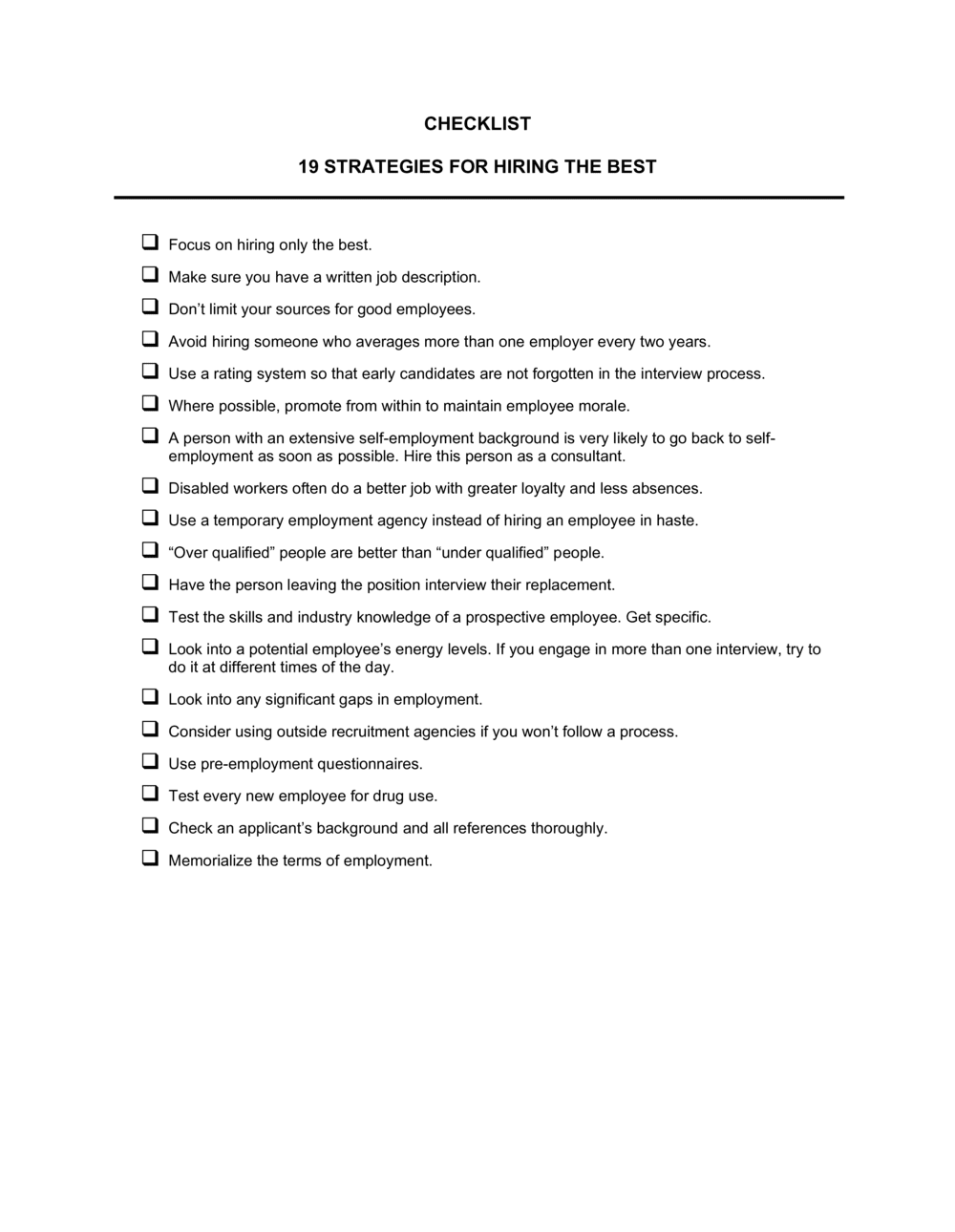
Checklist 19 Strategies for Hiring the Best

Free download β€’ Use as a template β€’ Print or share

1 pageβ€’20–25 min to useβ€’Difficulty: Standard
Learn more ↓
FreeChecklist 19 Strategies for Hiring the Best Template

At a glance

What it is
The 19 Strategies for Hiring the Best Checklist is a structured operational document that walks hiring managers and HR teams through nineteen evidence-based tactics for attracting, screening, and selecting top-performing candidates. This free Word download gives you a ready-to-use framework you can edit online and export as PDF to share with recruiters, department heads, or leadership teams.
When you need it
Use it when opening a new role, rebuilding a hiring process that has produced poor-fit hires, or standardizing recruitment practices across departments or locations. It is equally useful for a first-time hiring manager running their first search and a seasoned HR leader auditing an existing process.
What's inside
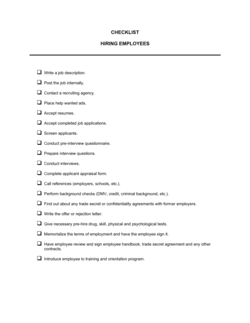
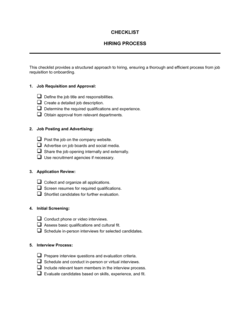
Role definition and job description best practices, sourcing channel selection, structured interview design, candidate evaluation criteria, reference and background check guidance, offer strategy, and post-hire onboarding handoff β€” organized as a sequential checklist with action items at each stage.

What is a Hiring Strategies Checklist?

A Hiring Strategies Checklist is a structured operational document that guides hiring managers and HR teams through nineteen proven tactics for attracting, evaluating, and selecting high-performing candidates. It organizes the entire recruitment process β€” from defining role success criteria and writing a targeted job description through structured interviews, reference checks, offer strategy, and onboarding handoff β€” into a sequential, action-oriented checklist that any manager can follow consistently. Rather than relying on institutional memory or improvising each search, teams use this document to ensure every hire receives the same rigorous, evidence-based process.

Why You Need This Document

Poor hiring decisions are expensive β€” the commonly cited cost of a bad hire runs between 30% and 150% of annual salary when you account for recruiting time, onboarding investment, team disruption, and eventual replacement. Most bad hires are not random; they are traceable to a specific skipped step: a job description that attracted the wrong candidates, an unstructured interview that selected for charm over competence, or reference checks completed after a verbal offer made the findings impossible to act on. This checklist closes those gaps by making every critical step explicit, assigned, and sequenced correctly before the search begins. For small business owners running their first formal hire and HR leaders building a scalable process alike, a completed checklist is the difference between a repeatable system and a recurring problem.

Which variant fits your situation?

If your situation is…Use this template
Hiring a single role with a structured multi-round interview processChecklist 19 Strategies for Hiring the Best
Documenting formal terms and obligations for a new hireEmployment Contract
Evaluating multiple candidates against the same criteriaCandidate Evaluation Form
Conducting structured performance reviews after the probationary periodEmployee Performance Review
Onboarding a new employee after hire decision is madeEmployee Onboarding Checklist
Describing a role clearly before posting it publiclyJob Description Template
Extending a formal offer with compensation detailsJob Offer Letter

Common mistakes to avoid

❌ Reusing an outdated job description

Why it matters: A posting built on last year's role requirements attracts candidates for a job that no longer exists and filters out people who would excel at the current version.

Fix: Start every search by documenting current 30/60/90-day success criteria with the hiring manager before opening the job description file.

❌ Skipping structured interview questions

Why it matters: Unstructured interviews produce decisions based on rapport and first impressions rather than evidence of competence β€” leading to hires that perform well in interviews but poorly on the job.

Fix: Write behavioral questions for each required competency and have every interviewer use the same rubric. Review the evidence together in a debrief before deciding.

❌ Running reference checks after the verbal offer

Why it matters: A reference that surfaces a serious concern after a verbal offer has been extended creates a difficult situation β€” withdrawing the offer or proceeding despite the red flag both carry significant cost.

Fix: Complete reference checks on your finalist before initiating any offer conversation. Build this step into your process timeline, not as an afterthought after the decision is made.

❌ Posting to every available job board simultaneously

Why it matters: A noisy, unmanageable pipeline wastes reviewer time and slows time-to-hire. High volume from the wrong channels makes it harder to find the right candidates, not easier.

Fix: Choose two to three channels based on where the target candidate profile is actually active. Evaluate pipeline quality β€” not just quantity β€” after the first week of posting.

❌ Failing to hand off interview findings at onboarding

Why it matters: When the manager who conducted interviews doesn't transfer notes and role context to whoever runs onboarding, the new hire's first 90 days are disconnected from what the hiring process revealed.

Fix: Create a one-page handoff document per hire that includes identified strengths, development areas surfaced in interviews, and the 30/60/90-day milestones used to define the role.

❌ Letting one vocal interviewer anchor the debrief discussion

Why it matters: When a senior or confident interviewer shares their opinion first, other panelists unconsciously conform β€” discarding independent observations that might have changed the decision.

Fix: Require all interviewers to submit numeric scorecards before the debrief meeting begins and share scores simultaneously at the start, before any open discussion.

The 10 key sections, explained

Role definition and success criteria

Job description and posting

Sourcing channel selection

Application screening criteria

Structured interview design

Interview panel coordination

Candidate evaluation and debrief

Reference and background checks

Offer strategy and negotiation

Onboarding handoff

How to fill it out

  1. 1

    Define the role's success criteria before drafting the job description

    Meet with the hiring manager to document what success looks like at 30, 60, and 90 days. List the three to five competencies that predict performance in this specific role.

    πŸ’‘ Ask the hiring manager: 'What would the ideal candidate have accomplished in their first 90 days that would make you say this hire was a success?' Specific answers prevent vague job postings.

  2. 2

    Write the job description from the success criteria, not a prior posting

    Use the success criteria and competency list to write responsibilities that reflect the actual current role. Include a compensation range β€” postings with visible pay attract 30–40% more qualified applicants in most markets.

    πŸ’‘ Limit required qualifications to the four or five that genuinely disqualify a candidate. Move everything else to 'preferred.'

  3. 3

    Select two to three sourcing channels matched to the candidate profile

    Identify where your target candidate actually spends time. For senior technical roles, LinkedIn and referrals outperform general job boards. For hourly or local roles, Indeed and local community boards produce better volume.

    πŸ’‘ Activate your employee referral program for every open role before paying for job board promotion β€” referrals produce hires 25–55% faster than cold applications in most studies.

  4. 4

    Set pass/fail screening criteria before reviewing applications

    Write down the minimum requirements for a phone screen before the first application arrives. Apply them consistently to every candidate in the pipeline.

    πŸ’‘ If more than 40% of applicants pass your screening criteria, your criteria are too loose β€” tighten them before the pipeline grows unmanageable.

  5. 5

    Build a structured question set with a scoring rubric

    Write two to three behavioral questions per competency and define what a 1-, 3-, and 5-point answer looks like for each. Distribute questions across interview rounds so each interviewer owns specific competency areas.

    πŸ’‘ Run a calibration session with interviewers before the first candidate comes in β€” walk through the rubric together using a sample answer to align scoring expectations.

  6. 6

    Coordinate the interview panel and divide competency coverage

    Assign each interviewer a specific competency set and send them the corresponding questions and rubric before their interview. Confirm scheduling so no interviewer repeats another's coverage.

    πŸ’‘ Send candidates a clear agenda β€” names, titles, and topics covered in each round β€” at least 24 hours before interviews. Prepared candidates give more useful answers.

  7. 7

    Run a structured debrief within 24 hours of final interviews

    Have each interviewer share numeric scores per competency before open discussion begins. Document the consensus decision and the rationale in writing.

    πŸ’‘ Require scorecards to be submitted within one hour of each interview, while recall is still accurate. Debrief quality degrades sharply when scorecards are filled out the day before the debrief.

  8. 8

    Complete reference checks before extending a verbal offer

    Contact at least two former direct managers. Ask specifically about the competencies that showed mixed signals in the interview process, not just general performance.

    πŸ’‘ If a reference is reluctant to say anything beyond confirming dates of employment, ask: 'Is there anything that would give you pause about recommending this person for a [ROLE TYPE] position?' Silence or hesitation is itself a signal.

Frequently asked questions

What is a hiring strategies checklist?

A hiring strategies checklist is a structured operational document that guides a hiring manager or HR team through the key steps and tactics required to attract, evaluate, and select high-performing candidates. It ensures no critical step is skipped β€” from defining role success criteria through offer strategy and onboarding handoff β€” and provides a consistent framework across every search the organization runs.

Why use a checklist instead of just following a general recruiting process?

A checklist makes each step explicit and accountable. General processes exist in people's heads and get abbreviated under time pressure β€” the structured interview gets dropped when the hiring manager is busy, or reference checks happen after the verbal offer instead of before. A checklist with defined action items and owners closes those gaps consistently, regardless of who is running the search.

What are the most important steps in a hiring process?

The highest-leverage steps are: defining role success criteria before writing the job description, using structured behavioral interview questions scored on a consistent rubric, running a facilitated debrief where scorecards are shared before open discussion, and completing reference checks with former direct managers before extending any offer. Most hiring mistakes are traceable to skipping or shortcutting one of these four steps.

How many interview rounds should a hiring process include?

For most roles, two to three rounds is the right range. A phone screen to confirm baseline qualifications, a structured competency interview with the hiring manager and one or two peers, and a final conversation covering culture fit and the offer are sufficient for roles up to senior manager level. Adding more rounds delays time-to-hire and signals indecision to strong candidates who have competing offers.

What is a structured interview and why does it matter?

A structured interview uses a predetermined set of questions asked in the same order to every candidate, with responses scored against a defined rubric. Research consistently shows structured interviews predict job performance significantly better than unstructured conversations. They also reduce the influence of rapport, appearance, and interviewer bias on the hiring decision.

When should reference checks happen in the hiring process?

Reference checks should be completed on your top finalist before a verbal offer is extended β€” not after. Conducting them post-offer puts you in an almost impossible position if a serious concern surfaces. Structuring the calls around role-relevant competencies, particularly any areas that showed mixed signals in the interview, produces far more useful information than a generic character reference.

How do I reduce time-to-hire without lowering quality?

The biggest time sinks are uncoordinated scheduling, delayed debrief meetings, and sequential approval chains for offers. Fix these operationally: block interview slots before the job posts, commit to a 24-hour debrief window after final interviews, and pre-approve a compensation range with clear exception authority before the first candidate enters the pipeline. Faster process and higher quality are not in conflict β€” disorganization causes both problems simultaneously.

Should I include compensation in the job posting?

Yes, in most cases. Postings that include a compensation range attract more qualified applicants, reduce time spent screening candidates whose salary expectations are misaligned, and are required by law in a growing number of US states and cities including California, Colorado, and New York. Omitting pay range does not improve your negotiating position β€” it primarily filters out candidates who have options and can afford to wait for transparent employers.

How does this checklist differ from a standard job description template?

A job description template helps you write the public-facing posting for a single role. This checklist covers the entire hiring process end-to-end β€” from role definition and sourcing strategy through interview design, reference checks, offer execution, and onboarding handoff. It is an operational process document for the hiring team, not a candidate-facing document.

How this compares to alternatives

vs Job Description Template

A job description template helps you write the external-facing posting for a single open role. This checklist covers the entire hiring process β€” from defining success criteria through onboarding handoff. You need both: the job description attracts candidates; the checklist ensures you select the right one and onboard them effectively.

vs Employee Onboarding Checklist

An onboarding checklist begins after an offer is accepted and covers the new hire's first days and weeks. This hiring checklist covers everything before the hire decision β€” role definition, sourcing, interviewing, and reference checks. The two documents should connect: the 30/60/90-day milestones defined here become the goals tracked during onboarding.

vs Employee Performance Review Template

A performance review evaluates an employee who is already in role, typically at 90 days and annually thereafter. This checklist operates upstream β€” it shapes who gets into the role in the first place. Strong hiring processes reduce the frequency and severity of performance issues that performance reviews are designed to address.

vs Job Offer Letter Template

A job offer letter is a single-point document that formalizes compensation, title, and start date for one candidate. This checklist is a process document covering the entire search. The offer letter is the output of a successful search; this checklist is the framework that produces a finalist worth offering to.

Industry-specific considerations

Technology / SaaS

Technical competency rubrics for engineering and product roles, take-home assessment integration, and high-volume pipeline management for fast-growth headcount plans.

Professional Services

Client-facing judgment and communication competencies assessed across multiple rounds, with reference checks weighted heavily given relationship-intensive roles.

Retail / Hospitality

High-turnover environments require rapid screening with clear pass/fail criteria, consistent panel interviews for shift supervisors, and expedited offer timelines to compete for candidates with multiple offers.

Healthcare

Credentialing and licensing verification added to the background check stage, behavioral questions focused on patient safety and protocol adherence, and mandatory reference checks with prior clinical supervisors.

Template vs pro β€” what fits your needs?

PathBest forCostTime
Use the templateSmall business owners, department managers, and HR teams running standard full-time or part-time searchesFree1–2 hours to configure per role type; 15–30 minutes to apply per search
Template + professional reviewCompanies standardizing hiring across multiple departments or locations, or building a repeatable process from scratch$500–$2,000 for an HR consultant review and calibration session1–2 weeks
Custom draftedHigh-volume hiring operations, executive search processes, or organizations in regulated industries requiring documented hiring procedures$2,000–$8,000 for a talent acquisition consultant or HR process designer3–6 weeks

Glossary

Structured Interview
An interview format in which every candidate is asked the same predetermined questions in the same order, enabling fair, apples-to-apples comparison.
Behavioral Interview Question
A question asking candidates to describe a specific past situation to predict future performance β€” typically framed as 'Tell me about a time when...'
Sourcing Channel
The platform or method used to find candidates, such as a job board, employee referral program, LinkedIn, or staffing agency.
Candidate Pipeline
The pool of active applicants moving through successive stages of a hiring process from initial application to final offer.
Time-to-Hire
The number of calendar days between opening a requisition and a candidate accepting an offer β€” a key efficiency metric for recruitment.
Offer Acceptance Rate
The percentage of job offers extended that are accepted by candidates β€” a signal of compensation competitiveness and candidate experience quality.
Scorecard
A standardized evaluation form interviewers complete immediately after each interview, rating candidates against predefined competencies and criteria.
Employer Value Proposition (EVP)
The combination of compensation, culture, career development, and benefits that an employer offers and communicates to attract and retain talent.
Reference Check
Structured conversations with a candidate's former managers or colleagues to verify experience, confirm performance, and surface any concerns before an offer.
Requisition
A formal internal request to fill a vacant or new position, typically requiring budget approval before recruitment begins.

Part of your Business Operating System

This document is one of 3,000+ business & legal templates included in Business in a Box.

  • Fill-in-the-blanks β€” ready in minutes
  • 100% customizable Word document
  • Compatible with all office suites
  • Export to PDF and share electronically

Create your document in 3 simple steps.

From template to signed document β€” all inside one Business Operating System.
1
Download or open template

Access over 3,000+ business and legal templates for any business task, project or initiative.

2
Edit and fill in the blanks with AI

Customize your ready-made business document template and save it in the cloud.

3
Save, Share, Send, Sign

Share your files and folders with your team. Create a space of seamless collaboration.

Save time, save money, and create top-quality documents.

β˜…β˜…β˜…β˜…β˜…

"Fantastic value! I'm not sure how I'd do without it. It's worth its weight in gold and paid back for itself many times."

Managing Director Β· Mall Farm
Robert Whalley
Managing Director, Mall Farm Proprietary Limited
β˜…β˜…β˜…β˜…β˜…

"I have been using Business in a Box for years. It has been the most useful source of templates I have encountered. I recommend it to anyone."

Business Owner Β· 4+ years
Dr Michael John Freestone
Business Owner
β˜…β˜…β˜…β˜…β˜…

"It has been a life saver so many times I have lost count. Business in a Box has saved me so much time and as you know, time is money."

Owner Β· Upstate Web
David G. Moore Jr.
Owner, Upstate Web

Run your business with a system β€” not scattered tools

Stop downloading documents. Start operating with clarity. Business in a Box gives you the Business Operating System used by over 250,000 companies worldwide to structure, run, and grow their business.

Free Forever PlanΒ Β·Β No credit card required