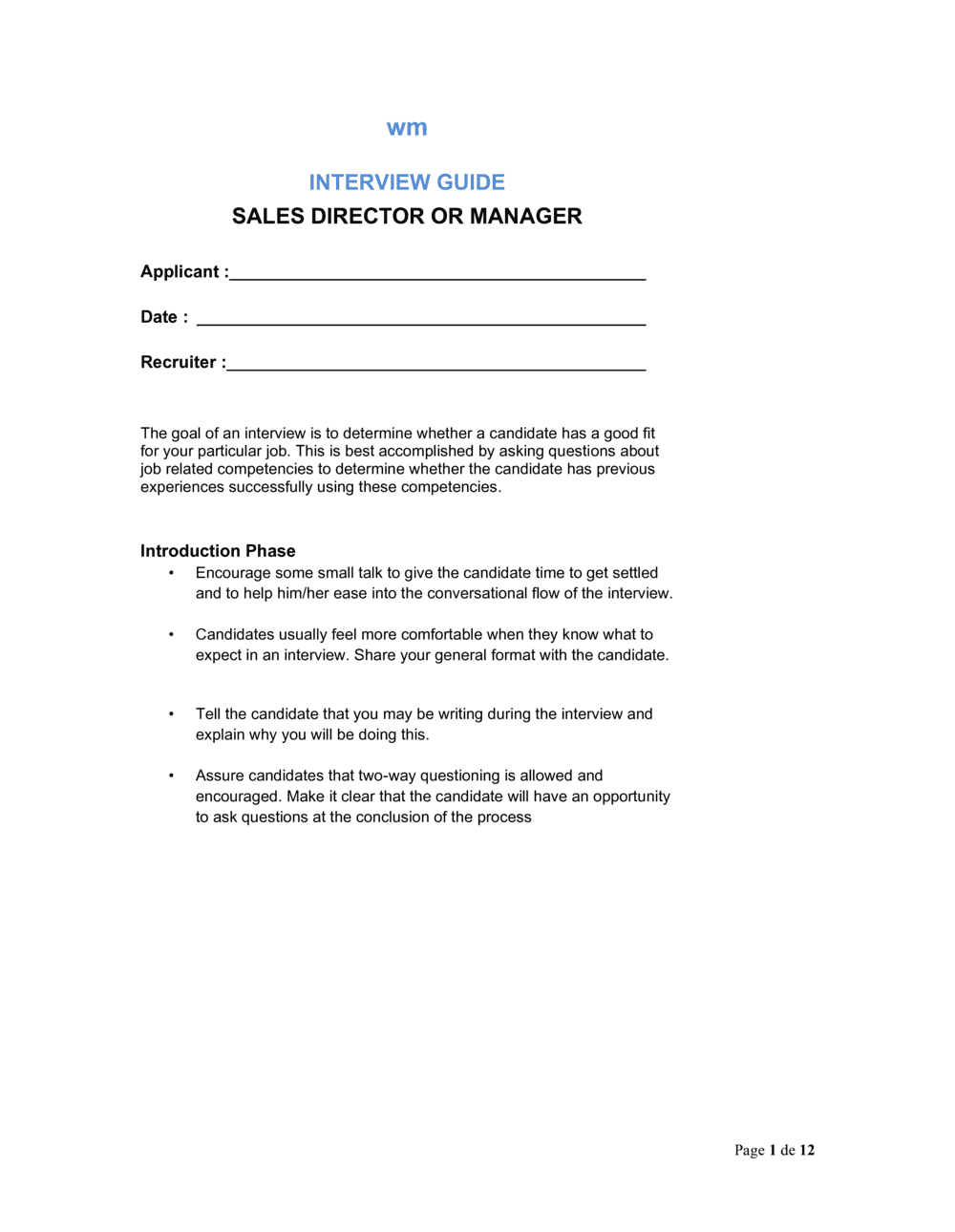
Interview Guide Sales Director or Manager

Free to read β€’ Save or share with one click

FreeInterview Guide Sales Director or Manager Template

At a glance

What it is
An Interview Guide for a Sales Director or Manager is a structured Word document that standardizes every stage of a sales leadership interview β€” from opening context-setting through competency-based questions, scoring rubrics, and a final hiring recommendation. This free Word download gives hiring managers and HR teams a consistent, repeatable framework they can edit online and export as PDF to use across every candidate in the process.
When you need it
Use it whenever you are hiring for a Sales Director, VP of Sales, or Sales Manager role and need multiple interviewers to evaluate candidates against the same criteria. It is especially valuable when the hiring panel includes non-HR stakeholders β€” such as the CEO or a department head β€” who benefit from a guided question set.
What's inside
Role overview and interview instructions, structured competency-based questions covering pipeline management, team leadership, forecasting, and revenue strategy, plus a numerical scoring rubric, interviewer notes fields, a red-flag checklist, and a final recommendation summary.

What is an Interview Guide for a Sales Director or Manager?

An Interview Guide for a Sales Director or Manager is a structured operational document that gives hiring panels a consistent, scored framework for evaluating candidates for sales leadership roles. It translates the competencies required of a Sales Director or Manager β€” pipeline management, team coaching, forecasting, cross-functional collaboration, and hiring track record β€” into specific behavioral questions, scoring rubrics with anchor descriptions, and a final recommendation summary. Rather than leaving interviewers to improvise, the guide ensures every candidate is asked the same questions in the same sequence and rated against the same criteria, making final-round comparisons defensible and data-driven.

Why You Need This Document

Hiring a Sales Director or Manager without a structured guide is one of the highest-cost hiring mistakes a business can make. An unstructured interview process systematically favors candidates who are polished presenters over those with genuine operational depth β€” and at the leadership level, the two are rarely the same person. Without scored competency sections, panel debriefs default to whoever speaks first, and critical red flags β€” inability to cite quota numbers, vague coaching examples, or external attribution for missed quarters β€” go unrecorded and unchallenged. A documented evaluation trail also protects the organization if a hiring decision is later questioned. This template gives every interviewer on your panel the questions, scoring anchors, and notes fields they need to produce a reliable, comparable assessment β€” turning a high-stakes conversation into a repeatable process.

Which variant fits your situation?

If your situation is…Use this template
Hiring an individual contributor sales representativeInterview Guide Sales Representative
Evaluating a VP of Sales or Chief Revenue OfficerInterview Guide VP Sales or CRO
Conducting a second-round technical or case-based interviewSales Case Study Interview Template
Assessing cultural fit and values alignment separatelyCulture Fit Interview Guide
Running a structured reference check after final roundReference Check Form
Documenting the full hiring decision with panel feedbackInterview Evaluation Form
Extending an offer after a successful interview processJob Offer Letter

Common mistakes to avoid

❌ Using the same guide for both Director and individual contributor roles

Why it matters: Director and Manager roles require team leadership, forecasting, and cross-functional competencies that are irrelevant for individual contributors β€” scoring them on the same rubric produces meaningless comparisons.

Fix: Maintain separate guides for Director/Manager, individual contributor, and executive roles, with competency sections calibrated to each level's actual responsibilities.

❌ Accepting vague answers without probing for specific numbers

Why it matters: Sales leaders who cannot cite their quota, team size, forecast accuracy, or ramp time from prior roles are either unprepared or inflating their experience β€” both are disqualifying signals at the Director level.

Fix: Add a follow-up prompt after each question: 'Can you give me the specific number?' Record the answer or the absence of one in the notes field.

❌ Skipping the scoring summary during the interview debrief

Why it matters: Without numeric scores, panel debriefs devolve into whoever speaks first setting the hiring decision β€” a well-documented bias that produces inconsistent hires.

Fix: Require every interviewer to submit completed scores before the debrief begins. Make numeric comparison the first agenda item.

❌ Treating the candidate-questions section as unstructured time

Why it matters: A sales director who asks only about base salary and vacation in their first interview has revealed something important about their priorities β€” and skipping the score on this section discards that signal.

Fix: Add a one-line evaluation prompt: note whether the candidate asked about pipeline health, team tenure, quota history, or strategic direction. Score this observation on the same 1–5 scale.

The 10 key sections, explained

Role overview and interview instructions

Candidate background and career trajectory

Revenue strategy and pipeline management

Team leadership and coaching

Forecasting and sales operations

Cross-functional collaboration and stakeholder management

Hiring, ramp, and team building

Handling adversity and performance pressure

Candidate questions and cultural alignment

Scoring summary and hiring recommendation

How to fill it out

  1. 1

    Customize the role overview section

    Replace all placeholders in the role overview β€” reporting line, team size, quota target, and territory β€” with the specifics of the open position. This context shapes how interviewers interpret and score candidate responses.

    πŸ’‘ If the role has changed in scope since the last hire, update this section even if you are re-using a previous version of the guide.

  2. 2

    Select and sequence the competency sections

    Decide which competency sections each interviewer will cover so that no section is duplicated and no section is skipped across the full panel. Assign section ownership in the guide header before distributing.

    πŸ’‘ Assign the pipeline and forecasting sections to the hiring manager or CRO β€” they can probe the numbers in ways HR interviewers typically cannot.

  3. 3

    Brief all interviewers on the scoring rubric

    Walk every interviewer through the 1–5 rubric anchor descriptions before the first interview. Calibration takes 15 minutes and significantly reduces score variance across the panel.

    πŸ’‘ Run a brief calibration exercise using a hypothetical weak answer and a strong answer so interviewers agree on what a 2 versus a 4 looks like in practice.

  4. 4

    Conduct the interview in section order

    Follow the guide section by section during the interview. Resist the temptation to skip ahead or improvise β€” consistency across candidates is what makes the scorecard comparable.

    πŸ’‘ Allow 5–7 minutes per section for a 60-minute interview. Set a silent timer so you reach the scoring summary section before the candidate leaves.

  5. 5

    Record notes in real time, not from memory

    Write brief verbatim notes on candidate responses β€” specific numbers cited, examples given, or moments of hesitation β€” in the notes fields during the interview, not immediately after.

    πŸ’‘ Note the absence of specifics as prominently as the specifics themselves. 'Candidate could not cite quota from most recent role' is a scored observation.

  6. 6

    Complete the scoring summary within 30 minutes of the interview

    Fill in competency scores and the recommendation field before speaking with other panel members to avoid anchoring bias. Numeric scores lock your independent assessment before group discussion.

    πŸ’‘ If your score on any single competency is a 1 or 2, flag it explicitly in the notes β€” a single critical-competency failure often outweighs a strong overall average.

  7. 7

    Debrief the panel using the completed scorecards

    Run the debrief by reviewing each interviewer's scores section by section before opening general discussion. This surfaces disagreements grounded in evidence rather than gut feeling.

    πŸ’‘ The hiring manager should share their scores last in the debrief to avoid anchoring the rest of the panel to their opinion.

  8. 8

    Archive the completed guide with the candidate's file

    Store the scored guide in the candidate's HR file regardless of the hiring outcome. Documented evaluations protect against discrimination claims and provide a reference point for future hiring decisions.

    πŸ’‘ Retain completed interview guides for at least 12 months after the hire decision, or longer if required by local employment regulations.

Frequently asked questions

What is an interview guide for a Sales Director or Manager?

An interview guide for a Sales Director or Manager is a structured document that standardizes every stage of the hiring interview β€” opening questions, competency-based behavioral questions, scoring criteria, and a recommendation summary. It ensures every candidate is evaluated against the same competencies and reduces the influence of interviewer bias on the final hiring decision.

What competencies should a Sales Director interview guide cover?

A complete guide covers revenue strategy and pipeline management, team coaching and performance management, forecasting accuracy, cross-functional collaboration, hiring and ramp track record, and how the candidate handles adversity such as a missed quarter or a lost key account. Each competency should have at least two behavioral questions with scoring anchors so interviewers can evaluate responses consistently.

How is a structured interview guide different from a list of questions?

A list of questions gives interviewers prompts but no framework for evaluating or comparing responses. A structured guide adds scoring rubrics with anchor descriptions, notes fields for verbatim observations, a red-flag checklist, and a recommendation summary β€” turning the interview into a scored, comparable data point rather than a conversation with a subjective outcome.

How many interviewers should use the same guide?

For a Sales Director or Manager hire, a panel of two to four interviewers is typical β€” often the hiring manager, a peer leader, an HR business partner, and sometimes the CEO for senior roles. Each interviewer should own specific sections of the guide rather than all asking the same questions, and all should score independently before the panel debrief.

Should the same interview guide be used for Sales Director and VP of Sales roles?

No. A VP of Sales or CRO requires additional competencies around go-to-market strategy, board-level communication, hiring senior leaders, and organizational design that are not evaluated in a Director or Manager guide. Using a Director-level guide for a VP search will systematically miss the most important evaluation criteria for the senior role.

What is the STAR method and should I require candidates to use it?

The STAR method β€” Situation, Task, Action, Result β€” is a structured response framework that prompts candidates to give complete, evidence-based answers to behavioral questions. You do not need to instruct candidates to use it, but interviewers should be trained to prompt for each element when a candidate gives a partial answer. If a candidate never reaches the Result component, that is itself a scored observation.

How long should a Sales Director or Manager interview take?

A single structured interview using this guide runs 45 to 60 minutes for most competency sections. A complete hiring process for a Sales Director typically involves two to three rounds β€” a first-round screen of 30 minutes, a structured panel interview of 60 minutes, and a final-round case or reference check. Each round should use a purpose-built guide or scorecard rather than an improvised question set.

Can this guide be used for a phone or video interview?

Yes. The guide works equally well for in-person, phone, and video interviews. For video interviews, enable note-taking in a split screen so you can record observations in real time without breaking eye contact for extended periods. The scoring summary should still be completed within 30 minutes of the interview ending, regardless of format.

What should I do if a candidate gives a strong answer to every question?

Strong overall scores are valid β€” but probe for specificity in at least two sections before concluding the candidate is exceptional. Ask for the specific revenue number, the exact team size, or the precise forecast accuracy percentage. A genuinely strong candidate will have concrete answers. If every answer is polished but non-specific, treat the lack of numbers as a flag worth noting in the recommendation section.

How this compares to alternatives

vs Interview Evaluation Form

An interview evaluation form is a short post-interview scoring sheet β€” typically one page β€” used to record a final rating and recommendation. An interview guide is the full in-interview tool that includes questions, probes, notes fields, and competency definitions. The evaluation form is the output; the guide drives the interview itself.

vs Job Description β€” Sales Manager

A job description defines what the role requires and is used to attract and screen candidates. An interview guide translates those requirements into specific behavioral questions and scoring criteria used during the live interview. Both documents should be built from the same competency model so evaluation criteria align with what was advertised.

vs Reference Check Form

A reference check form is used after the interview stage to verify a candidate's past performance with former managers or colleagues. An interview guide structures the live candidate conversation. Together they form a two-source validation of the same competencies β€” responses in the interview should be cross-checked against reference observations before a final decision.

vs Employment Contract β€” Sales

An employment contract documents the agreed terms of the hire after a candidate has been selected. An interview guide is used earlier in the process to evaluate and select that candidate. The interview guide feeds the hiring decision; the employment contract formalizes its outcome.

Industry-specific considerations

SaaS / Technology

Questions probe ARR targets, net revenue retention, product-led growth versus sales-led motion, and experience managing SDR or BDR teams feeding an AE pipeline.

Financial Services

Compliance awareness in sales conversations, regulated product knowledge requirements, and experience managing relationship managers or financial advisors are key evaluation points.

Manufacturing and Industrial

Long sales cycles (6–18 months), distributor and channel management experience, and the ability to manage technical sales engineers alongside commercial AEs are critical competencies.

Professional Services

Competency questions focus on managing partner-led sales, cross-selling to existing accounts, utilization rate impact of sales activity, and experience with RFP-driven procurement.

Template vs pro β€” what fits your needs?

PathBest forCostTime
Use the templateHR managers and hiring managers conducting Sales Director or Manager interviews at companies without a dedicated talent functionFree30–45 minutes to customize and distribute
Template + professional reviewCompanies hiring multiple sales leaders simultaneously or running a structured assessment process with external scoring calibration$500–$2,000 for an HR consultant or recruiter review2–5 days
Custom draftedEnterprise organizations building a full competency framework and assessment center for senior sales leadership pipelines$5,000–$20,000+ for an I/O psychologist or assessment firm4–12 weeks

Glossary

Competency-Based Interview
An interview method that asks candidates to describe specific past situations to evidence skills like pipeline management or team coaching.
STAR Method
A structured response framework β€” Situation, Task, Action, Result β€” used to evaluate the quality and depth of a candidate's behavioral examples.
Scoring Rubric
A defined scale (typically 1–5) with anchor descriptions for each score level, allowing multiple interviewers to evaluate candidates on a consistent basis.
Pipeline Coverage Ratio
The ratio of total qualified pipeline value to quota β€” typically 3–4Γ— β€” used to assess whether a sales manager understands forecast health.
Quota Attainment
The percentage of assigned sales target actually achieved, used as a key metric when evaluating a candidate's past performance as a sales leader.
Ramp Time
The period between a new sales hire's start date and the point at which they are expected to achieve full productivity, typically 3–9 months depending on deal complexity.
Panel Interview
An interview format in which two or more interviewers evaluate a candidate simultaneously, using a shared guide to ensure consistent coverage of topics.
Hiring Scorecard
A summary document that aggregates each interviewer's numerical ratings across competencies to produce a comparable ranking of finalists.
Red Flag Checklist
A structured list of warning signals β€” such as inability to cite specific quota numbers or vague team-coaching examples β€” that interviewers are prompted to note during the interview.
Structured Interview
An interview in which every candidate is asked the same questions in the same order, scored against the same rubric, reducing evaluator bias and improving predictive validity.

Part of your Business Operating System

This document is one of 3,000+ business & legal templates included in Business in a Box.

  • Fill-in-the-blanks β€” ready in minutes
  • Compatible with all office suites
  • Export to PDF and share electronically

Create your document in 3 simple steps.

From template to signed document β€” all inside one Business Operating System.
1
Download or open template

Access over 3,000+ business and legal templates for any business task, project or initiative.

2
Edit and fill in the blanks with AI

Customize your ready-made business document template and save it in the cloud.

3
Save, Share, Send, Sign

Share your files and folders with your team. Create a space of seamless collaboration.

Save time, save money, and create top-quality documents.

β˜…β˜…β˜…β˜…β˜…

"Fantastic value! I'm not sure how I'd do without it. It's worth its weight in gold and paid back for itself many times."

Managing Director Β· Mall Farm
Robert Whalley
Managing Director, Mall Farm Proprietary Limited
β˜…β˜…β˜…β˜…β˜…

"I have been using Business in a Box for years. It has been the most useful source of templates I have encountered. I recommend it to anyone."

Business Owner Β· 4+ years
Dr Michael John Freestone
Business Owner
β˜…β˜…β˜…β˜…β˜…

"It has been a life saver so many times I have lost count. Business in a Box has saved me so much time and as you know, time is money."

Owner Β· Upstate Web
David G. Moore Jr.
Owner, Upstate Web

Run your business with a system β€” not scattered tools

Stop downloading documents. Start operating with clarity. Business in a Box gives you the Business Operating System used by over 250,000 companies worldwide to structure, run, and grow their business.

Start freeΒ Β·Β No credit card required