- Structured Interview
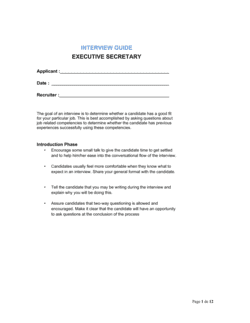
- An interview format in which every candidate is asked the same questions in the same order, with responses scored against a predefined rubric to reduce evaluator bias.
- Behavioral Interview Question
- A question asking candidates to describe a specific past situation, action, and result — typically framed as 'Tell me about a time when...' — to predict future behavior from past performance.
- STAR Method
- A response framework standing for Situation, Task, Action, and Result — used by interviewers to guide candidates toward concrete, scorable answers.
- Competency Framework
- A defined set of skills, behaviors, and knowledge areas — such as customer empathy, analytical thinking, and stakeholder alignment — against which all PM candidates are evaluated.
- Scoring Rubric
- A standardized scale (typically 1–4 or 1–5) with written descriptors for each score level, used to rate candidate responses consistently across interviewers.
- Debrief Session
- A structured post-interview meeting where all panelists share independent scores before discussing impressions, preventing anchoring bias from the first speaker.
- Product Sense
- A candidate's demonstrated ability to identify user needs, evaluate product trade-offs, and articulate a clear opinion on what makes a product good or bad.
- Prioritization Framework
- A structured method — such as RICE, ICE, or MoSCoW — for ranking features or initiatives by impact, confidence, effort, and reach to guide roadmap decisions.
- Cross-Functional Leadership
- The ability to align and influence engineering, design, marketing, sales, and operations teams toward a shared product goal without direct managerial authority.
- North Star Metric
- A single primary metric — such as weekly active users or items shipped per day — that a product team uses to measure whether the product is delivering core value to customers.
- Technical Depth
- A PM candidate's ability to engage credibly with engineering constraints, system architecture trade-offs, and API or data infrastructure decisions without being a software engineer.