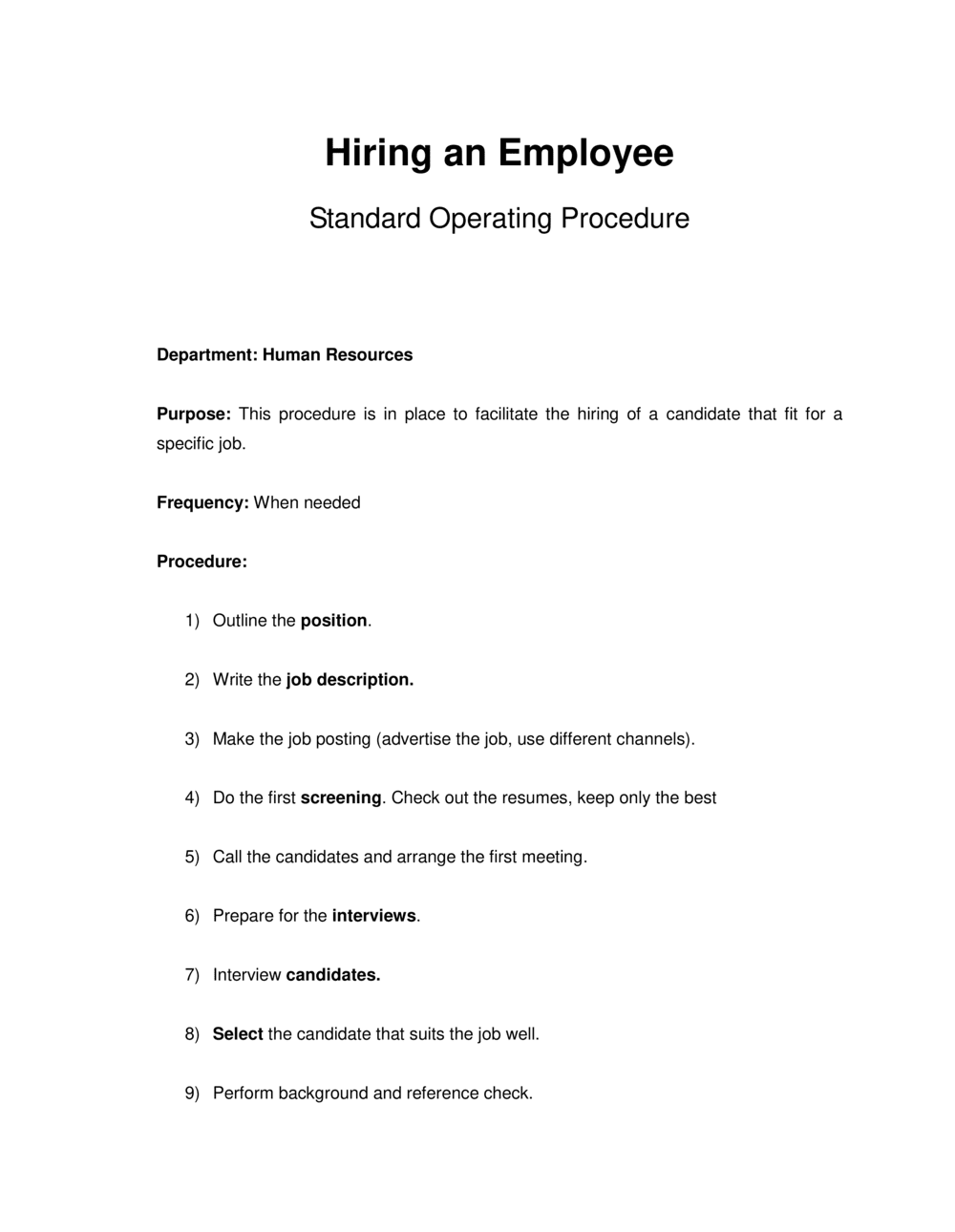
How to Hire an Employee

Free to read β€’ Save or share with one click

FreeHow to Hire an Employee Template

At a glance

What it is
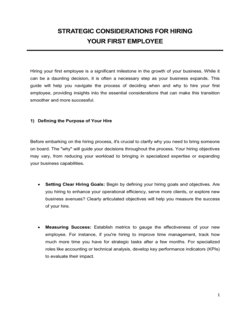
A How to Hire an Employee template is a structured operational guide that walks employers through every stage of the hiring process β€” from defining the role and posting the job through interviewing, selecting, making an offer, and onboarding the new hire. This free Word download gives small businesses and HR teams a repeatable, documented framework they can edit online and export as PDF for internal use or manager training.
When you need it
Use it any time you open a new position, backfill a vacancy, or want to standardize an ad-hoc hiring process that has grown inconsistent across managers or departments.
What's inside
Role definition and job description, sourcing and advertising strategy, application screening criteria, interview process and scoring, reference and background check guidance, offer letter workflow, and a structured pre-boarding and onboarding checklist.

What is a How to Hire an Employee Template?

A How to Hire an Employee template is a structured operational guide that documents every stage of the hiring process in a single, repeatable framework β€” from defining the open role and writing the job description through sourcing candidates, screening applications, conducting structured interviews, extending an offer, and completing onboarding. It gives employers a consistent, documented workflow that reduces the risk of skipped steps, compliance errors, and inconsistent candidate experiences. Rather than rebuilding the process from scratch for each new position, teams follow the same structured sequence and adapt it to the specific role.

Why You Need This Document

Without a documented hiring process, each manager runs recruitment differently β€” some skip reference checks, others make verbal offers without approval, and onboarding gets improvised on the new hire's first day. The consequences are concrete: a mis-sequenced background check can trigger a compliance violation in ban-the-box jurisdictions; an undocumented screening process creates exposure if a rejected candidate files a discrimination complaint; and a new hire who receives no 90-day plan is statistically twice as likely to leave within the year, costing 1.5–2Γ— their annual salary to replace. This template gives your business a structured, defensible, and repeatable hiring process that works whether you are making your first hire or your fiftieth.

Which variant fits your situation?

If your situation is…Use this template
Hiring a full-time salaried employee with a formal offer and contractHow to Hire an Employee
Engaging a freelancer or independent contractor for project workIndependent Contractor Agreement
Bringing on a temporary or seasonal worker for a fixed periodTemporary Employment Contract
Hiring an intern with a defined learning program and supervision planInternship Agreement
Filling a senior or executive role with a structured search processExecutive Employment Agreement
Conducting structured panel interviews with scored evaluation criteriaInterview Evaluation Form
Formalizing compensation and benefits before extending an offerJob Offer Letter

Common mistakes to avoid

❌ Posting a job before headcount is approved

Why it matters: Rescinding an offer after the candidate has resigned from their current role creates legal exposure and lasting reputation damage on employer review sites.

Fix: Complete the job requisition and receive written budget approval before advertising the role or contacting any candidates.

❌ Screening resumes without a written scorecard

Why it matters: Inconsistent screening produces shortlists driven by individual bias rather than job requirements and exposes the employer to equal-opportunity complaints.

Fix: Document knock-out criteria and a scoring rubric before the first application arrives and require all reviewers to use it.

❌ Running a background check before making a conditional offer

Why it matters: In jurisdictions with ban-the-box laws β€” including California, New York, and Illinois β€” checking criminal history before an offer is made is a statutory violation subject to fines.

Fix: Sequence the process correctly: conditional offer first, then written consent, then background check β€” and apply findings consistently to all candidates.

❌ Skipping a structured 90-day onboarding plan

Why it matters: New hires without a defined 30/60/90-day plan have significantly higher early attrition β€” typically costing 1.5–2Γ— annual salary to replace.

Fix: Build a written onboarding milestone plan covering training, introductions, and measurable 30-, 60-, and 90-day goals before the start date.

❌ Making a verbal offer without internal compensation approval

Why it matters: A manager who commits to terms that HR or finance later revises creates a trust breakdown that causes strong candidates to withdraw and accept competing offers.

Fix: Require written compensation approval before any verbal or written offer is extended, with a defined escalation path for counter-offer requests.

❌ Writing job descriptions that list tasks instead of outcomes

Why it matters: Task-focused descriptions attract candidates who are comfortable executing instructions but screen out results-oriented candidates who evaluate roles by impact.

Fix: Lead each job description with three to five measurable outcomes the role must achieve within 12 months, then derive required qualifications from those outcomes.

The 9 key sections, explained

Role definition and job requisition

Job description

Sourcing and job posting strategy

Application screening criteria

Interview process and evaluation scorecard

Reference and background check process

Compensation benchmarking and offer preparation

Offer extension and negotiation workflow

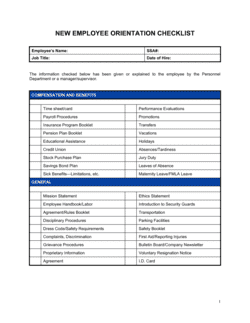
Pre-boarding and onboarding checklist

How to fill it out

  1. 1

    Define the role and get requisition approval

    Complete the role definition section with the job title, department, reporting line, salary budget, and business justification. Get sign-off from finance or leadership before posting.

    πŸ’‘ Attach a one-paragraph business case β€” headcount cost vs. revenue or productivity impact β€” to speed budget approval on new roles.

  2. 2

    Write a results-focused job description

    List the three to five outcomes the hire must achieve in the first 12 months, then derive the required qualifications from those outcomes. Separate required from preferred qualifications clearly.

    πŸ’‘ Include the compensation range in the job description β€” postings with salary bands receive 30–40% more applications and attract candidates who self-select for fit.

  3. 3

    Select and budget your sourcing channels

    Choose two to three primary channels based on the role level and function. Allocate a per-channel budget and set a target number of qualified applicants before moving to screening.

    πŸ’‘ Employee referrals produce hires with lower CAC and higher 12-month retention β€” activate them before spending on paid job boards.

  4. 4

    Build a documented screening scorecard

    Define your knock-out criteria and a 1–5 scoring rubric for resume review. Document it before reviewing any applications so every reviewer applies the same standard.

    πŸ’‘ Limit knock-out criteria to the absolute minimum requirements β€” each additional filter reduces your applicant pool by roughly 30%.

  5. 5

    Design a structured interview process

    Map each interview round to a specific evaluation purpose. Write the same core questions for every candidate and define the scoring criteria in advance.

    πŸ’‘ Cap the process at three rounds for most roles β€” each additional round increases candidate drop-off by 15–20% based on industry benchmarks.

  6. 6

    Conduct reference and background checks after a conditional offer

    Extend a conditional offer first, then initiate reference calls and background checks. Document what you verified and the outcome of each check.

    πŸ’‘ Ask references one specific question: 'Would you rehire this person?' The answer and the hesitation before it are both informative.

  7. 7

    Prepare and extend the offer

    Benchmark compensation, complete the internal approval, make a verbal offer call, and follow up with a written offer letter within one to two business days.

    πŸ’‘ State the offer deadline clearly β€” five business days is standard. An open-ended deadline extends the process and signals indecision.

  8. 8

    Execute the pre-boarding and onboarding checklist

    Assign ownership for each onboarding task (HR, IT, hiring manager) and confirm each milestone is complete before and after the start date.

    πŸ’‘ Send a welcome email two to three days before the start date with the day-one agenda β€” it reduces first-day anxiety and first-week no-shows.

Frequently asked questions

What are the basic steps to hire an employee?

The core steps are: define the role and get budget approval, write a job description, post and source candidates, screen applications against documented criteria, conduct structured interviews, check references and run a background check after a conditional offer, extend a written offer letter, and complete a structured onboarding plan. Skipping or compressing any step increases the risk of a bad hire or a compliance violation.

How long does it typically take to hire an employee?

The average time-to-fill for most roles in the US runs 30–45 days from posting to accepted offer. Senior or specialized roles frequently take 60–90 days. Pre-boarding and onboarding add another 30–90 days before the hire is fully productive. Planning for a 60-day end-to-end timeline for most professional roles is a reasonable baseline.

What documents do I need to hire an employee?

In the US, you need a completed Form I-9 (employment eligibility verification) and Form W-4 (tax withholding) on or before day one. Most employers also require a signed offer letter or employment contract, direct deposit authorization, and any policy acknowledgment forms. In Canada, the equivalent forms are a TD1 and proof of work authorization. State and provincial requirements vary β€” consult your jurisdiction's labor department for a complete list.

What is a structured interview and why does it matter?

A structured interview asks every candidate the same predetermined questions and scores answers against the same rubric. Research consistently shows structured interviews predict job performance more accurately than unstructured conversations and reduce the influence of interviewer bias. Using a scoring sheet for each candidate also creates a documented basis for your selection decision if it is ever challenged.

When should I run a background check?

Run a background check only after extending a conditional offer and receiving the candidate's written consent. Running checks earlier β€” or without consent β€” violates the Fair Credit Reporting Act (FCRA) in the US and equivalent privacy laws in Canada and the EU. If a background check reveals a disqualifying finding, follow the adverse action notice process required by the FCRA before withdrawing the offer.

What should an employee onboarding plan include?

A complete onboarding plan covers pre-start paperwork and system setup, a day-one welcome and orientation, a first-week training schedule, introductions to key colleagues and stakeholders, and defined milestones for 30, 60, and 90 days. Each milestone should include measurable goals the new hire and their manager review together. Plans that extend through day 90 consistently produce higher engagement and lower first-year attrition.

Do I need to post a job publicly before hiring?

In most private-sector situations, no β€” you are not legally required to advertise a role externally. However, federal contractors and government employers in the US must follow OFCCP affirmative action posting requirements. Even without a legal obligation, posting publicly and documenting your selection process is considered best practice for demonstrating non-discriminatory hiring if a complaint is ever filed.

What is the difference between a job description and a job posting?

A job description is an internal document defining the role's responsibilities, required qualifications, reporting structure, and compensation band β€” it is used to set expectations internally and evaluate candidates. A job posting is the externally published advertisement derived from the job description, typically shorter and written in a more candidate-facing tone to attract applicants. Both should be based on the same underlying role definition.

Can I use this template for hourly or part-time positions?

Yes β€” the hiring process steps apply to both hourly and salaried roles, though some sections simplify significantly for part-time or entry-level positions. For hourly workers, the compensation section should reference wage rates and overtime classification rather than annual salary, and the onboarding section typically focuses on shift-specific training and safety procedures rather than 90-day strategic goals.

How this compares to alternatives

vs Job Offer Letter

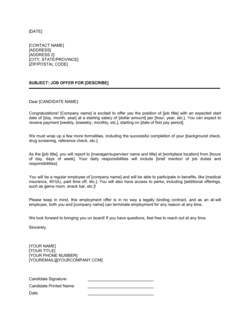
A job offer letter is a single-step output at the end of the hiring process β€” it confirms the role, compensation, and start date for one candidate. This hiring guide covers the full end-to-end process from role definition to onboarding. You need both: the guide to run the process, the offer letter to close it.

vs Employment Contract

An employment contract is a legally binding agreement that governs the ongoing employment relationship β€” duties, IP, non-compete, and termination terms. This hiring guide is an operational process document, not a legal agreement. The contract is executed at the offer stage; the hiring guide gets you to that point.

vs Employee Handbook

An employee handbook documents company policies, procedures, and expectations for the entire workforce. This hiring guide is scoped specifically to the recruitment and onboarding process for a single new hire. The handbook is what the new employee reads during onboarding; this guide is what the employer follows to get them there.

vs Job Description Template

A job description template covers one section of the hiring process β€” defining and communicating the role to candidates. This hiring guide encompasses the job description as one of nine structured sections, and continues through sourcing, interviewing, offers, and onboarding. Use the standalone job description template when you only need that component.

Industry-specific considerations

Technology / SaaS

Technical skills assessments and take-home exercises added between interview rounds; equity and remote-work terms incorporated into offer preparation.

Retail / Hospitality

High-volume, fast-cycle hiring with streamlined screening criteria; shift availability and WOTC screening added to the application stage.

Healthcare

Licensure and credentialing verification required before offer; drug screening and immunization records integrated into the background check step.

Professional Services

Portfolio or work-sample review added to the interview process; non-solicit and IP assignment reviewed before offer extension for client-facing roles.

Template vs pro β€” what fits your needs?

PathBest forCostTime
Use the templateSmall business owners, startup founders, and managers making their first few hires without a dedicated HR teamFree2–4 hours to customize; 30–45 days per hire
Template + professional reviewGrowing companies standardizing hiring across multiple managers or preparing for an HR audit$300–$800 for an HR consultant review1–2 weeks to finalize the process; ongoing per hire
Custom draftedMid-size businesses building a full talent acquisition function or operating in highly regulated industries$2,000–$8,000 for HR process design and ATS implementation4–8 weeks

Glossary

Job Requisition
A formal internal request to open a new or replacement position, typically requiring manager and budget approval before recruiting begins.
Job Description
A written document outlining the role's title, responsibilities, required qualifications, reporting structure, and compensation range.
Sourcing
The proactive process of identifying and attracting candidates through job boards, referrals, social media, recruiters, or direct outreach.
Applicant Tracking System (ATS)
Software that collects, organizes, and filters job applications, enabling hiring teams to move candidates through defined pipeline stages.
Structured Interview
An interview format where every candidate is asked the same predetermined questions and scored against the same criteria, reducing interviewer bias.
Behavioral Interview Question
A question asking the candidate to describe a specific past situation, the action they took, and the result β€” used to predict future performance.
Reference Check
A verification step in which the employer contacts the candidate's former managers or colleagues to confirm employment history and assess performance.
Background Check
A third-party verification of a candidate's criminal record, employment history, education credentials, and sometimes credit history, subject to applicable law.
Offer Letter
A written document extending a job offer that states the role, start date, compensation, benefits, and any conditions of employment.
Onboarding
The structured process of integrating a new employee into the organization β€” covering paperwork, system access, role training, and cultural orientation.
Probationary Period
A defined initial period β€” typically 30 to 90 days β€” during which performance is closely evaluated before confirming full employment status.

Part of your Business Operating System

This document is one of 3,000+ business & legal templates included in Business in a Box.

  • Fill-in-the-blanks β€” ready in minutes
  • Compatible with all office suites
  • Export to PDF and share electronically

Create your document in 3 simple steps.

From template to signed document β€” all inside one Business Operating System.
1
Download or open template

Access over 3,000+ business and legal templates for any business task, project or initiative.

2
Edit and fill in the blanks with AI

Customize your ready-made business document template and save it in the cloud.

3
Save, Share, Send, Sign

Share your files and folders with your team. Create a space of seamless collaboration.

Save time, save money, and create top-quality documents.

β˜…β˜…β˜…β˜…β˜…

"Fantastic value! I'm not sure how I'd do without it. It's worth its weight in gold and paid back for itself many times."

Managing Director Β· Mall Farm
Robert Whalley
Managing Director, Mall Farm Proprietary Limited
β˜…β˜…β˜…β˜…β˜…

"I have been using Business in a Box for years. It has been the most useful source of templates I have encountered. I recommend it to anyone."

Business Owner Β· 4+ years
Dr Michael John Freestone
Business Owner
β˜…β˜…β˜…β˜…β˜…

"It has been a life saver so many times I have lost count. Business in a Box has saved me so much time and as you know, time is money."

Owner Β· Upstate Web
David G. Moore Jr.
Owner, Upstate Web

Run your business with a system β€” not scattered tools

Stop downloading documents. Start operating with clarity. Business in a Box gives you the Business Operating System used by over 250,000 companies worldwide to structure, run, and grow their business.

Start freeΒ Β·Β No credit card required