Job Offer Letter Simple Template

Free Word download β€’ Edit online β€’ Save & share with Drive β€’ Export to PDF

1 pageβ€’15–25 min to fillβ€’Difficulty: Standard
Learn more ↓
FreeJob Offer Letter Simple Template

At a glance

What it is
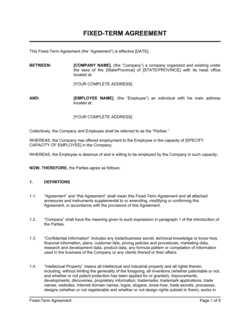
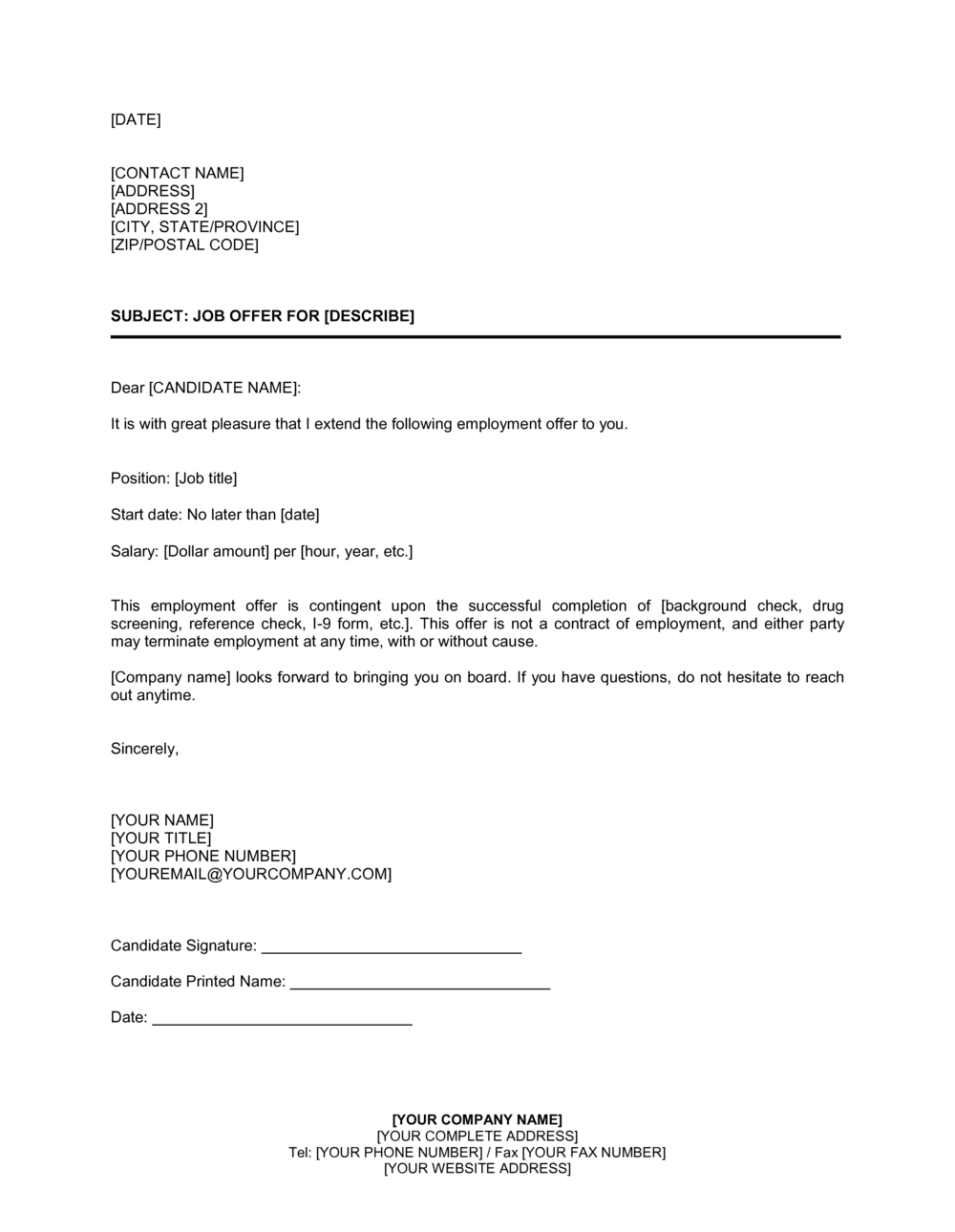
A Simple Job Offer Letter is a formal written communication from an employer to a selected candidate that confirms the terms of an employment offer β€” position, salary, start date, and any conditions such as background check clearance. This free Word download gives you a clean, professional starting point you can edit online and export as PDF to send in minutes.
When you need it
Use it immediately after verbally selecting a candidate and before their first day, whenever you need a written record of the offer terms without the full contractual detail of a formal employment agreement.
What's inside
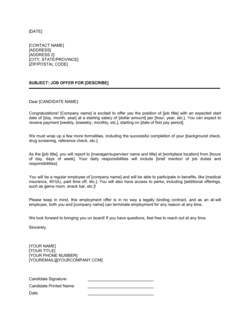
Opening salutation and congratulatory statement, position title and reporting line, compensation and hours, start date, conditions of offer, and a response-by deadline with acceptance instructions.

What is a Simple Job Offer Letter?

A Simple Job Offer Letter is a formal written notice an employer sends to a selected candidate to confirm the key terms of an employment offer: job title, start date, compensation, working hours, work location, and any conditions that must be satisfied before employment begins. Unlike a full employment contract, it is intentionally brief β€” its purpose is to confirm mutual agreement on the essential terms and secure the candidate's written acceptance quickly, without the legal formality of a binding agreement covering restrictive covenants or severance.

Why You Need This Document

Making a verbal offer without following up in writing leaves both sides working from memory. Candidates accept based on what they heard; employers issue payroll based on what they approved β€” and when those two versions differ, trust erodes before the new hire's first day. A written offer letter creates a shared, dated record of exactly what was offered and accepted, eliminating the most common source of early-tenure disputes. It also signals professionalism: candidates who receive a clear, well-formatted offer letter arrive on day one with confidence rather than uncertainty. For employers, it provides a paper trail that documents the terms in force if a termination or compensation dispute arises later. This template gives you a clean, professional letter you can complete in under ten minutes and send the same day you make your hiring decision.

Which variant fits your situation?

If your situation is…Use this template
Hiring a salaried full-time employee with enforceable restrictive covenantsEmployment Contract
Making a detailed offer to a senior or executive hireJob Offer Letter (Long Form)
Confirming a part-time or hourly positionJob Offer Letter Simple
Engaging an independent contractor rather than an employeeIndependent Contractor Agreement
Offering a fixed-term or project-based roleFixed-Term Employment Contract
Formalizing an internal promotion or role change in writingPromotion Letter

Common mistakes to avoid

❌ No response deadline

Why it matters: An open-ended offer lets candidates accept competing offers and then return to yours for leverage, leaving your hiring timeline and headcount budget in limbo.

Fix: Always set a specific response date β€” typically 3 to 5 business days β€” and state that the offer lapses if not accepted by that date.
❌ Quoting salary without specifying pay frequency

Why it matters: A candidate expecting a semi-monthly paycheck of $4,167 who receives a bi-weekly paycheck of $3,846 will notice the discrepancy immediately and may question the company's integrity.

Fix: State both the annual salary and the per-period amount β€” e.g., '$50,000 per year, paid bi-weekly at $1,923.08 per paycheck.'

❌ Omitting the at-will statement for US employees

Why it matters: Without explicit at-will language, courts in several US states have found that offer letters imply a guarantee of continued employment, complicating termination.

Fix: Include a clear, direct at-will statement and a sentence confirming the letter does not constitute a contract of employment for any definite term.

❌ Listing conditions of offer without a clearance timeline

Why it matters: A candidate who gives notice to their employer before a background check clears may be left unemployed if the check fails and there is no agreed timeline or process.

Fix: State the expected number of business days to clear each condition and confirm the start date is subject to adjustment if clearance is delayed.

The 9 key clauses, explained

Date and candidate address block

In plain language: The issue date of the letter, the candidate's full name, and their mailing address β€” placing the letter firmly in time and addressing a specific individual.

Sample language
[DATE] [CANDIDATE FULL NAME] [STREET ADDRESS] [CITY, STATE, ZIP]

Common mistake: Leaving the date blank or using 'TBD' β€” an undated offer letter creates ambiguity about the response deadline and the sequence of events if a dispute arises later.

Opening and congratulatory statement

In plain language: A direct opening sentence confirming that the company is pleased to offer the candidate employment and naming the role.

Sample language
Dear [CANDIDATE FIRST NAME], We are pleased to offer you the position of [JOB TITLE] at [COMPANY NAME], effective [START DATE].

Common mistake: Opening with a vague 'We would like to extend an offer' phrasing instead of a clear, direct statement β€” ambiguity here can undermine the candidate's confidence in the offer.

Position title and reporting line

In plain language: States the official job title and the name or title of the person the new hire will report to directly.

Sample language
You will serve as [JOB TITLE], reporting directly to [MANAGER NAME / TITLE] in the [DEPARTMENT] department.

Common mistake: Omitting the reporting line β€” candidates who later disagree with their manager structure cite the offer letter as evidence of a different arrangement.

Start date and work location

In plain language: Specifies the first day of employment and where the work will be performed β€” on-site address, remote, or hybrid.

Sample language
Your employment will begin on [START DATE]. Your primary work location will be [OFFICE ADDRESS / REMOTE / HYBRID β€” specify days on-site].

Common mistake: Stating only 'remote' without clarifying whether that is a permanent arrangement or subject to change β€” creates expectation disputes if the company later requires in-office attendance.

Compensation

In plain language: States the base salary or hourly rate, payment frequency, and the FLSA classification (exempt or non-exempt) for US employees.

Sample language
You will be compensated at a rate of [$X per year / $X per hour], paid [bi-weekly / semi-monthly / weekly]. This position is classified as [exempt / non-exempt] under the Fair Labor Standards Act.

Common mistake: Quoting an annual salary without specifying payment frequency β€” candidates and finance teams have mismatched expectations on paycheck amounts.

Hours of work

In plain language: Confirms the expected weekly hours and standard schedule, establishing the baseline for overtime calculations and attendance expectations.

Sample language
This is a [full-time / part-time] position. Standard hours are [X] hours per week, [Monday through Friday / specify schedule], from [START TIME] to [END TIME].

Common mistake: Omitting hours entirely for part-time or hourly roles β€” this leaves both parties without a reference point when scheduling or overtime disputes arise.

Conditions of the offer

In plain language: Lists any conditions that must be satisfied before employment begins β€” background check, drug screening, right-to-work verification, or reference clearance.

Sample language
This offer is contingent upon successful completion of a background check and verification of your eligibility to work in [COUNTRY]. Employment is also subject to your signing the Company's standard confidentiality agreement.

Common mistake: Listing conditions after the start date has passed β€” conditions must be cleared before day one, or the employer may be unable to act on a failed check without legal risk.

At-will statement (US) or notice reference

In plain language: For US employers, confirms the at-will nature of the employment relationship. For non-US employers, references the applicable notice period.

Sample language
Your employment with [COMPANY NAME] is at-will, meaning either party may end the relationship at any time, for any lawful reason, with or without notice. Nothing in this letter creates a contract of employment for a definite period.

Common mistake: Skipping the at-will statement entirely β€” without it, implied-contract claims are easier to assert in states that recognize the doctrine of reasonable reliance.

Response deadline and acceptance instructions

In plain language: Sets a specific date by which the candidate must accept or decline, and explains how to confirm acceptance β€” signature, email, or eSign.

Sample language
Please indicate your acceptance of this offer by signing and returning this letter by [RESPONSE DATE]. You may return it by email to [HR EMAIL] or via the eSign link provided.

Common mistake: No response deadline at all β€” open offers create scheduling uncertainty and give candidates leverage to accept competing offers and then return to yours.

How to fill it out

  1. 1

    Fill in company and candidate details

    Enter the company's legal name, the candidate's full legal name, their mailing address, and the letter's issue date in the header block.

    πŸ’‘ Use the candidate's legal name exactly as it appears on the ID they will submit for I-9 or right-to-work verification β€” mismatches cause onboarding delays.

  2. 2

    Confirm the job title, department, and reporting line

    Enter the exact job title that will appear on the employee's payroll record and HR system, the department name, and the manager's name or title.

    πŸ’‘ Cross-check the title against your payroll system before sending β€” a mismatch between the offer letter and the first paycheck creates an immediate trust problem.

  3. 3

    Set the start date and work location

    Enter a specific calendar date for the first day and specify whether the role is on-site, remote, or hybrid. If hybrid, state the expected number of on-site days per week.

    πŸ’‘ Confirm the start date with the hiring manager before sending β€” last-minute changes to a written start date feel like broken promises to candidates.

  4. 4

    Enter compensation and hours

    State the base salary or hourly rate, the payment frequency, weekly hours, standard schedule, and the FLSA exempt or non-exempt classification for US roles.

    πŸ’‘ For non-exempt employees, note the overtime policy explicitly β€” 'overtime is paid at 1.5Γ— for hours over 40 per week' removes any ambiguity about eligibility.

  5. 5

    List all conditions of the offer

    Add every contingency that applies β€” background check, drug screen, reference verification, right-to-work documentation. Be specific about what happens if a condition is not met.

    πŸ’‘ State the expected timeline for clearing conditions so the candidate knows when they can give notice to their current employer.

  6. 6

    Set the response deadline and acceptance method

    Enter a specific response-by date β€” typically 3 to 5 business days from the letter date β€” and provide clear instructions for how the candidate should confirm acceptance.

    πŸ’‘ Five business days is the standard window; anything shorter feels pressured and can cause strong candidates to withdraw.

Frequently asked questions

What is a simple job offer letter?

A simple job offer letter is a formal written notice from an employer to a selected candidate that confirms the key terms of an employment offer β€” position title, start date, salary or hourly rate, hours, and any conditions. It is less detailed than a full employment contract and is typically used for straightforward roles where comprehensive restrictive covenants are not required.

Is a job offer letter legally binding?

A job offer letter is generally not a legally binding employment contract in at-will jurisdictions, provided it includes clear at-will language and a disclaimer that it does not constitute a contract for a definite term. However, some courts have found implied contractual obligations when offer letters contain specific promises about job security or termination procedures. Using precise, unambiguous language reduces this risk.

What is the difference between a job offer letter and an employment contract?

A job offer letter summarizes the key terms of the offer β€” role, salary, start date, and conditions β€” to confirm acceptance before the first day. An employment contract is the comprehensive governing document that covers confidentiality, IP assignment, non-compete, termination notice, and severance in full legal detail. The offer letter triggers the relationship; the employment contract governs it.

Should a job offer letter be signed?

Requesting a signed copy is strongly recommended even though it is not legally required in most cases. A signed acknowledgment confirms the candidate received and accepted the specific terms stated, prevents later disputes about what was agreed, and gives the employer a clear record of the acceptance date for payroll and onboarding purposes.

How long should a candidate have to respond to a job offer?

Three to five business days is the standard window for most roles. Giving fewer than three days can pressure strong candidates into withdrawing. For senior or executive roles, one week is common. Always state the deadline explicitly in the letter rather than leaving the offer open-ended.

What conditions can be included in a job offer letter?

Common conditions include successful completion of a background check, drug screening, reference verification, proof of right-to-work eligibility, and signing a confidentiality or IP agreement before the start date. Each condition should be specific, and the letter should state what happens β€” typically withdrawal of the offer β€” if a condition is not met.

Do I need a lawyer to write a simple job offer letter?

For most straightforward domestic hires at the entry or mid level, a well-constructed template is sufficient. Consider a brief legal review when hiring in California or other states with restrictive employment laws, when the offer includes equity or complex compensation structures, or when the role involves a non-compete you plan to enforce later through a separate agreement.

When should I use a simple offer letter instead of a full employment contract?

Use a simple offer letter for hourly, entry-level, or administrative roles where the primary goal is to confirm terms and secure acceptance quickly. Use a full employment contract when the role involves access to sensitive IP, customer relationships that warrant non-solicitation restrictions, or compensation structures β€” such as equity or performance bonuses β€” that need contractual definition.

How this compares to alternatives

vs Job Offer Letter (Long Form)

The long-form offer letter adds sections for bonus eligibility, benefits summary, relocation assistance, and equity details. Use the simple version for entry-level or hourly roles where those elements are absent. Use the long form when the compensation package has multiple components that need written confirmation before a full contract is signed.

vs Employment Contract

An employment contract is the comprehensive legally binding document covering IP assignment, confidentiality, non-compete, and severance. A simple offer letter confirms terms and secures acceptance but does not create enforceable restrictive covenants. For any role where protecting IP or client relationships matters, the offer letter should be followed by a signed employment contract before day one.

vs Executive Employment Agreement

An executive agreement covers equity vesting, change-of-control provisions, enhanced severance, and D&O indemnification β€” terms far beyond what a simple offer letter addresses. Use the simple offer letter for non-executive staff only; C-suite and VP-level hires require a purpose-built executive agreement.

vs Independent Contractor Agreement

A contractor agreement engages a self-employed individual for project-based work with no employment entitlements β€” no benefits, no payroll withholding, no overtime. A job offer letter is for employees only. Using an offer letter to engage a contractor, or a contractor agreement for someone who is functionally an employee, risks worker misclassification penalties.

Industry-specific considerations

Retail and hospitality

High-volume hourly hiring means a simple, fast offer letter that clearly states rate, schedule, and FLSA classification is essential to reducing onboarding friction.

Professional services

Firms use a simple offer letter to confirm title and salary quickly, then follow up with a full employment agreement covering confidentiality and non-solicit before day one.

Technology / SaaS

Startups commonly issue a simple offer letter to secure acceptance fast while a full contract covering IP assignment and equity is being finalized in parallel.

Manufacturing

Shift-based roles require the letter to specify schedule, hourly rate, and overtime classification clearly to avoid FLSA disputes from the first pay period.

Template vs pro β€” what fits your needs?

PathBest forCostTime
Use the templateSmall businesses, startups, and hiring managers extending offers for entry-level, administrative, or hourly rolesFree10 minutes
Template + professional reviewEmployers hiring in California, New York, or other states with complex employment laws, or roles that will later require a non-compete$150–$400 for a one-hour attorney review1–2 business days
Custom draftedSenior hires with equity, complex compensation structures, or multi-jurisdiction onboarding requirements$500–$1,5003–5 business days

Glossary

Offer Letter
A written communication from an employer to a candidate that summarizes the key terms of an employment offer before a formal contract is signed.
At-Will Employment
Employment that either party may end at any time for any lawful reason, without advance notice β€” the default in most US states.
Contingent Offer
An offer that is valid only after the candidate satisfies one or more conditions, such as passing a background check, drug screening, or reference verification.
Start Date
The specific calendar date on which the new employee is expected to begin work and employment obligations commence.
Exempt vs. Non-Exempt
A US FLSA classification determining overtime eligibility: exempt employees are paid a salary and are not entitled to overtime; non-exempt employees must receive 1.5Γ— their regular rate for hours over 40 per week.
Probationary Period
A defined initial period β€” typically 30 to 90 days β€” during which performance is evaluated under reduced termination formalities.
Response Deadline
The date by which the candidate must accept or decline the offer, after which the employer may withdraw or reissue on different terms.
Compensation
The total remuneration offered, including base salary or hourly rate and any immediately applicable allowances β€” excluding bonuses and equity, which are typically covered in a full contract.
Employment Agreement
A comprehensive legally binding contract that supersedes the offer letter and governs the full employment relationship, including IP, confidentiality, and termination terms.

Part of your Business Operating System

This document is one of 3,000+ business & legal templates included in Business in a Box.

  • Fill-in-the-blanks β€” ready in minutes
  • 100% customizable Word document
  • Compatible with all office suites
  • Export to PDF and share electronically

Create your document in 3 simple steps.

From template to signed document β€” all inside one Business Operating System.
1
Download or open template

Access over 3,000+ business and legal templates for any business task, project or initiative.

2
Edit and fill in the blanks with AI

Customize your ready-made business document template and save it in the cloud.

3
Save, Share, Send, Sign

Share your files and folders with your team. Create a space of seamless collaboration.

Save time, save money, and create top-quality documents.

β˜…β˜…β˜…β˜…β˜…

"Fantastic value! I'm not sure how I'd do without it. It's worth its weight in gold and paid back for itself many times."

Managing Director Β· Mall Farm
Robert Whalley
Managing Director, Mall Farm Proprietary Limited
β˜…β˜…β˜…β˜…β˜…

"I have been using Business in a Box for years. It has been the most useful source of templates I have encountered. I recommend it to anyone."

Business Owner Β· 4+ years
Dr Michael John Freestone
Business Owner
β˜…β˜…β˜…β˜…β˜…

"It has been a life saver so many times I have lost count. Business in a Box has saved me so much time and as you know, time is money."

Owner Β· Upstate Web
David G. Moore Jr.
Owner, Upstate Web

Run your business with a system β€” not scattered tools

Stop downloading documents. Start operating with clarity. Business in a Box gives you the Business Operating System used by over 250,000 companies worldwide to structure, run, and grow their business.

Free Forever PlanΒ Β·Β No credit card required