Interview Guide General and Operations Manager

Free to read β€’ Save or share with one click

FreeInterview Guide General and Operations Manager Template

At a glance

What it is
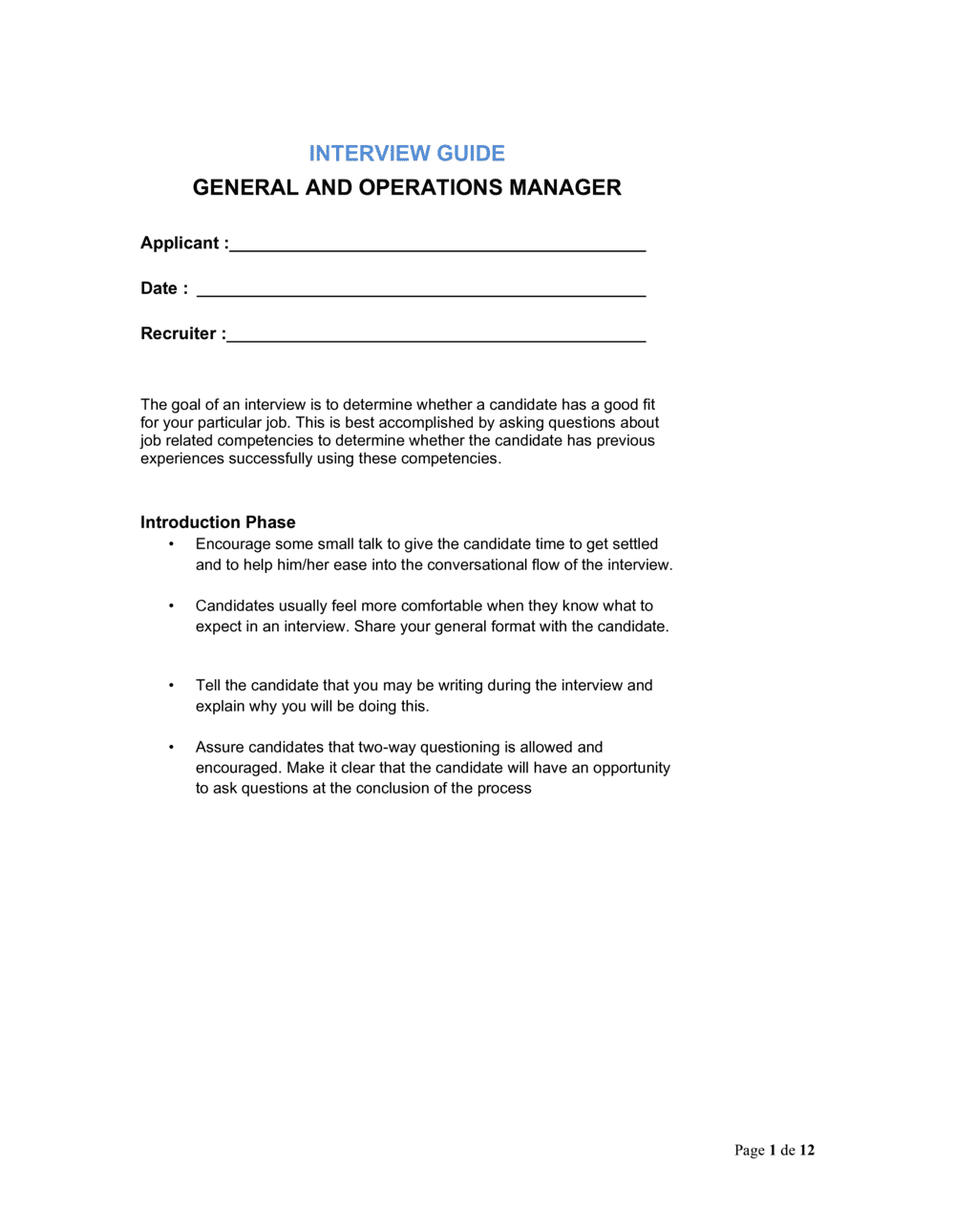
An Interview Guide for a General and Operations Manager is a structured Word document that equips hiring managers and HR teams with a consistent set of competency-based questions, scoring rubrics, and evaluation criteria for assessing candidates for a general or operations manager role. This free download gives you a ready-to-use framework you can edit online and export as PDF to share with every interviewer on the panel.
When you need it
Use it whenever you are filling a General Manager or Operations Manager position and need every panelist asking the same questions, scoring responses on the same scale, and arriving at a hiring decision based on documented evidence rather than gut feel.
What's inside
Role context and competency definitions, structured behavioral and situational questions organized by competency, a numerical scoring rubric for each question, interviewer notes fields, a candidate summary scorecard, and a post-interview debrief guide.

What is an Interview Guide for a General and Operations Manager?

An Interview Guide for a General and Operations Manager is a structured evaluation document that gives every member of a hiring panel the same competency-based questions, scoring rubrics, and evidence-capture fields to assess candidates for a general or operations management role. Rather than leaving each interviewer to ask whatever comes to mind, the guide defines four to five core competencies β€” such as people leadership, operational execution, strategic thinking, and stakeholder communication β€” and maps each to specific behavioral and situational questions with written criteria describing what a strong, average, or weak response looks like. The result is a consistent, comparable record for every candidate who interviews for the position.

Why You Need This Document

Without a structured guide, hiring panels for operations manager roles default to unstructured conversation β€” and unstructured interviews are among the least predictive selection methods available to employers. Different interviewers ask different questions, score differently, and bring different biases to the debrief, making it nearly impossible to compare two candidates fairly or explain a hiring decision if it is later challenged. For a General or Operations Manager role β€” where the wrong hire can cost six to twelve months of salary in lost productivity and rehiring expense β€” an undocumented process is a significant operational and legal risk. This template gives you a ready-to-use framework that standardizes the evaluation, reduces the influence of affinity bias and the halo effect, and produces a written record that supports every hiring decision from the first screen to the final offer.

Which variant fits your situation?

If your situation is…Use this template
Hiring a senior executive or VP of Operations with P&L responsibilityExecutive Interview Guide
Screening a high volume of applicants in an initial phone or video roundPhone Screen Interview Guide
Interviewing candidates for a frontline team lead or supervisor roleInterview Guide Supervisor
Assessing a candidate's technical or functional expertise in a specific domainTechnical Interview Scorecard
Running a structured panel interview with multiple evaluatorsPanel Interview Evaluation Form
Comparing multiple finalists after individual interviews are completeCandidate Comparison Matrix
Onboarding the selected hire after the offer is acceptedNew Employee Onboarding Checklist

Common mistakes to avoid

❌ Skipping the pre-interview calibration

Why it matters: Without a shared understanding of what a 3 versus a 5 looks like, two interviewers assessing the same answer will score it differently, making the combined scorecard meaningless.

Fix: Run a five-minute calibration session with all panelists before the first interview β€” agree on one anchor example for the midpoint score on each competency.

❌ Recording scores with no supporting evidence

Why it matters: A scorecard full of numbers and no notes cannot be defended in a debrief, a hiring audit, or a discrimination complaint β€” and it provides no learning for future hiring cycles.

Fix: Require each panelist to write at least one direct quote or specific example from the candidate's answer for every score they record.

❌ Asking the same questions across all competency blocks

Why it matters: Redundant questions generate redundant data β€” the panel learns nothing new in the third interview and the candidate grows frustrated by repetition.

Fix: Assign each interviewer a distinct competency block and enforce the division before the interviews begin.

❌ Allowing the most senior panelist to share scores first in the debrief

Why it matters: Senior-voice anchoring suppresses legitimate disagreement, producing false consensus β€” hires that looked unanimous in the room but were actually contentious.

Fix: Require all panelists to submit scores independently before the debrief meeting, and start the discussion with the lowest-seniority evaluator.

❌ Treating the guide as a formality rather than a decision-making tool

Why it matters: When interviewers complete the scoring summary after the fact to match a decision already made, the guide provides no protection against bias and no value for future calibration.

Fix: Enforce sequential completion β€” scores must be submitted before the debrief, and the debrief recommendation must be recorded before the offer is extended.

❌ Failing to file the completed guide with the candidate record

Why it matters: Undocumented hiring decisions expose the organization to discrimination claims it cannot defend, and lost interview records make it impossible to audit or improve the process over time.

Fix: Attach the completed, signed guide to the candidate's file in your ATS or HR system on the same day as the debrief, and retain it for at least 12 months.

The 9 key sections, explained

Role Context and Position Overview

Interview Structure and Timing Guide

Leadership and People Management Questions

Operational Execution and Process Improvement Questions

Strategic Thinking and Business Acumen Questions

Stakeholder Communication and Cross-Functional Collaboration Questions

Candidate Questions and Interviewer Observations

Competency Scoring Summary

Post-Interview Debrief Guide

How to fill it out

  1. 1

    Customize the role context section

    Replace the placeholder job title, reporting line, and key accountabilities with the specifics of the role you are filling. Confirm the competencies listed match what the hiring manager considers the top three to five predictors of success in this particular position.

    πŸ’‘ If you have a current job description, paste the top five bullet points into the role context section β€” this keeps interviewers anchored to what actually matters for the hire.

  2. 2

    Assign interviewers to competency blocks

    Divide the four competency blocks across your panel so each interviewer owns one or two areas. Avoid having every panelist ask every question β€” duplication wastes interview time and fatigues candidates.

    πŸ’‘ Give each interviewer a printed or digital copy of only their assigned block to reduce the chance they read ahead and telegraph questions to the candidate.

  3. 3

    Review the scoring rubric before the first interview

    Have all panelists read the rubric descriptions for each score level (1 through 5) and agree on one example response for a 3 before interviewing begins. Calibration before the first interview cuts inter-rater variability by roughly half.

    πŸ’‘ A five-minute calibration call with all panelists the morning of the interview is more effective than a lengthy written rubric they read alone.

  4. 4

    Conduct the interview following the timing guide

    Use the timing guide in Section 2 to keep each competency block on schedule. Assign one panelist as timekeeper. If a candidate gives a rich answer that runs long, note it and move on rather than skipping a full competency block.

    πŸ’‘ Record a note immediately after each answer rather than waiting until the candidate leaves β€” recall degrades sharply after 20 minutes.

  5. 5

    Complete the scoring summary independently

    After the interview ends, each panelist fills in their own scoring summary β€” scores and supporting evidence β€” before any group discussion takes place. Submit scores to the debrief facilitator before the debrief meeting.

    πŸ’‘ Use direct quotes from the candidate's answers as evidence wherever possible β€” paraphrases introduce interpretation bias.

  6. 6

    Run the structured debrief

    Follow the debrief protocol in the final section: lowest-seniority evaluator shares first, outlier scores are discussed before averaging, and a final recommendation is recorded with a rationale statement.

    πŸ’‘ Document the debrief outcome in writing the same day β€” decisions made verbally and not recorded are effectively invisible in a later audit or dispute.

  7. 7

    File the completed guide with the candidate record

    Attach the scored, completed interview guide to the candidate's file in your ATS or HR system. Retain for at least 12 months β€” or longer if required by your jurisdiction's employment record-keeping rules.

    πŸ’‘ Storing completed guides consistently also builds a calibration library: reviewing scores from past successful hires helps new interviewers understand what a 4 or 5 actually looks like in practice.

Frequently asked questions

What is an interview guide for a General and Operations Manager?

An interview guide for a General and Operations Manager is a structured document that gives hiring managers and panelists a consistent set of competency-based questions, scoring rubrics, and evaluation criteria specifically designed for this role. It replaces ad hoc questioning with a repeatable process that produces comparable, defensible scores across all candidates for the same position.

Why use a structured interview guide instead of an unstructured interview?

Structured interviews with defined questions and scoring rubrics are significantly more predictive of job performance than unstructured conversations β€” research in industrial-organizational psychology consistently shows validity coefficients roughly double those of unstructured interviews. They also reduce the influence of cognitive biases such as the halo effect and affinity bias, and they produce a documented record that supports fair and defensible hiring decisions.

What competencies should the guide assess for a General or Operations Manager?

The core competencies for this role typically include people leadership and performance management, operational execution and process improvement, strategic thinking and business acumen, stakeholder communication and cross-functional collaboration, and financial literacy including P&L management. The relative weight of each competency should reflect the specific demands of the position and the organization's current priorities.

How many interviewers should use the guide?

A panel of two to four interviewers is typical for a General or Operations Manager role. Fewer than two eliminates the calibration benefit of a scorecard; more than four introduces coordination overhead and can overwhelm candidates. Assign each panelist a distinct competency block rather than having everyone ask all questions.

Should the same interview guide be used for a phone screen and an in-person interview?

No β€” phone or video screens should use a shorter version of the guide covering one or two threshold competencies to qualify candidates before investing in a full panel interview. The complete guide with all competency blocks is best used for the in-person or final-round interview where the full panel is present and a hiring decision follows.

How should scoring disagreements between panelists be handled?

Any score gap of two or more points on the same competency should be discussed explicitly in the debrief before averaging. Each panelist shares the specific evidence behind their score. If the disagreement reflects genuinely different evidence from different interview segments, both data points are valid and should inform the final recommendation rather than simply being averaged away.

How long should an interview using this guide take?

A complete single-interviewer session covering all competency blocks typically runs 60 minutes β€” five minutes for opening, 40 minutes across competency blocks, 10 minutes for candidate questions, and five minutes to close. Panel formats where different interviewers cover different blocks can run 45 to 50 minutes per session without sacrificing depth.

Does this guide cover both general management and operations management roles?

Yes β€” the guide is designed for roles that combine strategic general management responsibilities (team leadership, cross-functional alignment, P&L ownership) with operational management accountabilities (process design, execution, efficiency measurement). Organizations hiring for a role that is exclusively one or the other may want to adjust the weighting of the competency blocks accordingly.

How long should completed interview guides be retained?

A minimum of 12 months after the hiring decision is a widely cited standard, as it covers most jurisdictions' windows for filing an employment discrimination complaint. Some organizations retain records for up to three years. Check the employment record-keeping requirements in your specific jurisdiction and industry, as regulated sectors may have longer retention obligations.

How this compares to alternatives

vs Job Description β€” General and Operations Manager

A job description defines the role's responsibilities, qualifications, and reporting structure for external posting. An interview guide translates those requirements into structured questions and scoring criteria for the evaluation panel. The job description attracts candidates; the interview guide helps you choose between them consistently.

vs Interview Guide β€” Supervisor

The Supervisor interview guide focuses on frontline team management, task delegation, and day-to-day performance monitoring. The General and Operations Manager guide adds competency blocks for strategic thinking, P&L management, and cross-functional stakeholder alignment β€” reflecting the broader scope and seniority of the role.

vs Employee Performance Review Template

A performance review evaluates an existing employee against established goals and competencies over a review period. An interview guide assesses a candidate before hire using behavioral and situational questions. Both use scoring rubrics, but the interview guide is prospective and prediction-focused, while the performance review is retrospective and development-focused.

vs New Employee Onboarding Checklist

The onboarding checklist is used after a hiring decision is made to integrate the selected candidate into the organization. The interview guide is used before the decision to evaluate candidates consistently. Together they form a complete hire-to-onboard sequence for the General and Operations Manager role.

Industry-specific considerations

Retail and E-commerce

Emphasizes store or warehouse operations metrics, inventory management experience, and the ability to lead large hourly workforces through peak seasons.

Manufacturing

Focuses heavily on lean or Six Sigma process improvement credentials, capacity planning, safety record management, and shift-schedule optimization.

Professional Services

Prioritizes cross-functional project coordination, client-facing communication, billable utilization management, and resource allocation across multiple engagements.

Food and Beverage / Hospitality

Weights food cost and labor cost management, health and safety compliance, high-turnover team leadership, and multi-location general management experience.

Healthcare

Adds questions on regulatory compliance, patient safety culture, credentialing processes, and cross-departmental coordination in high-stakes environments.

Technology / SaaS

Emphasizes scaling operational processes in high-growth environments, vendor and tooling evaluation, and aligning operations with product development and customer success functions.

Template vs pro β€” what fits your needs?

PathBest forCostTime
Use the templateHR managers, small business owners, and operations leaders hiring for a GM or Ops Manager role without a dedicated talent acquisition teamFree30–60 minutes to customize and distribute to the panel
Template + professional reviewOrganizations hiring for a senior or executive-level operations role where legal defensibility and bias reduction are priorities$300–$800 for an HR consultant or I/O psychologist review2–5 business days
Custom draftedLarge organizations building a validated, role-specific competency framework linked to performance data across dozens of annual hires$2,000–$8,000 for a custom competency model and validated guide4–8 weeks

Glossary

Competency-Based Interview
An interview format that uses structured questions designed to elicit evidence of specific skills or behaviors the role requires.
Behavioral Question
A question that asks the candidate to describe a past situation where they demonstrated a target competency, using a STAR-format response.
STAR Method
A response framework standing for Situation, Task, Action, Result β€” used to structure answers to behavioral interview questions.
Situational Question
A hypothetical question that presents a scenario and asks the candidate how they would respond, used to assess judgment and decision-making.
Scoring Rubric
A defined scale β€” typically 1 to 5 β€” with written criteria describing what a response at each score level looks like.
Interview Scorecard
A summary form that aggregates a candidate's competency scores from all interviewers into a single hiring recommendation.
Structured Interview
An interview in which every candidate is asked the same predetermined questions in the same order, scored on the same rubric.
Halo Effect
A cognitive bias where a strong first impression causes an interviewer to rate a candidate positively across all competencies, regardless of evidence.
Panel Interview
An interview format in which two or more interviewers assess the candidate simultaneously, each typically evaluating a different competency set.
Debrief
A structured post-interview meeting in which all panelists share scores and evidence before reaching a consensus hiring recommendation.

Part of your Business Operating System

This document is one of 3,000+ business & legal templates included in Business in a Box.

  • Fill-in-the-blanks β€” ready in minutes
  • Compatible with all office suites
  • Export to PDF and share electronically

Create your document in 3 simple steps.

From template to signed document β€” all inside one Business Operating System.
1
Download or open template

Access over 3,000+ business and legal templates for any business task, project or initiative.

2
Edit and fill in the blanks with AI

Customize your ready-made business document template and save it in the cloud.

3
Save, Share, Send, Sign

Share your files and folders with your team. Create a space of seamless collaboration.

Save time, save money, and create top-quality documents.

β˜…β˜…β˜…β˜…β˜…

"Fantastic value! I'm not sure how I'd do without it. It's worth its weight in gold and paid back for itself many times."

Managing Director Β· Mall Farm
Robert Whalley
Managing Director, Mall Farm Proprietary Limited
β˜…β˜…β˜…β˜…β˜…

"I have been using Business in a Box for years. It has been the most useful source of templates I have encountered. I recommend it to anyone."

Business Owner Β· 4+ years
Dr Michael John Freestone
Business Owner
β˜…β˜…β˜…β˜…β˜…

"It has been a life saver so many times I have lost count. Business in a Box has saved me so much time and as you know, time is money."

Owner Β· Upstate Web
David G. Moore Jr.
Owner, Upstate Web

Run your business with a system β€” not scattered tools

Stop downloading documents. Start operating with clarity. Business in a Box gives you the Business Operating System used by over 250,000 companies worldwide to structure, run, and grow their business.

Start freeΒ Β·Β No credit card required