How To Find Employees For Small Business

Free to read β€’ Save or share with one click

FreeHow To Find Employees For Small Business Template

At a glance

What it is
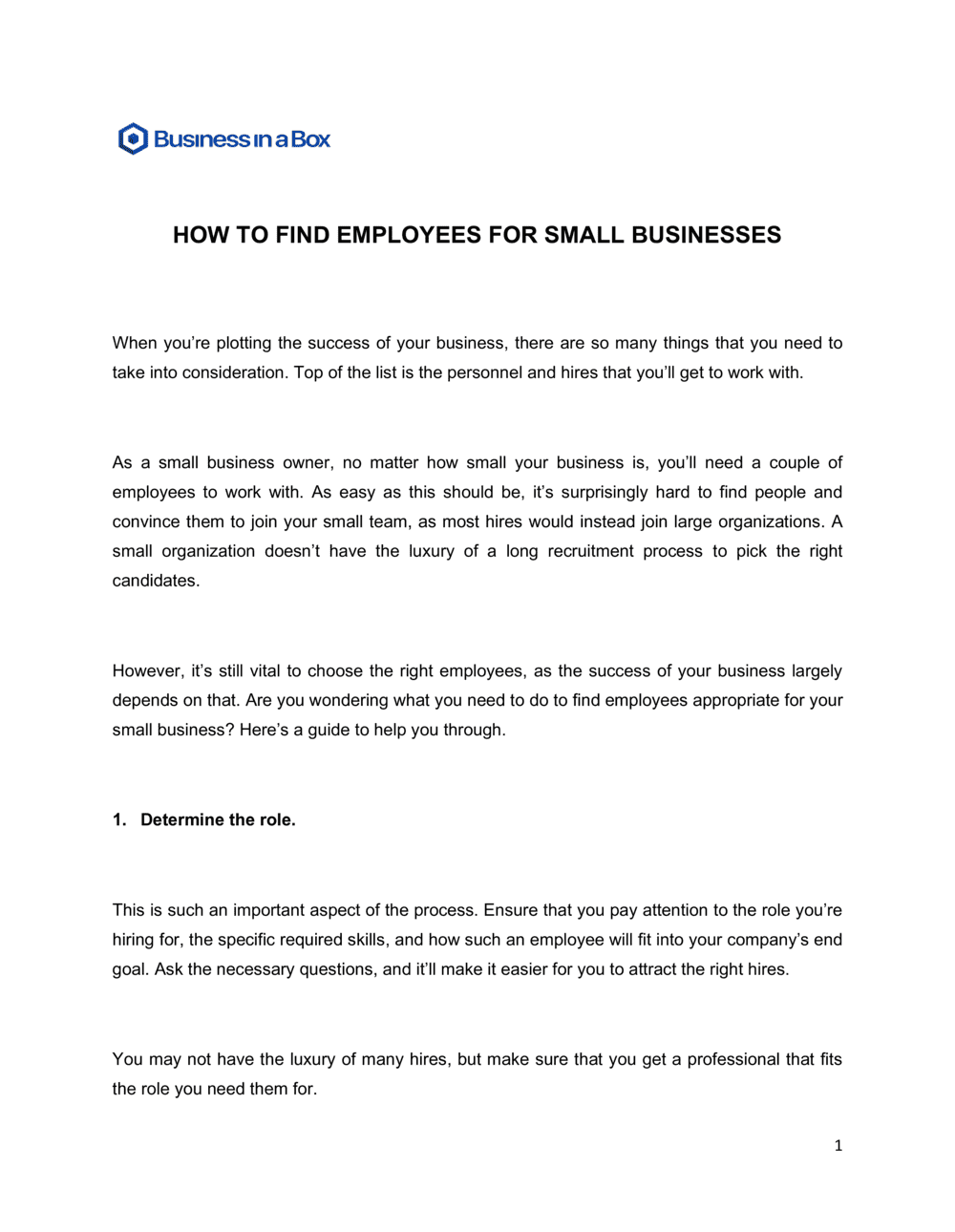
How To Find Employees For Small Business is a step-by-step operational guide and planning template that walks small business owners through defining their hiring need, writing a job posting, choosing sourcing channels, screening candidates, conducting interviews, and extending an offer. This free Word download gives you a structured, editable framework you can adapt to any role and export as PDF to share with a hiring manager or HR advisor.
When you need it
Use it when you are ready to bring on your first hire, backfill a departing employee, or scale headcount ahead of a growth phase β€” and you need a repeatable process rather than starting from scratch each time.
What's inside
Role definition and headcount justification, job description structure, sourcing channel selection, screening and shortlisting criteria, interview question frameworks, reference check steps, offer process, and a pre-onboarding checklist. Each section includes guidance notes and editable placeholders so you can complete the plan in a single sitting.

What is a How To Find Employees For Small Business Guide?

A How To Find Employees For Small Business guide is a structured operational document that walks a small business owner or hiring manager through every stage of the recruitment process β€” from defining the role and writing the job posting to screening candidates, conducting structured interviews, checking references, extending a written offer, and preparing for the new hire's first day. Unlike a generic HR policy, this template is role-agnostic and immediately actionable: each section includes editable placeholders, decision criteria, and scripted language you can adapt to any position in any industry. The result is a repeatable hiring process you can run again for every subsequent hire without rebuilding from scratch.

Why You Need This Document

Hiring without a structured process is one of the most expensive mistakes a small business can make. A bad hire at the $45,000 salary level costs an estimated $15,000–$30,000 in lost productivity, re-recruiting fees, and management time β€” before accounting for the damage to team morale. Without a written sourcing plan, most small businesses default to a single job board and hope for the best, missing the employee referral channel that consistently produces the fastest and lowest-cost hires. Without a screening rubric, hiring decisions come down to interview-day chemistry rather than demonstrated competence, and early turnover repeats the cycle. This template gives you the framework to define the right role, reach the right candidates, evaluate them consistently, and onboard them in a way that maximizes the chance they stay β€” closing the gap between the hire you wanted and the hire you actually get.

Which variant fits your situation?

If your situation is…Use this template
Hiring a full-time salaried employee for a defined roleEmployment Contract
Engaging a freelancer or contractor for project-based workIndependent Contractor Agreement
Posting a structured, detailed job descriptionJob Description Template
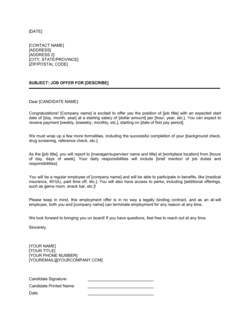
Sending a formal offer to a selected candidateJob Offer Letter
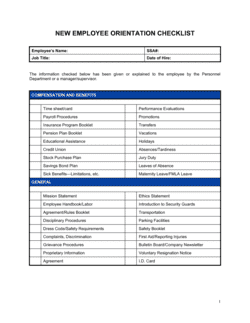
Onboarding a new hire after acceptanceEmployee Onboarding Checklist
Evaluating candidate performance during a probationary periodEmployee Probation Review
Defining the new role's performance expectations from day oneJob Performance Review Template

Common mistakes to avoid

❌ Posting a job without a written role definition

Why it matters: Without a clear scope, you attract the wrong candidates, conduct unfocused interviews, and often hire the most enthusiastic applicant rather than the most qualified one.

Fix: Write a one-paragraph role definition β€” purpose, core responsibilities, and 90-day success metric β€” before drafting a single word of the job posting.

❌ Ignoring employee referrals as a sourcing channel

Why it matters: Referred hires have a lower cost-per-hire, a shorter time-to-fill, and statistically higher retention rates than candidates sourced from job boards β€” yet most small businesses activate referrals only after paid channels fail.

Fix: Tell your current team about the opening the same day you post it externally and offer a documented referral bonus of $200–$500 payable after 60 days of employment.

❌ Conducting unstructured interviews without a scoring rubric

Why it matters: Interviewers who ask different questions to each candidate and rely on intuition are more likely to hire for likability than competence, which increases early turnover and potential discrimination exposure.

Fix: Write five to seven core questions tied to the role's requirements, use the same scoring rubric for every candidate, and make the hiring decision based on scores before debriefing.

❌ Skipping or rubber-stamping reference checks

Why it matters: Reference checks completed as a formality β€” limited to employment date verification β€” miss the single most predictive signal available before a hire: whether a former manager would rehire the person.

Fix: Ask at least two substantive questions per reference, including 'Would you rehire them?' and 'How did they respond to critical feedback?' Document the answers before making a final decision.

❌ Making only a verbal offer with no written follow-up

Why it matters: Verbal offers are misremembered and disputed. A candidate who accepts a verbal offer and later claims a different salary or start date was promised creates an immediate employment relationship problem.

Fix: Follow every verbal offer with a written offer letter within 24 hours, specifying role, compensation, start date, and employment type. Require a signed acknowledgment before onboarding begins.

❌ Starting onboarding tasks on day one instead of before

Why it matters: A new hire who arrives to no workstation, no system access, and no day-one plan forms a negative first impression in the first hour. Studies consistently link poor onboarding experiences to voluntary turnover within 90 days.

Fix: Use the pre-onboarding checklist immediately after offer acceptance to complete equipment, access, and paperwork tasks before the start date, and send the new hire a day-one agenda in advance.

The 9 key sections, explained

Role definition and headcount justification

Job description and requirements

Sourcing channel selection

Screening criteria and scoring rubric

Phone screen framework

Interview process and question bank

Reference check guide

Offer process and documentation

Pre-onboarding checklist

How to fill it out

  1. 1

    Define the role before opening the template

    Write one sentence describing what the hire will own, one sentence on why you need them now, and the specific outcome you expect within their first 90 days. These answers drive every other section.

    πŸ’‘ If you cannot write a single clear outcome for the first 90 days, the role is not yet ready to fill.

  2. 2

    Complete the job description section

    List five to seven core responsibilities (not a full task inventory), three to five hard requirements, and a salary range. Review comparable postings on Indeed or LinkedIn to sanity-check the range.

    πŸ’‘ Post the salary range. Postings with a salary range receive on average 30% more applications than those marked 'competitive' or left blank.

  3. 3

    Select two to three sourcing channels

    Choose channels based on role type: Indeed and employee referrals for most roles; LinkedIn for professional or management hires; trade schools or local workforce boards for skilled trades.

    πŸ’‘ Activate your employee referral channel before paying for job board ads β€” referred candidates hire faster, stay longer, and cost less.

  4. 4

    Build the screening rubric before applications arrive

    Define your pass/fail criteria and your 1–5 scoring dimensions in advance. Share the rubric with anyone involved in reviewing applications so shortlisting is consistent.

    πŸ’‘ Cap your shortlist at five to eight candidates per role. More than that signals your pass/fail criteria are too loose.

  5. 5

    Conduct phone screens within 48 hours of shortlisting

    Contact shortlisted candidates within two business days. Speed signals professionalism and prevents losing strong candidates to faster-moving employers.

    πŸ’‘ Block a 90-minute window for phone screens the day after your application deadline closes rather than scheduling them piecemeal over a week.

  6. 6

    Run structured interviews with consistent questions

    Use the same question bank for every candidate in the same round. Score each response immediately after the interview, before the next candidate is seen.

    πŸ’‘ Assign one interviewer to take notes and one to ask questions. Trying to do both results in incomplete notes and missed signals.

  7. 7

    Complete reference checks before issuing a written offer

    Contact at least two professional references for your top candidate. Document responses in writing and review them before the written offer goes out.

    πŸ’‘ Ask 'Is there anything that would have prevented you from recommending this person?' β€” it is harder to deflect than 'What are their weaknesses?'

  8. 8

    Issue the written offer and complete pre-onboarding tasks

    Send the written offer letter within 24 hours of the verbal offer. Start the pre-onboarding checklist immediately on acceptance so day one is ready before the hire arrives.

    πŸ’‘ Send the new hire a day-one agenda by email three days before the start date. It reduces first-day anxiety and lowers early no-show rates.

Frequently asked questions

How do small businesses find employees?

Small businesses find employees through a combination of job boards (Indeed, LinkedIn, ZipRecruiter), employee referral programs, local workforce boards, trade schools, social media, and staffing agencies. The most effective channel depends on the role type: referrals and local job boards work well for hourly and trades roles, while LinkedIn and professional networks work better for management and technical hires. Starting with employee referrals before paying for job board postings is the most cost-efficient first step for most small businesses.

What should a small business job posting include?

A strong small business job posting includes the job title, a one-sentence description of the role's purpose, five to seven core responsibilities, three to five required qualifications, preferred qualifications, the reporting structure, work schedule and location, and a salary or hourly rate range. Postings that include a compensation range receive significantly more applications than those that omit it. Keep the posting under 600 words β€” longer postings have lower application rates.

How much does it cost to hire an employee for a small business?

The cost of hiring depends on the channel and role. Job board postings typically run $200–$500 per posting per month. Staffing agencies charge 15–25% of the first year's salary for direct-hire placements. Beyond sourcing costs, factor in the time cost of screening, interviewing, and onboarding β€” typically 20–40 hours of staff time per hire for a small business. Using a structured hiring guide reduces that time significantly by eliminating unproductive interviews and mis-screened candidates.

How long does it take to hire an employee for a small business?

The average time-to-fill for a small business hire is 3–6 weeks from job posting to accepted offer, depending on role complexity and labor market conditions. Roles requiring specialized skills or licenses can take 8–12 weeks. Using a structured process with defined screening criteria and a firm decision timeline reduces time-to-fill by 30–40% compared to an ad-hoc approach.

Should a small business use a staffing agency to find employees?

Staffing agencies are worth the 15–25% placement fee when you need to fill a role quickly, lack internal recruiting capacity, or are hiring in a specialized field where you do not have the network to source candidates directly. For recurring hourly or entry-level roles, building your own sourcing and screening process is more cost-effective over time. A hybrid approach β€” using a template-driven internal process for most hires and an agency for hard-to-fill roles β€” balances speed and cost.

What questions should a small business ask in a job interview?

Effective small business interview questions are behavioral or situational and tied directly to the role's core requirements. Examples: 'Tell me about a time you handled a difficult customer β€” what did you do and what was the outcome?' and 'Describe a situation where you had to learn a new process quickly β€” how did you approach it?' Avoid hypothetical questions that let candidates give idealized answers; ask for specific past examples instead.

Do I need a written job offer letter for a small business hire?

Yes. A written offer letter is not legally required in most US states, but it is strongly recommended for every hire. It documents the agreed role title, compensation, start date, and employment type in a way that prevents disputes. It also signals professionalism to the candidate and creates a reference document for your payroll and HR records. A verbal offer followed by no written confirmation is one of the most common sources of early employment relationship disputes.

What is the difference between an employee and an independent contractor for a small business?

An employee works under your direction, on your schedule, using your tools, and you withhold payroll taxes on their behalf. An independent contractor sets their own schedule, uses their own tools, and is responsible for their own taxes. The distinction matters because misclassifying an employee as a contractor triggers back taxes, penalties, and potential benefits liability. If you control how and when the work is done, the worker is likely an employee regardless of what you call the arrangement.

How do I keep new employees once I hire them?

Retention starts before day one. New hires who receive a clear pre-onboarding communication, arrive to a prepared workspace, and have a structured first-week agenda are significantly more likely to stay past 90 days. Beyond onboarding, small businesses retain employees through consistent feedback, transparent expectations, competitive pay relative to the local market, and growth opportunities β€” even informal ones like cross-training and added responsibility.

How this compares to alternatives

vs Job Description Template

A job description template covers only the role specification β€” title, responsibilities, and qualifications. The hiring guide covers the full process from role justification through onboarding. Use the job description template to create the posting; use this guide to run the hiring process around it.

vs Employee Onboarding Checklist

An onboarding checklist picks up where the hiring guide ends β€” on or before the new hire's first day. The hiring guide covers sourcing, screening, interviewing, and offer; the onboarding checklist covers the integration steps after offer acceptance. Both are needed for a complete hire-to-productive workflow.

vs Recruitment Plan Template

A recruitment plan is a higher-level strategic document covering annual headcount needs, budget, and employer branding. This hiring guide is tactical and role-specific β€” focused on executing a single hire end to end. Growing businesses typically need both: a recruitment plan for annual workforce planning and this guide for each individual hire.

vs Employment Contract

An employment contract is the legally binding agreement signed by both parties after a candidate accepts an offer. This hiring guide covers the process used to find and select that candidate. The contract governs the employment relationship; the guide governs the hiring process that creates it.

Industry-specific considerations

Retail and hospitality

High-turnover hourly roles require a fast, repeatable screening process; employee referrals and walk-in applications are the highest-yield sourcing channels.

Construction and trades

Skilled tradespeople are best sourced through local union halls, trade school job boards, and word-of-mouth referrals; license and certification verification is a pass/fail screen requirement.

Professional services

LinkedIn, professional association networks, and employee referrals dominate sourcing; structured competency interviews and work-sample assessments improve hire quality for client-facing roles.

Food and beverage

Seasonal hiring spikes require a pre-built sourcing pipeline; food handler certification verification and availability screening are critical pass/fail criteria at the phone screen stage.

Template vs pro β€” what fits your needs?

PathBest forCostTime
Use the templateSmall business owners and managers running the hiring process themselves for standard rolesFree3–6 weeks from posting to accepted offer
Template + professional reviewBusinesses hiring for a senior, technical, or hard-to-fill role where sourcing strategy needs refinement$200–$800 for an HR consultant session or job posting optimization service2–5 weeks with professional sourcing input
Custom draftedHigh-volume hiring, executive search, or businesses in regulated industries requiring background checks and compliance documentation$3,000–$15,000+ for a staffing agency placement or executive recruiter4–12 weeks depending on role seniority and market conditions

Glossary

Headcount Justification
A written rationale explaining why a new role is needed, what problem it solves, and how the cost is offset by revenue, capacity, or risk reduction.
Job Description
A document outlining a role's title, responsibilities, required qualifications, reporting structure, and compensation range.
Sourcing Channel
Any platform, network, or method used to find and attract job candidates β€” including job boards, referrals, social media, and staffing agencies.
Applicant Tracking
The process or software used to log, organize, and move candidates through the hiring pipeline from application to offer.
Screening
An initial review of applications or a brief phone call to determine whether a candidate meets the minimum qualifications before a full interview.
Structured Interview
An interview format where every candidate is asked the same predetermined questions, scored against the same criteria, to reduce bias and improve comparability.
Reference Check
A conversation with a candidate's former employer or colleague to verify work history, performance, and character before extending an offer.
Offer Letter
A written document sent to the selected candidate confirming the role, start date, compensation, and key employment conditions.
Onboarding
The structured process of integrating a new hire into the business β€” including paperwork, system access, training, and introductions β€” during their first days and weeks.
Probationary Period
A defined initial period β€” typically 30 to 90 days β€” during which both the employer and new hire assess fit before confirming permanent employment.

Part of your Business Operating System

This document is one of 3,000+ business & legal templates included in Business in a Box.

  • Fill-in-the-blanks β€” ready in minutes
  • Compatible with all office suites
  • Export to PDF and share electronically

Create your document in 3 simple steps.

From template to signed document β€” all inside one Business Operating System.
1
Download or open template

Access over 3,000+ business and legal templates for any business task, project or initiative.

2
Edit and fill in the blanks with AI

Customize your ready-made business document template and save it in the cloud.

3
Save, Share, Send, Sign

Share your files and folders with your team. Create a space of seamless collaboration.

Save time, save money, and create top-quality documents.

β˜…β˜…β˜…β˜…β˜…

"Fantastic value! I'm not sure how I'd do without it. It's worth its weight in gold and paid back for itself many times."

Managing Director Β· Mall Farm
Robert Whalley
Managing Director, Mall Farm Proprietary Limited
β˜…β˜…β˜…β˜…β˜…

"I have been using Business in a Box for years. It has been the most useful source of templates I have encountered. I recommend it to anyone."

Business Owner Β· 4+ years
Dr Michael John Freestone
Business Owner
β˜…β˜…β˜…β˜…β˜…

"It has been a life saver so many times I have lost count. Business in a Box has saved me so much time and as you know, time is money."

Owner Β· Upstate Web
David G. Moore Jr.
Owner, Upstate Web

Run your business with a system β€” not scattered tools

Stop downloading documents. Start operating with clarity. Business in a Box gives you the Business Operating System used by over 250,000 companies worldwide to structure, run, and grow their business.

Free Forever PlanΒ Β·Β No credit card required