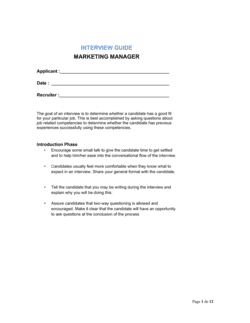
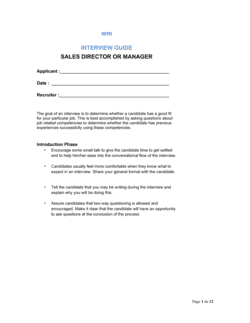
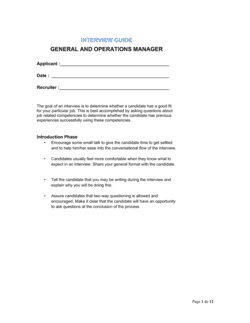
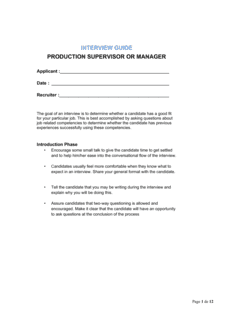
Interview Guide Human Resources Manager

Free to read β€’ Save or share with one click

FreeInterview Guide Human Resources Manager Template

At a glance

What it is
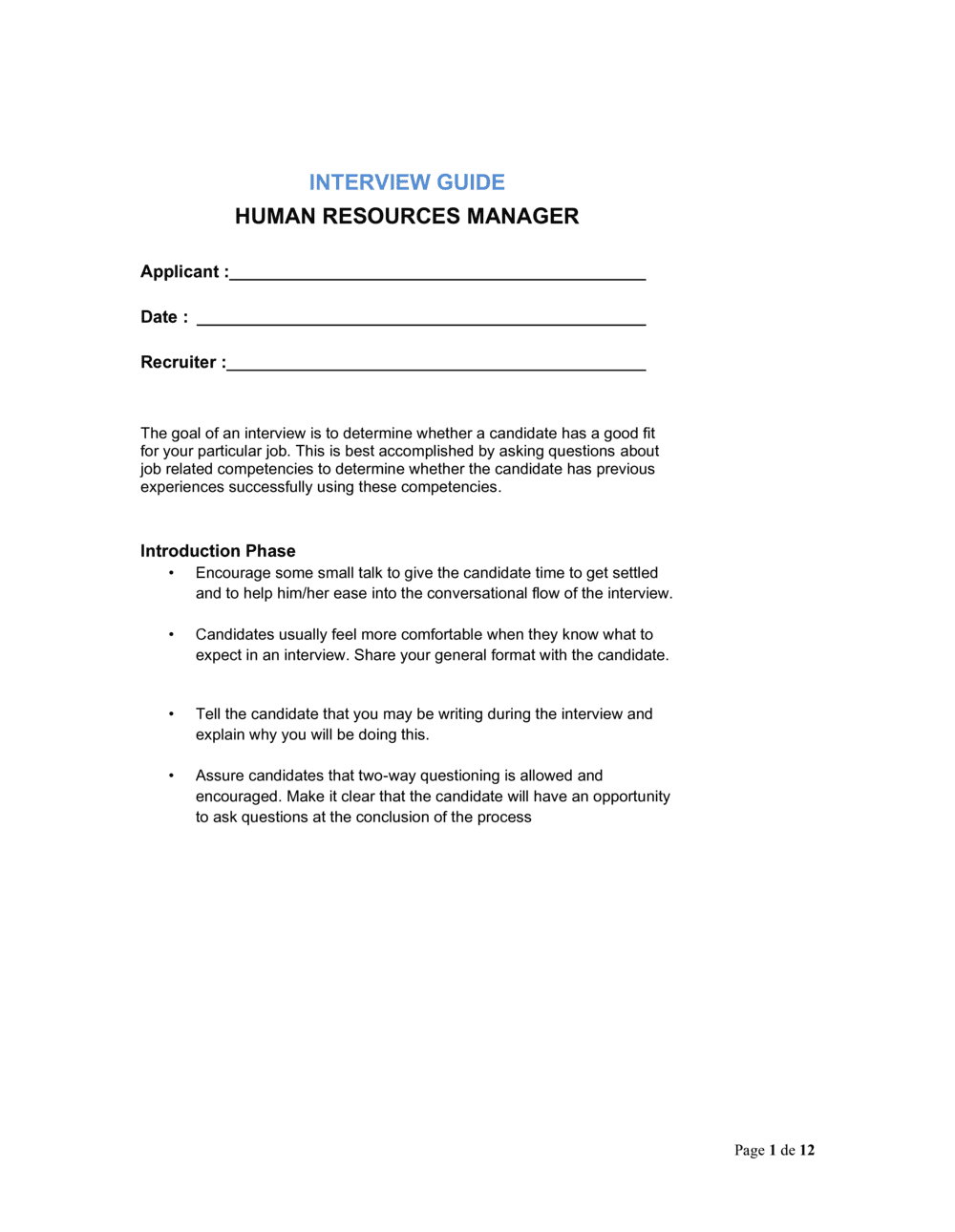
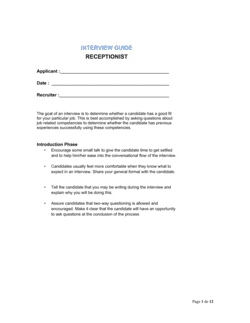
An Interview Guide Human Resources Manager is a structured document that organizes every phase of interviewing an HR manager candidate β€” from role context and competency-based questions through evaluation scoring and debrief notes. This free Word download gives interviewers a consistent, legally defensible framework they can edit online and export as PDF before each interview panel.
When you need it
Use it whenever you are actively recruiting for an HR manager position and need multiple interviewers β€” hiring managers, executives, or peer reviewers β€” to evaluate candidates against the same criteria. It is especially important when multiple finalists are being compared side by side.
What's inside
Role overview and must-have competencies, a structured question bank covering HR expertise, employment law awareness, employee relations, and leadership, individual scoring rubrics for each competency, and a post-interview debrief and recommendation section.

What is an Interview Guide Human Resources Manager?

An Interview Guide Human Resources Manager is a structured operational document that organizes the complete evaluation process for HR manager candidates β€” from role context and competency definitions through a question bank, scoring rubrics, and a post-interview debrief framework. It gives every interviewer on the panel a consistent set of questions, a shared rating scale with behavioral anchors, and a clear process for reaching a documented hire or no-hire recommendation. Unlike an informal list of questions, a structured guide ensures that candidates are compared against the same criteria rather than against each other's impressions, which is both fairer and more predictive of on-the-job performance.

Why You Need This Document

Hiring an HR manager without a structured guide exposes the organization to two simultaneous risks: a bad hire and a legal liability. On the quality side, unstructured interviews for HR roles β€” where candidates are sophisticated enough to give textbook answers β€” produce little signal about how a person will actually handle a workplace investigation, a termination, or a compliance audit. On the legal side, inconsistent questions across candidates create discrimination exposure that is particularly damaging when the HR function itself is the hiring unit. A well-prepared interview guide closes both gaps: it forces interviewers to probe for behavioral evidence rather than accept polished generalities, and it creates a documented, consistent evaluation record that demonstrates a fair process. This template gives you a ready-to-use structure you can customize in under 90 minutes and reuse across every future HR manager search.

Which variant fits your situation?

If your situation is…Use this template
Hiring a generalist HR manager for a small to mid-size companyInterview Guide Human Resources Manager
Recruiting an HR director or VP with strategic people leadership responsibilitiesInterview Guide HR Director
Screening a high volume of HR coordinator or specialist applicantsInterview Guide HR Coordinator
Evaluating an HR manager candidate's technical knowledge onlyHR Skills Assessment Test
Conducting a structured phone or video pre-screen before full panelPhone Interview Screening Guide
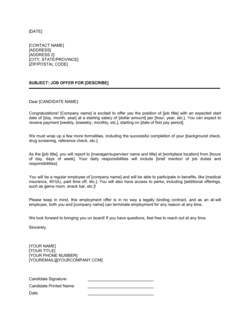
Documenting the final hiring decision and offer rationaleJob Offer Letter
Onboarding the selected HR manager after hireEmployee Onboarding Checklist

Common mistakes to avoid

❌ Distributing the guide the morning of the interview

Why it matters: Interviewers who receive the guide with no lead time skip the scoring rubric, improvise questions, and produce inconsistent evaluations that make candidate comparison unreliable.

Fix: Send the guide at least 48 hours before the scheduled interview with a note on each interviewer's assigned competency block and the scoring rules.

❌ Asking illegal or legally risky questions

Why it matters: Questions about age, national origin, marital status, religion, or disability β€” even phrased informally β€” expose the organization to discrimination claims, especially damaging when an HR function is the hiring unit.

Fix: Include a one-page list of prohibited question topics at the front of the guide. Train all interviewers on the list before any session begins.

❌ Scoring all candidates in the middle of the rubric

Why it matters: Central tendency bias β€” rating everyone a 3 out of 5 β€” makes the scorecard useless for differentiating finalists and effectively voids the structured process.

Fix: Use behavioral anchors for each score level and require interviewers to cite a specific behavior or quote to justify any score they assign.

❌ Skipping the debrief or replacing it with a group chat message

Why it matters: Without a structured in-person or synchronous debrief, the loudest opinion dominates and weaker evidence from other interviewers is lost, producing hiring decisions driven by seniority rather than data.

Fix: Schedule the debrief session at the time you schedule the interviews. Block 45 minutes immediately after the final panel session ends while observations are fresh.

The 9 key sections, explained

Role overview and success profile

Interview structure and time allocation

Core competencies and rating rubric

HR technical knowledge questions

Employee relations and conflict resolution questions

Leadership and people development questions

Culture fit and organizational alignment questions

Scoring summary and interviewer notes

Debrief facilitation guide

How to fill it out

  1. 1

    Complete the role overview before scheduling interviews

    Fill in the reporting structure, team size, and 90-day success outcomes before distributing the guide to interviewers. This context shapes how every interviewer interprets candidate answers.

    πŸ’‘ Get the hiring manager and CHRO to agree on the success profile in writing before any interviews begin β€” misalignment here is the leading cause of failed debrief sessions.

  2. 2

    Select and sequence the competencies

    Choose five to seven competencies that are genuinely critical for this specific role and company stage. Assign each competency to one interviewer or panel block so coverage is complete without redundancy.

    πŸ’‘ Limit each interviewer to evaluating no more than three competencies per session β€” evaluating more fragments attention and degrades scoring quality.

  3. 3

    Customize the question bank for your context

    Replace generic placeholder scenarios with examples relevant to your industry, company size, and the specific challenges the incoming HR manager will face in their first six months.

    πŸ’‘ Including one question about a real, anonymized challenge your HR function has faced generates the most revealing answers and differentiates strong candidates from scripted ones.

  4. 4

    Set behavioral anchors for each scoring level

    For each competency, write one concrete behavioral description for scores 1, 3, and 5. Interviewers use these anchors to calibrate independently before the debrief.

    πŸ’‘ Calibration is faster if you write the 5-anchor first (ideal answer) and the 1-anchor second (unacceptable answer), then fill in the 3 as the middle ground.

  5. 5

    Brief the interview panel before the first session

    Walk all interviewers through the guide, their assigned competency blocks, the scoring rubric, and the rule that scores must be recorded before the debrief discussion begins.

    πŸ’‘ A 15-minute panel calibration meeting before the first candidate cuts score variance by giving everyone a shared reference point.

  6. 6

    Conduct the interview following the time allocation

    Follow the structured time map β€” introduction, technical questions, behavioral questions, candidate Q&A, and close. Note specific quotes and behaviors in the evidence column as you go, not from memory afterward.

    πŸ’‘ Write down the candidate's exact words for the strongest and weakest answer. Paraphrasing in your memory shifts toward your existing impression of the candidate.

  7. 7

    Complete the scorecard independently before the debrief

    Each interviewer fills in their competency scores and supporting evidence immediately after their session ends, before talking to any other panel member.

    πŸ’‘ Set a 30-minute scorecard completion deadline after each interview round. Scores recorded more than two hours after the interview show measurable memory decay.

  8. 8

    Facilitate the debrief using the structured agenda

    Reveal scores simultaneously, surface disagreements of 2 or more points, and document the panel's consensus recommendation with specific behavioral evidence as the rationale.

    πŸ’‘ If the panel cannot reach consensus, that is a valid outcome β€” document the disagreement and escalate to the hiring manager rather than forcing a premature decision.

Frequently asked questions

What is an interview guide for an HR manager role?

An interview guide for an HR manager role is a structured document that organizes the entire candidate evaluation process β€” from role context and competency definitions through question banks, scoring rubrics, and debrief facilitation. It ensures every candidate is assessed against the same criteria by every interviewer, producing defensible, comparable hiring decisions. It is especially critical for HR roles because the incoming manager will themselves oversee future structured hiring processes.

What competencies should an HR manager interview guide assess?

A well-designed guide covers five to seven competencies tailored to the role. The most commonly included are employment law knowledge, employee relations and conflict resolution, HR systems and data literacy, compensation and benefits administration, talent acquisition and workforce planning, manager coaching and organizational development, and culture building. The weight given to each depends on the company's size, industry, and the specific HR challenges the incoming manager will face.

How many questions should an HR manager interview guide include?

A 60-minute interview typically accommodates eight to twelve structured questions, leaving time for the candidate to ask questions and for a proper close. Behavioral questions require two to four minutes for a complete STAR-format answer, so avoid cramming more than twelve substantive questions into a single session. Assign three to four questions per interviewer in a panel format rather than one interviewer covering the full bank.

What is the STAR method and why does it matter for HR manager interviews?

STAR stands for Situation, Task, Action, and Result. It is a structured response framework that prompts candidates to describe a specific past experience rather than a hypothetical preference. For HR manager interviews, STAR-format answers reveal whether a candidate has actually navigated complex employee relations scenarios, compliance issues, or organizational change β€” rather than simply knowing the theory. Follow up any vague answer with 'What specifically did you do?' to surface concrete evidence.

How do you score candidates consistently across an interview panel?

Consistent scoring requires three things: a written rubric with behavioral anchors at each score level (not just a number), an agreement that each interviewer scores independently before the debrief discussion, and a calibration session before the first interview where the panel aligns on what a 5 versus a 3 looks like for each competency. Without anchors and independent scoring, social influence β€” particularly from the most senior person in the room β€” dominates the debrief and overrides individual observations.

What questions are illegal to ask in an HR manager interview?

In the United States, interviewers may not ask about age, race, national origin, religion, disability, pregnancy, marital or family status, or sexual orientation. This applies regardless of how casually the question is phrased. Questions about salary history are restricted or banned in many states. Including a prohibited-topics reference sheet in the guide protects the organization and is particularly important when the interviewing team includes non-HR managers who may not know the rules.

Should an HR manager interview guide be different for a startup versus a large company?

Yes, meaningfully so. A startup's guide should weight generalist capability β€” comfort building programs from scratch, operating without established policies, and working with minimal administrative support β€” more heavily than deep specialization. A large company's guide typically emphasizes functional depth, people-management experience, and the ability to navigate complex organizational structures. The question bank and success profile should reflect the actual environment the candidate will step into.

How long does it take to prepare an HR manager interview guide?

Using a structured template, a talent acquisition lead or hiring manager can customize a complete guide in 60 to 90 minutes β€” including tailoring the question bank, writing behavioral anchors, and assigning panel coverage. Building one from scratch typically takes four to six hours. The time investment pays back quickly: structured interviews reduce mis-hires, which for a manager-level role typically cost 50–100% of annual salary to remediate.

Can the same interview guide be reused for future HR manager hires?

Yes, with updates. The core competency framework, scoring rubric, and question bank are largely reusable. Before each new search, update the role overview and 90-day success outcomes to reflect the current business context, and replace any scenario-based questions that are now too familiar to internal candidates who may have heard them previously. Review the guide annually to ensure question content reflects current employment law and organizational priorities.

How this compares to alternatives

vs Job description

A job description defines the role for external candidates and sets minimum qualifications for screening. An interview guide is an internal tool used after screening β€” it structures how interviewers evaluate the candidates who have already cleared the job description bar. You need both: the job description attracts candidates; the interview guide selects the right one.

vs Interview scorecard

An interview scorecard is the evaluation and rating section of a broader interview guide β€” it captures scores and evidence but does not include the question bank, time structure, or debrief facilitation guide. A full interview guide contains the scorecard as one of several integrated sections. Use a standalone scorecard only when the question bank and structure already exist elsewhere.

vs Job offer letter

An interview guide is used before a hiring decision to evaluate candidates. A job offer letter is issued after the decision to formalize the employment terms. The interview guide produces the hire recommendation; the offer letter acts on it. Both documents should be completed in sequence for every manager-level hire.

vs Employee onboarding checklist

An interview guide covers the pre-hire evaluation phase. An onboarding checklist begins after the candidate accepts the offer and covers the tasks, training, and introductions that set the new HR manager up for success in their first 30 to 90 days. The success outcomes documented in the interview guide should directly inform the onboarding checklist milestones.

Industry-specific considerations

Technology / SaaS

Technical questions cover distributed team policies, equity compensation administration, and rapid headcount scaling during funding rounds.

Healthcare

Guide emphasizes credentialing compliance, HIPAA training program management, and high-volume clinical staff relations scenarios.

Retail / Hospitality

Focus areas include hourly workforce scheduling compliance, high-turnover retention strategies, and managing employee relations across multiple locations.

Professional Services

Questions probe experience with performance-based compensation structures, utilization rate management, and professional development program design.

Template vs pro β€” what fits your needs?

PathBest forCostTime
Use the templateHR teams, hiring managers, and founders conducting structured HR manager interviews without a dedicated recruiting functionFree60–90 minutes to customize
Template + professional reviewCompanies hiring their first senior HR leader or operating in a heavily regulated industry with complex compliance interview requirements$300–$800 for an HR consultant or I/O psychologist review2–3 days
Custom draftedEnterprises standardizing structured interviewing across all manager-level roles with validated competency frameworks and EEOC audit trails$2,000–$8,000 for a custom competency model and validated question bank3–6 weeks

Glossary

Structured Interview
An interview format in which all candidates are asked the same predetermined questions in the same order, enabling fair, apples-to-apples comparison.
Competency-Based Question
A question asking candidates to describe a specific past situation that demonstrates a defined skill or behavior β€” often framed using the STAR method.
STAR Method
A response framework β€” Situation, Task, Action, Result β€” used to elicit concrete behavioral evidence from a candidate's work history.
Scoring Rubric
A defined rating scale (typically 1–5) with anchored behavioral descriptions for each score level, applied to each competency after each interview.
Competency
A specific, observable skill or behavior β€” such as conflict resolution, compliance knowledge, or workforce planning β€” that predicts job performance.
Panel Interview
An interview format involving two or more interviewers evaluating the same candidate simultaneously, reducing individual interviewer bias.
Debrief Session
A structured post-interview meeting in which all interviewers independently share scores and observations before discussing a hire or no-hire recommendation.
Employment Law Compliance
Adherence to federal, state, and local statutes governing hiring, termination, discrimination, pay equity, and leave β€” a core competency area for any HR manager candidate.
Employee Relations
The function of managing workplace conflicts, investigations, performance issues, and grievances between employees and the organization.
Adverse Impact
A statistical disparity in hiring outcomes between protected groups that can signal unlawful discrimination, even when unintentional β€” a risk that structured interviews help mitigate.

Part of your Business Operating System

This document is one of 3,000+ business & legal templates included in Business in a Box.

  • Fill-in-the-blanks β€” ready in minutes
  • Compatible with all office suites
  • Export to PDF and share electronically

Create your document in 3 simple steps.

From template to signed document β€” all inside one Business Operating System.
1
Download or open template

Access over 3,000+ business and legal templates for any business task, project or initiative.

2
Edit and fill in the blanks with AI

Customize your ready-made business document template and save it in the cloud.

3
Save, Share, Send, Sign

Share your files and folders with your team. Create a space of seamless collaboration.

Save time, save money, and create top-quality documents.

β˜…β˜…β˜…β˜…β˜…

"Fantastic value! I'm not sure how I'd do without it. It's worth its weight in gold and paid back for itself many times."

Managing Director Β· Mall Farm
Robert Whalley
Managing Director, Mall Farm Proprietary Limited
β˜…β˜…β˜…β˜…β˜…

"I have been using Business in a Box for years. It has been the most useful source of templates I have encountered. I recommend it to anyone."

Business Owner Β· 4+ years
Dr Michael John Freestone
Business Owner
β˜…β˜…β˜…β˜…β˜…

"It has been a life saver so many times I have lost count. Business in a Box has saved me so much time and as you know, time is money."

Owner Β· Upstate Web
David G. Moore Jr.
Owner, Upstate Web

Run your business with a system β€” not scattered tools

Stop downloading documents. Start operating with clarity. Business in a Box gives you the Business Operating System used by over 250,000 companies worldwide to structure, run, and grow their business.

Free Forever PlanΒ Β·Β No credit card required