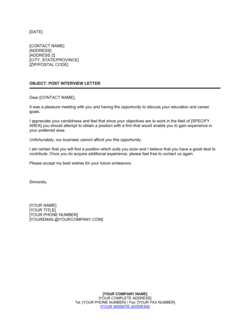
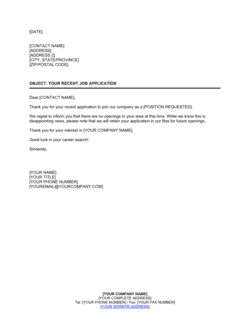
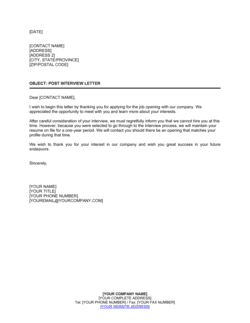
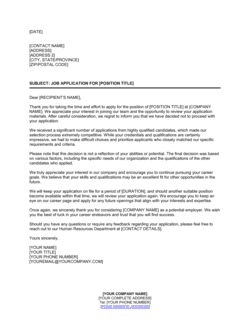
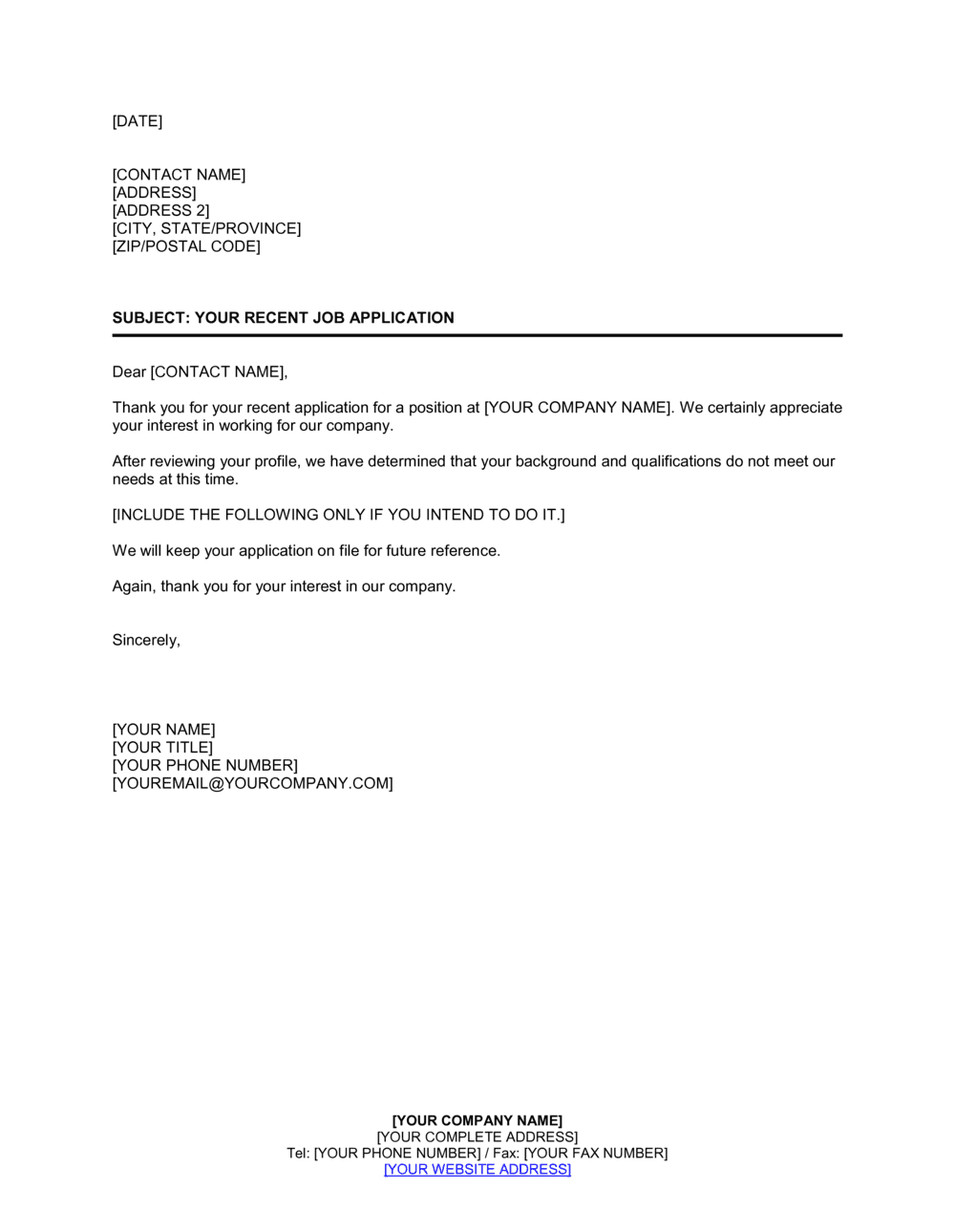
Negative Response_Qualifications Template

Free Word download • Edit online • Save & share with Drive • Export to PDF

1 page20–30 min to fillDifficulty: StandardSignature requiredLegal review recommended
Learn more ↓
FreeNegative Response_Qualifications Template

At a glance

What it is
A Negative Response Qualifications document is a formal written notice issued to a job applicant or candidate who has been disqualified from consideration following a screening or evaluation process. This free Word download gives employers, HR teams, and hiring managers a legally structured template that communicates the disqualification decision, cites the basis for it, and satisfies applicable statutory disclosure requirements — including FCRA adverse action obligations in the United States.
When you need it
Use it whenever a candidate is declined based on the results of a background check, credit report, reference verification, or other consumer report. It is also appropriate when an applicant fails to meet non-negotiable role qualifications and a documented record of the decision is required for compliance, audit, or litigation-protection purposes.
What's inside
Employer and applicant identification details, a clear statement of the adverse or negative decision, the specific grounds or qualifications that were not met, statutory disclosures required by applicable law, information about the candidate's rights to dispute or request further information, and authorized signature and date blocks.

What is a Negative Response Qualifications Notice?

A Negative Response Qualifications notice is a formal written document issued by an employer to a job applicant who has been disqualified from consideration following a screening or evaluation process. Where the disqualification is based in whole or in part on information obtained through a consumer report — such as a background check, credit history review, or reference verification conducted by a third-party reporting agency — the notice must satisfy the specific adverse action disclosure requirements of the Fair Credit Reporting Act in the United States and equivalent privacy and employment laws in other jurisdictions. The document identifies both parties, states the final hiring decision, cites the legal and factual basis for disqualification, names the consumer reporting agency involved, and informs the applicant of their rights to dispute the underlying information or request a copy of the report.

Why You Need This Document

Declining an applicant without the correct written notice is not a procedural technicality — it is a statutory violation that carries per-applicant damages, attorney's fees, and class-action exposure under the FCRA. Employers who issue a single informal rejection email when a background check was involved, or who skip the mandatory pre-adverse action waiting period, face penalties ranging from $100 to $1,000 per affected applicant for negligent violations, plus punitive damages for willful ones. Beyond FCRA compliance, a properly completed notice creates a defensible contemporaneous record of the disqualification grounds — essential evidence if the applicant later files an EEOC discrimination charge or a state-law wrongful rejection claim. This template provides the complete two-step FCRA-compliant structure, the required CRA disclosure fields, the statutory rights language, and the individualized assessment statement needed for criminal history decisions — giving HR teams a legally sound, consistently applied process for every adverse hiring decision.

Which variant fits your situation?

If your situation is…Use this template
Declining an applicant based on a third-party background check or credit reportNegative Response Qualifications (FCRA Adverse Action)
Rejecting a candidate who failed to meet minimum role qualificationsApplicant Rejection Letter
Notifying an internal employee of a promotion denialPromotion Denial Letter
Declining a candidate after an interview with no background check involvedPost-Interview Rejection Letter
Revoking a conditional offer of employment after a failed background checkOffer Revocation Letter
Documenting a disqualification for a regulated industry role (security, finance, healthcare)Regulated Industry Candidate Disqualification Notice
Terminating an existing employee based on newly discovered background check resultsEmployment Termination Letter

Common mistakes to avoid

❌ Skipping the pre-adverse action step

Why it matters: FCRA requires a two-step process when a consumer report is involved — a preliminary notice before the decision, then a final notice after the waiting period. Issuing only the final notice violates section 615(a) and exposes the employer to statutory damages of $100–$1,000 per violation, plus potential class-action liability.

Fix: Build a two-step workflow: send the pre-adverse action notice with the consumer report and FTC rights summary first, wait at least 5 business days, then issue this final negative response notice.

❌ Omitting the consumer reporting agency's contact information

Why it matters: FCRA section 615(a) explicitly requires the adverse action notice to identify the CRA by name, address, and phone number. A notice that omits this information is facially non-compliant and cannot be cured after the fact.

Fix: Enter the full legal name, mailing address, and phone number of the background check company in the basis-for-disqualification clause of every notice where a consumer report was involved.

❌ Using a paraphrased summary of FCRA rights instead of the official FTC form

Why it matters: The statute requires the FTC-prescribed summary — custom summaries, condensed versions, or website links to the rights document do not satisfy the statutory requirement and are treated as non-disclosures.

Fix: Always attach the current FTC form 'A Summary of Your Rights Under the Fair Credit Reporting Act' as a physical or digital enclosure with the notice.

❌ Failing to conduct or document an individualized assessment for criminal history

Why it matters: In ban-the-box jurisdictions and under EEOC guidance, blanket exclusion policies based on criminal records without individualized assessment create disparate impact exposure. Some jurisdictions — including New York City — impose fines for each violation.

Fix: For any disqualification based on criminal history, document a written individualized assessment in the applicant's file that addresses the nature of the offense, time elapsed, and relevance to the job duties before issuing the notice.

❌ Sending the notice to a personal email without confirming delivery

Why it matters: If the applicant later claims they never received the notice, and the employer has no delivery record, the employer cannot prove the required disclosures were made — exposing it to the full range of FCRA remedies.

Fix: Send the notice via certified mail, email with read-receipt confirmation, or an eSign platform that timestamps delivery. Retain the delivery record in the applicant's file alongside the notice.

❌ Applying a federal-only FCRA template in a state with additional requirements

Why it matters: California, New York, Washington, and several other states impose obligations beyond federal FCRA minimums — including longer waiting periods, additional disclosures, and enhanced dispute rights. A federal-only template leaves these gaps unfilled.

Fix: Identify the state where the applicant was applying to work and review that state's specific adverse action statutes before issuing the notice. Add any required state disclosures to the template's governing law clause.

The 10 key clauses, explained

Parties and Applicant Identification

In plain language: Identifies the employer by legal entity name and the applicant by full name, application reference, and the position applied for.

Sample language
This notice is issued by [EMPLOYER LEGAL NAME] ('Employer') to [APPLICANT FULL NAME] ('Applicant') in connection with Applicant's application for the position of [JOB TITLE], Reference No. [APPLICATION NUMBER], submitted on [DATE].

Common mistake: Using the employer's trade name instead of its registered legal entity name. If the adverse action is challenged, court filings must reference the correct legal entity — mismatches create procedural complications.

Statement of Negative Decision

In plain language: Clearly states that the employer has decided not to proceed with the applicant's candidacy and that the decision is final as of the notice date.

Sample language
After careful review, Employer has determined that it will not be proceeding with [APPLICANT FULL NAME]'s application for employment. This decision is effective as of [DATE].

Common mistake: Using ambiguous language such as 'we are unable to move forward at this time' rather than a definitive statement. Ambiguity creates grounds for the applicant to argue the process is ongoing and dispute rights have not yet attached.

Basis for Disqualification

In plain language: Identifies the specific ground — consumer report findings, unmet qualifications, or policy thresholds — that drove the adverse decision, without disclosing more detail than required.

Sample language
This decision was made in whole or in part based on information contained in a consumer report prepared by [CRA NAME], [CRA ADDRESS], [CRA PHONE NUMBER]. The consumer report indicated [GENERAL NATURE OF FINDING — e.g., a criminal record / credit history / verification discrepancy].

Common mistake: Omitting the identity and contact information of the consumer reporting agency when the decision is based on a CRA report. FCRA section 615(a) requires this disclosure; its absence exposes the employer to statutory damages of $100–$1,000 per violation.

Pre-Adverse Action Disclosure and Waiting Period Confirmation

In plain language: Confirms that the required pre-adverse action notice, copy of the consumer report, and summary of rights were previously provided, and that the mandatory waiting period has elapsed.

Sample language
On [DATE], Employer provided Applicant with a copy of the consumer report and a written summary of Applicant's rights under the Fair Credit Reporting Act (FCRA), 15 U.S.C. § 1681 et seq. A period of not less than [5] business days has elapsed since that notice was issued.

Common mistake: Skipping the pre-adverse action step entirely and issuing only the post-adverse notice. The two-step process is not optional under FCRA when a consumer report is involved — a single notice does not satisfy the statute.

Applicant's Dispute and Correction Rights

In plain language: Informs the applicant of their right to dispute the accuracy of the consumer report directly with the reporting agency and to request a free copy of the report within 60 days.

Sample language
Applicant has the right to dispute the accuracy or completeness of any information in the consumer report by contacting [CRA NAME] directly at [CRA CONTACT DETAILS]. Applicant may obtain a free copy of the report from [CRA NAME] within 60 days of this notice.

Common mistake: Directing the applicant to dispute with the employer rather than the consumer reporting agency. Under FCRA, disputes about report accuracy must go to the CRA; the employer cannot investigate or correct CRA data on the CRA's behalf.

Summary of FCRA Rights

In plain language: References or attaches the FTC-prescribed Summary of Consumer Rights Under the FCRA, which employers are required to provide alongside the adverse action notice.

Sample language
A copy of 'A Summary of Your Rights Under the Fair Credit Reporting Act,' as prescribed by the Federal Trade Commission, is attached to and incorporated into this notice.

Common mistake: Paraphrasing FCRA rights rather than using or attaching the official FTC-prescribed summary. The statute requires the specific prescribed form — a custom summary does not satisfy the requirement.

Non-Discrimination and Individualized Assessment Statement

In plain language: States that the employer's decision was made in a non-discriminatory manner consistent with EEOC guidance, and where applicable, confirms that an individualized assessment of the applicant's circumstances was conducted.

Sample language
Employer's decision was made consistent with applicable equal employment opportunity laws and, where required by applicable law or Employer policy, an individualized assessment of the nature, gravity, and age of the relevant information and its relationship to the position was conducted.

Common mistake: Omitting any reference to individualized assessment when the disqualifying ground is a criminal record. In jurisdictions with ban-the-box laws, failure to document an individualized assessment is a standalone violation independent of the FCRA process.

Contact Information for Questions

In plain language: Provides a named employer contact — typically in HR — whom the applicant may reach with questions about the notice, distinct from the CRA contact for report disputes.

Sample language
Questions regarding this notice (other than disputes about the consumer report itself) may be directed to [HR CONTACT NAME], [TITLE], [EMPLOYER], [ADDRESS], [EMAIL], [PHONE].

Common mistake: Providing a general company email or main phone line instead of a specific HR contact. Applicants who cannot reach anyone to discuss the notice have a stronger basis for arguing they were denied a meaningful opportunity to respond.

Governing Law

In plain language: Specifies the jurisdiction whose laws govern the notice and, where applicable, references the specific statutes the notice is designed to satisfy.

Sample language
This notice is issued in compliance with the Fair Credit Reporting Act, 15 U.S.C. § 1681 et seq., and any applicable state or local laws governing adverse action in employment, including but not limited to [STATE STATUTE IF APPLICABLE]. This notice is governed by the laws of [STATE / PROVINCE / COUNTRY].

Common mistake: Using a template drafted for federal FCRA compliance only in a state — such as California or New York — that imposes additional adverse action obligations beyond federal minimums. State law supplements, not replaces, the FCRA.

Authorized Signature and Date

In plain language: Identifies the authorized employer representative issuing the notice, with their signature, printed name, title, and the date of issuance.

Sample language
Issued by: [AUTHORIZED REPRESENTATIVE NAME] | Title: [TITLE] | Date: [DATE] | On behalf of: [EMPLOYER LEGAL NAME]

Common mistake: Leaving the notice unsigned or signed by an unauthorized individual. An unsigned adverse action notice weakens the employer's position in any subsequent FCRA complaint or employment discrimination claim.

How to fill it out

  1. 1

    Identify the employer entity and applicant details

    Enter the employer's full registered legal name — not a trade name — along with the applicant's full legal name, the position applied for, the application reference number, and the submission date.

    💡 Cross-reference the applicant's name against the authorization form they signed before the background check to ensure the names match exactly — discrepancies can complicate dispute resolution.

  2. 2

    Issue the pre-adverse action notice first

    Before completing this final notice, confirm that a pre-adverse action notice was sent to the applicant with a copy of the consumer report and the FTC rights summary. Record the date it was sent.

    💡 Set a calendar reminder for 5 business days after the pre-adverse action notice is sent. Issue this final notice only after that period has elapsed and the applicant has not successfully disputed the report.

  3. 3

    State the basis for the negative decision

    Identify whether the decision was based on a consumer report, an unmet qualification, or both. If a consumer report is involved, enter the CRA's full name, mailing address, and phone number as required by FCRA section 615(a).

    💡 Do not describe the specific disqualifying item in detail — the CRA name and general nature of the finding is sufficient and limits the employer's legal exposure.

  4. 4

    Confirm the waiting period has elapsed

    Enter the date the pre-adverse action notice was issued and confirm that at least 5 business days have passed. Note the date in the clause confirming the waiting period.

    💡 Some states — including California — require a longer waiting period or additional disclosures. Confirm state-specific requirements before issuing the final notice.

  5. 5

    Complete the applicant's rights section

    Enter the CRA's contact details in the dispute rights clause so the applicant knows exactly where to direct a report dispute. Confirm that a free copy of the report is available within 60 days.

    💡 Attach the official FTC 'A Summary of Your Rights Under the Fair Credit Reporting Act' form — do not substitute a paraphrase or condensed version.

  6. 6

    Add the individualized assessment statement if required

    If the disqualifying ground is a criminal record and the employer operates in a ban-the-box jurisdiction, complete the individualized assessment statement confirming the nature, gravity, and relevance of the offense were considered.

    💡 Document the individualized assessment in a separate internal memo retained in the applicant's file — the notice references it but should not include the detailed analysis.

  7. 7

    Enter the HR contact and governing law details

    Provide a specific HR representative's name, title, email, and phone number for questions. Enter the governing jurisdiction and any applicable state or local statutes beyond the federal FCRA.

    💡 If the employer operates in multiple states, use the law of the state where the applicant was applying to work — not the employer's home state.

  8. 8

    Obtain authorized signature and retain a copy

    Have an authorized HR representative or officer sign the notice with their full name, title, and the issuance date. Send the signed notice to the applicant and retain a timestamped copy in the applicant's file for at least 5 years.

    💡 Use certified mail, email with read-receipt, or an eSign platform to create a verifiable delivery record — this is critical evidence if the applicant later files an FCRA complaint.

Frequently asked questions

What is a negative response qualifications notice?

A negative response qualifications notice is a formal written communication issued by an employer to a job applicant who has been disqualified from consideration following a screening or evaluation process. When the disqualification is based in whole or in part on a consumer report — such as a background check or credit report — the notice must satisfy specific requirements under the Fair Credit Reporting Act in the United States, including identifying the consumer reporting agency and informing the applicant of their dispute rights.

When is a negative response qualifications notice legally required?

In the United States, a written adverse action notice is required under FCRA section 615(a) whenever an employer takes an adverse employment action based on information in a consumer report. This includes decisions not to hire, not to promote, or to terminate an existing employee. Even when no consumer report is involved, maintaining a written record of disqualification decisions is considered best practice for EEOC compliance and litigation defense.

What is the difference between a pre-adverse action notice and a final adverse action notice?

A pre-adverse action notice is the preliminary communication sent to the applicant before the employer makes its final decision — it must include a copy of the consumer report and the FTC rights summary, and gives the applicant an opportunity to dispute inaccuracies. The final adverse action notice — which is what this template documents — is issued after the waiting period (typically 5 business days) has elapsed, confirming the employer's decision and the applicant's remaining rights. Both notices are required under FCRA when a consumer report is involved; issuing only one does not satisfy the statute.

How long must an employer wait between the pre-adverse action notice and the final notice?

The FCRA does not specify an exact waiting period, but 5 business days is the widely adopted standard based on regulatory guidance. Some states impose longer waiting periods — California's ICRAA requires 5 business days minimum and some municipalities require up to 10 business days. The waiting period is designed to give the applicant a meaningful opportunity to review the consumer report and initiate a dispute before the decision is finalized.

Does a negative response notice need to be signed?

Yes — the notice should be signed by an authorized employer representative, typically an HR manager or officer. An unsigned notice weakens the employer's evidentiary position if the applicant files an FCRA complaint or an employment discrimination charge. The signature confirms the notice was officially issued by a responsible party and provides a date of record for the adverse action.

What are the penalties for failing to comply with FCRA adverse action requirements?

Under FCRA, employers who willfully fail to comply face statutory damages of $100–$1,000 per violation plus punitive damages and attorney's fees. Negligent non-compliance triggers actual damages, court costs, and attorney's fees. Because adverse action failures often affect multiple applicants, class-action exposure is substantial — settlements in FCRA class actions have ranged from hundreds of thousands to tens of millions of dollars.

Can the same notice be used for disqualifications not based on a background check?

Yes, with modifications. When the disqualification is based solely on unmet role qualifications — such as a required certification the applicant does not hold — the FCRA-specific clauses (CRA identification, pre-adverse action confirmation, FTC rights summary) are not required. The notice should still clearly state the decision, the grounds, and an employer contact for questions. A legal review is advisable to confirm that the grounds cited do not inadvertently trigger discrimination claims under Title VII, the ADA, or applicable state law.

Are there additional requirements in California for adverse action notices?

Yes. California's Investigative Consumer Reporting Agencies Act (ICRAA) and Consumer Credit Reporting Agencies Act (CCRAA) impose requirements that supplement FCRA, including specific disclosure language, additional waiting periods in some contexts, and restrictions on the types of information employers may use. California also has statewide ban-the-box laws for employers with 5 or more employees, requiring individualized assessment before any criminal history-based disqualification. A California-specific review is strongly recommended before issuing adverse action notices to applicants in that state.

How this compares to alternatives

vs Applicant Rejection Letter

A standard applicant rejection letter communicates a hiring decision made on merit, cultural fit, or competitive selection — it carries no statutory disclosure requirements. A negative response qualifications notice is triggered when a consumer report or a specific legal disqualification ground is involved, and it must satisfy FCRA or equivalent statutory requirements. Using a plain rejection letter when FCRA applies exposes the employer to substantial penalties.

vs Employee Dismissal Letter

An employee dismissal letter terminates an existing employment relationship and typically addresses notice periods, final pay, and benefits continuation. A negative response qualifications notice is issued to applicants — not current employees — who are disqualified before hire. When an existing employee is dismissed based on a background check, a dismissal letter is required, but the FCRA adverse action process must also be followed independently.

vs Pre-Adverse Action Notice

A pre-adverse action notice is the preliminary first step — sent before the final decision to give the applicant a chance to dispute the consumer report. This negative response qualifications template is the final step, issued after the waiting period to confirm the adverse decision. Both documents are required under FCRA; neither substitutes for the other.

vs Offer Revocation Letter

An offer revocation letter withdraws a conditional employment offer and may be issued for a range of reasons, including a failed background check or reference discrepancy. A negative response qualifications notice is the legally required FCRA-compliant adverse action component of that revocation when a consumer report is the basis — the two documents should be issued together in that scenario.

Industry-specific considerations

Financial Services

Stringent credit and criminal history screening for roles with fiduciary responsibilities means adverse action notices are routine and must meet both FCRA and FINRA or state financial regulator requirements.

Healthcare

OIG exclusion checks and state licensing board verifications trigger disqualifications that require carefully worded notices distinguishing regulatory ineligibility from standard consumer report findings.

Transportation and Logistics

DOT-regulated positions require driving record and drug screening, and adverse decisions based on MVR or DOT drug test results carry their own statutory disclosure requirements layered on top of FCRA obligations.

Retail and Hospitality

High-volume hiring pipelines mean adverse action notices must be scalable and consistently applied to avoid disparate impact exposure across large applicant pools with varying criminal history profiles.

Jurisdictional notes

United States

The FCRA (15 U.S.C. § 1681 et seq.) governs adverse action notices at the federal level and requires the two-step pre-adverse / post-adverse process, CRA identification, and the FTC rights summary. State laws in California, New York, Washington, Colorado, and others impose additional obligations including longer waiting periods, individualized assessment requirements, and enhanced disclosures. Ban-the-box ordinances exist in over 35 states and 150 cities, affecting when and how criminal history may be considered.

Canada

Canada does not have a direct FCRA equivalent, but PIPEDA and provincial privacy laws (notably Alberta's PIPA and Quebec's Law 25) require employers to obtain consent before collecting personal information and to limit use to the stated purpose. Candidates who are declined based on a background check have rights to access the information used and to challenge its accuracy under applicable privacy legislation. Quebec employers must comply with French-language requirements for formal employment communications.

United Kingdom

UK employers conducting DBS (Disclosure and Barring Service) checks or credit checks must comply with UK GDPR and the Data Protection Act 2018. Applicants have the right to be informed of the data used in a decision affecting them and to contest automated decisions under Article 22 of UK GDPR. Employers in regulated sectors (financial services, childcare, healthcare) must follow FCA, Ofsted, or CQC-specific vetting requirements that supplement general data protection obligations.

European Union

EU GDPR Article 22 requires that individuals not be subject to solely automated decisions with significant effects, and Article 13/14 mandates transparency about data used in hiring decisions. Criminal record checks are treated as special category data in most member states and are subject to heightened consent and necessity requirements. France, Germany, and the Netherlands have specific national laws governing employer use of background information that must be reviewed alongside GDPR before issuing any disqualification notice.

Template vs lawyer — what fits your deal?

PathBest forCostTime
Use the templateSmall to mid-sized employers handling routine adverse action notices in a single US state with no unusual disqualification groundsFree15–20 minutes per notice
Template + legal reviewEmployers hiring in California, New York, or other states with layered adverse action requirements, or dealing with criminal history disqualifications$200–$500 for an employment attorney review of the template and workflow1–3 days
Custom draftedMulti-state employers, federal contractors, regulated industries (finance, healthcare, transportation), or employers facing an active FCRA complaint$1,000–$3,500+ for a custom compliance program and template suite1–3 weeks

Glossary

Adverse Action
A decision by an employer not to hire, promote, or retain an individual, triggered in whole or in part by information contained in a consumer report.
Consumer Report
Any written, oral, or other communication by a consumer reporting agency bearing on a person's creditworthiness, character, general reputation, or personal characteristics — used for employment purposes.
FCRA (Fair Credit Reporting Act)
US federal law that regulates how consumer reporting agencies collect, disseminate, and use consumer information, and imposes specific obligations on employers who take adverse action based on such reports.
Pre-Adverse Action Notice
A preliminary notice sent to the applicant before the final adverse decision is made, providing a copy of the consumer report and a summary of FCRA rights so the applicant can dispute inaccuracies.
Post-Adverse Action Notice
The final written notice sent to the applicant after the waiting period has elapsed confirming the employer's decision not to hire and disclosing the applicant's remaining dispute rights.
Consumer Reporting Agency (CRA)
A third-party organization — such as a background check company — that assembles and evaluates consumer information and supplies it to employers for screening purposes.
Disqualification Grounds
The specific qualification criteria, policy thresholds, or factual findings that resulted in the applicant being excluded from further consideration.
Individualized Assessment
A review process in which an employer considers the nature of a disqualifying offense, the time elapsed, and the relevance to the job before making a final adverse decision — required in some jurisdictions and recommended in others.
Ban-the-Box
Laws or ordinances that prohibit employers from asking about criminal history on initial job applications, delaying inquiry until a conditional offer has been extended.
EEOC Guidance
Non-binding but influential guidance from the US Equal Employment Opportunity Commission on how employers should use criminal history in hiring to avoid disparate impact discrimination.
Waiting Period
The minimum number of days — typically 5 business days under FCRA best practices — between sending a pre-adverse action notice and issuing the final adverse action notice, giving the applicant time to respond.

Part of your Business Operating System

This document is one of 3,000+ business & legal templates included in Business in a Box.

  • Fill-in-the-blanks — ready in minutes
  • 100% customizable Word document
  • Compatible with all office suites
  • Export to PDF and share electronically

Create your document in 3 simple steps.

From template to signed document — all inside one Business Operating System.
1
Download or open template

Access over 3,000+ business and legal templates for any business task, project or initiative.

2
Edit and fill in the blanks with AI

Customize your ready-made business document template and save it in the cloud.

3
Save, Share, Send, Sign

Share your files and folders with your team. Create a space of seamless collaboration.

Save time, save money, and create top-quality documents.

★★★★★

"Fantastic value! I'm not sure how I'd do without it. It's worth its weight in gold and paid back for itself many times."

Managing Director · Mall Farm
Robert Whalley
Managing Director, Mall Farm Proprietary Limited
★★★★★

"I have been using Business in a Box for years. It has been the most useful source of templates I have encountered. I recommend it to anyone."

Business Owner · 4+ years
Dr Michael John Freestone
Business Owner
★★★★★

"It has been a life saver so many times I have lost count. Business in a Box has saved me so much time and as you know, time is money."

Owner · Upstate Web
David G. Moore Jr.
Owner, Upstate Web

Run your business with a system — not scattered tools

Stop downloading documents. Start operating with clarity. Business in a Box gives you the Business Operating System used by over 250,000 companies worldwide to structure, run, and grow their business.

Start free · No credit card required