1
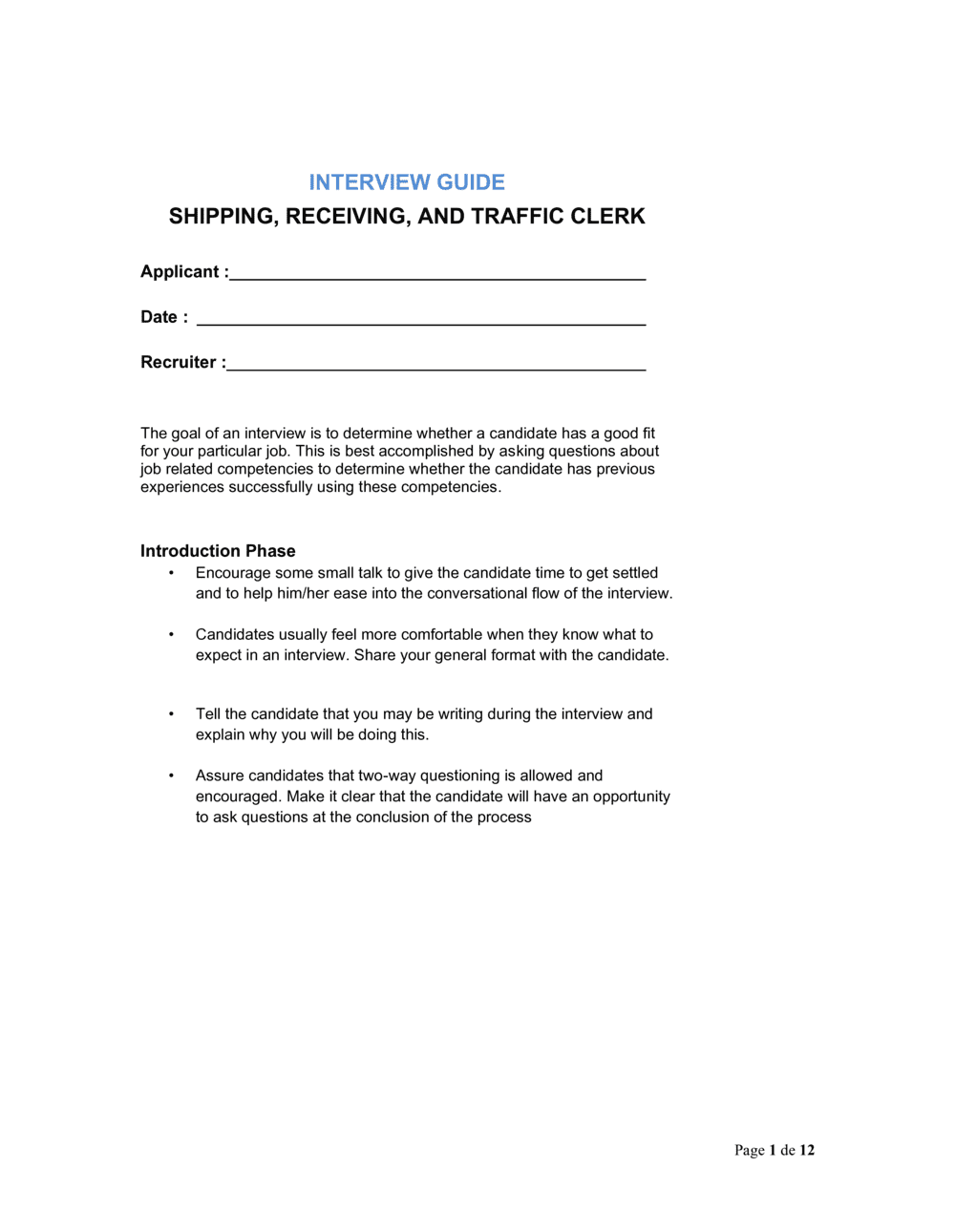
Confirm the role requirements before editing the guide
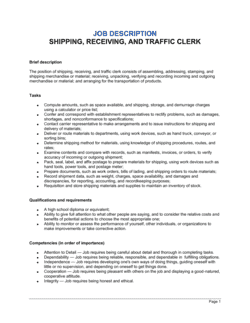
Review the current job description and confirm the must-have qualifications, reporting line, shift schedule, and physical requirements. Enter these into the role overview section of the template.
💡 If the job description is outdated, update it before finalizing the interview guide — questions built on an inaccurate JD will surface the wrong competencies.
2
Select the competencies most critical for this hire
From the full competency list in the template, identify the four to six that matter most for your specific opening — e.g., accuracy, time management, carrier communication, and system proficiency. Prioritize questions for those competencies.
💡 Rank competencies by impact on the role's top three failure modes — the most common reasons clerks in this position underperform or turn over.
3
Customize technical questions to your systems and processes
Edit the technical knowledge questions to reflect the specific WMS, shipping software, or carrier platforms your operation uses. Replace placeholder system names with the actual tools candidates will work with on day one.
💡 Asking about your actual systems — 'We use [WMS NAME]. Have you worked with it? If not, how have you learned similar systems?' — gives you a direct readiness signal.
4
Set scoring rubric anchors before the first interview
Review each competency's 1–4 scale and write one concrete behavioral example for each anchor level. Do this before seeing any candidate to avoid anchoring on your first interviewee.
💡 Calibrate rubric anchors with all panel interviewers in a 15-minute pre-interview meeting — score alignment before the process starts, not after.
5
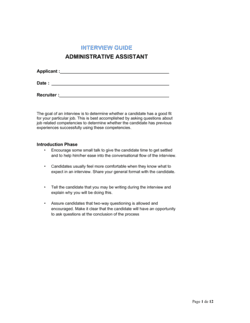
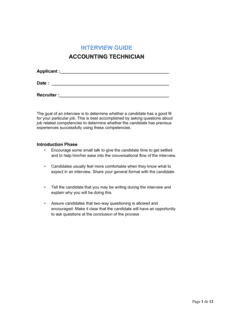
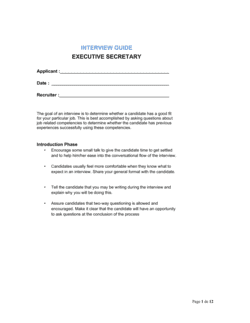
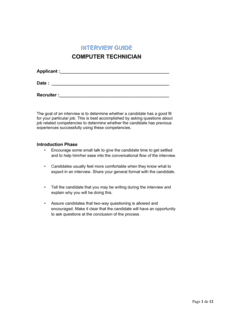
Print or share the guide with all interviewers
Distribute the completed guide to every interviewer at least 24 hours before the interview. Each interviewer should complete their own scoring sheet independently before any debrief discussion.
💡 Independent scoring before group discussion prevents the 'halo effect' — where one interviewer's strong opinion anchors the entire panel's view.
6
Conduct the interview in the sequence laid out in the guide
Follow the section order: opening, technical, behavioral, situational, work style, candidate questions. Deviating from the sequence mid-interview makes it harder to compare candidates afterward.
💡 Keep a timer visible. Behavioral questions typically take 5–7 minutes each — budget time by section to avoid running out of time before the scoring rubric section.
7
Complete the scoring rubric immediately after the interview
Fill in all competency scores and the overall hire/no-hire recommendation within 30 minutes of the interview ending, while the conversation is fresh. Add specific behavioral examples in the notes field to support each score.
💡 A score without a supporting note is nearly impossible to defend in a debrief — always pair the number with a one-sentence behavioral example.
8
Debrief as a panel and document the final hiring decision
Compare independent scores across interviewers, discuss any significant rating gaps, and document the consensus recommendation. Retain all completed scoring sheets for a minimum of one year.
💡 Store completed interview guides in the candidate's personnel file or your ATS — they are your primary evidence of a fair, consistent process if a hiring decision is ever questioned.