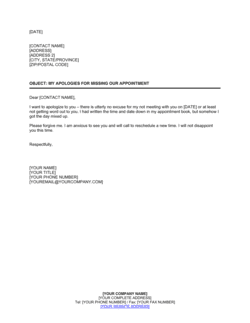
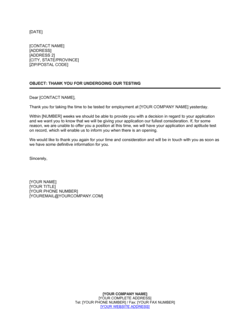
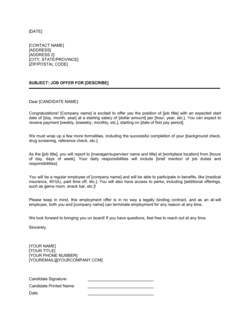
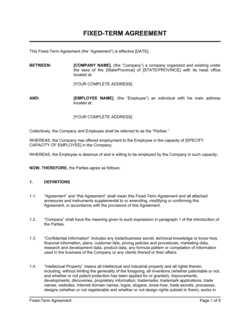
Appointment for Employment Interview and Testing Template

Free Word download • Edit online • Save & share with Drive • Export to PDF

1 page20–30 min to fillDifficulty: StandardSignature requiredLegal review recommended
Learn more ↓
FreeAppointment for Employment Interview and Testing Template

At a glance

What it is
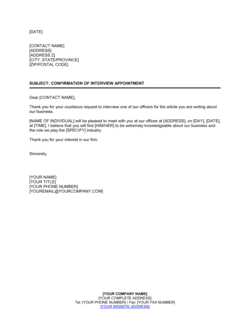
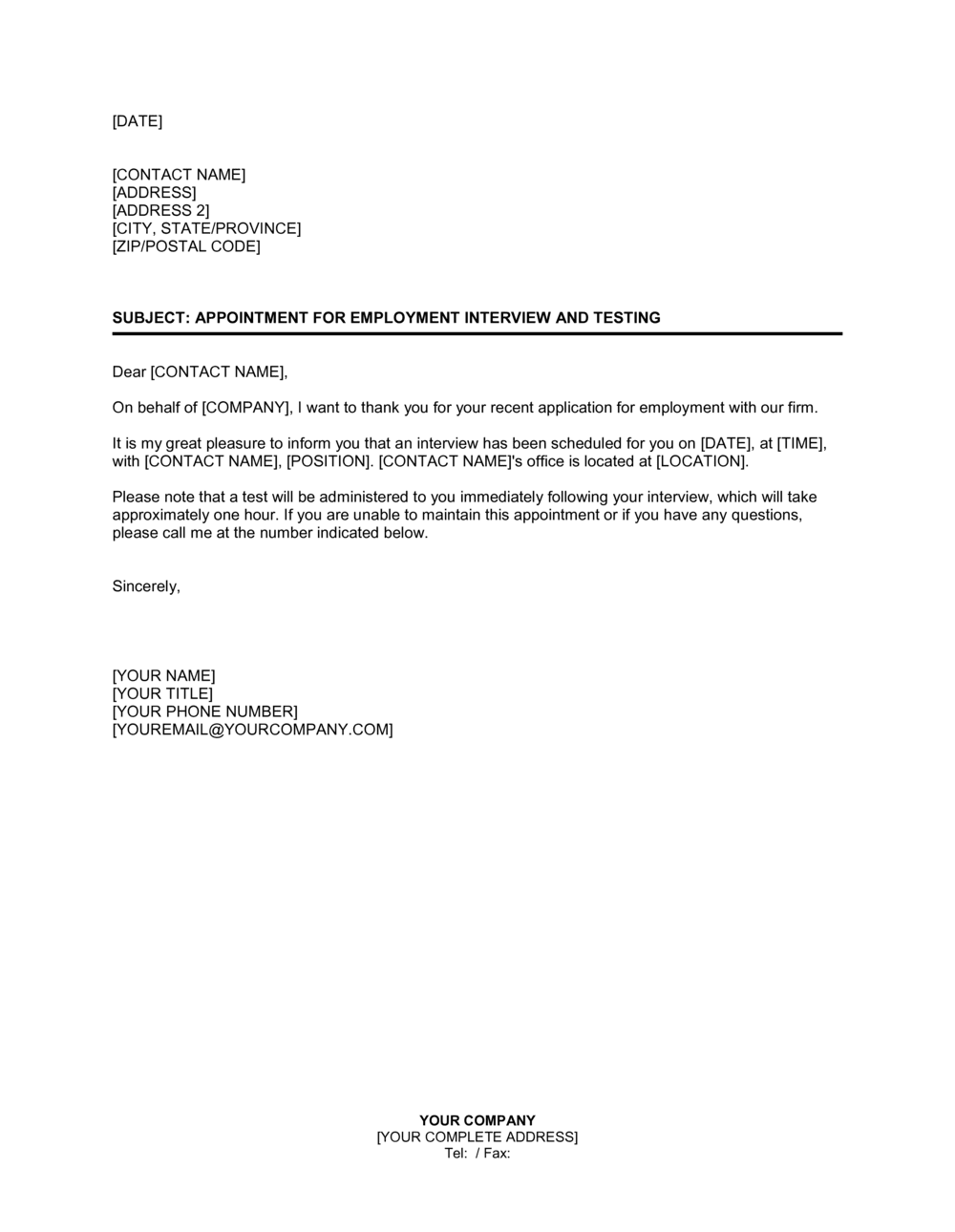
An Appointment for Employment Interview and Testing is a formal written notice issued by an employer to a job candidate that schedules a specific interview date, time, and location, and outlines any pre-employment testing requirements the candidate must complete. This free Word download gives you a structured, legally sound template you can edit online and export as PDF to send to candidates during your hiring process.
When you need it
Use it whenever you are scheduling a formal interview combined with pre-employment assessments — such as skills tests, background checks, drug screenings, or psychological evaluations — and need a single written document that confirms all logistical details and candidate obligations in advance.
What's inside
Employer and candidate identification, appointment date and time, interview location and format, description of all required testing components, candidate instructions and what to bring, confidentiality acknowledgment, consent to testing, and candidate signature block confirming receipt and acceptance.

What is an Appointment for Employment Interview and Testing?

An Appointment for Employment Interview and Testing is a formal written notice issued by an employer to a job candidate that simultaneously confirms the scheduled interview date, time, and location and sets out every pre-employment assessment — skills tests, background checks, drug screenings, or physical evaluations — the candidate must complete as part of the selection process. Unlike a casual scheduling email, this document includes candidate consent clauses for each testing component, confidentiality provisions governing how results are handled, reasonable accommodation language, and a signed acknowledgment that creates a documented record of the candidate's informed agreement. It bridges the gap between an informal interview invitation and the legally meaningful consent required before collecting sensitive candidate data.

Why You Need This Document

Relying on an informal email or verbal confirmation to schedule interviews with testing components exposes your organization to three distinct risks simultaneously. First, without written consent clauses, pre-employment tests — particularly background checks, drug screenings, and credit inquiries — may violate FCRA, GDPR, PIPEDA, or applicable state privacy laws, triggering regulatory fines and candidate claims. Second, without a rescheduling and no-show clause, last-minute cancellations by candidates leave multi-person interview panels wasted with no documented basis to remove the candidate from consideration. Third, without a reasonable accommodation invitation, any candidate disadvantaged by your standard testing format has a straightforward disability or religious discrimination claim with no record of you having offered adjustments. A properly completed appointment letter eliminates all three exposures in a single 15-minute document, creates an audit trail that satisfies privacy regulators, and signals to candidates that your hiring process is professional and legally sound — improving both your compliance posture and your employer brand.

Which variant fits your situation?

If your situation is…Use this template
Scheduling a standard in-person interview with no testing componentInterview Invitation Letter
Confirming a video or remote interview appointmentRemote Interview Appointment Letter
Notifying a candidate of a mandatory drug screening onlyPre-Employment Drug Test Notice
Sending a formal offer after the interview and testing are completeJob Offer Letter
Scheduling a second-round or panel interviewSecond Interview Appointment Letter
Informing a candidate they did not pass the testing stageCandidate Rejection Letter
Onboarding a candidate after all pre-employment requirements are clearedEmployment Contract

Common mistakes to avoid

❌ Bundling all testing consents into a single clause

Why it matters: Privacy and employment laws in the US (FCRA), Canada (PIPEDA), the UK (UK GDPR), and the EU (GDPR) require specific, informed consent for each distinct data-collection activity. A single blanket consent clause is routinely found insufficient during regulatory audits.

Fix: Draft a separate, labeled consent paragraph for each test type — background check, drug screening, skills assessment — with a distinct acknowledgment for each.

❌ Omitting the time zone from remote interview appointments

Why it matters: Candidates and interviewers in different regions interpret 'local time' inconsistently, resulting in missed appointments and wasted panel time. A no-show caused by an ambiguous time reference still triggers rescheduling costs.

Fix: State the time zone explicitly in every appointment letter — for example, '10:00 AM Eastern Time (ET / UTC-5)' — regardless of whether the candidate appears to be in the same region.

❌ No rescheduling notice window specified

Why it matters: Without a defined notice period, candidates feel entitled to cancel the day before a multi-person panel, leaving no time to fill the slot. The employer has no documented basis to remove the candidate from consideration.

Fix: State a minimum rescheduling notice period — typically two business days for standard roles — and the consequence of non-compliance in the appointment letter itself.

❌ Failing to include a reasonable accommodation clause

Why it matters: Omitting this clause exposes the employer to disability and religious discrimination claims if a candidate is disadvantaged by the standard testing format and did not receive an opportunity to request adjustments.

Fix: Include a standard accommodation invitation in every appointment letter and name a specific HR contact responsible for processing requests before the appointment date.

❌ No document retention period stated for test results

Why it matters: Indefinite retention of pre-employment health records, background check results, and drug test data violates privacy legislation in most jurisdictions and exposes the employer to regulatory fines.

Fix: Include a specific retention period in the confidentiality clause — typically 12 to 24 months for unsuccessful candidates — and align it with the applicable jurisdiction's employment records law.

❌ Sending the letter to an unverified email address without a read receipt or signature requirement

Why it matters: An appointment letter sent without any confirmation of receipt creates a credibility gap if the candidate claims they never received the testing consent terms — voiding the consent clause retroactively.

Fix: Use a delivery-confirmation email, require a countersigned hard copy, or use a timestamped e-signature solution that records when the document was opened and signed.

The 9 key clauses, explained

Parties and Position Identification

In plain language: Identifies the employer and the candidate by full legal name, states the specific job title or position being applied for, and records the date the appointment notice was issued.

Sample language
This appointment notice is issued by [EMPLOYER LEGAL NAME] ('Employer') to [CANDIDATE FULL NAME] ('Candidate') in connection with the Candidate's application for the position of [JOB TITLE], Reference No. [REQUISITION NUMBER], on [DATE].

Common mistake: Using a department name or recruiter's personal name instead of the employer's registered legal entity name — creating ambiguity about which organization is extending the appointment.

Interview Date, Time, and Location

In plain language: States the exact date, start time, expected duration, and physical address or video-conference link for the interview, and names the interviewer or panel.

Sample language
The interview is scheduled for [DATE] at [TIME] ([TIMEZONE]) at [FULL ADDRESS / BUILDING / ROOM NUMBER] or via [VIDEO PLATFORM LINK]. The anticipated duration is [X] hours. You will be meeting with [INTERVIEWER NAME(S) AND TITLE(S)].

Common mistake: Omitting the time zone for remote or multi-location employers — candidates in different jurisdictions frequently interpret local time incorrectly, causing no-shows.

Description of Testing Requirements

In plain language: Lists all pre-employment assessments the candidate must complete, the format of each test, who administers it, where it takes place, and the estimated time required.

Sample language
As part of the selection process, Candidate is required to complete the following assessments: (a) [TEST NAME] — [FORMAT], administered by [PARTY], approximately [DURATION]; (b) [BACKGROUND CHECK TYPE], conducted by [THIRD-PARTY PROVIDER]. All testing will occur on the same day as the interview unless otherwise stated.

Common mistake: Listing testing requirements without specifying the administrator or location — leaving candidates unprepared and creating logistical disputes on the day of the appointment.

Candidate Instructions and Required Documents

In plain language: Specifies what the candidate must bring to the appointment, including government-issued ID, reference documents, portfolio materials, or completed pre-screening forms.

Sample language
Candidate must bring: (a) one piece of government-issued photo identification; (b) [ANY REQUIRED FORMS COMPLETED IN ADVANCE]; (c) [PORTFOLIO / WORK SAMPLES / CERTIFICATIONS, if applicable]. Failure to present required identification may result in rescheduling of the appointment.

Common mistake: Failing to specify acceptable forms of identification — causing delays when candidates arrive with non-photo ID or expired documents.

Consent to Pre-Employment Testing

In plain language: Records the candidate's informed written consent to each testing component, explains how results will be used in the hiring decision, and confirms that the candidate understands refusal may affect their application.

Sample language
By signing below, Candidate consents to the pre-employment assessments described in this notice. Candidate understands that results will be used solely for the purpose of evaluating fitness for the position and that refusal to participate in any mandatory assessment may disqualify Candidate from further consideration.

Common mistake: Bundling consent for multiple distinct assessments — such as drug testing and credit checks — into a single vague clause. Regulators in many jurisdictions require separate, specific written consent for each test type.

Confidentiality of Assessment Results

In plain language: States that test results are confidential, identifies who within the organization has access, and confirms that results will not be shared with third parties except as required by law or the specific testing provider's process.

Sample language
All assessment results are confidential and will be reviewed only by [AUTHORIZED PERSONNEL / HR DEPARTMENT]. Results will not be disclosed to third parties except [TESTING PROVIDER / AS REQUIRED BY LAW]. Results will be retained for [RETENTION PERIOD] and then securely destroyed.

Common mistake: No retention period specified — many jurisdictions impose maximum retention limits for pre-employment health and criminal records, and an indefinite retention policy can violate privacy legislation.

Rescheduling and Cancellation Terms

In plain language: Defines the notice period required if the candidate needs to reschedule, the process for doing so, what constitutes a no-show, and whether the employer reserves the right to cancel the appointment.

Sample language
If Candidate is unable to attend, Candidate must notify [CONTACT NAME] at [EMAIL / PHONE] no later than [X] business days before the scheduled date. Employer reserves the right to cancel or reschedule this appointment at any time with reasonable notice. Failure to attend without prior notice may result in removal from the candidate pool.

Common mistake: Setting a cancellation notice window shorter than 24 hours — this is impractical for panel scheduling and frequently leads to wasted interviewer time without any contractual recourse.

Reasonable Accommodation Statement

In plain language: Invites candidates who require modifications to the interview or testing process due to a disability or religious observance to request accommodation in advance, and identifies the contact responsible for arranging it.

Sample language
Employer is committed to providing equal access to all candidates. If Candidate requires a reasonable accommodation for the interview or any testing component due to a disability or religious requirement, please contact [HR CONTACT NAME] at [EMAIL] at least [X] business days before the appointment.

Common mistake: Omitting this clause entirely — exposing the employer to disability discrimination claims when candidates with undisclosed accommodation needs are disadvantaged by the standard testing format.

Acknowledgment and Candidate Signature

In plain language: Confirms that the candidate has read, understood, and accepted the terms of the appointment notice, including consent to testing, and records the candidate's signature and date.

Sample language
By signing below, Candidate confirms receipt of this appointment notice, acknowledges understanding of all requirements set out herein, and consents to the testing components described above. Candidate Name: [FULL NAME] | Signature: _______________ | Date: [DATE]

Common mistake: Using a digital acknowledgment checkbox without a timestamp or audit trail — undermining enforceability of the consent clause if a candidate later disputes what they agreed to.

How to fill it out

  1. 1

    Enter the employer's legal name and the candidate's details

    Use the employer's full registered legal name — not a department or recruiter's name. Enter the candidate's full legal name as submitted on the application and include the exact job title and internal requisition number.

    💡 Confirm the candidate's preferred name and pronouns in a separate communication — the legal name on the appointment letter should match the name on their government ID for identification verification purposes.

  2. 2

    Set the interview date, time, time zone, and location

    Enter the confirmed interview date, start time, expected duration, and the full physical address or video-conference link. Include the time zone explicitly, especially for remote candidates.

    💡 For in-person appointments, include parking instructions or nearest transit stop — reducing late arrivals that disrupt panel scheduling.

  3. 3

    List every testing component with format and duration

    Name each assessment, specify whether it is written, online, or physical, identify who administers it, and estimate how long it takes. If a third-party testing provider is involved, include their name and location.

    💡 Provide the candidate with preparation guidance — for example, whether the skills test is open-book or timed — to reduce test anxiety and improve result quality.

  4. 4

    Specify required documents and identification

    List every document the candidate must bring, including acceptable forms of photo ID, any pre-completed forms, certifications, or portfolio materials. Be explicit about format — original documents versus photocopies.

    💡 For positions requiring professional licensing, state the exact license category and issuing body to avoid candidates arriving with the wrong credential.

  5. 5

    Complete the consent to testing clause for each assessment

    Draft a separate consent statement for each distinct test type — skills assessment, background check, drug screening, and credit check each require their own explicit authorization under most privacy frameworks.

    💡 Include a reference to the legal basis for each test (e.g., FCRA authorization for background checks in the US) to demonstrate compliance if the process is later audited.

  6. 6

    Set rescheduling and cancellation notice requirements

    Enter the minimum business days' notice required for rescheduling, the contact person's name and contact details, and the consequence of a no-show — typically removal from the candidate pool for that vacancy.

    💡 For senior roles with large interview panels, set the rescheduling window at a minimum of two business days to avoid coordination costs.

  7. 7

    Add the reasonable accommodation request details

    Identify the HR contact responsible for processing accommodation requests and set a minimum advance notice period of at least three business days before the appointment.

    💡 Train the named contact on what constitutes a reasonable accommodation before sending letters — candidates sometimes call the same day, and an unprepared response creates legal exposure.

  8. 8

    Obtain the candidate's signature and retain a copy

    Send the completed letter to the candidate, obtain a signed copy before the appointment date, and store the executed document in the candidate's pre-employment file for the duration of the required retention period.

    💡 Use a timestamped e-signature solution to create an audit trail that confirms when consent was given — particularly important for drug testing consent in regulated industries.

Frequently asked questions

What is an appointment for employment interview and testing?

An appointment for employment interview and testing is a formal written notice an employer issues to a job candidate that confirms the scheduled date, time, and location of their interview and details any pre-employment assessments — such as skills tests, background checks, or drug screenings — the candidate must complete. It serves as both a logistical confirmation and a legal consent document covering each testing component required during the hiring process.

Is a signed appointment letter legally required before conducting pre-employment tests?

In many jurisdictions, written consent is legally required before certain pre-employment tests can be conducted. Under the US Fair Credit Reporting Act, written authorization is mandatory before running a background check. Drug testing laws vary by state and industry. In Canada, the UK, and the EU, data protection legislation requires specific informed consent before collecting personal or biometric data. A signed appointment letter that includes explicit consent clauses for each test type satisfies most of these requirements and creates a documented audit trail.

Can a candidate be disqualified for refusing to sign the appointment letter?

Typically, yes — for mandatory testing components. If a candidate refuses to consent to a lawfully required pre-employment assessment, the employer is generally permitted to withdraw the candidate from consideration for that vacancy. However, the employer cannot penalize a candidate for requesting a reasonable accommodation for the testing process, and in some jurisdictions, certain tests — such as polygraph examinations — cannot be made mandatory at all. Consult applicable employment law before treating refusal as automatic disqualification.

What pre-employment tests can employers legally require?

Permissible tests vary by jurisdiction and role. Skills and aptitude tests are broadly permitted when job-relevant. Background checks are widely allowed with written consent and subject to FCRA rules in the US or DPA rules in the UK. Drug testing is permitted in many US states and required in safety-sensitive industries but is more restricted in Canada and most EU countries. Psychological or personality assessments are permitted but must be validated as job-relevant to avoid discrimination claims. Medical examinations are generally only permitted post-conditional-offer in the US under the ADA, and post-offer in the UK and EU.

How far in advance should an appointment letter be sent to the candidate?

Best practice is to send the appointment letter at least five to seven business days before the scheduled interview date. This gives the candidate sufficient time to review the testing requirements, arrange any necessary documents, request accommodations if needed, and confirm or reschedule. For senior roles with complex multi-stage assessments, two weeks' advance notice is preferable to reduce last-minute rescheduling.

What happens to pre-employment test results if the candidate is not hired?

Test results for unsuccessful candidates should be retained only for as long as required by applicable employment records law — typically 12 to 24 months in most jurisdictions — then securely destroyed. Background check results and drug test data are subject to additional privacy requirements under FCRA, GDPR, PIPEDA, and equivalent legislation. The appointment letter should state the retention period and destruction method so the candidate is informed at the time of consent.

Does the appointment letter need to be different for remote versus in-person interviews?

The core structure is the same, but the logistics section must be adapted. A remote appointment letter should include the video-conference platform, meeting link, access code, time zone, and technical requirements. If any testing component is conducted online, include the platform URL and login process. If the candidate must attend a third-party facility for drug testing or a physical assessment, that address and its operating hours should be listed separately from the main interview details.

Can the employer reschedule or cancel the appointment after sending the letter?

Yes — employers typically reserve the right to reschedule or cancel with reasonable notice, which should be stated explicitly in the rescheduling clause. What constitutes reasonable notice depends on the jurisdiction and the nature of the tests involved. If a third-party testing provider has already been booked, cancellation fees may apply and the letter should address who bears that cost. Repeated last-minute rescheduling by the employer may give rise to candidate claims for wasted expenses in some jurisdictions.

Is this document different from a standard interview invitation letter?

Yes. A standard interview invitation letter confirms the time and place of the interview and is not a legal consent document. An appointment for employment interview and testing is a more comprehensive document that also records the candidate's informed consent to each pre-employment assessment, specifies what happens with the results, invites accommodation requests, and sets rescheduling and no-show terms. The consent and confidentiality clauses are what give this document its legal function beyond a simple scheduling notice.

What should employers do if a candidate requests a reasonable accommodation for testing?

The employer should acknowledge the request promptly — ideally within one to two business days — and engage in an interactive process to identify a workable adjustment. Common accommodations include extended time for written tests, alternative formats for candidates with visual impairments, or a private room for candidates with anxiety-related conditions. The accommodation must not fundamentally alter the assessment's ability to measure the job-relevant skills being tested. Document the request and the accommodation provided in the candidate's pre-employment file.

How this compares to alternatives

vs Job Offer Letter

A job offer letter is issued after the hiring decision has been made and sets out compensation, benefits, and start date. An appointment for employment interview and testing is issued before the hiring decision and governs the candidate's participation in the selection process. The two documents are used at opposite ends of the hiring timeline and should never be substituted for each other.

vs Employment Contract

An employment contract is a binding agreement that governs the ongoing working relationship once a candidate is hired. An appointment for employment interview and testing is a pre-hire procedural document that governs the selection process only. Signing the appointment letter does not create an employment relationship or imply a conditional offer of employment.

vs Candidate Rejection Letter

A candidate rejection letter is sent after the selection process concludes to notify an unsuccessful applicant. An appointment for employment interview and testing is sent before the process begins to schedule the assessment stage. They bookend the evaluation stage from opposite directions and serve entirely different legal and administrative purposes.

vs Employee Background Check Authorization

A standalone background check authorization is a narrow consent form covering only criminal or credit record searches, typically required under FCRA or equivalent legislation. An appointment for employment interview and testing is a broader document that incorporates background check consent alongside interview scheduling and all other testing components. For roles requiring only a background check, the standalone form is sufficient; where multiple assessments are combined, the appointment letter is the more complete and efficient solution.

Industry-specific considerations

Financial Services

Mandatory background checks covering criminal history and credit records are standard for roles with access to client funds, requiring separate FCRA-compliant written consent documentation alongside the appointment letter.

Healthcare

Drug screening, immunization verification, and professional license checks are typically required before a first shift, and the appointment letter must coordinate all three assessments within a single scheduling notice.

Transportation and Logistics

DOT-mandated drug and alcohol testing for safety-sensitive roles requires chain-of-custody documentation, and the appointment letter must reference the specific testing protocol and collection site address.

Professional Services

Education credential verification and skills-based assessments are frequently combined in a single appointment, with the letter specifying both the third-party verification provider and the in-house test format and scoring criteria.

Jurisdictional notes

United States

The Fair Credit Reporting Act requires separate written authorization before conducting background or credit checks, and candidates must receive specific FCRA disclosure documents. Drug testing requirements vary significantly by state — some states require advance written notice, others mandate testing only for safety-sensitive roles, and a growing number restrict testing for cannabis. The ADA prohibits pre-offer medical examinations; any medical or physical fitness assessment must occur post-conditional offer only.

Canada

PIPEDA and provincial privacy legislation — including Alberta's PIPA and Quebec's Law 25 — require that consent to collect personal information be specific, informed, and freely given for each category of data collected. Drug testing in Canada is heavily restricted under human rights legislation; mandatory pre-employment drug testing is generally not permitted except for safety-critical positions, and even then only with established policy frameworks. French-language requirements apply to all employment documents issued to candidates in Quebec.

United Kingdom

UK GDPR and the Data Protection Act 2018 require a clear lawful basis for processing candidate personal data collected during testing, with explicit consent required for special-category data such as health information. The Equality Act 2010 prohibits pre-employment health inquiries unless directly related to an intrinsic requirement of the role. Criminal record checks via DBS (Disclosure and Barring Service) are only permitted for eligible roles defined in the Rehabilitation of Offenders Act 1974 (Exceptions) Order.

European Union

GDPR requires that consent for processing candidate personal data during pre-employment testing be freely given, specific, informed, and unambiguous — and candidates must be informed of their right to withdraw consent without detriment to their application. Processing special-category data (health, biometrics) requires explicit consent and typically a legitimate purpose under Article 9. Member states have significant variation in drug testing rules: testing is broadly restricted in Germany and France without safety justification, while Ireland and the Netherlands permit it in specific industries with proper policy frameworks.

Template vs lawyer — what fits your deal?

PathBest forCostTime
Use the templateStandard domestic hires where testing is limited to skills assessments and a basic background check in a single jurisdictionFree15–20 minutes per candidate
Template + legal reviewRoles involving drug testing, credit checks, or medical assessments in regulated industries or multiple jurisdictions$150–$400 for an HR counsel review of the consent clauses1–2 days
Custom draftedHigh-volume hiring programs, government contractors with statutory testing obligations, or cross-border candidates subject to GDPR or PIPEDA in addition to US law$500–$2,000 for a customized multi-jurisdiction template set1–2 weeks

Glossary

Pre-Employment Testing
Any formal assessment conducted before a hiring decision is made, including skills tests, cognitive evaluations, background checks, drug screenings, or physical fitness assessments.
Candidate Consent
A written acknowledgment by the job applicant authorizing the employer to conduct specified assessments and use the results as part of the hiring decision.
Background Check
A review of a candidate's criminal history, employment history, education credentials, and credit record, subject to applicable privacy and employment laws.
Drug Screening
A medical test, typically urine or oral fluid analysis, used to detect the presence of controlled substances as a condition of employment.
Aptitude or Skills Test
A standardized assessment measuring a candidate's ability to perform specific tasks relevant to the role, such as typing speed, numerical reasoning, or technical knowledge.
Appointment Confirmation
A formal written acknowledgment that both parties have agreed to the scheduled interview date, time, and location and that the candidate understands all requirements.
Interview Panel
A group of two or more interviewers from the hiring organization who assess the candidate simultaneously during a structured interview session.
Conditional Offer
A job offer extended to a candidate that becomes binding only after successful completion of specified pre-employment conditions, such as passing a background check or drug test.
Reasonable Accommodation
A modification to the interview or testing process required by disability discrimination law to give candidates with disabilities an equal opportunity to participate.
Right to Withdraw
A candidate's ability to decline the appointment or withdraw consent to testing at any point prior to the interview, without prejudice to a future application.
Chain of Custody
The documented process ensuring that a biological sample collected for drug testing is tracked from collection through laboratory analysis to prevent tampering or misidentification.

Part of your Business Operating System

This document is one of 3,000+ business & legal templates included in Business in a Box.

  • Fill-in-the-blanks — ready in minutes
  • 100% customizable Word document
  • Compatible with all office suites
  • Export to PDF and share electronically

Create your document in 3 simple steps.

From template to signed document — all inside one Business Operating System.
1
Download or open template

Access over 3,000+ business and legal templates for any business task, project or initiative.

2
Edit and fill in the blanks with AI

Customize your ready-made business document template and save it in the cloud.

3
Save, Share, Send, Sign

Share your files and folders with your team. Create a space of seamless collaboration.

Save time, save money, and create top-quality documents.

★★★★★

"Fantastic value! I'm not sure how I'd do without it. It's worth its weight in gold and paid back for itself many times."

Managing Director · Mall Farm
Robert Whalley
Managing Director, Mall Farm Proprietary Limited
★★★★★

"I have been using Business in a Box for years. It has been the most useful source of templates I have encountered. I recommend it to anyone."

Business Owner · 4+ years
Dr Michael John Freestone
Business Owner
★★★★★

"It has been a life saver so many times I have lost count. Business in a Box has saved me so much time and as you know, time is money."

Owner · Upstate Web
David G. Moore Jr.
Owner, Upstate Web

Run your business with a system — not scattered tools

Stop downloading documents. Start operating with clarity. Business in a Box gives you the Business Operating System used by over 250,000 companies worldwide to structure, run, and grow their business.

Start free · No credit card required