Plan Templates
Forward-looking strategy or planning docs — business plan, marketing plan, project plan.
Instant downloads • Fully editable • Export to Word, Excel or PDF
266 templates
Includes Business Plan, Marketing Plan, Product Roadmap and 263 more.
At a glance
What it is
Plan templates are forward-looking strategy and planning documents that help businesses define goals, allocate resources, and set measurable milestones across every function. This filter surfaces every planning document in the catalog — from a full business plan used to attract investors, to a project plan used to deliver a single initiative on schedule.
When you need one
Operators reach for plan templates whenever a decision requires documented intent: launching a venture, pitching a lender, kicking off a project, or preparing for disruption. Having a structured template shortens the drafting time and ensures the right sections are covered before work begins.
Popular Plan Templates
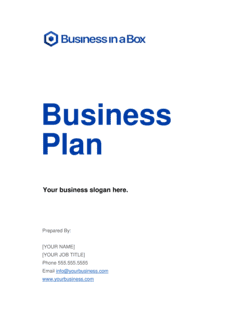

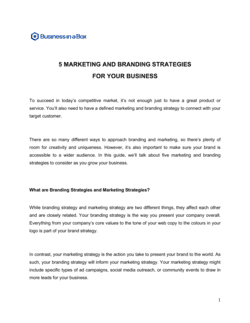
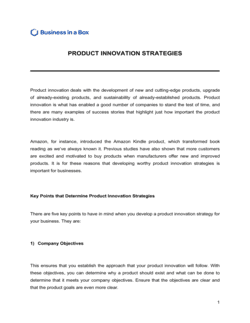
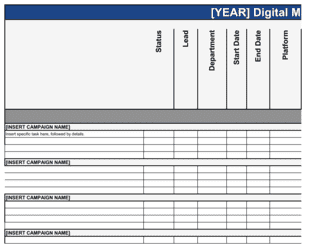 XLS
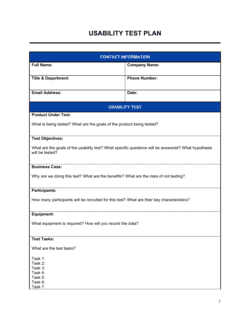
 XLS

 XLS
 XLS

Showing 60 of 266 templates
Looking for something else?
Search all 266 templates in this category by name or keyword.
Business-in-a-Box has all 266 in this category, plus the rest of the library, ready to edit. See what's inside
Which template fits your situation?
The right plan template depends on your planning horizon and audience — whether you are presenting to external stakeholders, coordinating an internal team, or preparing for risk. Use the scenarios below to find the closest match.
How to write a business plan
Every plan template follows the same preparation logic regardless of function — the steps below apply whether you are completing a full business plan or a focused project plan.
Identify your audience and purpose
Determine whether the plan is for internal alignment, investor review, lender submission, or operational guidance — the audience shapes every section that follows.
Choose the right template for your scope
Match the template to the function: use a Business Plan for company-level strategy, a Project Plan for a bounded initiative, and a Marketing Plan for campaign-specific activity.
Define the objective and success metrics upfront
Write the goal and how you will measure success before filling in any other section — this keeps every subsequent section anchored to a clear outcome.
Complete the scope, timeline, and resource sections
Fill in who is responsible, what is in and out of scope, when milestones fall, and what budget or headcount is committed.
Document risks and assumptions
List the conditions the plan relies on and the scenarios that could require a revision — reviewers and investors will check this section closely.
Circulate for review and align stakeholders
Share a draft with the relevant decision-makers and capture feedback before the plan is treated as final.
Set a review cadence and assign an owner
Decide how frequently the plan will be updated and name one person responsible for keeping it current as conditions change.
Glossary
- business plan
- A structured document describing a company's objectives, strategy, market analysis, and financial projections, typically used to guide operations or attract funding.
- operational plan
- An internal document that details how day-to-day activities will be organized and resourced to meet the goals set in a strategic or business plan.
- milestone
- A defined checkpoint in a plan that marks the completion of a phase or the achievement of a measurable goal.
- KPI (key performance indicator)
- A quantifiable measure used to evaluate whether a plan's objectives are being met within a given timeframe.
- business continuity plan
- A document that outlines how an organization will maintain or restore critical operations following an unexpected disruption.
- contingency plan
- A pre-defined course of action to be taken if a specific risk or assumption in the main plan fails to hold.
- staffing plan
- A forward-looking document that maps out hiring needs, role requirements, and workforce costs against projected business growth.
- succession plan
- A document that defines how leadership or ownership of a business will be transferred to a successor, including timing and transition responsibilities.
- scope
- The defined boundaries of a plan — what it covers, what it excludes, and the conditions under which it applies.
- planning horizon
- The time period a plan is designed to cover, ranging from a single project sprint to a multi-year strategic outlook.
Plan Templates by department
Browse other document types
Frequently asked questions
What plan templates are available?
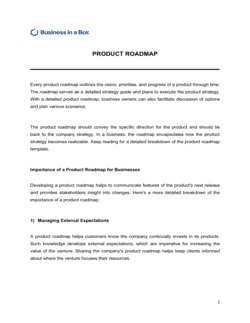
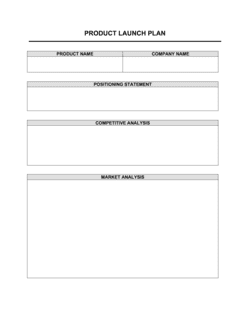
266 plan templates, including Business Plan, Marketing Plan, Product Roadmap, Advertising Plan, Product Launch Plan.
What is the difference between a business plan and a business proposal?
A business plan is a strategy document — it describes what the business will do, how it will operate, and how it will achieve its financial goals. A business proposal is a persuasion document directed at a specific external reader asking for a decision. A plan guides internal execution; a proposal wins external approval. Most businesses need a plan on file before they can write a credible proposal.
Which plan template should a new business start with?
Most new businesses start with the Business Plan template because it covers the full picture: market analysis, operational structure, and financial projections. Once that foundation is in place, they typically add a Marketing Plan and an Operational Plan to guide day-to-day execution. Industry-specific variants — such as the Clinic Business Plan or Consultant Business Plan — are available when a generic format is too broad.
Do plan templates work for lender or investor submissions?
Yes. Templates such as the Business Plan and Business Plan Guidelines are structured to meet the standard expectations of lenders and investors — executive summary, market opportunity, management team, and financial projections. You will still need to populate the financials with your actual numbers and tailor the narrative to your specific audience.
How often should a plan be updated?
Most operational plans benefit from a quarterly review; strategic business plans are typically reviewed annually or when a significant change occurs — a new product line, a change in ownership, or a market shift. Plans like the Business Continuity Plan and Crisis Management Plan should be reviewed at least annually and tested against a simulated scenario.
Can I use these templates for internal planning as well as external reporting?
Yes — most plan templates serve both purposes. An Operational Plan or Staffing Plan is primarily an internal coordination tool; a Business Plan or Investment Plan is often shared externally. Some teams maintain two versions of the same plan: a detailed internal working document and a cleaner summary for outside audiences.
Are there plan templates specific to certain industries or professions?
Several templates in this filter are built for specific sectors: Architect Business Plan, Clinic Business Plan, Campground Business Plan, Daycare Business Plan, and Dentist Business Plan each contain section prompts and financial assumptions tailored to their respective industries. If your industry is not represented, the generic Business Plan template covers the same structural components and can be adapted.
What is a business continuity plan and when is it required?
A business continuity plan documents the steps an organization will take to keep critical operations running during and after an unexpected disruption — a natural disaster, cyberattack, or sudden loss of a key person. Some regulated industries and enterprise procurement processes require a current continuity plan as a condition of doing business. Even where it is not mandated, having one reduces recovery time and financial exposure when disruptions occur.
How do project plans differ from operational plans?
A project plan governs a specific, time-limited initiative with a defined start and end date — it tracks tasks, owners, and milestones. An operational plan describes how the business will run its ongoing functions over a planning period, typically a fiscal year. You might have one operational plan covering the year and several project plans running concurrently within it.
One document. A more organized business.
Your documents are part of how your business operates. Business in a Box brings the work, people and information around them into one workspace.
Start with the template you need. Bring the rest of your business together when you're ready.
How our templates are made
Every template is written by the Business in a Box editorial team and published by Bruno Goulet, CEO & Editor-in-Chief. Business in a Box has published business and legal templates for more than 20 years. Each document page explains what the template covers and how to fill it in; for legal documents, have a qualified professional review the final version when the stakes warrant it.