Report Templates
Analytical or status documents — annual report, audit report, KPI report.
Instant downloads • Fully editable • Export to Word, Excel or PDF
28 templates
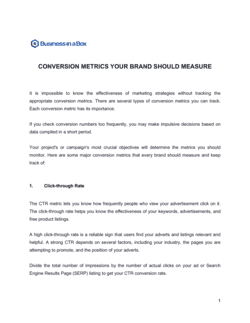
Includes Annual Report, Competitive Analysis Report, Conversion Metrics Report and 25 more.
At a glance
What it is
Business report templates are pre-structured documents that help teams present analytical findings, performance metrics, and status updates in a consistent, readable format. They cover every reporting context a business encounters — from quarterly financials and KPI dashboards to incident logs and due diligence summaries.
When you need one
Reach for these templates whenever a decision-maker needs summarized data rather than a live conversation — a board meeting, an investor update, a post-incident review, or a regulatory submission. Having a ready-made structure cuts the time spent on formatting and keeps the focus on the analysis itself.
Popular Report Templates
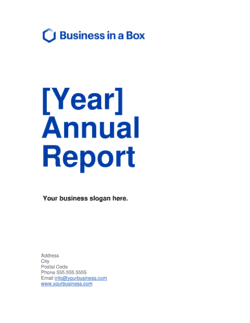
 XLS
Which template fits your situation?
The right report template depends on audience, cadence, and subject matter. Use the scenarios below to match the situation you're in to the template that fits it best.
How to write a business report
A well-constructed report follows a predictable sequence — from defining the question to delivering a recommendation — so that any reader can follow the logic without needing context beyond what's on the page.
Define the purpose and audience
Identify the single question your report needs to answer and confirm who will read it, since the level of detail and terminology should match the audience's background.
Select the right template
Match the reporting context to the template type — operational cadence reports (daily, weekly, quarterly) differ structurally from analytical reports (feasibility, competitive analysis, due diligence).
Gather and organize your data
Collect the figures, observations, or records you need before opening the template, so you can populate sections in order rather than jumping around.
Complete the scope and methodology section first
Writing this section before the findings forces clarity about what the report covers and prevents scope creep in later sections.
Populate findings with specific data points
Replace placeholder text with actual numbers, dates, and named parties — vague findings undermine the report's usefulness and credibility.
Write recommendations tied to specific findings
Each recommendation should reference the finding that supports it, so readers can trace the reasoning without re-reading the whole document.
Write the executive summary last
Summarize the key findings and top recommendations once the full report is complete — this ensures accuracy and prevents the summary from contradicting the body.
Route for review and sign-off
Share with the appropriate reviewer before distributing, particularly for financial, audit, or incident reports where accuracy has compliance or legal implications.
Glossary
- executive summary
- A brief section at the start of a report that captures the key findings and recommendations so a senior reader can understand the document without reading it in full.
- KPI (key performance indicator)
- A quantifiable metric used to evaluate progress toward a defined business objective, reported on a regular cadence.
- audit report
- A formal document produced after an internal or external audit that records the scope, findings, risk ratings, and recommended corrective actions.
- due diligence report
- An investigative document that summarizes the findings of a structured review of a business, asset, or counterparty before a transaction or agreement is finalized.
- feasibility report
- A structured analysis that evaluates whether a proposed project, product, or market entry is viable given financial, operational, and market constraints.
- variance analysis
- The process of comparing actual financial results to budgeted or prior-period figures and explaining the differences, typically presented within a financial or quarterly report.
- reporting cadence
- The scheduled frequency at which a report is produced and distributed — daily, weekly, monthly, or quarterly.
- incident log
- A running record of workplace incidents, near-misses, or safety events, often compiled from individual incident report submissions.
- findings section
- The core body of a report where data, observations, or measurements are presented with supporting evidence before interpretation begins.
- sign-off authority
- The individual or role responsible for reviewing and approving a report before it is distributed, establishing accountability for its accuracy.
- data analysis report
- A document that presents the outputs of a quantitative or qualitative analysis, explains the methodology used, and draws conclusions from the results.
- competitive analysis report
- A structured review of competitor positioning, pricing, products, and market share used to inform strategic decision-making.
Report Templates by department
Browse other document types
Frequently asked questions
What report templates are available?
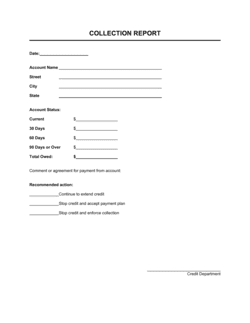
28 report templates, including Annual Report, Competitive Analysis Report, Conversion Metrics Report, Quarterly Business Review, Collection Report.
What is a business report template?
A business report template is a pre-formatted document structure that guides the writer through the standard sections of a formal report — scope, findings, analysis, and recommendations. Templates save time by eliminating blank-page formatting decisions and ensure consistency across reports produced by different team members. Business in a Box offers 33+ report templates covering financial, operational, compliance, and analytical reporting contexts.
What is the difference between a status report and a progress report?
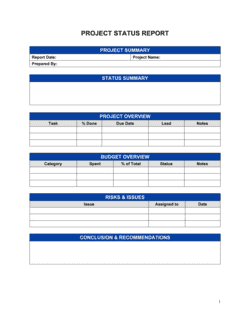
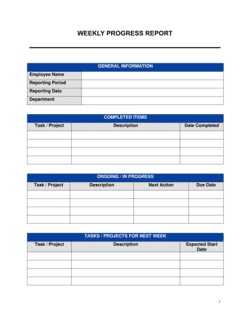
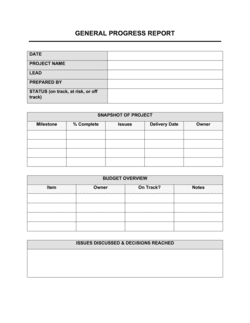
A status report provides a snapshot of where a project or initiative stands at a specific point in time — often used for recurring check-ins on multiple workstreams. A progress report focuses on a single project, documenting what has been completed against a plan, what remains, and what obstacles exist. Both are periodic documents, but a progress report typically has a stronger narrative arc tied to a defined start and end goal.
How often should a KPI report be produced?
KPI reports are typically produced monthly or quarterly, though high-velocity teams sometimes run weekly cycles. The cadence should match the decision-making rhythm of the audience — a leadership team that meets monthly needs a monthly report; a sales team tracking daily outreach may need weekly or even daily summaries. The KPI Report template in this collection is designed to accommodate any cadence with minimal structural changes.
When is a feasibility report needed?
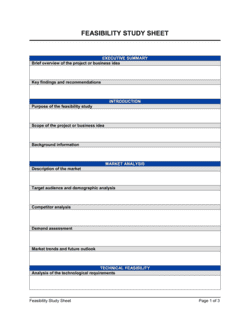
A feasibility report is needed before committing resources to a new project, product, market entry, or acquisition. It evaluates whether the opportunity is viable from financial, operational, legal, and market perspectives. Organizations typically produce one after an initial idea has been validated informally but before a formal business case or budget request is submitted.
Can report templates be used for regulatory submissions?
Many of these templates — including the Auditing Report, IT Security Assessment Report, and Incident Report — follow structures that align with common regulatory expectations. However, specific regulatory bodies (SEC, OSHA, ISO auditors, etc.) may have mandatory formats or fields. Always verify that the template output meets the precise requirements of the applicable regulation before submitting, and consider having a qualified professional review the final document.
What is the difference between an annual report and a quarterly report?
An annual report covers a full fiscal year and typically includes audited financial statements, a letter from leadership, and a narrative review of strategic progress. A quarterly report covers a three-month period, is usually unaudited, and focuses on performance against short-term targets. Public companies are often required to file both; private companies produce them as internal governance or investor communication tools.
What should an executive report include?
An executive report should include a brief summary of the issue or reporting period, the three to five most important findings or metrics, and clear recommendations or decisions required from leadership. It is intentionally concise — typically one to two pages — because its audience has limited time and needs to act rather than study. Supporting data is referenced but moved to an appendix.
How do incident reports differ from accident reports?
An incident report documents any unplanned event that could have caused or did cause harm — including near-misses, property damage, or security breaches. An accident report specifically documents an event that resulted in injury, damage, or loss. In practice the two are closely related; some organizations use a single form for both, while others maintain separate templates to distinguish severity and trigger different response protocols.
Are these report templates suitable for small businesses?
Yes. Templates like the Small Business Expense Report, Daily Report, and Weekly Report are specifically scoped for smaller operations. More advanced templates — Annual Report, Auditing Report, Due Diligence Report — can also be used by small businesses, particularly when seeking financing, preparing for acquisition, or satisfying investor requirements. All templates are editable, so sections that don't apply can be removed.
One document. A more organized business.
Your documents are part of how your business operates. Business in a Box brings the work, people and information around them into one workspace.
Start with the template you need. Bring the rest of your business together when you're ready.
How our templates are made
Every template is written by the Business in a Box editorial team and published by Bruno Goulet, CEO & Editor-in-Chief. Business in a Box has published business and legal templates for more than 20 years. Each document page explains what the template covers and how to fill it in; for legal documents, have a qualified professional review the final version when the stakes warrant it.