Business Growth Plan Template

Free Word download β€’ Edit online β€’ Save & share with Drive β€’ Export to PDF

7 pagesβ€’1h 5m – 1h 25m to fillβ€’Difficulty: Expert
Learn more ↓
FreeBusiness Growth Plan Template

At a glance

What it is
A Business Growth Plan is a structured operational document that maps where a company is today, where it intends to grow, and the specific strategies, resources, and milestones required to get there β€” typically covering a 12-to-36-month horizon. This free Word download gives you a ready-to-edit framework you can tailor to your market, export as PDF, and share with leadership, investors, or a board of directors.
When you need it
Use it when preparing for a new growth phase β€” entering a new market, scaling a product line, pursuing a funding round, or aligning a leadership team around a common revenue target with accountable action items.
What's inside
Executive summary, current business assessment, growth objectives and KPIs, market opportunity analysis, growth strategies, operational requirements, financial projections, risk assessment, and a phased implementation roadmap with owners and deadlines.

What is a Business Growth Plan?

A Business Growth Plan is a structured operational document that establishes a company's current baseline, defines specific revenue and market-share targets for a 12-to-36-month horizon, and maps the strategies, operational investments, and phased milestones required to reach those targets. Unlike a general business plan written to introduce a new venture to outside readers, a growth plan is designed for businesses that are already operating and need to align leadership, secure financing, or hold teams accountable to a concrete expansion strategy. It connects market opportunity analysis directly to financial projections and assigns ownership to every major initiative on the roadmap.

Why You Need This Document

Without a written business growth plan, leadership teams execute against different assumptions about which markets to pursue, which initiatives to prioritize, and how much resource each initiative deserves β€” producing fragmented effort and missed revenue targets. Banks and investors who receive a verbal growth narrative rather than a structured plan with supporting financials routinely decline to proceed. Internally, growth initiatives without named owners, defined budgets, and scheduled reviews routinely stall when day-to-day operational demands compete for the same people. A well-built growth plan eliminates these failure modes: it forces you to validate market assumptions before committing capital, pressure-test financial projections against operational capacity, and establish a review cadence that keeps the business accountable to its targets every month rather than discovering at year-end that the strategy was never executed.

Which variant fits your situation?

If your situation is…Use this template
Comprehensive plan for raising capital or presenting to a boardBusiness Growth Plan
Early-stage ideation or quick internal alignmentOne-Page Business Plan
Full business plan for a bank loan or investor due diligenceBusiness Plan
Multi-year strategic direction for an established companyStrategic Plan
Specific plan for launching a new product or service lineNew Product Launch Plan
Marketing and customer acquisition component onlyMarketing Plan
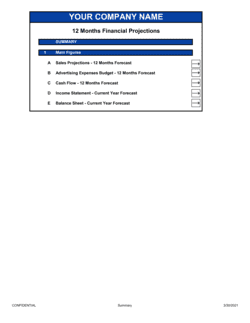
Detailed revenue and expense outlook for the next 12 monthsFinancial Projections (12 Months)

Common mistakes to avoid

❌ Writing the executive summary first

Why it matters: It will contradict the body of the plan because the strategy and financial sections have not been finalized yet, making the document feel inconsistent to any reader who reviews both.

Fix: Complete every other section before writing the executive summary so it accurately reflects the finished plan rather than an early draft of the thinking.

❌ Setting revenue targets without a bottom-up customer model

Why it matters: A $5M revenue target that requires acquiring 5,000 customers with no plan for how to reach them is not a strategy β€” it is a number on a page, and investors and lenders will reject it as such.

Fix: Build the revenue line from customer count times average contract value, and trace each customer addition back to a specific acquisition channel with a realistic conversion assumption.

❌ Prioritizing too many strategies simultaneously

Why it matters: Pursuing five growth strategies at once divides resources below the threshold needed for any single one to succeed, producing mediocre results across the board instead of strong results in one area.

Fix: Select two to three strategies maximum, rank them by expected ROI and feasibility, and sequence them so the first generates the capital or learning needed to fund the next.

❌ Omitting the operational requirements section

Why it matters: A plan that targets 40% revenue growth without accounting for the additional sales reps, infrastructure, or working capital that growth requires will miss its targets and surprise leadership with unbudgeted costs.

Fix: For each growth strategy, explicitly list the headcount, systems, and process changes required, with a cost estimate and timeline attached to each item.

❌ No named owner for each roadmap initiative

Why it matters: When every initiative is owned by 'the team' or the CEO, nothing gets done on schedule because no single person feels accountable when competing priorities arise.

Fix: Assign one named owner per initiative, confirm they have accepted the responsibility, and make ownership visible in the monthly review meeting.

❌ No review or update cadence defined in the plan

Why it matters: A growth plan with no scheduled reviews becomes a static document that is ignored within 60 days as the business moves faster than the plan anticipated.

Fix: Define a monthly KPI review and a quarterly full-plan review in the document itself, and schedule the first session before distributing the plan.

The 10 key sections, explained

Executive Summary

Current Business Assessment

Growth Objectives and KPIs

Market Opportunity Analysis

Growth Strategies

Operational Requirements

Financial Projections

Risk Assessment

Implementation Roadmap

Monitoring and Review Process

How to fill it out

  1. 1

    Complete the current business assessment first

    Gather your most recent revenue figures, customer count, and market position data before writing anything else. This baseline is the foundation every subsequent section builds on.

    πŸ’‘ Pull actuals from your accounting system for the trailing 12 months β€” estimates in the baseline section undermine every projection that follows.

  2. 2

    Define growth objectives with specific numbers and dates

    Set a primary revenue or growth target with a deadline, then identify two to four supporting KPIs you will track monthly. Avoid ranges β€” pick a single number.

    πŸ’‘ Use the SMART framework as a quick test: is each objective Specific, Measurable, Achievable, Relevant, and Time-bound? Objectives that fail any one of the five criteria need to be rewritten.

  3. 3

    Research and size the market opportunity

    Find at least two independent sources for your market size estimate. Then build a bottom-up validation: count reachable customers in the target segment and multiply by your expected average contract value.

    πŸ’‘ If your bottom-up estimate is less than 50% of your top-down figure, your SAM is smaller than you assumed β€” revisit the target segment definition before committing to revenue targets.

  4. 4

    Select and sequence two to four growth strategies

    Choose the strategies most aligned to your current strengths and the identified opportunity. Rank them by expected impact and feasibility, then sequence them so the first strategy funds or enables the second.

    πŸ’‘ Each strategy should map directly to an Ansoff quadrant β€” knowing whether you are doing market penetration, market development, product development, or diversification clarifies the risk level and resource requirement.

  5. 5

    Build out the operational requirements by strategy

    For each growth strategy, identify the headcount additions, technology investments, and process changes required. Assign a cost and a timeline to each requirement.

    πŸ’‘ Build the headcount plan before the financial model β€” revenue projections that assume growth without proportional sales or delivery capacity will be challenged immediately.

  6. 6

    Build financial projections from the bottom up

    Model each year's revenue by multiplying customer count by average contract value or average transaction value. Layer in gross margin, operational expense increases from the requirements section, and net income.

    πŸ’‘ Include a single sensitivity column showing the outcome if revenue comes in at 75% of plan. Readers always test the downside β€” having it pre-built shows rigor.

  7. 7

    Write the executive summary last

    Pull the single most compelling data point from each section β€” the market size, the revenue target, the primary strategy, the investment required β€” and compress them into one to two pages.

    πŸ’‘ If the executive summary requires more than two pages, the plan's core thesis is not yet sharp enough. Tighten the strategy section first.

  8. 8

    Assign owners and review dates before distributing

    Every initiative in the roadmap needs a named owner and a review date. Before sharing the plan, confirm each owner has acknowledged their responsibilities in writing.

    πŸ’‘ Schedule the first monthly KPI review meeting on the calendar before you distribute the plan β€” it signals that execution accountability starts immediately.

Frequently asked questions

What is a business growth plan?

A business growth plan is a structured document that defines where a company is today, the specific revenue or market-share targets it aims to reach, the strategies it will use to get there, the operational investments required, and a phased roadmap with owners and deadlines. It differs from a general business plan in that it focuses specifically on the path from the current baseline to a defined future state, rather than describing the business from scratch for an outside audience.

What is the difference between a business plan and a business growth plan?

A business plan describes the entire business β€” history, products, market, team, and financials β€” primarily for external audiences such as investors or lenders who are evaluating whether to fund the company. A business growth plan starts from an existing baseline and focuses on the specific strategies, investments, and milestones needed to reach the next level of scale. Established businesses typically need a growth plan; new ventures starting from zero need a full business plan.

How long should a business growth plan be?

For most small and mid-sized businesses, 15–25 pages is the right range β€” long enough to cover market analysis, financial projections, and a phased roadmap with credibility, but short enough to be read and acted on. A plan shared with a board or investors may run slightly longer with appendices. Internal operating plans used by leadership teams can be shorter if the team has shared context on the market and baseline.

What financial projections should a business growth plan include?

At minimum, a growth plan should include annual revenue projections for each year of the plan horizon, gross margin by year, a summary of incremental operating expenses tied to the growth strategies, and a net income or EBITDA line. For plans used in capital raises or loan applications, a monthly cash flow projection for Year 1 and a funding requirements schedule are also expected.

Who should be involved in writing a business growth plan?

The CEO or founder typically owns the document, but the most effective growth plans are built with input from sales, marketing, finance, and operations leads β€” because each function owns assumptions in a different section. A plan written by one person without cross-functional input routinely underestimates operational requirements and overestimates near-term revenue, because the people closest to execution were not consulted.

How often should a business growth plan be updated?

KPIs should be reviewed monthly against the plan's targets. A full review of strategy assumptions β€” market sizing, competitive dynamics, and financial model β€” should happen quarterly. The full plan should be formally updated at least annually, aligned to the fiscal year planning cycle. Any significant market change, competitive event, or funding milestone should trigger an unscheduled review as well.

Can a small business use a business growth plan to get a bank loan?

Yes. Many banks and SBA lenders accept a well-structured growth plan as part of a loan application, particularly for expansion financing rather than startup capital. The lender will focus most closely on the financial projections, the market opportunity evidence, and the operational plan that supports the revenue assumptions. A growth plan that includes a realistic cash flow model and a clear use-of-funds section is typically sufficient for loans under $500K.

What is the difference between a growth plan and a strategic plan?

A strategic plan covers the full scope of a company's direction over 3–5 years β€” values, mission, competitive positioning, organizational priorities, and high-level goals across all functions. A business growth plan is narrower: it focuses specifically on revenue and market expansion, with detailed strategies, operational requirements, and financial targets tied to a specific growth horizon. Many companies use a strategic plan to set direction and a growth plan to operationalize the revenue-growth component of that strategy.

How is a business growth plan different from a marketing plan?

A marketing plan is one component of a growth plan β€” it covers the customer acquisition channels, messaging, campaigns, and budgets needed to drive demand. A business growth plan is broader: it includes the market opportunity analysis, financial projections, operational requirements, risk assessment, and implementation roadmap that give the marketing strategy its context and resource constraints.

How this compares to alternatives

vs Business Plan

A business plan describes the entire company from the ground up β€” products, team, market, and financials β€” primarily for external audiences evaluating a new venture. A business growth plan starts from an existing baseline and focuses on the specific strategies and investments needed to scale. Established businesses use growth plans; new ventures starting from zero use full business plans.

vs Strategic Plan

A strategic plan sets long-range organizational direction across all functions β€” mission, values, competitive positioning, and multi-year goals. A business growth plan is narrower, focused specifically on revenue expansion and market growth with operational and financial detail. Most companies use both: the strategic plan sets direction, the growth plan operationalizes the revenue component.

vs Marketing Plan

A marketing plan covers demand generation β€” channels, campaigns, messaging, and acquisition budgets. A business growth plan includes the marketing strategy as one of several components alongside financial projections, operational requirements, risk assessment, and implementation ownership. Use the marketing plan to detail the go-to-market execution; use the growth plan to integrate it with the broader business context.

vs Financial Projections

A financial projections document is a standalone model of revenue, expenses, and cash flow. A business growth plan contextualizes those numbers with the market evidence, strategies, and operational investments that make them credible. Numbers without strategy context are difficult to defend; a growth plan provides the narrative that explains why the financial model is achievable.

Industry-specific considerations

SaaS / Technology

Growth plans in SaaS center on MRR expansion, churn reduction targets, and the unit economics of new acquisition channels β€” particularly the ratio of CAC payback period to customer lifetime value.

Retail / E-commerce

Retail growth plans typically address new geographic markets, additional SKU categories, or channel expansion (wholesale, marketplace, direct-to-consumer), with inventory and fulfillment capacity modeled as constraints.

Professional Services

Growth in professional services firms is constrained by billable headcount, so growth plans must model hiring timelines, utilization targets, and the revenue lag between a new hire's start date and full productivity.

Manufacturing

Manufacturing growth plans require detailed capacity utilization analysis β€” plants operating above 85% capacity need capital investment before revenue growth is possible, making capex timing a central planning variable.

Food and Beverage

Growth plans in food and beverage must address distribution channel expansion, co-packer or production capacity constraints, and the working capital requirements of retailer payment terms that typically run 30–60 days.

Healthcare / MedTech

Growth plans in healthcare must account for regulatory approval timelines, reimbursement code availability, and the long sales cycles typical of hospital and health system procurement.

Template vs pro β€” what fits your needs?

PathBest forCostTime
Use the templateSmall business owners, founders, and operators building an internal growth roadmap or preparing a bank loan applicationFree1–3 weeks (20–40 hours)
Template + professional reviewBusinesses preparing a growth plan for a board presentation, series A raise, or SBA loan above $350K$500–$2,500 for a financial model review or strategy advisor session2–4 weeks
Custom draftedCompanies raising institutional capital above $1M, entering highly regulated markets, or requiring a plan built from primary market research$3,000–$10,000 for a business plan writer or strategy consultant4–8 weeks

Glossary

Growth Strategy
The specific combination of markets, products, channels, and partnerships a company will use to increase revenue over a defined period.
KPI (Key Performance Indicator)
A quantifiable metric used to measure progress toward a specific business objective β€” for example, monthly recurring revenue or customer acquisition rate.
Market Penetration
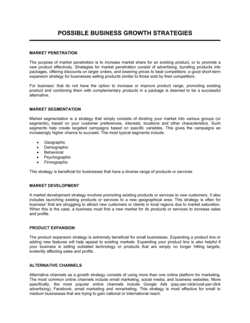
A growth strategy focused on increasing share of an existing market with existing products, typically through pricing, promotion, or distribution improvements.
Market Development
A growth strategy that takes existing products into new geographic regions, customer segments, or sales channels.
CAGR (Compound Annual Growth Rate)
The rate at which a metric β€” usually revenue β€” grows from one period to another, expressed as an annualized percentage that accounts for compounding.
SWOT Analysis
A structured assessment of a company's internal Strengths and Weaknesses alongside external Opportunities and Threats.
Ansoff Matrix
A strategic planning tool that maps four growth options β€” market penetration, market development, product development, and diversification β€” against risk level.
Runway
The number of months a business can operate at its current cash burn rate before requiring additional revenue or outside funding.
OKR (Objectives and Key Results)
A goal-setting framework pairing a qualitative objective with two to five measurable key results that indicate whether the objective has been achieved.
Churn Rate
The percentage of customers or revenue lost within a given period β€” a critical growth health metric, particularly for subscription businesses.
Growth Lever
A specific, controllable action or investment β€” such as a new sales channel or price change β€” that predictably drives measurable growth when applied.

Part of your Business Operating System

This document is one of 3,000+ business & legal templates included in Business in a Box.

  • Fill-in-the-blanks β€” ready in minutes
  • 100% customizable Word document
  • Compatible with all office suites
  • Export to PDF and share electronically

Create your document in 3 simple steps.

From template to signed document β€” all inside one Business Operating System.
1
Download or open template

Access over 3,000+ business and legal templates for any business task, project or initiative.

2
Edit and fill in the blanks with AI

Customize your ready-made business document template and save it in the cloud.

3
Save, Share, Send, Sign

Share your files and folders with your team. Create a space of seamless collaboration.

Save time, save money, and create top-quality documents.

β˜…β˜…β˜…β˜…β˜…

"Fantastic value! I'm not sure how I'd do without it. It's worth its weight in gold and paid back for itself many times."

Managing Director Β· Mall Farm
Robert Whalley
Managing Director, Mall Farm Proprietary Limited
β˜…β˜…β˜…β˜…β˜…

"I have been using Business in a Box for years. It has been the most useful source of templates I have encountered. I recommend it to anyone."

Business Owner Β· 4+ years
Dr Michael John Freestone
Business Owner
β˜…β˜…β˜…β˜…β˜…

"It has been a life saver so many times I have lost count. Business in a Box has saved me so much time and as you know, time is money."

Owner Β· Upstate Web
David G. Moore Jr.
Owner, Upstate Web

Run your business with a system β€” not scattered tools

Stop downloading documents. Start operating with clarity. Business in a Box gives you the Business Operating System used by over 250,000 companies worldwide to structure, run, and grow their business.

Start freeΒ Β·Β No credit card required