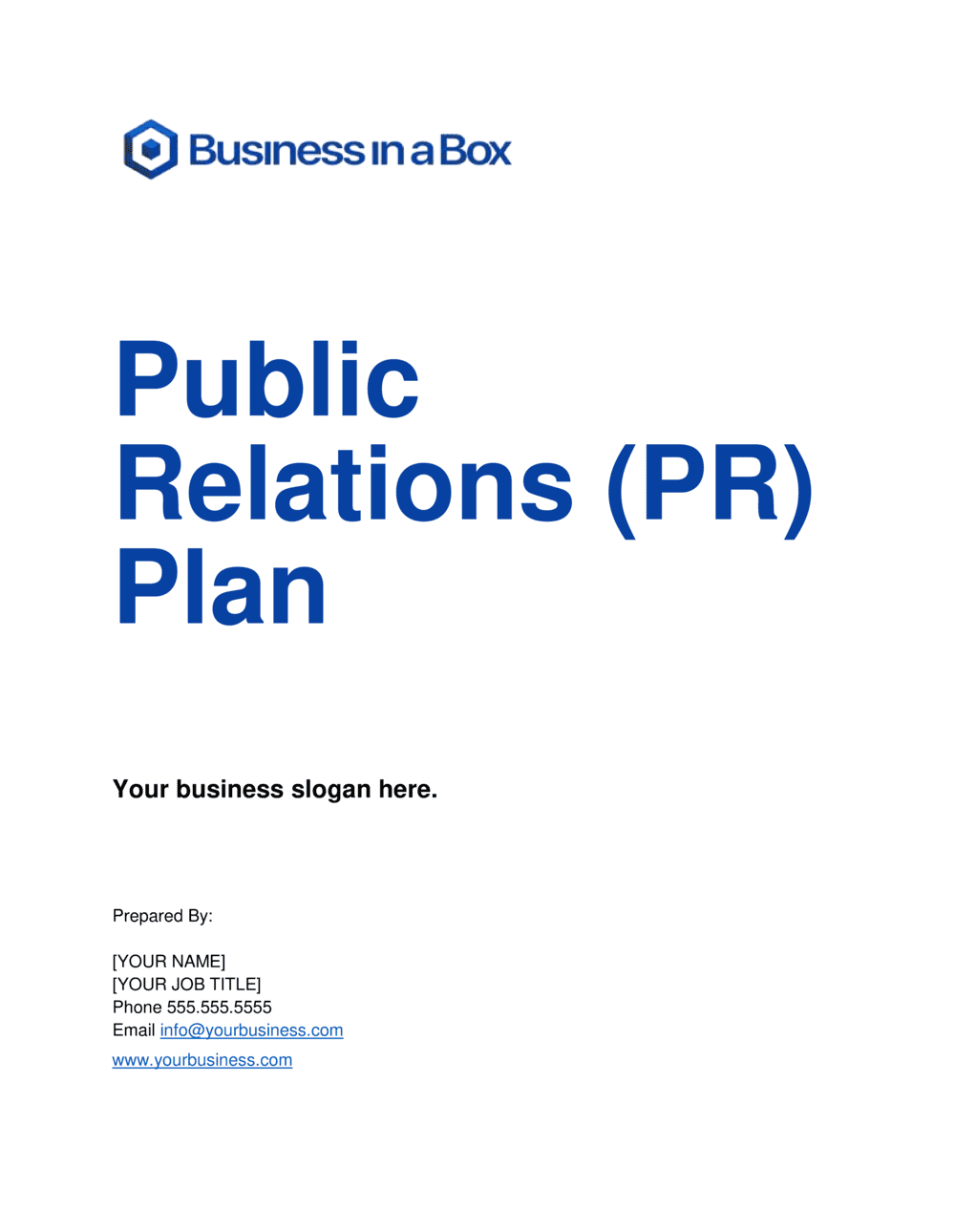
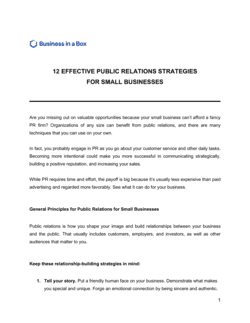
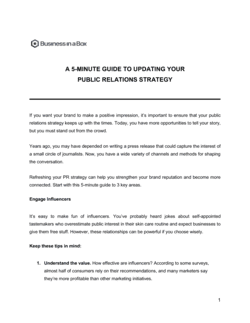
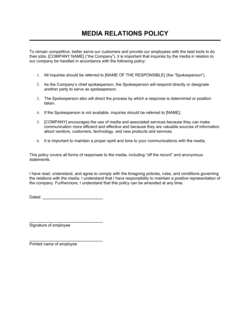
Public Relations Plan Template

Free Word download β€’ Edit online β€’ Save & share with Drive β€’ Export to PDF

13 pagesβ€’30–40 min to fillβ€’Difficulty: Complex
Learn more ↓
FreePublic Relations Plan Template

At a glance

What it is
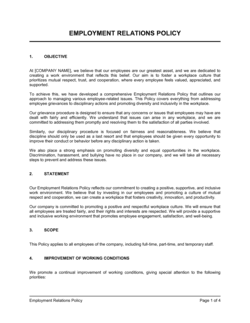
A Public Relations Plan is an operational document that defines your organization's PR objectives, target audiences, key messages, media tactics, and success metrics for a defined period β€” typically 6 to 12 months. This free Word download gives you a structured, ready-to-edit starting point you can tailor to a product launch, brand awareness campaign, crisis response, or ongoing media relations program, then export as PDF to share with your team or agency.
When you need it
Use it when launching a new product or company, managing a brand reputation issue, entering a new market, or building a proactive media presence from scratch. Any initiative where public perception directly affects business outcomes warrants a written PR plan.
What's inside
Situation analysis and PR objectives, target audience profiles, key messages, media and channel strategy, editorial calendar, spokesperson guidelines, budget allocation, and measurement framework with KPIs.

What is a Public Relations Plan?

A Public Relations Plan is a structured operational document that defines an organization's PR objectives, target audiences, key messages, media and channel strategy, editorial calendar, spokesperson protocols, budget, and measurement framework for a defined period β€” typically 6 to 12 months. Unlike an ad hoc press release or a single media pitch, a PR plan connects every communications activity to a stated business goal and establishes in advance how success will be measured. It functions as both an internal roadmap for the communications team and a briefing document for external agencies or senior stakeholders who need to understand where PR effort and budget are going and what results to expect.

Why You Need This Document

Without a written PR plan, media outreach becomes a series of disconnected, reactive actions β€” press releases sent when something happens, pitches made when time allows, and coverage evaluated by feel rather than data. The cost of operating without a plan is concrete: spokespeople go off-message because no approved talking points exist, editorial opportunities are missed because no calendar was built around them, and leadership loses confidence in PR because results cannot be tied to business objectives. A documented PR plan eliminates these gaps by giving every campaign activity a news hook, a target outlet, an owner, and a KPI. This template gives you the structure to build that plan in a single working session, whether you are launching a brand from scratch, preparing for a product announcement, or formalizing a PR program that has been running informally for years.

Which variant fits your situation?

If your situation is…Use this template
Planning PR for a specific product or service launchProduct Launch Plan
Managing communications during a crisis or reputation issueCrisis Communications Plan
Coordinating internal and external messaging across departmentsCommunications Plan
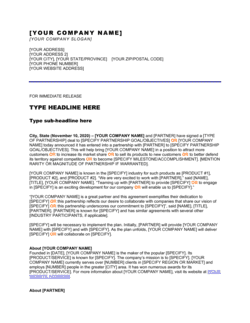
Pitching media coverage with a structured story anglePress Release
Planning a full-year marketing and communications strategyMarketing Plan
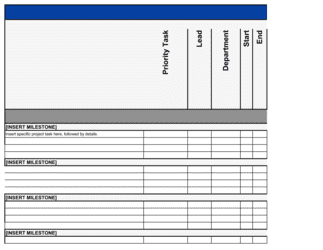
Tracking PR deliverables and deadlines across a teamAction Plan
Presenting brand positioning context to a PR agencyBrand Strategy Template

Common mistakes to avoid

❌ Activity-based objectives instead of outcome-based ones

Why it matters: Measuring how many press releases you sent rather than how many placements you secured makes it impossible to demonstrate PR's business impact to leadership or clients.

Fix: Rewrite every objective as 'Achieve [measurable outcome] by [date].' Tie each outcome to a business metric β€” leads, revenue, hiring pipeline, or share of voice.

❌ Skipping the situation analysis

Why it matters: Without a baseline on current media presence and sentiment, you cannot prove the plan produced any improvement β€” and you risk setting targets that are either trivially easy or completely unrealistic.

Fix: Run a 90-day media audit before finalizing any objectives. Document mention volume, sentiment breakdown, and top-performing story angles.

❌ No defined spokesperson routing protocol

Why it matters: An unauthorized team member responding directly to a journalist inquiry β€” even with good intentions β€” can produce a damaging quote that drives a negative news cycle.

Fix: Write a one-paragraph inquiry routing policy naming who receives media requests, who approves responses, and the target response window. Include it in the plan and distribute it to all staff.

❌ Building a media list without matching it to audience tiers

Why it matters: Pitching a consumer lifestyle story to a B2B trade editor wastes their time, damages your relationship, and produces zero coverage regardless of how good the story is.

Fix: Segment your media list into tiers by outlet type and audience match. Write a separate pitch angle for each tier rather than sending the same release to everyone.

❌ Omitting the budget section

Why it matters: Without a budget line, PR costs accumulate invisibly β€” tool subscriptions, distribution fees, and agency hours add up quickly and make ROI calculation impossible.

Fix: Include a line-item budget even for in-house programs. Assign a dollar value or hourly time cost to every planned activity so leadership can evaluate PR spend against results.

❌ Measuring only outputs, not outcomes

Why it matters: Reporting that you sent 12 press releases and made 80 pitches tells stakeholders nothing about whether PR generated business value.

Fix: Add at least two outcome KPIs to the measurement framework β€” share of voice percentage, inbound leads attributed to media coverage, or domain authority backlinks from earned placements.

The 10 key sections, explained

Executive Summary

Situation Analysis

PR Objectives

Target Audiences

Key Messages

Media and Channel Strategy

Editorial Calendar and Activity Plan

Spokesperson Guidelines

Budget

Measurement Framework

How to fill it out

  1. 1

    Complete the situation analysis before writing any goals

    Audit your current media presence using a monitoring tool or manual search. Document baseline metrics β€” number of mentions, sentiment ratio, top publications, and share of voice versus two or three key competitors.

    πŸ’‘ A 90-day media audit using Google Alerts costs nothing and is sufficient to establish a baseline for most small businesses.

  2. 2

    Set outcome-based PR objectives with numbers and deadlines

    Write two to four objectives in the format 'Achieve [X] by [DATE] as measured by [METRIC].' Tie each objective to a business goal β€” lead generation, fundraising, hiring, or market expansion.

    πŸ’‘ If you cannot identify a measurement method when writing the objective, rewrite the objective β€” unmeasurable goals are unmanageable goals.

  3. 3

    Build audience profiles with media consumption habits

    For each target audience, identify the specific publications they read, podcasts they listen to, and social platforms they use. Note what story angles resonate with each group.

    πŸ’‘ Interview two or three real customers or stakeholders about where they get industry news. Their answers are more reliable than demographic assumptions.

  4. 4

    Draft key messages for each audience segment

    Write two to three messages per audience. Each message should be one sentence, lead with the audience's interest rather than your product feature, and include a supporting proof point.

    πŸ’‘ Test messages against the 'so what?' check β€” if a journalist or customer would respond with 'so what?', the message is not specific enough.

  5. 5

    Build a tiered media list matched to each audience

    Categorize target outlets into Tier 1 (national/industry-leading), Tier 2 (trade and vertical), and Tier 3 (local, niche, or influencer). Assign each tier to the corresponding audience and objective.

    πŸ’‘ A focused list of 30 highly relevant outlets will outperform a generic list of 200. Quality of fit matters more than volume for earned media.

  6. 6

    Map activities to the editorial calendar with news hooks

    Place each planned press release, pitch, event, or article on a monthly calendar. For each activity, write one sentence explaining the news hook β€” the reason a journalist would cover it right now.

    πŸ’‘ Align PR calendar milestones to industry events, product release dates, and seasonal news cycles where possible. Timeliness multiplies coverage likelihood.

  7. 7

    Define the spokesperson policy and approval workflow

    Name each authorized spokesperson with their approved topic areas. Write a one-paragraph media inquiry routing protocol: who receives the inquiry, who approves the response, and what the target response time is.

    πŸ’‘ Create a one-page spokesperson briefing card with approved talking points and three anticipated tough questions β€” brief spokespeople before every media interaction, not only during crises.

  8. 8

    Set up the measurement framework before launching any activity

    Configure your monitoring tools, create a KPI tracking spreadsheet, and schedule monthly reporting reviews before the first press release goes out. Retroactive measurement misses early data.

    πŸ’‘ Track UTM-tagged URLs from press releases and media coverage in Google Analytics to connect PR placements directly to web traffic and conversions.

Frequently asked questions

What is a public relations plan?

A public relations plan is a structured document that defines an organization's PR objectives, target audiences, key messages, media tactics, editorial calendar, spokesperson protocols, and measurement framework for a defined time period. It translates broad communications goals into a concrete, actionable program that can be executed by an in-house team or external agency.

What should a PR plan include?

A complete public relations plan covers ten core elements: an executive summary, situation analysis, measurable PR objectives, target audience profiles, key messages, media and channel strategy, an editorial calendar, spokesperson guidelines, a line-item budget, and a measurement framework with specific KPIs. Plans that omit the situation analysis or measurement framework cannot demonstrate ROI.

How is a PR plan different from a marketing plan?

A marketing plan covers all demand-generation activities β€” paid advertising, email, content, events, and PR among them. A PR plan focuses specifically on earned media, reputation management, and stakeholder communications. The two documents should be aligned and share consistent key messages, but a PR plan goes deeper on media strategy, journalist relationships, and coverage measurement than a marketing plan typically does.

How long should a public relations plan be?

For most organizations, 8–15 pages covers the core content effectively. Agency plans presented to clients typically run 15–25 pages with supporting appendices β€” media lists, sample pitch templates, and a detailed editorial calendar. An internal operating plan can be shorter if the audience already understands the business context.

How do you measure the success of a PR plan?

Effective PR measurement uses a mix of output metrics (press releases issued, pitches sent), outtake metrics (placements secured, reach, sentiment), and outcome metrics (web traffic from coverage, inbound leads, share of voice versus competitors). Outcome metrics are the ones leadership cares about β€” build your KPI framework around those first, then use output and outtake metrics to diagnose performance.

Do small businesses need a formal PR plan?

Yes β€” even a two to three page plan that defines your target publications, two key messages, and a simple editorial calendar of four press releases per year produces better results than ad hoc media outreach. Without a plan, PR activities compete with every other priority and are the first thing cut when workloads increase. A documented plan gives PR a defined place in the business calendar.

How often should a PR plan be updated?

For most organizations, an annual plan reviewed quarterly is standard. Update the situation analysis, objectives, and editorial calendar at the start of each fiscal year. Mid-year reviews should compare actual placements and KPI progress against plan targets and adjust the second-half calendar if market conditions or business priorities have shifted. Crisis situations require an immediate ad hoc update.

Should I hire a PR agency or manage PR in-house?

In-house PR works well when you have a dedicated communications professional, consistent news flow, and established journalist relationships. A PR agency adds value when you need immediate media relationships in a new market, specialized expertise for a product launch or IPO, or surge capacity for a crisis. A well-structured PR plan template reduces agency onboarding time significantly by giving any agency a clear brief from day one.

What is the difference between a PR plan and a crisis communications plan?

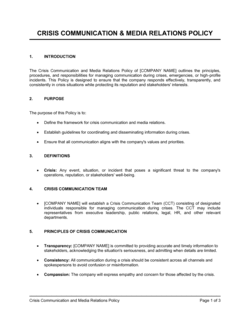
A PR plan is a proactive document focused on building positive media presence and brand awareness over a defined period. A crisis communications plan is a reactive protocol that defines who speaks, what is said, and how quickly in the event of a negative incident β€” a product recall, data breach, or leadership scandal. Both are necessary; the crisis plan should be referenced in the PR plan's spokesperson section as the protocol to activate when needed.

How this compares to alternatives

vs Marketing Plan

A marketing plan covers the full mix of paid, owned, and earned channels β€” advertising, email, content, events, and PR. A PR plan focuses exclusively on earned media, reputation management, and stakeholder communications. The two should share consistent key messages and be reviewed together, but a PR plan provides far more depth on media strategy, journalist targeting, and coverage measurement than a marketing plan typically does.

vs Communications Plan

A communications plan governs all internal and external messaging β€” employee communications, investor relations, customer announcements, and media outreach. A PR plan is narrower, focusing specifically on earned media and public perception. Use a communications plan when you need to coordinate messaging across all stakeholder groups; use a PR plan when media coverage and brand reputation are the primary focus.

vs Press Release

A press release is a single tactical output β€” a formatted news announcement sent to media to announce a specific event or milestone. A PR plan is the strategic document that determines when press releases are issued, to which outlets, with which key messages, and how their results are measured. A press release without a PR plan is a one-off tactic; a PR plan without press releases is a strategy without execution.

vs Crisis Communications Plan

A crisis communications plan is a reactive protocol activated when a negative event threatens brand reputation β€” it defines who speaks, what the approved messages are, and how quickly responses must be issued. A PR plan is proactive, focused on building positive media presence over time. Both documents should exist and reference each other; the spokesperson section of the PR plan should point to the crisis plan as the override protocol when an incident occurs.

Industry-specific considerations

Technology / SaaS

Product launch cycles, analyst relations programs, and developer community media all require distinct PR tracks with separate key messages and media lists.

Healthcare and Life Sciences

Regulatory approval announcements, clinical trial results, and patient advocacy media require careful legal and compliance review before any media outreach.

Retail and Consumer Brands

Seasonal editorial calendars tied to retail moments, influencer media strategy, and product review programs require tight coordination between PR and marketing.

Professional Services

Thought leadership placement in trade publications, awards submissions, and speaking opportunities at industry conferences form the core of most professional services PR programs.

Nonprofit and Social Impact

Donor awareness campaigns, impact reporting, and cause-related media pitches require storytelling-first key messages tied to measurable community outcomes.

Food and Beverage

Seasonal product launches, food media relationships, and restaurant review strategies demand a tightly timed editorial calendar aligned to menu and distribution cycles.

Template vs pro β€” what fits your needs?

PathBest forCostTime
Use the templateSmall business owners, startups, and in-house marketing teams managing PR without a dedicated agencyFree4–8 hours to complete
Template + professional reviewGrowing businesses preparing for a product launch, funding announcement, or new market entry$500–$2,000 for a PR consultant review and media list build1–2 weeks
Custom draftedEnterprise organizations, IPO-stage companies, or brands managing complex multi-market PR programs$5,000–$25,000+ for a full-service agency plan and retainer3–6 weeks

Glossary

Earned Media
Coverage generated through editorial merit β€” news articles, broadcast segments, and podcast mentions β€” without paid placement.
Key Message
A concise, consistent statement that communicates a core point about your brand, product, or initiative to a specific audience.
Media Pitch
A brief, targeted message sent to a journalist or editor proposing a story idea and explaining why it is relevant to their audience.
Spokesperson
The designated individual authorized to speak on behalf of an organization to media, representing the company's official positions.
Situation Analysis
An assessment of the current state of your brand's public perception, competitive environment, and relevant media landscape before setting PR goals.
Editorial Calendar
A schedule mapping planned press releases, media pitches, events, and content to specific dates throughout the campaign period.
Media List
A curated database of journalists, editors, and influencers organized by beat, publication, and contact details for targeted outreach.
Share of Voice
Your brand's proportion of total media mentions within a defined category or industry, relative to competitors, over a given period.
KPI (Key Performance Indicator)
A measurable metric used to evaluate whether PR activities are achieving their stated objectives β€” for example, number of placements, reach, or sentiment score.
Boilerplate
A standardized paragraph at the end of press releases that provides a consistent, approved description of the company for media use.
News Hook
A timely angle or trigger β€” a trend, event, data release, or milestone β€” that makes a story relevant and attractive to journalists right now.

Part of your Business Operating System

This document is one of 3,000+ business & legal templates included in Business in a Box.

  • Fill-in-the-blanks β€” ready in minutes
  • 100% customizable Word document
  • Compatible with all office suites
  • Export to PDF and share electronically

Create your document in 3 simple steps.

From template to signed document β€” all inside one Business Operating System.
1
Download or open template

Access over 3,000+ business and legal templates for any business task, project or initiative.

2
Edit and fill in the blanks with AI

Customize your ready-made business document template and save it in the cloud.

3
Save, Share, Send, Sign

Share your files and folders with your team. Create a space of seamless collaboration.

Save time, save money, and create top-quality documents.

β˜…β˜…β˜…β˜…β˜…

"Fantastic value! I'm not sure how I'd do without it. It's worth its weight in gold and paid back for itself many times."

Managing Director Β· Mall Farm
Robert Whalley
Managing Director, Mall Farm Proprietary Limited
β˜…β˜…β˜…β˜…β˜…

"I have been using Business in a Box for years. It has been the most useful source of templates I have encountered. I recommend it to anyone."

Business Owner Β· 4+ years
Dr Michael John Freestone
Business Owner
β˜…β˜…β˜…β˜…β˜…

"It has been a life saver so many times I have lost count. Business in a Box has saved me so much time and as you know, time is money."

Owner Β· Upstate Web
David G. Moore Jr.
Owner, Upstate Web

Run your business with a system β€” not scattered tools

Stop downloading documents. Start operating with clarity. Business in a Box gives you the Business Operating System used by over 250,000 companies worldwide to structure, run, and grow their business.

Free Forever PlanΒ Β·Β No credit card required