Change Management Plan Template

Free Word download β€’ Edit online β€’ Save & share with Drive β€’ Export to PDF

8 pagesβ€’25–30 min to fillβ€’Difficulty: Standard
Learn more ↓
FreeChange Management Plan Template

At a glance

What it is
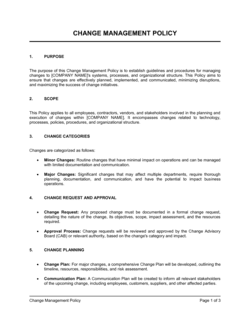
A Change Management Plan is a structured operational document that guides an organization through a defined transition β€” a new system, restructuring, process overhaul, or strategic pivot β€” by documenting scope, impact, stakeholder roles, communication strategy, training requirements, and success metrics. This free Word download gives you a ready-to-edit framework you can complete online and export as PDF for leadership, project teams, or board review.
When you need it
Use it whenever a significant organizational change is planned β€” ERP implementation, workforce restructuring, merger integration, policy rollout, or a shift in operating model β€” where unmanaged resistance or gaps in communication could derail execution.
What's inside
Change scope and objectives, stakeholder identification and impact assessment, communication plan, training and support strategy, risk and resistance management, implementation timeline, and success metrics with a post-implementation review process.

What is a Change Management Plan?

A Change Management Plan is a structured operational document that guides an organization through a defined transition β€” whether a new technology system, a restructured team, a revised process, or a strategic shift β€” by documenting scope, stakeholder impacts, communication strategy, training requirements, risk mitigations, implementation milestones, and adoption metrics in a single actionable reference. It addresses the human side of change: who is affected, what they need to know and do differently, and how the organization will support and measure the transition. This free Word download gives project leads, HR directors, and change managers a ready-to-edit framework they can tailor to any initiative and export as PDF for leadership or board review.

Why You Need This Document

Organizations that attempt significant changes without a formal plan consistently see the same failure modes: frontline employees who learn about a change from rumors rather than management, training delivered too early or too late, and adopted behaviors that quietly revert to old habits within 60 days of go-live. Research by Prosci consistently finds that projects with excellent change management are six times more likely to meet objectives than those with poor or no change management. Without a written plan, accountability for communication and training defaults to no one β€” meaning critical steps get skipped when project timelines compress. A completed change management plan creates a shared record of who owns each action, what success looks like, and how the organization will know the change has actually stuck β€” protecting both the investment in the change initiative and the productivity of the people it affects.

Which variant fits your situation?

If your situation is…Use this template
Rolling out a new enterprise software system across departmentsIT Change Management Plan
Restructuring teams or reducing headcountOrganizational Restructuring Plan
Integrating two companies following a merger or acquisitionMerger Integration Plan
Communicating a specific policy or compliance change to staffInternal Communication Plan
Managing a short-term operational process improvementProcess Improvement Plan
Coordinating a company-wide digital transformation initiativeDigital Transformation Roadmap
Tracking change progress and executive reporting at a program levelChange Management Status Report

Common mistakes to avoid

❌ Skipping the stakeholder impact assessment

Why it matters: Without a structured impact assessment, communication and training plans default to one-size-fits-all β€” missing the groups most at risk of non-adoption and wasting resources on those least affected.

Fix: Complete a stakeholder impact matrix before drafting any other section of the plan, and update it whenever scope changes.

❌ Treating communication as a single announcement

Why it matters: A single launch email generates awareness at best. Employees who do not receive repeated, role-specific messages consistently revert to old behaviors within two to four weeks of go-live.

Fix: Build a communication calendar with a minimum of three touchpoints per key audience group β€” pre-launch, at launch, and 30 days post-launch.

❌ Scheduling training too far before go-live

Why it matters: Procedural knowledge decays rapidly. Employees trained four to six weeks before go-live retain significantly less than those trained one to two weeks out, requiring costly re-training sessions.

Fix: Schedule final training no more than ten business days before go-live and provide a job aid or quick-reference guide employees can use during the first week.

❌ No post-implementation review

Why it matters: Without a structured review at 30 and 90 days, workarounds, shadow processes, and unresolved training gaps become permanent features of the new operating model β€” often undoing the change's intended benefits.

Fix: Book the 30-day and 90-day review meetings before the change launches and assign a named owner who reports findings to the change sponsor.

The 9 key sections, explained

Change overview and objectives

Scope and boundaries

Stakeholder identification and impact assessment

Communication plan

Training and support strategy

Risk and resistance management

Implementation timeline and milestones

Success metrics and KPIs

Post-implementation review

How to fill it out

  1. 1

    Define the change and its business rationale

    Write a clear, jargon-free description of what is changing, why the organization is making the change, and what success looks like. This becomes the anchor statement every other section references.

    πŸ’‘ Test your rationale by asking whether a frontline employee reading it would understand why the change is necessary β€” if not, revise until it passes that test.

  2. 2

    Identify and document all impacted stakeholders

    List every group β€” by role, department, and location β€” whose work, tools, or workflows will change. Rate impact as high, medium, or low and note the specific change each group faces.

    πŸ’‘ Include indirect stakeholders such as customers, vendors, or partner teams whose workflows depend on the process you are changing.

  3. 3

    Build the communication plan by audience

    For each stakeholder group, define the message, channel, sender, timing, and frequency. Senior leaders need strategic context; frontline workers need practical guidance on what to do differently from day one.

    πŸ’‘ Designate a manager cascade channel for any change affecting more than 50 people β€” direct manager communication consistently outperforms company-wide announcements in driving behavioral adoption.

  4. 4

    Conduct a training needs analysis

    Identify the specific skill or knowledge gaps each affected group needs to close before go-live. Match training format (instructor-led, e-learning, or job aid) to the complexity of the new behavior and the size of the audience.

    πŸ’‘ Schedule training no more than two weeks before go-live and build in a practice period β€” even one 30-minute simulation session improves day-one performance significantly.

  5. 5

    Document risks and resistance triggers

    List the top five to eight risks to adoption β€” including likely sources of resistance, key-person dependencies, and technical failure points. Assign an owner and a mitigation action to each.

    πŸ’‘ Run a pre-mortem: ask your team to imagine the change has failed and work backward to identify what caused it. Pre-mortems surface risks that standard risk registers miss.

  6. 6

    Set the implementation timeline with explicit buffers

    Map all phases from planning to post-implementation review. Include a minimum two-week stabilization window between training completion and go-live, and at least a 30-day hypercare period after go-live.

    πŸ’‘ Sequence dependencies carefully β€” communication should always precede training, and training should always precede go-live by at least five business days.

  7. 7

    Define measurable success metrics

    Set at least three KPIs with baseline values, targets, and measurement dates at 30, 60, and 90 days post-go-live. Include both leading indicators (training completion rate) and lagging indicators (adoption rate at 90 days).

    πŸ’‘ Avoid metrics you cannot actually measure β€” if your system cannot report adoption data, build a manual audit process before go-live, not after.

  8. 8

    Schedule the post-implementation review before go-live

    Book the 30-day and 90-day review meetings before the change launches. Assign the review owner, confirm the data inputs that will be needed, and distribute the lessons-learned template in advance.

    πŸ’‘ Connecting the post-implementation review owner to the change sponsor creates accountability β€” reviews that lack executive visibility are the first thing dropped when teams get busy.

Frequently asked questions

What is a change management plan?

A change management plan is a structured document that guides an organization through a defined transition by documenting the change scope, affected stakeholders, communication strategy, training approach, risk mitigations, implementation timeline, and success metrics. It functions as the operational playbook that keeps all teams aligned and accountable throughout a transition β€” from initial announcement through post-implementation review.

When do you need a change management plan?

You need a change management plan whenever a change will materially alter how people do their work β€” new software systems, process redesigns, organizational restructuring, policy changes, or strategic pivots. As a rule of thumb, any change affecting more than 20 people or requiring new skills warrants a formal plan. Smaller, routine changes can be managed with a simplified communication memo.

What is the difference between a change management plan and a project plan?

A project plan manages the technical delivery of a change β€” tasks, dependencies, resources, and deadlines. A change management plan manages the human side β€” how people are informed, trained, supported, and held accountable for adopting the new way of working. Both are required for complex changes; treating them as the same document is one of the most common causes of go-live failures.

What change management frameworks work with this template?

The template is framework-agnostic and compatible with ADKAR (Prosci), Kotter's 8-Step Model, McKinsey's 7-S Framework, and ITIL change management processes. The section structure maps most directly to ADKAR β€” the communication plan addresses Awareness and Desire, training addresses Knowledge and Ability, and the post-implementation review addresses Reinforcement. Teams already using a specific methodology can annotate sections with framework terminology without restructuring the document.

Who should own the change management plan?

A designated change manager or project lead should own the document and be responsible for keeping it current throughout the initiative. A senior executive β€” the change sponsor β€” should formally approve the plan and remain visibly engaged throughout execution. Without visible executive sponsorship, employees consistently rate changes as lower priority and adoption rates fall.

How detailed does a change management plan need to be?

For an enterprise-wide system implementation or organizational restructuring, a complete plan covering all nine sections is appropriate. For a department-level process change, a condensed version covering scope, stakeholders, communication, training, and a go-live date is often sufficient. Depth should be proportionate to the number of people affected, the complexity of the behavioral change required, and the business risk of failed adoption.

What metrics indicate a change management plan is working?

Leading indicators include training completion rate (target 95%+ before go-live), communication open and acknowledgment rates, and help-desk ticket volume in the first week post-launch. Lagging indicators include adoption rate at 30, 60, and 90 days, error or incident rate compared to baseline, and productivity recovery to pre-change levels. Combining both types gives an accurate picture of adoption progress.

How long does it take to create a change management plan?

For a mid-sized organizational change affecting 50–200 people, expect three to five days of focused work to complete a thorough plan from scratch β€” primarily for the stakeholder impact assessment, communication calendar, and training needs analysis. Using a structured template cuts that time by roughly 50%, leaving most of your effort for the organization-specific content that requires original thinking.

Can a change management plan be used for IT system changes?

Yes β€” IT changes are one of the most common applications. ERP migrations, CRM rollouts, and core infrastructure upgrades all require structured stakeholder analysis, communication campaigns, and training programs to achieve user adoption. IT project managers often combine a technical project plan with this change management plan to cover both delivery and adoption dimensions of the same initiative.

How this compares to alternatives

vs Project Plan

A project plan governs technical delivery β€” tasks, owners, deadlines, and resource allocation. A change management plan governs adoption β€” how people are informed, trained, and supported through the transition. Complex changes require both documents running in parallel, with the change plan informing communication and training milestones in the project plan.

vs Communication Plan

A communication plan is a single section within a change management plan, focused exclusively on message content, channels, audiences, and timing. A change management plan is broader β€” it adds stakeholder impact assessment, training strategy, risk management, implementation timeline, and success metrics. Use a standalone communication plan only for changes where training and structural impact are minimal.

vs Process Improvement Plan

A process improvement plan defines how a specific workflow will be redesigned for greater efficiency. A change management plan defines how the organization will transition to and sustain that redesigned workflow. Process improvements without a companion change management plan frequently see teams revert to old methods within 90 days of implementation.

vs Strategic Plan

A strategic plan sets the long-term direction and priorities for an organization. A change management plan operationalizes a specific initiative within that strategy by managing the human and process transitions required to execute it. Every major strategic initiative typically requires one or more change management plans to translate strategy into adopted behavior.

Industry-specific considerations

Technology / SaaS

Platform migrations, agile process adoption, and rapid product-team restructuring require change plans that keep engineering, product, and customer-success teams synchronized through frequent releases.

Healthcare

EHR system rollouts, clinical protocol changes, and regulatory compliance updates demand change plans with rigorous training records and adoption audits to meet accreditation standards.

Financial Services

Regulatory-driven process changes, core banking migrations, and risk framework updates require change plans with detailed compliance sign-off steps and audit trails for internal and external review.

Manufacturing

Lean or Six Sigma process redesigns, equipment upgrades, and safety procedure changes need shift-aware communication plans and hands-on training formats that accommodate production schedules.

Template vs pro β€” what fits your needs?

PathBest forCostTime
Use the templateProject leads and HR managers managing department-level or single-system changesFree2–4 days to complete
Template + professional reviewEnterprise-wide changes affecting 200+ people or involving regulatory compliance requirements$500–$2,500 for a change management consultant review1–2 weeks
Custom draftedLarge-scale transformations such as mergers, core ERP migrations, or multi-country restructuring programs$5,000–$30,000+ for a full change management engagement4–12 weeks

Glossary

Change Sponsor
A senior leader with the authority and accountability to authorize, fund, and visibly champion a change initiative.
Stakeholder Impact Assessment
A structured analysis identifying which individuals or groups are affected by a change, how significantly, and what actions are needed to support them.
Resistance Management
Planned tactics to identify, understand, and address the causes of pushback from employees or leaders affected by a change.
Change Readiness
An assessment of whether the organization β€” in terms of culture, capacity, skills, and leadership alignment β€” is prepared to absorb and sustain a proposed change.
Adoption Rate
The percentage of impacted users or teams actively using a new process, system, or behavior at a defined point after go-live.
Go-Live Date
The planned date on which a new system, process, or structure becomes operational and the old one is retired or deprecated.
Reinforcement Plan
Post-implementation actions β€” recognition, performance feedback, audits β€” designed to sustain changed behaviors after initial training is complete.
ADKAR Model
A change management framework (Awareness, Desire, Knowledge, Ability, Reinforcement) used to diagnose where individuals are in their change journey.
Change Impact
The degree to which a change alters how a role, team, or process operates β€” typically rated by severity (high, medium, low) and breadth of people affected.
Training Needs Analysis
An assessment of the skills or knowledge gaps that must be closed through training before affected employees can operate under the new state.

Part of your Business Operating System

This document is one of 3,000+ business & legal templates included in Business in a Box.

  • Fill-in-the-blanks β€” ready in minutes
  • 100% customizable Word document
  • Compatible with all office suites
  • Export to PDF and share electronically

Create your document in 3 simple steps.

From template to signed document β€” all inside one Business Operating System.
1
Download or open template

Access over 3,000+ business and legal templates for any business task, project or initiative.

2
Edit and fill in the blanks with AI

Customize your ready-made business document template and save it in the cloud.

3
Save, Share, Send, Sign

Share your files and folders with your team. Create a space of seamless collaboration.

Save time, save money, and create top-quality documents.

β˜…β˜…β˜…β˜…β˜…

"Fantastic value! I'm not sure how I'd do without it. It's worth its weight in gold and paid back for itself many times."

Managing Director Β· Mall Farm
Robert Whalley
Managing Director, Mall Farm Proprietary Limited
β˜…β˜…β˜…β˜…β˜…

"I have been using Business in a Box for years. It has been the most useful source of templates I have encountered. I recommend it to anyone."

Business Owner Β· 4+ years
Dr Michael John Freestone
Business Owner
β˜…β˜…β˜…β˜…β˜…

"It has been a life saver so many times I have lost count. Business in a Box has saved me so much time and as you know, time is money."

Owner Β· Upstate Web
David G. Moore Jr.
Owner, Upstate Web

Run your business with a system β€” not scattered tools

Stop downloading documents. Start operating with clarity. Business in a Box gives you the Business Operating System used by over 250,000 companies worldwide to structure, run, and grow their business.

Start freeΒ Β·Β No credit card required