Quality Control Plan Template

Free Word download β€’ Edit online β€’ Save & share with Drive β€’ Export to PDF

14 pagesβ€’25–35 min to fillβ€’Difficulty: Complex
Learn more ↓
FreeQuality Control Plan Template

At a glance

What it is
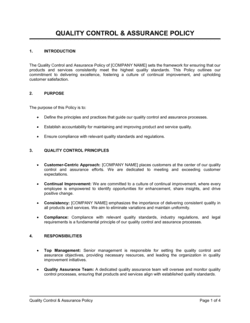
A Quality Control Plan is an operational document that defines the inspection activities, acceptance criteria, testing methods, and corrective action procedures a business uses to ensure its products or services consistently meet specified standards. This free Word download gives you a structured, editable starting point you can adapt for manufacturing, construction, software, or services and export as PDF to share with production teams, auditors, or clients.
When you need it
Use it when launching a new product line, onboarding a new supplier, responding to a spike in customer defect reports, or preparing for an ISO, client, or regulatory audit that requires documented QC procedures.
What's inside
Scope and objectives, quality standards references, inspection and testing procedures, acceptance and rejection criteria, roles and responsibilities, corrective and preventive action (CAPA) workflow, documentation and recordkeeping requirements, and a review and revision schedule.

What is a Quality Control Plan?

A Quality Control Plan is an operational document that defines the inspection activities, testing methods, acceptance criteria, and corrective action procedures a business uses to ensure its products or services consistently meet specified quality standards. It maps every control point in a production or delivery process to a measurable outcome β€” identifying who inspects what, how they measure it, what counts as a pass or fail, and what happens when something falls outside tolerance. Unlike a general quality policy, a QC plan is specific enough to guide daily decisions on the shop floor, job site, or service delivery team.

Why You Need This Document

Without a written quality control plan, inspection decisions vary from shift to shift and person to person, defects reach customers before anyone catches them, and corrective actions are informal responses rather than documented process changes. The consequences are concrete: higher rework and scrap costs, customer returns, failed supplier audits, and lost contracts that require demonstrated QC capability. A written plan also provides the audit trail that ISO 9001 certification, government procurement contracts, and regulated industries require β€” without it, you cannot prove your quality system exists, even if it works in practice. This template gives you a complete, structured starting point that you can adapt to your specific process and have ready for an audit or customer review in a matter of hours.

Which variant fits your situation?

If your situation is…Use this template
Manufacturing physical products with defined dimensional tolerancesManufacturing Quality Control Plan
Managing quality on a construction or civil engineering projectConstruction Quality Control Plan
Documenting QC for software development and release cyclesSoftware Quality Assurance Plan
Setting incoming inspection standards for purchased componentsSupplier Quality Control Plan
Meeting ISO 9001 documentation requirements for certificationQuality Management Plan
Tracking defect rates and corrective actions over timeCorrective Action Report
Running a pre-shipment inspection for export goodsPre-Shipment Inspection Checklist

Common mistakes to avoid

❌ Vague inspection instructions

Why it matters: Instructions like 'inspect for surface defects' without defining what counts as a defect result in different pass/fail decisions from different inspectors, making quality data meaningless.

Fix: Specify defect types, measurement methods, instruments, and acceptance thresholds in enough detail that a new inspector can apply them consistently without additional coaching.

❌ No in-process control points

Why it matters: Inspecting only at final stage means defects introduced early propagate through the entire production run, multiplying rework or scrap costs before anyone catches them.

Fix: Add at least one hold point or inspection check after each major process step where a defect introduced there cannot be economically corrected downstream.

❌ CAPA closed without effectiveness verification

Why it matters: Marking a corrective action complete without confirming it eliminated the root cause means the same defect recurs, each time generating new paperwork without improving quality.

Fix: Add a mandatory 'verification of effectiveness' step to the CAPA form with a scheduled follow-up date β€” typically 30 to 90 days after the action was implemented.

❌ Plan never updated after process changes

Why it matters: A QC plan that no longer reflects the actual production process is worse than no plan β€” it creates the illusion of control while leaving real risks unmanaged and fails regulatory or customer audits.

Fix: Make plan revision a required step in your management of change process so that any approved process change automatically triggers a QC plan review before the new process goes live.

The 9 key sections, explained

Scope and objectives

Reference standards and specifications

Roles and responsibilities

Inspection and testing procedures

Acceptance and rejection criteria

Control points and inspection schedule

Non-conformance and CAPA process

Documentation and recordkeeping

Review and revision schedule

How to fill it out

  1. 1

    Define the scope precisely

    Identify the specific product, service, project, or process the plan covers. State the facility or team it applies to, the production volume or project size, and the time period or contract it governs.

    πŸ’‘ A narrow, well-enforced plan is more effective than a broad one nobody follows β€” start with one product line or one process, then expand.

  2. 2

    List all applicable standards and specifications

    Compile every external standard, customer requirement, regulatory specification, and internal engineering document that defines what 'good' looks like for this product or service. Record document numbers and revision levels.

    πŸ’‘ Set a calendar reminder to check for standard revisions annually β€” referencing an outdated standard is one of the most common audit findings.

  3. 3

    Assign roles with named individuals, not departments

    For each QC activity β€” inspection, non-conformance disposition, CAPA approval, plan review β€” assign a specific job title or name and a backup. Avoid 'QC Department' or 'Management'.

    πŸ’‘ If a role is currently vacant, note the interim owner explicitly to prevent QC activities from falling through the gap.

  4. 4

    Document each inspection method in measurable terms

    For every control point, write what is being measured or tested, the instrument or method used, the calibration requirement for that instrument, and the sampling frequency or sample size.

    πŸ’‘ Use the same language your inspectors use on the shop floor β€” ambiguous terminology in the plan creates inconsistency between inspectors.

  5. 5

    Set specific acceptance criteria for all defect categories

    Define pass/fail thresholds for critical, major, and minor defects separately. Reference AQL tables or customer specs where applicable and state the disposition options for non-conforming items.

    πŸ’‘ Walk through the criteria with your production team before finalizing β€” if experienced operators find them unworkable, the criteria will be ignored in practice.

  6. 6

    Map your control and hold points to the process flow

    Draw or reference the production or service delivery sequence and identify where each inspection occurs. Mark hold points where work physically cannot proceed without sign-off.

    πŸ’‘ Place at least one in-process control point for every stage where a defect introduced there would be expensive or impossible to detect later.

  7. 7

    Write the CAPA procedure with time-bound actions

    Describe the full non-conformance workflow: identification, tagging, segregation, root cause investigation, corrective action, verification of effectiveness. Assign a maximum response time to each step.

    πŸ’‘ Include a field on your NCR form for 'verification date' β€” without a scheduled follow-up, corrective actions are rarely confirmed effective.

  8. 8

    Set the review trigger and schedule before distributing

    Agree on the annual review date and the specific thresholds β€” defect rate, complaint volume, process change β€” that trigger an unscheduled revision. Record the version number and effective date on the cover page.

    πŸ’‘ Distribute the approved plan to all affected roles and confirm receipt in writing β€” an unacknowledged plan provides no protection in an audit or dispute.

Frequently asked questions

What is a quality control plan?

A quality control plan is an operational document that defines how a business monitors and verifies that its products, services, or project deliverables meet specified quality standards. It identifies inspection activities, acceptance criteria, control points, responsibilities, and the corrective action process to follow when something falls outside tolerance. Unlike a broad quality management system, a QC plan is specific to a product line, project, or process.

What is the difference between quality control and quality assurance?

Quality control (QC) is the detection side β€” inspecting, testing, and measuring outputs to identify defects after they occur. Quality assurance (QA) is the prevention side β€” designing processes, procedures, and systems to stop defects from occurring in the first place. A quality control plan lives on the QC side, but an effective plan incorporates preventive actions through CAPA and in-process control points.

Who needs a quality control plan?

Any business that produces physical products, delivers complex services, or manages construction or engineering projects benefits from a written QC plan. It is required for ISO 9001 certification, typically mandated by contract in government and defense procurement, and increasingly expected by enterprise customers as part of supplier qualification. Even small manufacturers with no certification goal benefit from the consistency a written plan creates across shifts and operators.

What should a quality control plan include?

A complete quality control plan includes the scope and objectives, applicable standards and specifications, roles and responsibilities, inspection and testing procedures with methods and frequencies, acceptance and rejection criteria, control and hold points mapped to the process, a non-conformance and CAPA workflow, documentation and recordkeeping requirements, and a review and revision schedule. Missing any of these sections leaves gaps that auditors and customers will flag.

How is a quality control plan different from a quality management plan?

A quality management plan describes the overall quality system for a project or organization β€” governance, standards, roles, and improvement objectives. A quality control plan is a tactical execution document that drills into the specific inspection activities, tests, and criteria for a defined product or process. The management plan sets the framework; the control plan tells operators what to do and when.

How often should a quality control plan be reviewed and updated?

A formal annual review is standard practice, aligned to your management review cycle. Unscheduled reviews should be triggered automatically by specific events: a defect rate exceeding your defined threshold for two or more consecutive periods, a significant process or equipment change, a material customer complaint, or a failed audit finding. A plan that is only updated annually but not when processes change quickly becomes inaccurate and misleading.

Does a quality control plan need to meet ISO 9001 requirements?

If your business is pursuing ISO 9001 certification or is certified, the QC plan must align with the standard's requirements for monitoring and measurement, nonconforming output, and corrective action documented under Clauses 8–10. If ISO certification is not a goal, the plan still benefits from following the same structure β€” it is designed around common failure modes that affect all quality systems regardless of certification status.

What is an acceptable quality level (AQL) and should it go in the plan?

An Acceptable Quality Level (AQL) is the maximum defect percentage considered acceptable in a sample for a lot to be approved β€” expressed separately for critical, major, and minor defects. AQL sampling tables (typically ANSI/ASQ Z1.4 for attributes) determine how many units to inspect based on lot size and the AQL threshold. Including AQL values in your QC plan converts subjective inspection judgments into statistically defensible accept/reject decisions.

Can I use one quality control plan for multiple products?

A single plan can cover a product family if the inspection methods, acceptance criteria, and control points are genuinely similar across variants. More often, individual plans per product or process are cleaner and easier to maintain β€” a generic plan that applies to everything typically provides insufficient detail to guide real inspections. Use a master plan for shared procedures (CAPA process, recordkeeping) and product-specific annexes for inspection criteria and tolerances.

How this compares to alternatives

vs Quality Assurance Plan

A quality assurance plan focuses on designing the processes, procedures, and system controls that prevent defects from occurring. A quality control plan focuses on detecting and responding to defects that do occur through inspection and testing. Both documents are complementary β€” the QA plan governs how you build quality in; the QC plan governs how you verify it.

vs Standard Operating Procedure (SOP)

An SOP describes how to perform a specific task step by step. A quality control plan defines what to inspect, how to measure it, and what to do when something fails β€” across an entire process or product lifecycle. SOPs often sit underneath the QC plan, providing the detailed work instructions for individual inspection tasks the plan identifies.

vs Inspection Checklist

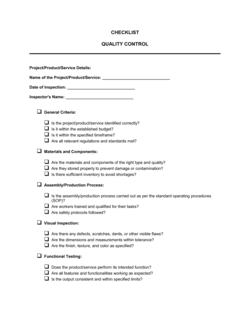
An inspection checklist is a single-use form for recording the results of one inspection event. A quality control plan is the governing document that defines which checklists are used, when, by whom, and what happens when a checklist item fails. The checklist is a tool the plan generates; it does not replace the plan.

vs Corrective Action Report

A corrective action report documents a single non-conformance event β€” root cause, action taken, and verification. A quality control plan defines the process and criteria that generate corrective action reports, including who initiates them, the required response timeline, and how effectiveness is confirmed. The report lives inside the plan's CAPA workflow.

Industry-specific considerations

Manufacturing

Dimensional tolerances, material certifications, AQL sampling plans, first-article inspection, and statistical process control charts are central to manufacturing QC plans.

Construction

Hold points tied to inspection and test plans (ITPs), third-party engineer sign-off requirements, material conformance certificates, and compliance with project specifications and building codes.

Food and Beverage

HACCP critical control points, microbiological testing frequencies, temperature and humidity monitoring, allergen control procedures, and FDA or CFIA traceability requirements.

Technology / Software

Test case coverage thresholds, defect severity classifications, regression testing gates, release approval checklists, and post-deployment monitoring criteria.

Template vs pro β€” what fits your needs?

PathBest forCostTime
Use the templateSmall manufacturers, project managers, and operations teams building their first formal QC processFree4–8 hours to complete
Template + professional reviewBusinesses preparing for ISO 9001 certification, customer audits, or regulated industry compliance$500–$2,000 for a quality consultant review session1–2 weeks
Custom draftedDefense contractors, FDA-regulated manufacturers, or high-complexity construction projects with contractually mandated QC documentation$3,000–$10,000+ for a certified quality engineer engagement3–6 weeks

Glossary

Acceptance Criteria
The minimum standards a product or deliverable must meet to be approved β€” expressed as tolerances, pass/fail thresholds, or measurable performance targets.
CAPA (Corrective and Preventive Action)
A structured process for identifying the root cause of a defect, correcting it, and preventing recurrence through documented process changes.
Control Point
A specific stage in a production or delivery process where an inspection or test is performed to catch defects before the next step.
Defect Rate
The percentage of units or deliverables that fail to meet acceptance criteria within a defined production run or time period.
Statistical Process Control (SPC)
A method that uses statistical techniques β€” typically control charts β€” to monitor process variation and detect out-of-control conditions before defects occur.
Non-Conformance
Any product, material, or process output that fails to meet a specified requirement, triggering a formal review and disposition decision.
ISO 9001
An internationally recognized standard for quality management systems, requiring documented procedures, measurable objectives, and continuous improvement.
Inspection and Test Plan (ITP)
A detailed schedule listing each inspection activity, the responsible party, the method used, and the acceptance criteria at every stage of production.
Root Cause Analysis (RCA)
A structured investigation method β€” such as 5-Why or fishbone diagram β€” used to identify the underlying cause of a non-conformance rather than just its symptoms.
Hold Point
A mandatory pause in production or delivery where work cannot proceed until an inspection is completed and approved by a designated authority.

Part of your Business Operating System

This document is one of 3,000+ business & legal templates included in Business in a Box.

  • Fill-in-the-blanks β€” ready in minutes
  • 100% customizable Word document
  • Compatible with all office suites
  • Export to PDF and share electronically

Create your document in 3 simple steps.

From template to signed document β€” all inside one Business Operating System.
1
Download or open template

Access over 3,000+ business and legal templates for any business task, project or initiative.

2
Edit and fill in the blanks with AI

Customize your ready-made business document template and save it in the cloud.

3
Save, Share, Send, Sign

Share your files and folders with your team. Create a space of seamless collaboration.

Save time, save money, and create top-quality documents.

β˜…β˜…β˜…β˜…β˜…

"Fantastic value! I'm not sure how I'd do without it. It's worth its weight in gold and paid back for itself many times."

Managing Director Β· Mall Farm
Robert Whalley
Managing Director, Mall Farm Proprietary Limited
β˜…β˜…β˜…β˜…β˜…

"I have been using Business in a Box for years. It has been the most useful source of templates I have encountered. I recommend it to anyone."

Business Owner Β· 4+ years
Dr Michael John Freestone
Business Owner
β˜…β˜…β˜…β˜…β˜…

"It has been a life saver so many times I have lost count. Business in a Box has saved me so much time and as you know, time is money."

Owner Β· Upstate Web
David G. Moore Jr.
Owner, Upstate Web

Run your business with a system β€” not scattered tools

Stop downloading documents. Start operating with clarity. Business in a Box gives you the Business Operating System used by over 250,000 companies worldwide to structure, run, and grow their business.

Free Forever PlanΒ Β·Β No credit card required