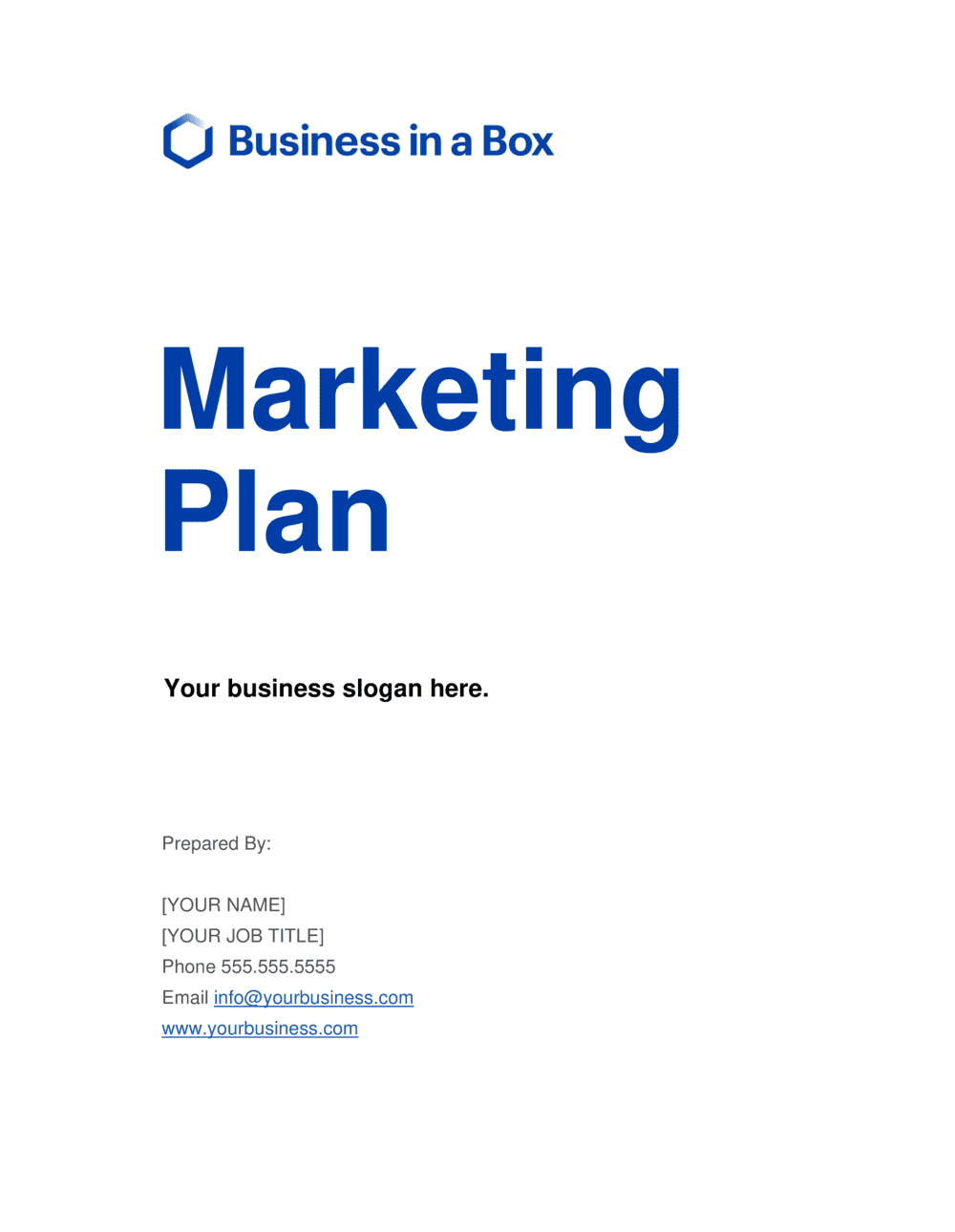
Marketing Plan Template

Free Word download β€’ Edit online β€’ Save & share with Drive β€’ Export to PDF

18 pagesβ€’1h 45m – 2h 25m to fillβ€’Difficulty: Expert
Learn more ↓
FreeMarketing Plan Template

At a glance

What it is
A Marketing Plan is a 20-page strategic document that maps your company's marketing activity for a defined period β€” typically 12 months. Download it free in Word, customize every section online, and export a polished PDF to share with leadership or investors. It translates business goals into audience segments, channel choices, budget allocation, and measurable KPIs.
When you need it
Use it at the start of each fiscal year, when entering a new market, launching a product, or restructuring a marketing team.
What's inside
Executive summary, situation analysis, target audience profiles, brand positioning, channel plan, content calendar framework, budget, KPIs, accountability matrix, and 12-month rollout timeline.

What is a Marketing Plan?

A Marketing Plan is a structured strategic document that translates business revenue goals into a concrete, executable program for a defined period β€” most commonly 12 months. It specifies which customer segments to target, how the brand is positioned against competitors, which channels will carry the message, how the budget is distributed across those channels, and which KPIs will determine whether the investment is working. Done well, it gives every member of the marketing team a single source of truth for priorities and accountability.

Why You Need This Document

Without a written marketing plan, budget allocation defaults to inertia β€” last year's spend, repeated. Campaigns launch without a clear audience or positioning brief. Results get measured inconsistently, making it impossible to know what is working. A structured plan solves all three problems: it forces explicit choices about which customers to pursue and which channels to fund, it sets measurable targets so performance is unambiguous, and it creates the accountability structure β€” named owners, quarterly reviews, numeric KPIs β€” that turns strategy into revenue rather than a quarterly scramble.

Which variant fits your situation?

If your situation is…Use this template
Planning marketing for a new product launchProduct Launch Marketing Plan
Planning digital-only channels (SEO, paid, email, social)Digital Marketing Plan
Focused on content strategy, editorial calendar, and SEOContent Marketing Plan
Need a one-page strategic summary for investors or leadershipMarketing Strategy Template
Planning social media channels specificallySocial Media Marketing Plan
Tracking campaigns and spend against targets on a rolling basisMarketing Budget Template
Presenting marketing results to the executive team quarterlyMarketing Report Template

Common mistakes to avoid

❌ Setting revenue goals without working backward to required inputs

Why it matters: A goal of '$2M in marketing-attributed revenue' means nothing without knowing the conversion rates, lead volumes, and spend required to get there.

Fix: Build a demand waterfall: start with revenue target, divide by average deal size to get deals needed, then work back through close rate, SQL rate, and MQL rate to find required top-of-funnel volume.

❌ Copying last year's plan with new dates

Why it matters: Markets shift. A channel that returned 5:1 ROAS in Year 1 may return 2:1 in Year 2 due to saturation or rising CPCs. Unchanged plans quietly underperform.

Fix: Require a channel performance review section that compares last year's targets to actuals before approving any channel budget.

❌ Treating the plan as a static document

Why it matters: A plan reviewed once per year becomes irrelevant by Q2. Campaign data, competitor moves, and budget changes make quarterly reviews non-negotiable.

Fix: Schedule a 90-minute quarterly plan review meeting, compare KPI actuals to targets, and update the channel mix and budget allocation before the next quarter begins.

❌ No single owner for each KPI

Why it matters: When a KPI is owned by 'the marketing team,' accountability dissolves. Missed targets produce post-mortems with no clear cause and no named person responsible.

Fix: Name one person per KPI in the accountability matrix. That person reports progress monthly β€” not the team.

❌ Omitting a competitive analysis section

Why it matters: Positioning without knowing competitor messaging is guesswork. You can accidentally mirror a competitor's tagline or ignore a channel they have abandoned at scale.

Fix: Include a 1-page competitor snapshot covering positioning claims, primary channels, pricing signals, and known weaknesses for your top 3 competitors.

❌ Underestimating content production time and cost

Why it matters: Teams routinely budget for content distribution but forget that producing a quality case study takes 8–15 hours of internal time, plus design and approval cycles.

Fix: For every content asset in the plan, log the estimated production hours, responsible team member, and any external costs before finalizing the budget.

The 9 key sections, explained

Executive Summary

Situation Analysis (SWOT)

Target Audience and Buyer Personas

Brand Positioning and Messaging Framework

Channel Plan and Marketing Mix

Content Plan and Editorial Calendar Framework

Budget Allocation

KPIs, Targets, and Accountability Matrix

12-Month Rollout Timeline

How to fill it out

  1. 1

    Complete the situation analysis before writing strategy

    Run a SWOT, audit competitor positioning, and pull 12 months of performance data from your analytics and CRM. Strategy written without this grounding is guesswork.

    πŸ’‘ Pull organic search position data and paid CPC trends β€” these two numbers alone will shape 60% of your channel decisions.

  2. 2

    Define 2–4 target personas using real data

    Interview 5–10 existing customers and pull CRM demographic data. Identify the job title, company size, primary pain point, and the 1–2 channels they use most.

    πŸ’‘ Start with your highest-LTV customer segment and build persona 1 from that profile. The rest of the plan should serve that persona first.

  3. 3

    Write the positioning statement and message pillars

    Use the provided positioning framework to articulate who you serve, what you offer, and why it beats alternatives. Then derive 3 message pillars that every channel will reinforce.

    πŸ’‘ Test the positioning statement against 3 competitors. If they could say the same thing, it is not a position β€” sharpen the differentiation.

  4. 4

    Allocate budget by channel with expected ROI targets

    Start with total approved budget, assign percentages to each channel, and set a ROAS or CPL target for each. Do not finalize channel selection before setting persona-to-channel match scores.

    πŸ’‘ Reserve 5–10% of budget for testing new channels. Committing 100% to known channels leaves no room to find a breakthrough.

  5. 5

    Set KPIs and assign owners

    For each strategic goal, identify 1–2 measurable KPIs, set a numeric target, and assign a single named owner β€” not a team. Shared ownership produces no ownership.

    πŸ’‘ Limit primary KPIs to 5–7. Supporting metrics can be tracked in dashboards without appearing in the plan itself.

  6. 6

    Build the quarterly timeline with dependencies flagged

    Map each initiative to a quarter, note what must be true before it can launch (website live, CRM integrated, creative approved), and flag items with external dependencies.

    πŸ’‘ Add a 2-week buffer to any initiative that requires legal approval, third-party integration, or creative production by an external agency.

  7. 7

    Write the executive summary last

    Summarize the top 3 goals, total budget, primary channel bets, and the single metric that defines success for the year. Keep it under one page.

    πŸ’‘ If the executive summary takes more than one page, the plan is not yet strategic β€” it is still a task list. Consolidate until the choices are unmistakable.

Frequently asked questions

What is a marketing plan?

A marketing plan is a strategic document that defines how a company will reach its target audience, position its brand, allocate its marketing budget, and measure results over a specific period β€” typically 12 months. It connects business revenue goals to the specific channels, content, and campaigns that will generate awareness, leads, and conversions.

What should a marketing plan include?

A complete marketing plan includes an executive summary, situation analysis (SWOT), target audience personas, brand positioning, channel plan, content calendar framework, budget breakdown by channel, KPIs with numeric targets, an accountability matrix naming one owner per KPI, and a quarter-by-quarter rollout timeline. Plans that omit budget or KPIs are strategy documents, not executable plans.

How long should a marketing plan be?

For most small to mid-sized businesses, 10–20 pages is the right range. Shorter than 10 pages typically means the channel plan or budget detail is missing. Longer than 20 pages usually signals that tactical task lists have been included β€” those belong in project management tools, not the plan itself. This template runs 20 pages and covers every required section.

How is a marketing plan different from a marketing strategy?

A marketing strategy defines the 'why' and 'what' β€” your positioning, target audience, and competitive differentiation. A marketing plan is the operational document that defines the 'how', 'when', 'who', and 'how much'. Strategy can fit on 2–3 pages; a plan includes budget, KPIs, timelines, and accountability β€” typically 10–20 pages.

How do I set a marketing budget?

The two most common methods are percentage-of-revenue (B2B companies typically allocate 6–12% of projected revenue; B2C 10–20%) and goal-based budgeting (work backward from revenue targets using conversion rates and CPL benchmarks to determine required spend). Early-stage companies and product launches often require above-average spend β€” 15–25% of revenue β€” to build awareness from zero.

What KPIs should a marketing plan track?

The right KPIs depend on your funnel stage. Common primary KPIs: marketing-attributed pipeline ($), customer acquisition cost (CAC), ROAS for paid channels, organic sessions growth, email-to-MQL conversion rate, and net new customers per quarter. Limit the plan to 5–7 primary KPIs. Supporting metrics (CTR, open rate, bounce rate) belong in dashboards, not the plan.

How often should a marketing plan be updated?

The full plan should be revised annually. Channel mix, budget allocation, and KPI targets should be reviewed and updated quarterly against actual performance. Any plan that goes 6 months without a structured review is almost certainly misallocating budget β€” campaign data and competitive conditions change faster than an annual cycle can capture.

Can a small business use this template?

Yes. The template scales down cleanly β€” a 5-person company can complete the persona, positioning, and channel sections in a single half-day session. Fill in only the sections relevant to your stage: executive summary, 1–2 personas, channel plan with 2–3 channels, a simple budget table, and 3–5 KPIs. A focused 8-page plan outperforms an elaborate 20-page plan that never gets executed.

How this compares to alternatives

vs Business Plan

A business plan covers the entire business β€” operations, financials, team, and market opportunity β€” and is written primarily for investors or lenders. A marketing plan is a focused operational document for the marketing function, detailing channels, campaigns, budget, and KPIs for a defined period.

vs Marketing Strategy

A marketing strategy defines positioning, target audience, and competitive differentiation β€” the 'why' and 'what'. A marketing plan is the execution document that adds budget, timelines, KPIs, and named owners β€” the 'how', 'when', and 'who'. Strategy fits on 2–3 pages; a plan runs 10–20 pages.

vs Marketing Budget Template

A marketing budget template is a financial spreadsheet tracking spend by channel, program, and period against targets. It is one section of a marketing plan. Without the strategy, audience, and channel rationale that the plan provides, a budget template has no context for why money is allocated the way it is.

vs Go-to-Market Plan

A go-to-market plan is a one-time launch document focused on bringing a specific product to market β€” it defines launch timing, ICP, pricing, and initial channels. A marketing plan is an ongoing operational document covering all products and programs across a full year.

Industry-specific considerations

SaaS / Software

Product-led growth loops, free trial conversion rates, expansion revenue targets, PLG vs. sales-led channel mix.

Retail and E-commerce

Seasonal campaign calendar, ROAS targets by product category, retention vs. acquisition budget split, loyalty program integration.

Professional Services

Thought leadership and referral as primary channels, long sales cycles (60–180 days), content mapped to specific buyer job titles.

Healthcare and Wellness

Regulatory constraints on claims, patient privacy requirements, trust-building content strategy, local SEO for clinic-based businesses.

Manufacturing and B2B

Trade show budget allocation, distributor co-marketing programs, long specification cycles, technical content for engineering buyers.

Hospitality and Food & Beverage

Seasonal demand peaks, review platform management, local paid search, loyalty and repeat-visit programs.

Template vs pro β€” what fits your needs?

PathBest forCostTime
Use the templateStartups, small businesses, and teams with a defined strategy that need a structured format to document and present itFree3–6 hours
Template + professional reviewGrowing companies that want a marketing consultant or fractional CMO to pressure-test the strategy, channel mix, and budget allocation before presenting to leadership$500–$2,5003–5 days
Custom draftedEnterprises, PE-backed companies, or businesses entering new markets that need a fully researched plan built from primary competitive and customer research$5,000–$25,000+3–8 weeks

Glossary

Target Audience
A defined segment of potential customers characterized by shared demographics, behaviors, or pain points your product addresses.
Brand Positioning
A concise statement of how your brand occupies a distinct place in the customer's mind relative to competitors.
Marketing Mix
The combination of product, price, place, and promotion decisions β€” often expanded to include people, process, and physical evidence.
Channel Plan
A prioritized list of distribution and communication channels (SEO, paid search, email, events) with assigned budget and expected contribution.
KPI (Key Performance Indicator)
A quantifiable metric tied directly to a strategic goal β€” e.g., cost per lead, organic traffic growth, or marketing-attributed revenue.
Buyer Persona
A semi-fictional profile of an ideal customer built from research, including job role, goals, objections, and preferred content formats.
Marketing Funnel
A model describing the stages a prospect moves through β€” awareness, consideration, decision, and retention β€” each requiring different tactics.
CAC (Customer Acquisition Cost)
Total marketing and sales spend divided by the number of new customers acquired in the same period.
ROAS (Return on Ad Spend)
Revenue generated divided by the cost of advertising β€” used to evaluate paid media efficiency; a 4:1 ratio is a common baseline target.
Situation Analysis
An audit of internal capabilities and external conditions β€” typically structured as a SWOT β€” that grounds strategy in reality.
Content Calendar
A scheduled plan mapping content topics, formats, channels, and publish dates to ensure consistent output and audience coverage.
OKR (Objective and Key Result)
A goal-setting framework pairing a qualitative objective with 2–4 measurable results used to track marketing team progress.

Part of your Business Operating System

This document is one of 3,000+ business & legal templates included in Business in a Box.

  • Fill-in-the-blanks β€” ready in minutes
  • 100% customizable Word document
  • Compatible with all office suites
  • Export to PDF and share electronically

Create your document in 3 simple steps.

From template to signed document β€” all inside one Business Operating System.
1
Download or open template

Access over 3,000+ business and legal templates for any business task, project or initiative.

2
Edit and fill in the blanks with AI

Customize your ready-made business document template and save it in the cloud.

3
Save, Share, Send, Sign

Share your files and folders with your team. Create a space of seamless collaboration.

Save time, save money, and create top-quality documents.

β˜…β˜…β˜…β˜…β˜…

"Fantastic value! I'm not sure how I'd do without it. It's worth its weight in gold and paid back for itself many times."

Managing Director Β· Mall Farm
Robert Whalley
Managing Director, Mall Farm Proprietary Limited
β˜…β˜…β˜…β˜…β˜…

"I have been using Business in a Box for years. It has been the most useful source of templates I have encountered. I recommend it to anyone."

Business Owner Β· 4+ years
Dr Michael John Freestone
Business Owner
β˜…β˜…β˜…β˜…β˜…

"It has been a life saver so many times I have lost count. Business in a Box has saved me so much time and as you know, time is money."

Owner Β· Upstate Web
David G. Moore Jr.
Owner, Upstate Web

Run your business with a system β€” not scattered tools

Stop downloading documents. Start operating with clarity. Business in a Box gives you the Business Operating System used by over 250,000 companies worldwide to structure, run, and grow their business.

Start freeΒ Β·Β No credit card required