How to Creating a Customer Service Strategy

Free Word download β€’ Edit online β€’ Save & share with Drive β€’ Export to PDF

3 pagesβ€’20–25 min to fillβ€’Difficulty: Standard
Learn more ↓
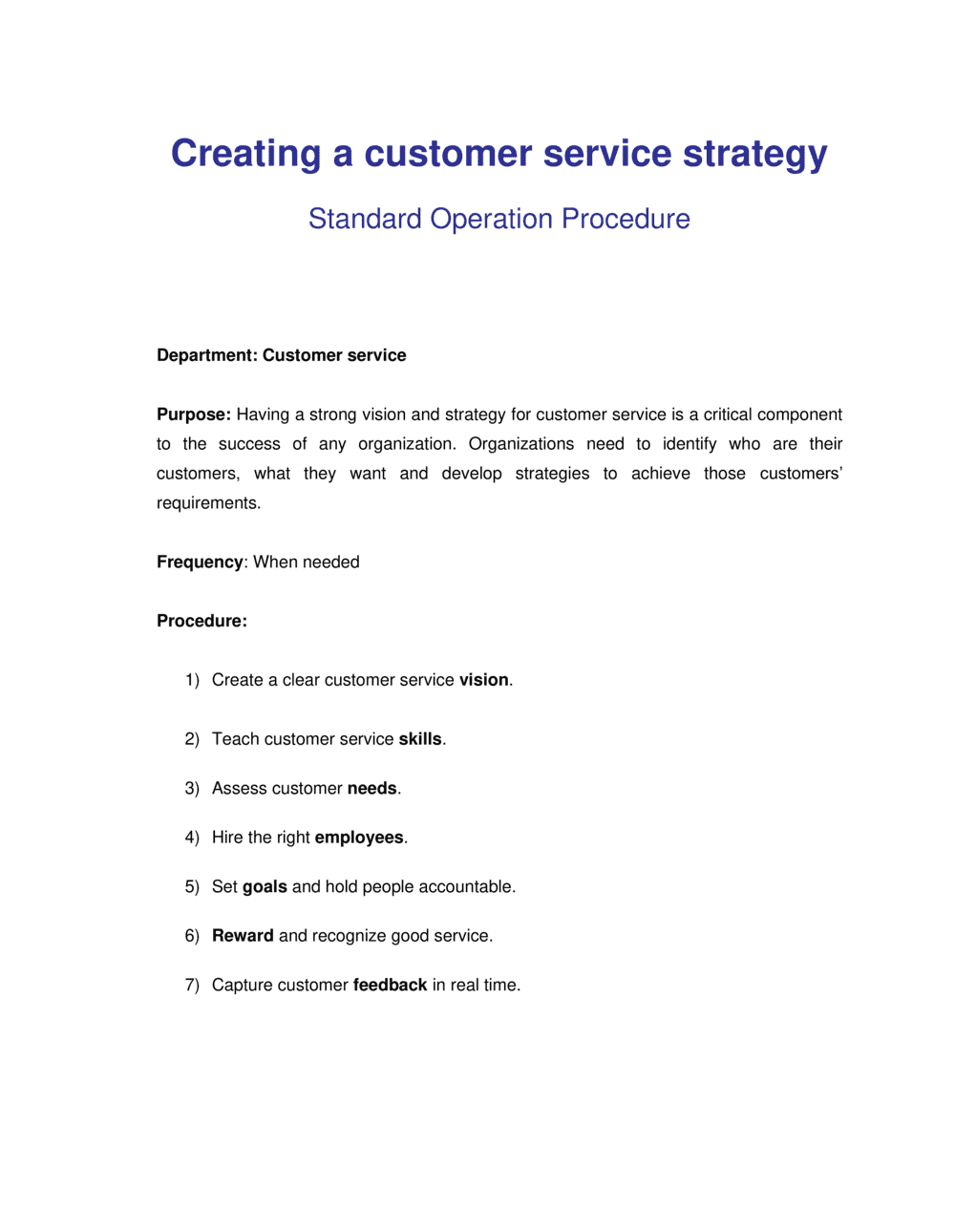
FreeHow to Creating a Customer Service Strategy Template

At a glance

What it is
A Customer Service Strategy is a structured planning document that defines how a business will deliver, measure, and continuously improve its customer support experience. This free Word download gives you a ready-made framework covering service vision, customer personas, channel coverage, response standards, escalation procedures, team structure, KPIs, and improvement cycles β€” all in a format you can edit online and export as PDF to share with leadership or your support team.
When you need it
Use it when launching a support function from scratch, overhauling an inconsistent service experience, or aligning a growing team around shared standards and measurable goals. It is also the right document when leadership or investors ask for a formal service improvement plan.
What's inside
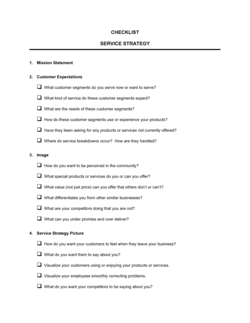
A service vision statement and guiding principles, customer persona profiles, channel and coverage matrix, response time standards, escalation and complaint resolution procedures, team structure and training requirements, KPIs and measurement methodology, and a continuous improvement review cycle.

What is a Customer Service Strategy?

A Customer Service Strategy is a structured operational document that defines how a business delivers, measures, and continuously improves its customer support experience. It translates a high-level service vision into concrete decisions: which channels to staff, what response time targets to commit to, how escalations are routed, which KPIs the team is held to, and how often the plan is reviewed and updated. Unlike a customer service policy β€” which documents rules β€” a strategy explains the rationale behind those rules and connects individual agent behaviors to measurable business outcomes such as retention, satisfaction scores, and churn reduction.

Why You Need This Document

Without a written customer service strategy, support teams operate on informal habits and individual judgment, producing wildly inconsistent experiences across agents, channels, and shifts. The consequences are measurable: customers who receive inconsistent service are significantly more likely to churn, and support teams without documented standards spend disproportionate time on escalations that better-defined procedures would have resolved at the first contact. When your team grows from two agents to ten, or when you add a second support channel, the absence of a strategy becomes a training problem, a quality problem, and a retention problem simultaneously. This template gives you a ready-to-edit framework that turns service standards from institutional memory into a documented, reviewable, and improvable plan β€” one your entire team can align to from day one.

Which variant fits your situation?

If your situation is…Use this template
Documenting rules for a single support channel such as live chat or emailCustomer Service Policy
Creating a repeatable script for handling inbound phone inquiriesCall Center Script Template
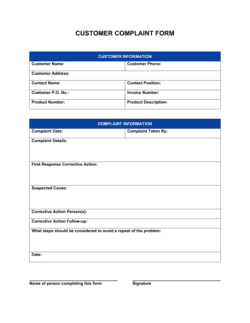
Tracking individual complaint cases through to resolutionCustomer Complaint Form
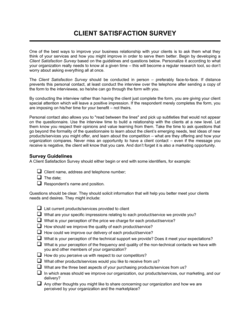
Measuring satisfaction after each support interactionCustomer Satisfaction Survey
Onboarding new support agents with consistent training contentEmployee Training Plan
Defining broader experience goals beyond reactive supportCustomer Experience Strategy
Setting team-level performance targets for a support departmentCustomer Service KPI Dashboard

Common mistakes to avoid

❌ Writing principles too vague to guide decisions

Why it matters: Principles like 'be customer-centric' give agents no behavioral direction. In ambiguous situations, every agent interprets them differently, producing inconsistent service.

Fix: Rewrite each principle as a specific action: 'Acknowledge the customer's frustration before offering a solution' is actionable; 'be empathetic' is not.

❌ Setting one SLA for all issue types

Why it matters: A single response-time target causes agents to treat a system outage the same as a general FAQ question, delaying urgent resolutions and wasting capacity on low-priority tickets.

Fix: Define at least three priority tiers with distinct response and resolution windows, and document the criteria for assigning each tier.

❌ No defined escalation trigger criteria

Why it matters: Without explicit criteria, escalations are based on agent judgment and customer persistence β€” the most patient customers get the worst outcomes.

Fix: State objective triggers: issue unresolved after [X minutes], customer uses specific language about legal action, or issue type falls outside Tier 1 scope.

❌ Tracking too many KPIs without a primary metric

Why it matters: A dashboard of 15 metrics gives leadership data without insight. Teams optimize for the easiest metrics to move rather than the ones that reflect real service quality.

Fix: Choose one primary KPI β€” CSAT or FCR β€” as the headline measure and limit the dashboard to five to seven supporting metrics that explain why that number moves.

❌ Treating the strategy as a one-time document

Why it matters: A strategy written once and filed away is obsolete within months as product lines, channels, and customer expectations evolve. Teams that rely on it make decisions based on outdated assumptions.

Fix: Schedule a formal quarterly review at the time the strategy is signed off, and define specific KPI thresholds that trigger an out-of-cycle revision.

❌ Describing the current team structure instead of the target structure

Why it matters: A strategy that simply documents what already exists provides no direction. Stakeholders cannot tell whether the current setup is adequate or whether investment is needed.

Fix: Document both the current state and the target state side by side, with the gap clearly labeled as a hiring plan, training requirement, or tool investment.

The 9 key sections, explained

Service Vision and Guiding Principles

Customer Personas and Needs Analysis

Channel Coverage Matrix

Response Time and Resolution Standards

Escalation and Complaint Resolution Procedure

Team Structure and Roles

Training and Quality Standards

Key Performance Indicators and Measurement

Continuous Improvement and Review Cycle

How to fill it out

  1. 1

    Write the service vision and three to five principles

    Draft a single sentence stating the experience standard you commit to, then list three to five behavioral principles that translate it into daily agent actions. Keep each principle to one sentence.

    πŸ’‘ Test each principle by asking: could a frontline agent use this to make a decision in a 30-second interaction? If not, rewrite it.

  2. 2

    Profile your two to four primary customer segments

    For each segment, document their most frequent support reason, preferred contact channel, acceptable response time, and escalation sensitivity. Pull data from your ticketing system or past customer surveys rather than guessing.

    πŸ’‘ If you have no existing data, review the last 100 closed support tickets and categorize by issue type and channel β€” the pattern will appear quickly.

  3. 3

    Map every active support channel with hours and ownership

    List each channel, the hours it is staffed, the role responsible, and which issue types it handles. Note any channel that is active but unstaffed β€” these are service gaps.

    πŸ’‘ Mark each channel as 'primary,' 'secondary,' or 'monitor only' so agents know where to invest response effort when volume spikes.

  4. 4

    Set SLA targets by issue priority tier

    Create at least three priority tiers (critical, standard, low) and assign first-response and resolution time targets to each. Base targets on what your team can actually achieve today, then set 6-month improvement targets.

    πŸ’‘ Under-promise on SLAs and consistently exceed them rather than setting aspirational targets you breach regularly β€” missed SLAs erode trust faster than slow ones.

  5. 5

    Document the escalation path step by step

    Write out each escalation tier, the role that owns it, the criteria for escalating (time elapsed, issue type, customer tier), and the exact language agents should use when handing off to a customer.

    πŸ’‘ Role-play the escalation script with two agents before finalizing it β€” what reads clearly in a document often sounds awkward spoken aloud.

  6. 6

    Select five to seven KPIs with explicit targets and data sources

    Choose KPIs that your current tools can actually measure. For each, state the target value, the system that captures the data, and how often it will be reported.

    πŸ’‘ Pick one primary KPI β€” CSAT or FCR is most common β€” that the whole team understands as the headline number. Secondary KPIs support diagnosis; the primary KPI drives behavior.

  7. 7

    Schedule the quarterly review and assign ownership

    Set a recurring calendar event for each quarterly review now, name the role responsible for leading it, and list the three inputs that will be reviewed: KPI trends, VoC themes, and escalation data.

    πŸ’‘ If no one owns the review, it will not happen. Assign it to a named role, not a team β€” shared ownership means no ownership.

Frequently asked questions

What is a customer service strategy?

A customer service strategy is a documented plan that defines how a business will handle customer interactions β€” across every support channel β€” from first contact through resolution and follow-up. It covers the service vision, customer personas, channel coverage, response standards, escalation procedures, team structure, KPIs, and improvement cycle. It differs from a customer service policy in that it sets direction and goals, not just rules.

Why do businesses need a written customer service strategy?

Without a written strategy, support teams operate on individual judgment and informal habits. This produces inconsistent experiences β€” two customers with the same issue receive different outcomes depending on which agent they reach. A written strategy aligns the team around shared standards, makes training faster, provides a baseline for measuring improvement, and gives leadership a document to hold the team accountable against.

What is the difference between a customer service strategy and a customer service policy?

A customer service policy documents the rules agents must follow β€” return windows, refund thresholds, communication tone guidelines. A customer service strategy is the higher-level plan that explains why those rules exist, who the customers are, what channels are used, and how performance is measured. The strategy guides the policy; the policy operationalizes the strategy. Both documents should exist and reference each other.

What KPIs should a customer service strategy include?

The most commonly used KPIs are Customer Satisfaction Score (CSAT), First Contact Resolution (FCR), Average Handle Time (AHT), Net Promoter Score (NPS), and ticket volume by channel and category. Choose five to seven that your current tools can actually track, designate one as the primary metric, and report the others as supporting context. Tracking more than seven without a clear primary metric dilutes accountability.

How often should a customer service strategy be updated?

A formal review should happen quarterly, covering KPI trends, Voice of Customer themes, and escalation data. A full strategy refresh is appropriate annually or whenever a significant change occurs β€” such as a new product line, a channel addition, or a sustained drop in CSAT scores. Strategies that go more than 18 months without review are effectively obsolete.

How do you define service level agreements in a customer service strategy?

Start by categorizing issues into priority tiers β€” at minimum, critical, standard, and low. For each tier, set a first-response time and a resolution time target, expressed in business hours or calendar hours depending on your support model. Base the targets on what your team can consistently achieve today, then set a 6-month improvement target. Publish the SLA commitments to customers only after your team has demonstrated it can meet them for at least 30 consecutive days.

What channels should a customer service strategy cover?

Cover every channel customers currently use to contact you, plus any you plan to add within the next 12 months. At minimum, most businesses need to address email, phone, and a self-service knowledge base. Growing businesses commonly add live chat, social media monitoring, and an in-app support widget. For each channel, the strategy should state the staffing level, hours of coverage, and which issue types it handles.

Can a small business use this template, or is it only for large companies?

A small business with as few as two or three support staff benefits from a written strategy. The document does not need to be long β€” a concise version covering service vision, three customer personas, two channels, and four KPIs is more useful than a generic 40-page enterprise framework. The template scales: complete only the sections relevant to your current stage and expand them as the team grows.

How this compares to alternatives

vs Customer Service Policy

A customer service policy documents specific rules agents must follow β€” refund thresholds, response tone, escalation authority. A customer service strategy is the higher-level plan that defines the vision, personas, channel model, and KPIs that give those rules context. Write the strategy first, then derive the policy from it.

vs Customer Experience Strategy

A customer experience strategy covers the entire customer journey β€” from first brand awareness through post-purchase loyalty β€” across marketing, product, and support. A customer service strategy focuses specifically on the reactive support function: how issues are handled after the customer contacts the business. Both documents should exist in a mature organization and cross-reference each other.

vs Customer Satisfaction Survey

A customer satisfaction survey is a measurement tool β€” a set of questions sent after an interaction to collect CSAT or NPS data. A customer service strategy is the planning document that defines what you do with that data, including the KPI targets and improvement cycles. The survey feeds data into the strategy's measurement section.

vs Employee Training Plan

An employee training plan documents the onboarding and ongoing learning program for support agents β€” course content, hours, and completion criteria. A customer service strategy defines the service standards and quality benchmarks that the training plan is designed to achieve. The strategy sets the target; the training plan is how you get agents there.

Industry-specific considerations

SaaS / Technology

Tiered support by subscription plan (free, pro, enterprise), in-app chat coverage, technical escalation paths to engineering, and churn-risk monitoring through low CSAT signals.

E-commerce / Retail

Returns, refunds, and shipping dispute workflows are the dominant issue types; peak-season staffing surges and social media response times require specific SLA adjustments.

Financial Services

Regulatory complaint-handling timelines, mandatory written acknowledgment within 24 hours, audit trail requirements for every interaction, and specialized escalation paths for fraud and dispute cases.

Healthcare

HIPAA-compliant communication channels, sensitivity protocols for billing and insurance queries, and patient-facing language standards that differ materially from standard commercial service scripts.

Template vs pro β€” what fits your needs?

PathBest forCostTime
Use the templateSmall businesses, startups, and support managers building or formalizing a service function for the first timeFree4–8 hours
Template + professional reviewGrowing companies with 5+ support staff or multiple channels who need a CX consultant to validate KPI targets and staffing ratios$500–$2,000 for a CX consultant review session1–2 weeks
Custom draftedEnterprise organizations, regulated industries (healthcare, financial services), or businesses deploying omnichannel support with complex escalation hierarchies$3,000–$10,000 for a dedicated CX strategy engagement4–8 weeks

Glossary

Service Vision
A one or two-sentence statement describing the standard of experience the company commits to delivering to every customer.
Customer Persona
A research-based profile of a key customer segment, describing their goals, communication preferences, pain points, and typical support needs.
Service Level Agreement (SLA)
A documented commitment to respond to or resolve a customer issue within a defined time window, such as first reply within 4 business hours.
First Contact Resolution (FCR)
The percentage of customer issues resolved fully on the first interaction, without a follow-up or escalation required.
Customer Satisfaction Score (CSAT)
A metric collected via a post-interaction survey, typically on a 1–5 scale, measuring how satisfied the customer was with a specific interaction.
Net Promoter Score (NPS)
A metric that asks customers how likely they are to recommend the company on a 0–10 scale, used to measure overall loyalty and experience quality.
Escalation Path
A defined sequence of handoffs that moves an unresolved or complex issue from a frontline agent to a supervisor or specialist tier.
Omnichannel Support
A service model in which the customer can move between email, chat, phone, and social channels without repeating context β€” all interactions are linked in a single record.
CSAT Loop
A closed-feedback process in which low satisfaction scores automatically trigger a follow-up action, such as a manager callback or a service recovery offer.
Voice of the Customer (VoC)
The practice of systematically capturing and analyzing customer feedback β€” from surveys, reviews, and support transcripts β€” to inform service and product decisions.

Part of your Business Operating System

This document is one of 3,000+ business & legal templates included in Business in a Box.

  • Fill-in-the-blanks β€” ready in minutes
  • 100% customizable Word document
  • Compatible with all office suites
  • Export to PDF and share electronically

Create your document in 3 simple steps.

From template to signed document β€” all inside one Business Operating System.
1
Download or open template

Access over 3,000+ business and legal templates for any business task, project or initiative.

2
Edit and fill in the blanks with AI

Customize your ready-made business document template and save it in the cloud.

3
Save, Share, Send, Sign

Share your files and folders with your team. Create a space of seamless collaboration.

Save time, save money, and create top-quality documents.

β˜…β˜…β˜…β˜…β˜…

"Fantastic value! I'm not sure how I'd do without it. It's worth its weight in gold and paid back for itself many times."

Managing Director Β· Mall Farm
Robert Whalley
Managing Director, Mall Farm Proprietary Limited
β˜…β˜…β˜…β˜…β˜…

"I have been using Business in a Box for years. It has been the most useful source of templates I have encountered. I recommend it to anyone."

Business Owner Β· 4+ years
Dr Michael John Freestone
Business Owner
β˜…β˜…β˜…β˜…β˜…

"It has been a life saver so many times I have lost count. Business in a Box has saved me so much time and as you know, time is money."

Owner Β· Upstate Web
David G. Moore Jr.
Owner, Upstate Web

Run your business with a system β€” not scattered tools

Stop downloading documents. Start operating with clarity. Business in a Box gives you the Business Operating System used by over 250,000 companies worldwide to structure, run, and grow their business.

Start freeΒ Β·Β No credit card required