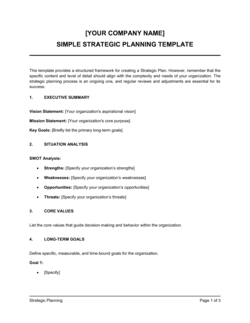
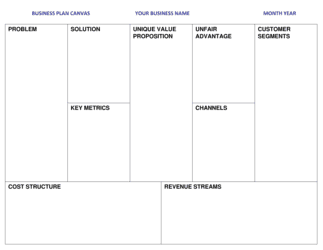
Product Launch Plan Template

Free Word download β€’ Edit online β€’ Save & share with Drive β€’ Export to PDF

2 pagesβ€’45–55 min to fillβ€’Difficulty: Expert
Learn more ↓
FreeProduct Launch Plan Template

At a glance

What it is
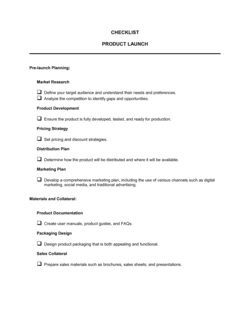
A Product Launch Plan is a structured operational document that maps every activity, owner, deadline, and success metric required to bring a new product or feature to market. This free Word download gives you a ready-to-edit framework covering market positioning, messaging, channel strategy, launch timeline, and post-launch measurement β€” exportable as PDF for stakeholder review.
When you need it
Use it when preparing to release a new product, a major feature update, or a product expansion into a new market or customer segment. It is equally applicable to a company's first-ever launch and to a seasoned team running its tenth product release.
What's inside
Executive summary, product overview and value proposition, target market and buyer personas, competitive positioning, go-to-market strategy, marketing and messaging plan, sales enablement, launch timeline with milestones, and post-launch success metrics.

What is a Product Launch Plan?

A Product Launch Plan is a structured operational document that defines every activity, owner, timeline, and success metric required to bring a new product β€” or a significant product update β€” from internal readiness to market availability. It aligns product, marketing, sales, and customer support teams around a single source of truth, covering the product's value proposition, target buyer personas, competitive positioning, go-to-market channel strategy, messaging architecture, and a dated milestone timeline with named owners. Unlike a marketing plan or a business plan, a product launch plan is deliberately time-bounded and cross-functional β€” it exists to orchestrate execution across teams who each have different definitions of "ready."

Why You Need This Document

Without a written launch plan, the most common outcome is a fragmented release: marketing campaigns go live before the sales team knows how to demo the product, the website messaging contradicts the pitch deck, and no one owns the decision to delay when a critical milestone slips. The cost of a disorganized launch is not just a bad week β€” early adopters form lasting impressions, press coverage happens once, and competitors use the window of confusion to position against you. A complete product launch plan forces every team to agree on the value proposition, the customer, the channels, and the numeric definition of success before anyone spends budget or sends a press release. This template gives you the structure to coordinate that alignment in days rather than weeks, with every section pre-built for the decisions that determine whether a launch generates momentum or loses it.

Which variant fits your situation?

If your situation is…Use this template
Launching a SaaS product or digital serviceSaaS Product Launch Plan
Releasing a new physical consumer productConsumer Product Launch Plan
Introducing a new feature to an existing productFeature Release Plan
Entering a new geographic market with an existing productMarket Expansion Plan
Planning the full marketing campaign tied to the launchMarketing Plan
Aligning sales team enablement and training before launchSales Plan
Setting overarching company strategy that the launch supportsStrategic Plan

Common mistakes to avoid

❌ Setting a launch date before the plan is complete

Why it matters: When the date is announced internally before the plan exists, every subsequent decision is made under artificial time pressure β€” positioning, messaging, and enablement all get cut short.

Fix: Draft the full plan first, build the timeline backward from the required milestones, and then commit to a public launch date once the plan confirms it is achievable.

❌ Activating all channels on day one

Why it matters: Spreading budget and attention across eight channels simultaneously means no single channel gets enough investment to generate meaningful signal about what is working.

Fix: Phase the go-to-market strategy β€” lead with two to three high-confidence channels in Weeks 1–2, then expand based on early conversion data.

❌ Finishing sales enablement materials on launch day

Why it matters: Sales reps who receive battle cards and demo scripts on the morning of launch have no time to practice β€” their first live customer conversations become the training session.

Fix: Complete all sales enablement materials at least one week before launch and run a mandatory training session with a recorded demo so every rep is ready on day one.

❌ Defining success without numeric targets

Why it matters: Vague goals like 'strong adoption' or 'good press coverage' make it impossible to determine whether the launch worked β€” and impossible to decide when to change course.

Fix: Set specific numeric targets with a date attached for each KPI: '500 trial sign-ups by Day 30,' '15% trial-to-paid conversion by Day 60.' Review actuals against targets weekly.

❌ Skipping a launch readiness review

Why it matters: Without a formal cross-functional checkpoint two to four weeks out, gaps in product, support, or infrastructure surface on launch day instead of in time to fix them.

Fix: Schedule a launch readiness review with product, engineering, marketing, sales, and customer support at least two weeks before the launch date and require each team to sign off explicitly.

❌ Treating the plan as a one-time document

Why it matters: A plan filed away after the kickoff meeting stops reflecting reality within days β€” teams make decisions without consulting it and the launch fragments into disconnected workstreams.

Fix: Assign one owner to maintain the plan as a living document, update milestone status weekly, and use it as the standing agenda for launch sync meetings.

The 9 key sections, explained

Executive Summary

Product Overview and Value Proposition

Target Market and Buyer Personas

Competitive Positioning

Go-to-Market Strategy

Messaging and Content Plan

Sales Enablement Plan

Launch Timeline and Milestones

Post-Launch Metrics and Review Plan

How to fill it out

  1. 1

    Define the product and write the value proposition

    Start with a single sentence that names the product, the target customer, the outcome delivered, and the key differentiator from alternatives. Test it against a real customer before locking it.

    πŸ’‘ If you cannot write the value proposition in one sentence, the product's positioning is not yet clear enough to plan a launch around.

  2. 2

    Identify and profile your target buyer personas

    Define one to three buyer personas using data from customer interviews, CRM records, or market research. For each, document their role, primary goal, biggest frustration, and the trigger that would make them buy today.

    πŸ’‘ Personas built from real interview quotes are far more useful than ones assembled from assumptions β€” schedule at least five customer conversations before finalizing them.

  3. 3

    Map the competitive landscape and confirm your position

    List at least three direct or indirect competitors. For each, note their pricing, primary strength, and key weakness. Then write one paragraph stating exactly where your product sits and what it owns.

    πŸ’‘ A two-axis positioning map (e.g., price vs. ease of use) makes this section scannable and forces you to commit to a specific position rather than claiming to be best at everything.

  4. 4

    Design the go-to-market strategy with phased channels

    Select two to three primary acquisition channels for launch. For each, define the target audience, the message, the call to action, and the budget. Phase them sequentially rather than activating everything simultaneously.

    πŸ’‘ Rank channels by estimated CAC and time-to-first-result so you can cut underperforming ones quickly in the first 30 days without disrupting the overall plan.

  5. 5

    Build the messaging and content asset list

    Document the core headline, three supporting proof points, and the top three customer objections with prepared responses. Then list every content asset required by launch date with an owner and due date for each.

    πŸ’‘ Set content asset deadlines at least two weeks before launch day β€” assets finalized the night before miss review cycles and introduce errors.

  6. 6

    Complete the sales enablement section

    List every item the sales team needs β€” pricing sheet, battle cards, demo script, objection FAQ β€” and assign a specific owner and due date to each. Schedule a mandatory product training session at least one week before launch.

    πŸ’‘ Record the product demo training session so new reps hired post-launch can onboard to the product without a dedicated re-training event.

  7. 7

    Build the dated milestone timeline with named owners

    Enter every launch activity into the timeline section with a specific date and a single named owner. Mark hard dependencies β€” activities that cannot start until a prior one is complete.

    πŸ’‘ Work backward from the launch date to set milestone dates. Starting from today and scheduling forward consistently underestimates the lead time needed for each phase.

  8. 8

    Set numeric post-launch KPIs and schedule the review

    Define specific, numeric targets for Day 30, Day 60, and Day 90 β€” sign-ups, revenue, conversion rate, NPS. Book the post-launch review meeting before launch day so it does not get canceled under pressure.

    πŸ’‘ Pick no more than five KPIs to track actively in the first 30 days. Tracking twenty metrics means none of them get acted on when they miss target.

Frequently asked questions

What is a product launch plan?

A product launch plan is a structured document that defines every activity, owner, and deadline required to bring a new product to market successfully. It covers the product's value proposition, target market, competitive positioning, go-to-market strategy, messaging, sales enablement, launch timeline, and post-launch success metrics β€” giving every team a single source of truth for the release.

What should a product launch plan include?

A complete product launch plan includes an executive summary, product overview and value proposition, target market and buyer personas, competitive positioning, go-to-market strategy, messaging and content plan, sales enablement requirements, a dated milestone timeline with named owners, and post-launch KPIs with a review schedule. Missing any of these sections typically results in misaligned teams and a fragmented launch execution.

How far in advance should you create a product launch plan?

For a major product launch, plan creation should begin 8–12 weeks before the target launch date. Feature releases and smaller updates can be planned in 4–6 weeks. The timeline section of the plan works backward from the launch date β€” which means the plan itself must exist early enough to set realistic milestones and catch resourcing gaps before they become crises.

What is the difference between a product launch plan and a go-to-market strategy?

A go-to-market strategy is one section within a product launch plan β€” it defines the channels, sequencing, and messaging used to reach customers. A product launch plan is the broader operational document that also covers internal readiness: the timeline, sales enablement, cross-functional ownership, and post-launch measurement. A GTM strategy tells you where to play; the launch plan tells you how to execute and who does what by when.

Who owns the product launch plan?

Ownership varies by company structure, but product management most commonly owns the plan and is accountable for its execution. In smaller companies, a founder or marketing director may own it. What matters more than title is that a single named person is responsible for keeping the plan current, running launch sync meetings, and escalating when milestones slip.

How is a product launch plan different from a marketing plan?

A marketing plan covers the full annual marketing strategy β€” campaigns, budget allocation, brand, and channel mix across all products. A product launch plan is a time-bounded operational document focused on a single release β€” it includes a marketing section but also covers product readiness, sales enablement, internal milestones, and support preparation that fall outside a marketing plan's scope.

What KPIs should a product launch plan track?

The most useful launch KPIs are specific to the product type and business model, but common examples include: trial sign-ups or downloads in the first 30 days, trial-to-paid conversion rate, revenue or MRR at Day 30 and Day 90, number of qualified media placements, sales-qualified leads generated within the first month, and Net Promoter Score from early users. Pick five or fewer to track actively β€” more than that dilutes focus.

Can a small business use this product launch plan template?

Yes β€” the template is designed to scale from a solo founder launching a first product to a 50-person team running a coordinated release. Smaller teams can condense the sections where they have fewer stakeholders, but the core structure β€” value proposition, target customer, go-to-market phasing, milestone timeline, and numeric success criteria β€” applies regardless of company size.

What happens during a post-launch review?

A post-launch review, typically held 30–60 days after general availability, compares actual results against the plan's numeric targets for each KPI. The team documents what worked, what did not, and what assumptions proved incorrect. Findings are used to adjust ongoing campaign spend, reprioritize the product roadmap, and improve the process for the next launch.

How this compares to alternatives

vs Marketing Plan

A marketing plan covers the full annual marketing strategy across all products, channels, and campaigns. A product launch plan is a time-bounded operational document focused on a single release, including internal readiness elements β€” sales enablement, milestone timelines, and support preparation β€” that fall outside a marketing plan's scope. Most launches require both: the marketing plan sets annual context; the launch plan drives execution.

vs Business Plan

A business plan addresses the full company β€” market opportunity, team, financials, and capital requirements β€” as an investor or lender document. A product launch plan is an internal operational document scoped to a single release. A startup may build a business plan to raise funding, then build a product launch plan to execute the first release the funding enables.

vs Strategic Plan

A strategic plan defines 3–5 year company goals, priorities, and resource allocation. A product launch plan executes one initiative within that strategy over a period of weeks to months. The strategic plan explains why a product is being built; the launch plan explains how it gets to market.

vs Sales Plan

A sales plan covers quota allocation, territory design, pipeline targets, and sales process for the full sales organization over a year. A product launch plan includes a sales enablement section β€” the training and tools the sales team needs for a specific release β€” but does not replace the broader sales plan. Both documents should reference each other for a new product release.

Industry-specific considerations

SaaS / Technology

Beta program management, trial-to-paid conversion tracking, in-app onboarding milestones, and coordinated G2 or Capterra review campaigns at launch.

Consumer Goods / Retail

Retail placement timelines, packaging approval gates, distributor sell-in plans, and Amazon or DTC launch sequencing coordinated with PR and influencer seeding.

Healthcare / MedTech

Regulatory clearance as a hard launch gate, clinical evidence requirements for messaging, and separate launch tracks for physician, payer, and patient audiences.

Food and Beverage

Distributor and buyer presentation timelines, co-manufacturer readiness checkpoints, shelf-placement lead times, and sampling program coordination at launch.

Professional Services

Service productization and pricing documentation, internal practitioner training before client-facing announcement, and case study development from pilot clients.

E-commerce

Inventory readiness and 3PL fulfillment capacity checks, paid acquisition budget scaling plan, email list warm-up sequence, and return policy documentation before launch.

Template vs pro β€” what fits your needs?

PathBest forCostTime
Use the templateStartups, small business owners, and product teams launching with a lean cross-functional teamFree1–2 weeks to complete
Template + professional reviewGrowth-stage companies launching a flagship product with significant marketing budget and multiple stakeholder groups$500–$2,000 for a product marketing consultant review2–3 weeks
Custom draftedEnterprise product launches with regulatory considerations, multi-region rollout, or a dedicated launch war room$3,000–$10,000 for a product marketing agency engagement4–8 weeks

Glossary

Go-to-Market (GTM) Strategy
The specific plan of channels, messaging, and sequencing a company uses to reach target customers and drive adoption of a new product.
Value Proposition
A clear statement of the specific benefit a product delivers to a defined customer, and why it is better than the next-best alternative.
Buyer Persona
A semi-fictional profile of an ideal customer, built from real market data, that describes their goals, pain points, and buying behavior.
Launch Milestone
A defined, date-bound checkpoint in the launch plan β€” such as beta release, press embargo lift, or first sale β€” used to track progress.
Sales Enablement
The materials, training, and tools provided to the sales team so they can communicate the product's value and close deals effectively from day one.
Beta Program
A controlled early-access release to a limited group of customers or testers to validate product-market fit and surface issues before general availability.
Press Embargo
An agreement with media contacts to hold a story until a specified date, coordinating press coverage with the official product announcement.
KPI (Key Performance Indicator)
A measurable metric used to evaluate whether the launch is achieving its stated goals β€” examples include units sold in the first 30 days, trial sign-ups, or media mentions.
Launch Readiness Review
A formal cross-functional checkpoint, typically 2–4 weeks before launch, confirming that product, marketing, sales, and support are each ready to go live.
Post-Mortem
A structured review conducted after the launch to document what worked, what did not, and what the team would do differently β€” used to improve future launches.
Part of your Business Operating System

This document is one of 3,000+ business & legal templates included in Business in a Box.

  • Fill-in-the-blanks β€” ready in minutes
  • 100% customizable Word document
  • Compatible with all office suites
  • Export to PDF and share electronically

Create your document in 3 simple steps.

From template to signed document β€” all inside one Business Operating System.
1
Download or open template

Access over 3,000+ business and legal templates for any business task, project or initiative.

2
Edit and fill in the blanks with AI

Customize your ready-made business document template and save it in the cloud.

3
Save, Share, Send, Sign

Share your files and folders with your team. Create a space of seamless collaboration.

Save time, save money, and create top-quality documents.

β˜…β˜…β˜…β˜…β˜…

"Fantastic value! I'm not sure how I'd do without it. It's worth its weight in gold and paid back for itself many times."

Managing Director Β· Mall Farm
Robert Whalley
Managing Director, Mall Farm Proprietary Limited
β˜…β˜…β˜…β˜…β˜…

"I have been using Business in a Box for years. It has been the most useful source of templates I have encountered. I recommend it to anyone."

Business Owner Β· 4+ years
Dr Michael John Freestone
Business Owner
β˜…β˜…β˜…β˜…β˜…

"It has been a life saver so many times I have lost count. Business in a Box has saved me so much time and as you know, time is money."

Owner Β· Upstate Web
David G. Moore Jr.
Owner, Upstate Web

Run your business with a system β€” not scattered tools

Stop downloading documents. Start operating with clarity. Business in a Box gives you the Business Operating System used by over 250,000 companies worldwide to structure, run, and grow their business.

Start freeΒ Β·Β No credit card required